Shape-Shifting, Magic & Ancient Beliefs
When the Boundary Between Human, Animal and Otherworld Begins to Disappear
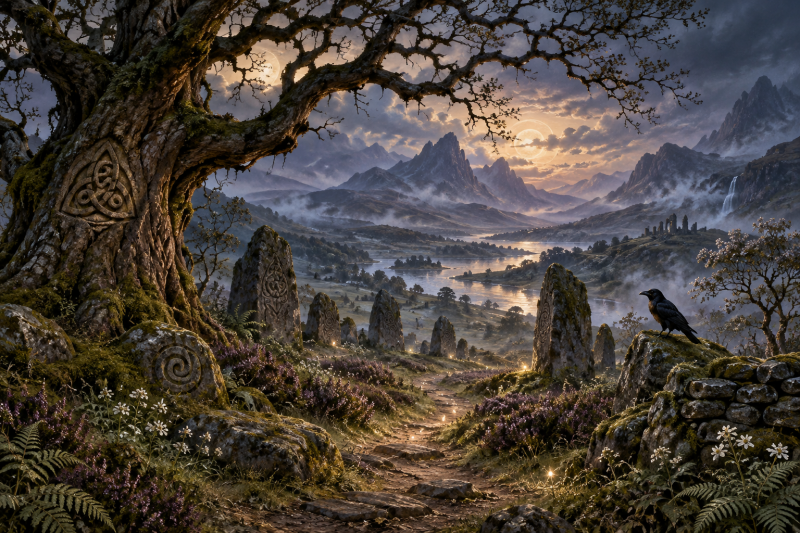
A woman becomes an owl.
A warrior takes the form of a wolf.
A mysterious hare races across a moonlit field and disappears where a human was expected to be.
A poet becomes a salmon, a bird and a grain of wheat while desperately trying to escape.
Across the mythology and folklore of Ireland, Wales, Scotland and Britain, transformation appears again and again.
People become animals. Supernatural beings change their appearance. Heroes cross into mysterious realms. Witches are accused of travelling in animal form, while ordinary creatures sometimes turn out to be something far stranger.
To modern readers these are wonderful stories.
To the people who originally heard them, however, they belonged to a world where the boundaries between nature, humanity and the supernatural could sometimes seem far less certain.
Welcome to the strange world of shape-shifting, magic and ancient belief.
A World Where Form Could Change
Transformation is one of humanity's oldest storytelling ideas.
The natural world itself constantly changes.
A caterpillar becomes a butterfly.
A seed disappears beneath the earth before returning as a plant.
A snake sheds its skin.
A deer grows and loses its antlers.
The moon disappears and returns.
The seasons transform the entire landscape.
For communities living much closer to these natural cycles than most of us do today, transformation was everywhere.
Perhaps it is unsurprising that mythology imagined humans and supernatural beings changing too.
In Celtic literature, transformation can represent punishment, escape, knowledge, supernatural power or the crossing of boundaries.
Sometimes it is voluntary.
Sometimes it most certainly is not.
Taliesin — The Great Transformation Chase
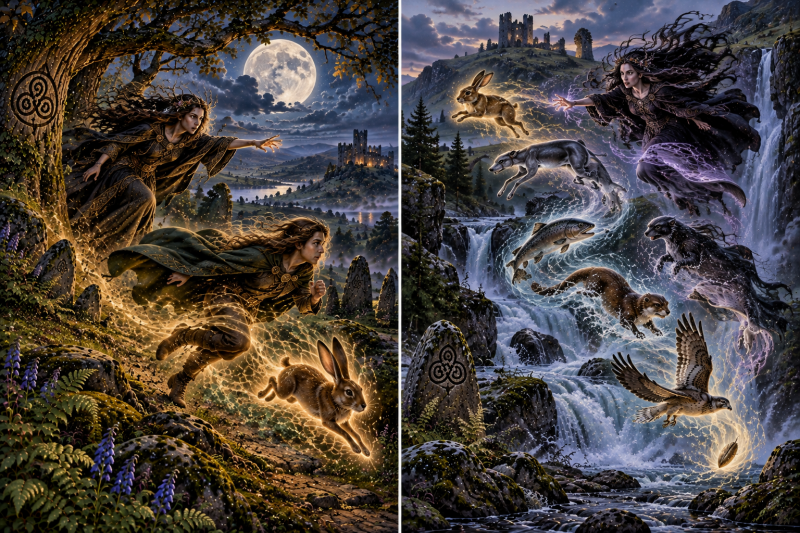
One of the most extraordinary transformation stories preserved in Welsh tradition is associated with the legendary poet Taliesin.
In the later tale Hanes Taliesin, the boy Gwion Bach accidentally receives magical inspiration intended for someone else.
The enchantress Ceridwen pursues him.
What follows is a spectacular magical chase.
Gwion transforms into a hare.
Ceridwen becomes a greyhound.
He becomes a fish.
She becomes an otter.
He becomes a bird.
She becomes a hawk.
Finally, Gwion transforms himself into a tiny grain of wheat.
Ceridwen becomes a hen —
and eats him.
The story does not end there.
Gwion is eventually reborn as Taliesin, the legendary poet.
It is a remarkable sequence involving transformation, death, rebirth and inspiration.
Blodeuwedd — The Woman Who Became an Owl
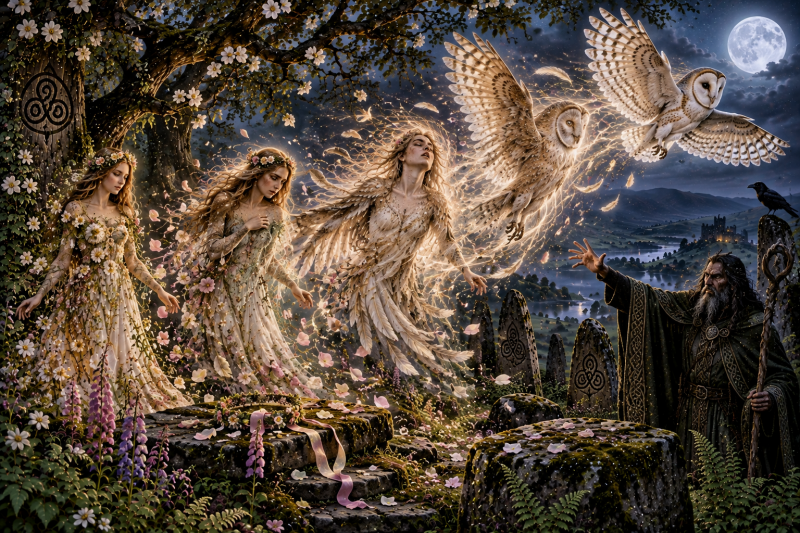
Another famous Welsh transformation occurs in the Fourth Branch of the Mabinogi.
Blodeuwedd is created magically from flowers to become the wife of Lleu Llaw Gyffes.
But the story turns dark.
Blodeuwedd falls in love with another man and becomes involved in an attempt to kill Lleu.
The plan fails.
As punishment, the magician Gwydion transforms Blodeuwedd into an owl.
The story has inspired countless later interpretations concerning femininity, independence, betrayal, transformation and the night.
Modern Pagan traditions have sometimes reinterpreted Blodeuwedd considerably.
But the medieval story itself remains extraordinary.
A woman created from flowers ends her story as a creature of darkness.
Tuan mac Cairill — Remembering Through Many Lives
Irish literature preserves another remarkable transformation story involving Tuan mac Cairill.
Tuan survives across enormous stretches of legendary history by passing through different forms.
His transformations include animals such as a stag, boar, hawk and salmon.
Through these different lives he witnesses generations and events that ordinary humans could never have survived to remember.
Transformation therefore becomes connected with memory.
By becoming different creatures, Tuan carries the past forward.
The story also places animals in a fascinating position.
Each animal form becomes another way of experiencing the world.
Wolves and Human Transformation
Few animals became as strongly associated with human transformation in European folklore as the wolf.
Medieval Irish literature contains unusual stories involving people with wolf-like connections, while later European tradition developed the much more familiar figure of the werewolf.
One particularly fascinating medieval account was recorded by Gerald of Wales in the twelfth century.
He tells a strange story concerning a man and woman from Ossory who had supposedly been transformed into wolves.
Whether Gerald or his audience literally believed the story is difficult to determine.
But its inclusion shows that ideas concerning humans becoming wolves circulated within medieval Ireland.
The wolf represented the wilderness beyond human settlement.
To become a wolf was, in a sense, to cross from civilisation into the wild.
Hares, Witches and Shape-Shifting
The hare became one of the most persistent shape-shifting animals in later British and Irish folklore.
Stories told of witches taking the form of hares to travel unnoticed or steal milk from cattle.
A familiar pattern appears in many tales.
A hunter sees an unusually bold hare.
He shoots or injures it.
The animal escapes.
Later, a local woman is discovered with an injury in exactly the same place.
The implication is obvious.
The hare and the woman were the same being.
These stories belong largely to later witchcraft folklore rather than providing straightforward evidence for ancient Celtic religious practice.
But they demonstrate how older animal symbolism and later supernatural fears could become intertwined.
Selkies — Between Seal and Human
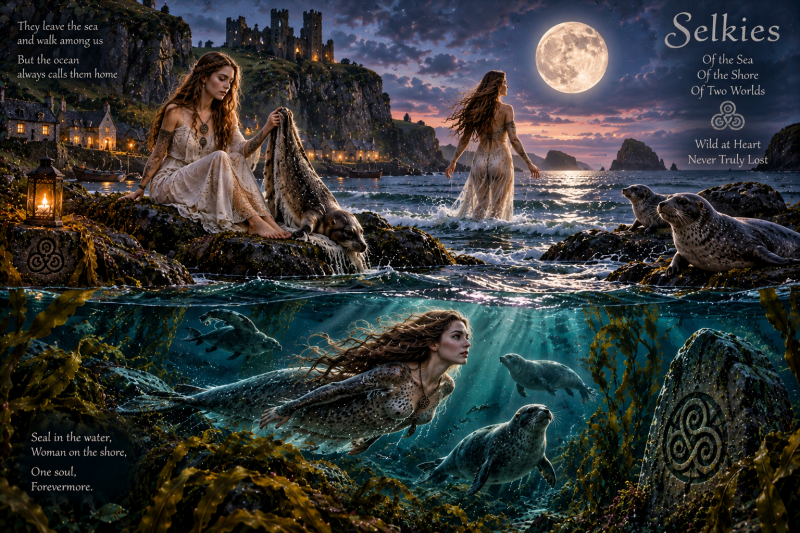
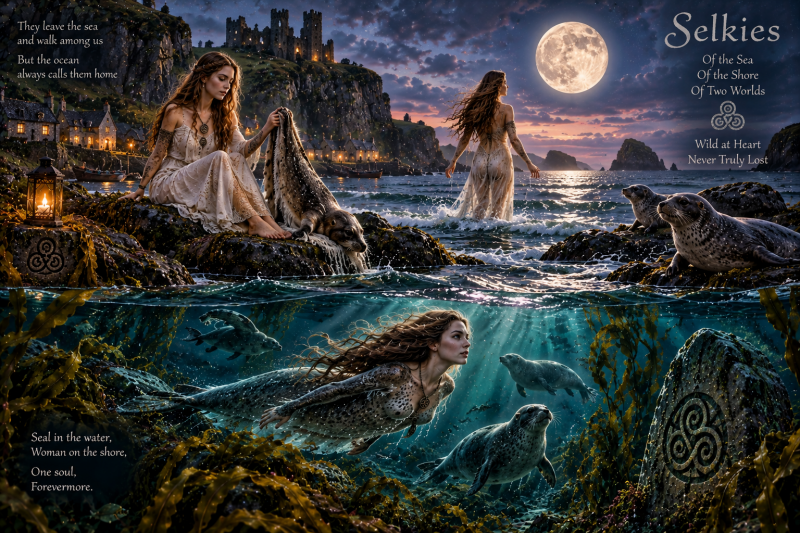
Along the coasts of Scotland, particularly in the Northern Isles, folklore developed around one of Britain's most beautiful shape-shifting traditions.
Selkies were beings capable of moving between seal and human form.
According to many later tales, a selkie could leave the sea, remove its seal skin and appear human upon the shore.
Some stories are romantic.
Others are deeply sad.
A human might steal and hide a selkie's skin, preventing the being from returning to the sea.
Years might pass.
A family might be created.
But if the hidden skin was eventually discovered, the call of the ocean became irresistible.
The selkie returned to the water.
These stories often carry a powerful message:
something wild cannot truly be possessed.
The Púca — The Shape That Never Stays Still
Irish folklore contains the mysterious púca, a supernatural being famous for appearing in different forms.
Descriptions vary.
It might appear as a horse, goat, dog, hare or other creature.
Sometimes it appears frightening.
Sometimes mischievous.
Occasionally it may even be helpful.
Like so many supernatural beings in folklore, the púca refuses to fit comfortably into the categories of good and evil.
Its changing appearance is part of what makes it unsettling.
How can you know what something truly is when its shape cannot be trusted?
Magic and the Power of Words
Not all magic involved transformation.
Words themselves could possess enormous power within traditional storytelling.
Blessings protected.
Curses harmed.
Poetry could inspire or humiliate.
Names carried significance.
Spoken formulas were used in later folk traditions for healing, protection and good fortune.
In societies where oral storytelling preserved history and knowledge, words mattered enormously.
A skilled poet could preserve someone's reputation for generations.
A storyteller could keep an event alive long after everyone involved had died.
In that sense, words genuinely did possess a form of magic.
They could defeat time.
Druids — History and Legend
No subject associated with Celtic magic attracts more modern mythology than the Druids.
Classical Greek and Roman writers described Druids among Celtic peoples of Gaul and Britain.
They appear to have held important religious, intellectual and perhaps legal roles.
Unfortunately, they left us no surviving written explanation of their own beliefs.
Almost everything we know comes from outside observers, archaeology and much later literature.
Over the centuries, Druids became increasingly surrounded by legend.
They have been portrayed as priests, philosophers, astronomers, magicians, prophets and guardians of secret wisdom.
Some of these ideas have historical foundations.
Others belong to much later imagination.
The true Druids remain partly hidden from us.
Perhaps that mystery explains why they continue to fascinate people today.
Magic in Medieval Celtic Stories
Medieval Irish and Welsh literature is filled with events we would now call magical.
Prophecies are made.
People transform.
Curses alter lives.
Supernatural objects appear.
Impossible journeys take place.
Otherworldly beings intervene in human affairs.
Yet characters within these stories do not always react to magic as modern fantasy characters might.
The supernatural often exists alongside ordinary life.
A king can hold a feast while something completely impossible happens outside.
A hunter can follow an animal and unexpectedly enter another world.
The magical and everyday are woven together.
Healing, Charms and Folk Magic
Long after the medieval period, communities throughout Britain and Ireland continued using various forms of folk magic.
People used charms for healing.
Objects might be carried for protection.
Plants developed magical reputations.
Certain wells were visited for cures.
Households followed customs intended to protect livestock, crops or family members.
Practitioners sometimes became known as cunning folk, charmers, healers or wise people.
These traditions should not simply be labelled “Celtic magic.”
Many developed within Christian communities and drew upon mixtures of local folklore, prayer, herbal knowledge and older customs.
Folk belief constantly borrowed from whatever was available.
Protective Trees and Plants
Plants could also acquire supernatural reputations.
Rowan became particularly famous in Scottish and British folklore for protection against witchcraft and harmful influences.
Hawthorn developed strong connections with fairy tradition.
Elder gathered its own collection of warnings and beliefs.
Herbs might be placed around homes or carried as charms.
Again, there was no single ancient Celtic book assigning one magical meaning to every plant.
Local tradition mattered.
A plant could be ordinary vegetation in one community and surrounded by powerful stories in another.
Iron and the Supernatural
Iron became an important protective material in later fairy folklore.
Horseshoes are perhaps the most familiar surviving example.
Stories sometimes describe iron as something supernatural beings disliked or avoided.
Exactly why this belief developed is uncertain.
Iron was technologically important, valuable and capable of being transformed through intense heat by skilled smiths.
Blacksmiths themselves sometimes acquired almost magical reputations.
They could take apparently lifeless stone and metal and transform it into weapons, tools and useful objects.
To someone watching the process centuries ago, the forge must have been an extraordinary place.
The Blacksmith — Master of Transformation
Few traditional crafts look more like magic than blacksmithing.
Fire roars.
Metal glows red.
Sparks fill the darkness.
And something apparently solid becomes soft enough to reshape with a hammer.
Smiths occupy interesting positions in mythology and folklore across many cultures.
Their knowledge separated them from ordinary people.
They understood fire, metal and transformation.
In a page devoted to shape-shifting and magic, the blacksmith therefore deserves a place.
Not because the smith literally changed humans into animals —
but because they performed real transformation every day.
Stone became metal. Metal became tools. Fire changed the world.
Prophecy and Divination
People have always wanted to know what happens next.
Weather.
Harvests.
Marriage.
Illness.
War.
Death.
Uncertainty created countless traditions involving signs, omens and divination.
Bird behaviour might be interpreted as meaningful.
Dreams could contain warnings.
Unusual events might be treated as omens.
Seasonal celebrations accumulated customs intended to reveal the future.
Samhain and later Halloween traditions became particularly rich in forms of fortune-telling, especially concerning marriage and relationships.
These customs changed over centuries, but the desire behind them remains completely familiar.
We still want to know what tomorrow will bring.
The Moon and Magical Belief
The moon has become one of the most familiar symbols of modern Pagan spirituality.
Its changing phases provide a powerful natural image of cycles, disappearance and renewal.
Historical folk traditions also paid attention to lunar phases for various activities, although beliefs differed enormously between communities and periods.
Modern Pagan systems have developed much more detailed spiritual interpretations of the lunar cycle.
It is therefore useful to distinguish between historical folk customs and modern spiritual practice.
Both are interesting.
They simply belong to different chapters of the story.
Samhain — When Strange Things Happen
Few festivals are now more closely associated with supernatural belief than Samhain.
In medieval Irish tradition, Samhain marked an important seasonal transition around the beginning of winter.
Supernatural events appear in stories associated with this period.
Later customs surrounding Halloween added ghosts, divination, disguise and countless other traditions.
Today, Samhain is often described as the time when “the veil between worlds is thinnest.”
That exact wording is largely modern.
But the broader association between the season and supernatural activity has genuine roots in older traditions.
Darkness arrives earlier.
The harvest ends.
Winter approaches.
It is a natural time for stories about boundaries.
Was Magic Really Believed?
For many people, yes.
But belief was never necessarily simple.
Someone might use a protective charm while also attending church.
A person might laugh at a fairy story during daylight and avoid a supposedly haunted path after dark.
A farmer might dismiss witchcraft yet hesitate before cutting down a particular tree.
Human beings are remarkably comfortable holding contradictory ideas.
Folklore often survives in the space between absolute belief and complete disbelief.
“I don't believe it — but I'm not taking the chance.”
That sentence could probably explain the survival of countless traditions.
Ancient Belief or Modern Invention?
One of the goals of Pixie Page Crafts is to enjoy the mystery without pretending everything is ancient.
The internet is filled with claims such as:
“The Celts believed…”
“The Druids always…”
“Ancient Pagans knew…”
Often the historical evidence is far less certain.
Some traditions genuinely appear in medieval literature or archaeological evidence.
Others come from folklore recorded centuries later.
Still others were developed by modern Pagan movements.
Knowing the difference doesn't destroy the magic.
It makes the journey more interesting.
We can watch an idea travel through ancient religion, medieval storytelling, village folklore, Victorian romanticism and modern spirituality.
Few stories remain unchanged for that long.
Magic in Modern Paganism
Modern Paganism has created vibrant new traditions inspired by nature, mythology, folklore and pre-Christian religions.
Some practitioners work with seasonal cycles.
Others use meditation, ritual, divination, herbs, candles or symbolic objects.
Celtic-inspired Pagan paths may draw inspiration from Irish or Welsh mythology.
These are living modern spiritual traditions.
They do not need to be disguised as unchanged ancient practices to possess meaning.
Like folklore itself, traditions evolve.
Every generation inherits stories —
and then adds something of its own.
Transformation in the Natural World
Perhaps shape-shifting stories survive because transformation is not really fantasy at all.
We see it constantly.
A bare woodland becomes green.
Flowers become fruit.
A caterpillar becomes a butterfly.
A tadpole becomes a frog.
A salmon leaves its river and eventually attempts to return.
A stag loses its antlers and grows them again.
A landscape disappears beneath winter snow and returns in spring.
Even we transform.
Children become adults.
Faces change.
Generations replace one another.
Nothing in nature remains exactly the same.
Perhaps the storytellers simply took one of the most fundamental truths of the natural world —
and imagined what would happen if humans could transform too.
Somewhere Between Magic and Memory

We may never know exactly what the people who first told some of these stories believed.
Perhaps some tales were sacred.
Perhaps others were entertainment.
Perhaps some were warnings.
And perhaps the best storytellers simply discovered that adding a transformation, mysterious animal or supernatural encounter made everyone lean slightly closer to the fire.
But the stories survived.
Taliesin still runs from Ceridwen.
Blodeuwedd still becomes the owl.
The selkie still searches for her skin.
The mysterious hare still disappears across the moonlit field.
And somewhere in an old story, a traveller still wonders whether the animal watching from the edge of the forest is really an animal at all.
That is the enduring power of folklore.
It allows the ordinary world to remain ordinary —
while quietly asking us to imagine that it might not be.
The oldest magic was transformation — and nature has been performing it forever. 🌿