Selkies in Scottish & Northern Isles Folklore
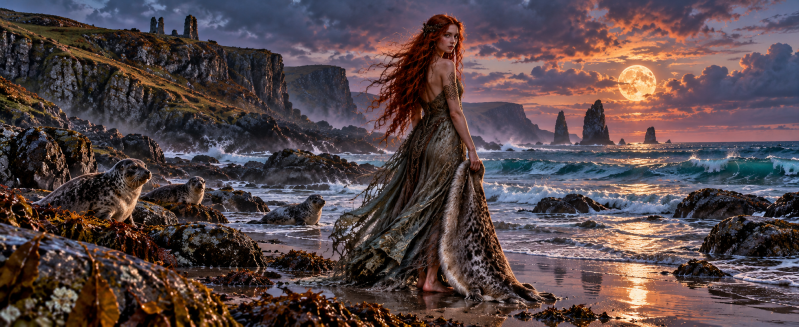
Along the rocky shores of Scotland's northern islands, old stories tell of seals that were not always what they appeared to be.
When they came ashore, these mysterious beings could shed their sealskins and take human form. They danced upon lonely beaches, walked among ordinary people and sometimes formed relationships with those who lived beside the sea.
They were known as selkies.
Selkie stories are particularly associated with Orkney and Shetland, although traditions of seal-people and similar supernatural beings appear elsewhere around the coasts of Scotland and Ireland.
Some tales are beautiful. Others are deeply unsettling.
One of the best-known stories tells of a man discovering a selkie woman on the shore and hiding her sealskin so that she cannot return to the sea. Unable to transform again, she becomes his wife and lives for years in the human world.
But she never truly belongs there.
Eventually the hidden skin is discovered. The selkie returns to the shore, puts it on and disappears beneath the waves — sometimes leaving her human husband and children behind.
These stories are often described today as romantic tales of love between humans and supernatural beings. Yet beneath them lies something considerably darker: captivity, loss, longing and the desire to return home.
Perhaps that is why selkie folklore has remained so powerful.
The sea in these stories is not merely where the selkie lives.
It is where the selkie belongs.
What Is a Selkie?
A selkie is a supernatural being from the folklore of Scotland's northern and western coasts, particularly associated with Orkney and Shetland.
In the sea, selkies appeared as seals. But according to traditional stories, they could come ashore, remove their sealskins and take the form of human beings.
The discarded skin was far more than clothing.
Without it, a selkie could not transform back into a seal and return to the sea. This idea lies at the heart of many of the best-known selkie tales, in which a human discovers and hides the skin of a selkie encountered on the shore.
Selkies in human form were often described as striking or attractive, and stories tell of relationships developing between them and ordinary people. Yet these relationships frequently contained sadness from the beginning.
The selkie might live in the human world for years, marry and raise children, but the pull of the sea remained.
If the hidden sealskin was eventually discovered, the choice was rarely difficult.
The selkie would take the skin, return to the shore and disappear beneath the waves.
The transformation therefore represents more than magic. In selkie folklore, the sealskin is connected with identity, freedom and belonging.
To lose it is to lose the ability to return home.
The Stolen Sealskin
One of the most widespread selkie stories begins with a human discovering a group of seals on a lonely shore.
As the watcher approaches, something extraordinary becomes clear. The seals have removed their skins and taken human form, leaving the empty pelts upon the rocks while they dance or gather beside the sea.
In many versions, a man secretly takes the skin belonging to one of the selkie women.
When the others return to the water, she cannot follow them.
Without her sealskin she is trapped in human form, and the man who has hidden it persuades — or compels — her to become his wife.
Years may pass. The couple might have children and outwardly appear to live an ordinary life, but the selkie never forgets the sea or the skin that was taken from her.
Then, often through accident or the discovery of a hidden key, the sealskin is found.
The moment she touches it, everything changes.
She returns to the shore, puts on the skin and becomes a seal once more. In some versions she says farewell to her children; in others the departure is sudden. Either way, she returns to the sea and does not resume her former human life.
Modern retellings sometimes present this as a tragic supernatural romance, but the older story contains a much darker idea.
The selkie's ability to leave was deliberately taken from her.
Her return to the sea is therefore not simply the end of a love story. It is the moment she regains her freedom and her true identity.
The hidden sealskin was never merely magical clothing.
It was the way home.
Selkie Men and Human Women
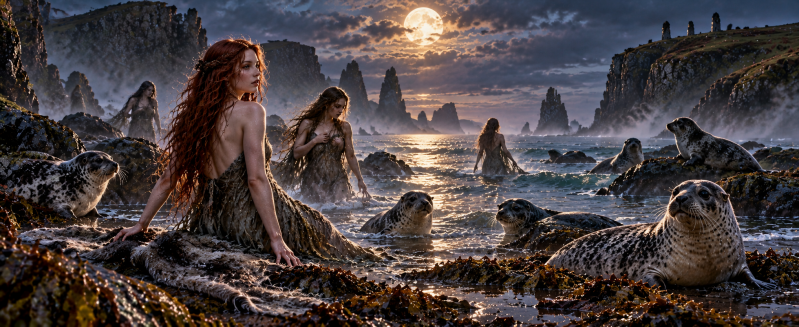
Not every selkie story concerns a woman prevented from returning to the sea.
Folklore also tells of male selkies who came ashore in human form and formed relationships with human women.
These selkie men were often portrayed as unusually handsome and mysterious strangers. In some traditions, they were particularly likely to attract women who were lonely, dissatisfied in marriage or waiting for husbands who spent long periods away at sea.
Unlike the captive selkie-wife stories, these encounters could begin because the human deliberately sought the supernatural visitor.
Some traditions tell of women calling a selkie from the sea by performing a particular action or casting a set number of tears into the water. The details vary between versions, but the underlying idea remains the same: the sea could answer human longing by sending someone who did not entirely belong to the human world.
Relationships between selkie men and human women were rarely simple.
The selkie ultimately belonged to the sea, and any relationship formed on land existed between two different worlds. The supernatural visitor might return to the water, leaving the human partner behind.
Children born from unions between humans and selkies also appear in folklore. Some stories gave these descendants unusual physical characteristics or a special connection with the sea.
Whether the selkie was male or female, the same theme repeatedly returned:
love might cross the boundary between land and sea, but it could not always erase it.
Why Seals?
It is easy to understand why seals became the subject of supernatural stories among communities living beside the northern seas.
Seals inhabit two worlds.
They move effortlessly through the ocean but also come ashore, resting on beaches and rocks where people can observe them closely. Seen from a distance, a seal rising upright from the water can possess an unexpectedly human appearance.
Their large dark eyes, rounded faces and haunting calls may also have encouraged people to imagine something familiar behind the animal form.
For fishing communities in Orkney, Shetland and around Scotland's coast, seals were not exotic creatures. They shared the same waters upon which human lives depended.
The sea itself was unpredictable. It provided food, travel and livelihoods, but it could also take people away without warning. Families living beside it knew both its generosity and its danger.
Selkie stories brought these worlds together.
The seal became a creature capable of crossing the boundary between sea and land, animal and human, familiar and supernatural.
Perhaps that is why the transformation feels so natural within the folklore.
A selkie does not become something entirely different when it steps onto land.
It simply reveals the human being the storyteller imagined might have been there all along.
Selkies of Orkney and Shetland
Selkie traditions are particularly strongly associated with Orkney and Shetland, the island groups lying beyond the northern coast of mainland Scotland.
Here, the sea has shaped human life for generations.
Fishing, travel and communication depended upon it, while storms and dangerous waters were an unavoidable part of island life. Against this landscape of rocky shores, isolated beaches and powerful seas, stories of people who belonged beneath the waves found a natural home.
In Orkney folklore, supernatural seal-people appear in tales of encounters between islanders and mysterious beings from the sea. Stories of selkie women losing their skins and becoming trapped on land became particularly well known.
Shetland preserves related traditions, although names and details can vary between communities and storytellers.
The Northern Isles also possess a distinctive cultural history. For centuries they were closely connected with the Norse world before becoming part of Scotland, leaving traces of both Scottish and Scandinavian influence within island traditions, language and folklore.
This does not mean that every selkie story can simply be labelled either Celtic or Norse.
Folklore rarely respects boundaries quite so neatly.
Instead, the selkie belongs to the particular world of the northern islands — places where people lived surrounded by the sea and where the horizon marked the beginning of another, largely unseen world.
On a remote Orkney or Shetland shore, the idea that a seal might step from the water and become human perhaps did not seem quite as impossible as it does today.
The Selkie's Children
Some selkie stories do not end when the supernatural parent returns to the sea.
They continue through the children left behind.
Folklore surrounding unions between humans and selkies sometimes describes their descendants as possessing unusual characteristics that revealed their connection with the sea. One recurring tradition concerns children born with webbed fingers or toes, interpreted within the story as evidence of selkie ancestry.
Such tales could transform an unusual physical characteristic into part of a family's supernatural history.
A child might grow up entirely within the human community while still carrying something that connected them to another world — and to the parent who had disappeared beneath the waves.
This gives the selkie story another layer of sadness.
When a selkie mother recovered her skin and returned to the sea, she might leave children behind on land. Some stories suggest that she continued to watch them from the water or occasionally returned to see them.
The boundary between the two worlds had therefore not completely closed.
The children belonged to the land, but part of their story would always belong to the sea.
In this way, selkie folklore allowed the supernatural to become something more intimate than a creature glimpsed on a distant shore.
It could become part of the family.
Selkies, Mermaids and Other Sea Folk
Selkies are sometimes grouped together with mermaids and other supernatural inhabitants of the sea, but the traditions are quite different.
A mermaid is usually imagined as a being whose body combines human and fish-like features. Although mermaid stories vary enormously, the creature is generally supernatural even while visible in its ordinary form.
The selkie is different.
In the water, a selkie appears to be a seal. On land, after removing its skin, it can appear completely human. The transformation between those two forms is central to the story.
This makes the sealskin especially important. Unlike the mermaid's tail, it can be removed, hidden, stolen and eventually recovered.
Other sea beings appear throughout Scottish, Irish and wider northern European folklore, and their traditions sometimes overlap. Stories travelled between coastal communities, sailors carried tales from one shore to another, and storytellers adapted supernatural beings to their own landscapes.
For this reason, folklore rarely provides a perfectly organised catalogue of creatures.
But the selkie remains distinctive.
Its story is not simply about a mysterious being living beneath the waves. It is about a creature capable of living among human beings while longing for another world.
The Sea as a Boundary Between Worlds
Throughout the folklore of Britain and Ireland, water often appears as more than part of the landscape.
Rivers, wells, lakes and the sea can mark places where the familiar world meets something mysterious. Journeys across water lead to enchanted islands, supernatural beings emerge from beneath its surface, and ordinary people sometimes cross into places governed by very different rules.
Selkie stories belong naturally within this tradition.
The shoreline itself is a boundary — neither completely land nor completely sea. With every tide it changes, disappearing beneath the water and emerging again hours later.
The selkie does something remarkably similar.
In the sea it belongs to one world, moving through the water as a seal. On shore it removes its skin and enters another, taking human form and sometimes living among ordinary people for years.
This makes the selkie a powerful symbol of crossing between worlds.
Yet unlike many supernatural journeys, the transformation carries a cost. A selkie who loses its skin can become trapped on the wrong side of the boundary, unable to return to the place where it truly belongs.
These stories connect with wider traditions surrounding [the Celtic Otherworld], where water frequently separates the ordinary landscape from supernatural realms.
They also belong to the broader folklore of [sacred waters, wells and rivers], in which water could possess meanings extending far beyond its everyday use.
For the selkie, however, the boundary is particularly personal.
The sea is not simply another world. It is home.
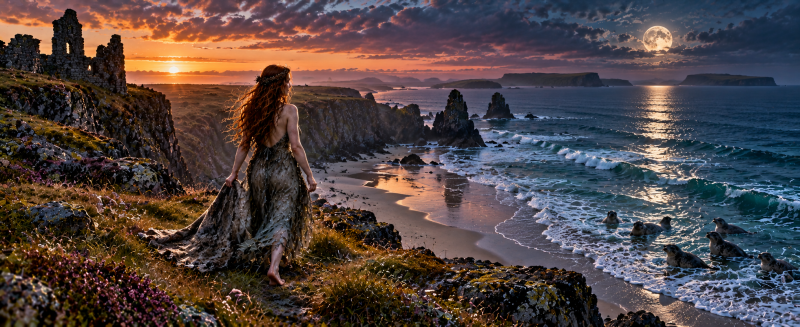
Are Selkie Stories Really Love Stories?
Selkie tales are frequently described today as tragic romances — stories of impossible love between a human being and a mysterious creature from the sea.
Some certainly contain love, longing and loss.
But the most famous selkie-wife story becomes considerably more uncomfortable when viewed from the selkie's perspective.
Her sealskin is deliberately hidden from her. Without it she cannot return to the sea, and the person responsible for taking away that freedom then becomes her husband.
Whatever affection may develop during the years that follow, the relationship begins with a choice being taken away.
This makes the moment when the selkie finally discovers her skin particularly important.
She does not simply abandon the human world because the sea casts a magical spell upon her. She recovers the thing that allows her to decide where she belongs.
Her return to the water can therefore be understood as a story about freedom, identity and the right to return home.
Like many traditional tales, selkie folklore can hold several meanings at once. It can contain love and sadness while also exploring captivity, separation and the consequences of attempting to possess something that belongs to another world.
Perhaps that is why the story has survived so well.
The selkie can live on land.
But she must be free to choose the sea.
Selkies in Folklore Today
Selkies have travelled far beyond the fishing communities and islands where their stories were traditionally told. Today they appear in novels, films, music, artwork and modern fantasy, often portrayed as beautiful and melancholy beings caught between two worlds. Their transformation from seal to human remains immediately recognisable, even when modern storytellers change the details of the older traditions.
Modern interpretations frequently emphasise romance, particularly the idea of a mysterious stranger arriving from the sea and falling in love with a human being. Traditional stories, however, are often more complicated. They contain separation, captivity, dangerous seas and families divided between land and water, alongside the beauty and wonder that have made selkie folklore so enduring.
The selkie has also become strongly associated with ideas of identity and belonging. The hidden sealskin can be understood as something more than a magical object: it represents the selkie's ability to decide who she is and where she belongs. Recovering it restores not only her supernatural form but also her freedom to choose between land and sea.
Perhaps this explains why selkie stories continue to appeal to modern audiences. The supernatural setting may belong to an older world of island folklore, but the emotions within it — longing for home, losing part of yourself and wanting the freedom to determine your own life — remain entirely understandable today.
Where the Land Meets the Sea
Selkie stories belong to landscapes where the boundary between land and water is impossible to ignore. On the shores of Orkney and Shetland, the sea surrounds everyday life, changing with the weather and tides and stretching towards islands beyond the horizon. It is easy to imagine how such places inspired stories about beings capable of belonging to both worlds.
The selkie transforms that landscape into something deeply personal. She can walk among human beings, form relationships and even raise a family on land, yet part of her identity remains connected to the sea. When her sealskin is hidden, she loses more than the ability to change shape; she loses the freedom to cross the boundary between those two parts of herself.
Perhaps this is why the old stories rarely end with the selkie choosing permanently to remain on land once her skin has been recovered. However long she has lived among humans, the sea continues to represent freedom, identity and home. Her return can be joyful and heartbreaking at the same time, particularly when children or loved ones remain behind.
Even today, a seal watching quietly from the water can appear strangely thoughtful and familiar. On a misty northern shore, with waves breaking against the rocks and seals calling somewhere beyond the surf, it is not difficult to understand how the old stories began. Perhaps some creatures simply belong to the sea, no matter how long they walk upon the land.
Sources & Further Reading
-
Orkney.com — Wild Orkney: Selkie Folklore — discusses the Orcadian tradition of selkies shedding their skins, taking human form and the familiar stories in which a human steals the selkie woman's skin. Orkney.com
Wild Orkney — Selkie Folklore -
Orkney North Isles — Folklore of the Sea — describes the supernatural beings traditionally associated with Orkney's waters, including selkies, mermaids and Finfolk, and specifically identifies selkies as seals capable of assuming human form. North Isles Ferries Journeys
Orkney North Isles — Folklore -
Orkney North Isles — The Selkie That Did No' Forget — a particularly nice traditional tale from Sanday, recorded by Orcadian folklorist Walter Traill Dennison, in which a selkie eventually repays a man's act of kindness many years later. North Isles Ferries Journeys
The Selkie That Did No' Forget -
Shetland Museum & Archives — Customs and Folklore — useful background for the wider supernatural beliefs and traditional customs preserved in Shetland. Shetland Museum & Archives
Shetland Museum & Archives — Customs and Folklore -
Shetland Museum & Archives — Archive Collections — for readers who want to go deeper, the Shetland Archives hold manuscripts, books and oral-history material relating to Shetland's culture and history. Shetland Museum & Archives
Explore the Shetland Archives
Explore More Folklore
Selkie stories form part of a much wider tradition in which animals, water and the supernatural world overlap. Explore [Shape-Shifting, Magic & Ancient Beliefs] to discover other British and Irish traditions of transformation, or journey into [The Celtic Otherworld], where water and wild landscapes often mark the boundaries between worlds.
For more stories connected with mysterious waters, visit [Sacred Waters, Wells & Rivers] or discover the darker legends surrounding [Kelpies & Water Horses in British & Irish Folklore]. You can also return to [Folklore of Britain & Ireland] to explore more legends, supernatural beings and traditional beliefs from across the islands.