The Salmon in Celtic & Irish Folklore
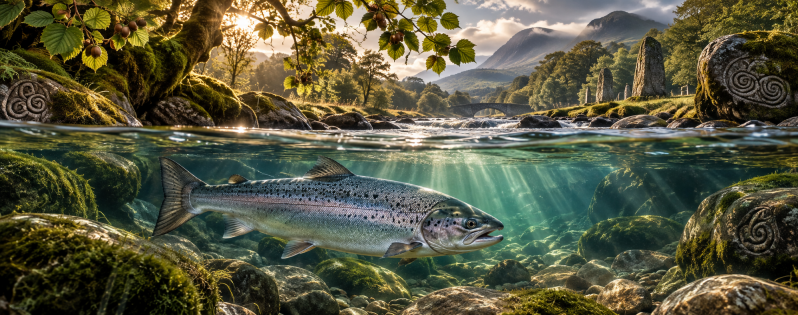
Few animals are as closely connected with wisdom and ancient knowledge in Irish tradition as the salmon. Living within rivers yet travelling far beyond them into the sea, the salmon has an extraordinary natural life cycle that made it a powerful creature around which stories could develop.
The most famous example is the Salmon of Knowledge, whose story became connected with the legendary hero Fionn mac Cumhaill. According to medieval Irish tradition, a remarkable salmon acquired extraordinary knowledge and was sought by the poet Finn Eces, who believed that eating it would grant him wisdom.
Salmon also appear in medieval Welsh tradition. In Culhwch and Olwen, Arthur's companions seek the help of the ancient Salmon of Llyn Llyw, one of a sequence of extraordinarily old animals consulted during the search for the missing Mabon. Here again, the salmon is associated not simply with water, but with age, memory and knowledge inaccessible to ordinary people.
These stories have encouraged the salmon to become a modern symbol of wisdom, inspiration and spiritual knowledge. Yet, as with the other animals explored throughout Pixie Page Crafts, it is worth separating what the surviving medieval stories actually tell us from symbolic meanings developed much later.
The Salmon of Knowledge and Fionn mac Cumhaill
One of the most famous stories in Irish tradition tells how the young Fionn mac Cumhaill gained extraordinary knowledge through a salmon. The tale survives in medieval Irish literature and forms part of the wider body of tradition surrounding Fionn, who would become the great hero associated with the Fianna.
The poet Finn Eces — whose name is also written Finn Éces — had spent years seeking a remarkable salmon associated with the Pool of Fec, traditionally connected with the River Boyne. According to the story, it had been foretold that whoever ate this salmon would gain extraordinary knowledge.
Eventually Finn Eces caught the fish and instructed the young Fionn to cook it for him, warning him not to eat any of it. While cooking the salmon, however, Fionn burned his thumb on its skin. He instinctively placed the injured thumb into his mouth and, through this seemingly accidental act, received the knowledge that had been intended for the poet.
When Finn Eces saw Fionn afterwards, he realised what had happened and told him to eat the salmon. From then on, Fionn possessed extraordinary wisdom and insight. In later tradition, this knowledge became associated with Fionn placing his thumb in his mouth when he needed access to hidden knowledge.
Modern retellings often describe the fish as gaining its wisdom by eating magical hazelnuts that fell into a sacred pool. Hazel and poetic wisdom certainly have important connections within Irish tradition, but different versions and later retellings have blended elements of these stories in different ways. As with much mythology, there is no need to force every surviving tradition into one single version.
Hazel, Sacred Waters and the Search for Wisdom
The connection between salmon, hazel trees and supernatural knowledge belongs to a wider group of Irish traditions in which water and wisdom are closely intertwined. Wells, pools and rivers can mark places where knowledge is discovered, guarded or obtained, while the hazel is repeatedly associated with poetic and supernatural wisdom.
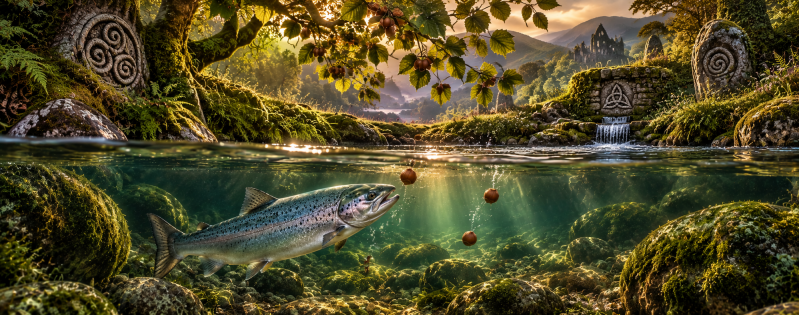
One important tradition concerns Connla's Well, a legendary source of wisdom described in medieval Irish literature. Hazel trees were said to grow around the well, and their nuts fell into the water below. Salmon ate the hazelnuts, linking the fish with the wisdom contained within them. Some accounts describe the number of spots appearing upon the salmon as connected with the nuts they had eaten.
This imagery creates a remarkable chain between landscape and knowledge: hazel tree → nut → sacred water → salmon → wisdom. Knowledge is not presented as something existing separately from nature. Instead, it moves through trees, water and animals before ultimately becoming accessible to a human being.
Later retellings have often combined traditions surrounding Connla's Well with the story of Fionn and the Salmon of Knowledge. The result is the familiar modern image of a salmon becoming all-knowing after eating magical hazelnuts. The traditions are closely related in theme, but surviving medieval material is more varied than a single neat version sometimes suggests.
Whether considered separately or together, these stories help explain why the salmon became such a compelling creature within Irish storytelling. It inhabits deep water, travels between river and sea, and in legend becomes the keeper of knowledge that human beings desperately seek.
The Salmon of Llyn Llyw — An Ancient Creature of Welsh Tradition
A remarkable salmon also appears in the medieval Welsh tale Culhwch and Olwen. During the search for Mabon son of Modron, Arthur's companions must discover where Mabon has been imprisoned. Because ordinary people cannot answer the question, they seek knowledge from a succession of extraordinarily ancient animals.
The search leads through creatures remembered for their great age, including the Blackbird of Cilgwri, the Stag of Rhedynfre, the Owl of Cwm Cawlwyd and the Eagle of Gwernabwy. Each has lived for an immense period, yet none possesses the knowledge the heroes require.
Eventually they are directed to the Salmon of Llyn Llyw, an animal of even greater antiquity. The salmon remembers encountering a mysterious place during its travels and carries Cai and Bedwyr upon its back to the location where Mabon is imprisoned.
The episode gives the salmon a particularly fascinating role. It is not merely an animal that possesses wisdom in an abstract sense: its knowledge comes through age, movement and memory of the landscape. Having travelled through waters inaccessible to human beings, it knows something even the other ancient creatures do not.
This makes an interesting comparison with the Irish traditions. In both, the salmon becomes associated with exceptional knowledge, but the stories express that idea differently. The Salmon of Knowledge is connected with wisdom acquired by Fionn, while the Salmon of Llyn Llyw possesses the accumulated memory necessary to guide Arthur's companions to something lost from the human world.
Salmon, Rivers and the Otherworld
Water frequently acts as a boundary in the mythological and folkloric traditions of Britain and Ireland. Rivers, wells, lakes and the sea can separate places, conceal mysterious beings or provide routes into landscapes beyond ordinary human experience. The salmon is naturally at home within this world of moving water.
Its real life cycle makes the animal especially remarkable. Atlantic salmon hatch in freshwater, migrate vast distances into the ocean and later return to rivers to reproduce. To people observing these journeys without modern biological knowledge, the disappearance and eventual return of salmon must have seemed extraordinary.
Medieval stories do not give us a simple rule stating that salmon were “messengers of the Celtic Otherworld”. That idea belongs more comfortably to modern symbolic interpretation. What the surviving stories do show is that exceptional salmon could possess knowledge unavailable to humans and move through watery landscapes that people themselves could not easily enter.
This makes the salmon particularly suited to stories about hidden knowledge. Water conceals what lies beneath its surface, while the salmon travels through that concealed world. In the Welsh tale, the Salmon of Llyn Llyw remembers a place forgotten by others; in Irish tradition, extraordinary knowledge becomes embodied within a salmon and ultimately passes to Fionn.
Rather than proving a single ancient Celtic belief about salmon, these stories reveal something subtler: storytellers repeatedly found the animal useful when imagining wisdom, memory, mysterious waters and knowledge hidden beyond ordinary human reach.
Salmon Symbolism and Modern Paganism
In modern Paganism and contemporary Celtic-inspired spirituality, the salmon is often associated with wisdom, intuition, inspiration, memory and the search for hidden knowledge. Of all the modern animal associations explored throughout Pixie Page Crafts, these have particularly clear connections with surviving medieval stories in which extraordinary salmon genuinely do possess knowledge beyond that of ordinary people.
The story of Fionn and the Salmon of Knowledge makes wisdom the most obvious association. In modern interpretation, Fionn's accidental acquisition of knowledge can also represent discovery, inspiration and the idea that wisdom sometimes arrives through unexpected experience rather than deliberate study.
The salmon's journey between river and sea has encouraged further modern symbolism. Its ability to travel enormous distances before returning to freshwater can be interpreted as perseverance, instinct, returning to one's origins and following an inner sense of direction. These meanings are appealing, but they arise largely from modern reflection on the animal's natural behaviour rather than from a single documented ancient Celtic belief.
Similarly, modern spiritual writing sometimes describes the salmon as a creature able to travel between worlds. Medieval Irish and Welsh traditions certainly connect extraordinary salmon with mysterious waters and exceptional knowledge, but they do not provide evidence for one universal ancient doctrine in which every salmon was regarded as an Otherworld messenger.
The distinction does not make modern symbolism less meaningful. Instead, it allows us to appreciate two different traditions: the remarkable salmon preserved in medieval storytelling, and the new meanings people continue to find in the animal today.
Salmon Symbolism and Modern Paganism
In modern Paganism and contemporary Celtic-inspired spirituality, the salmon is often associated with wisdom, intuition, inspiration, memory and the search for hidden knowledge. Of all the modern animal associations explored throughout Pixie Page Crafts, these have particularly clear connections with surviving medieval stories in which extraordinary salmon genuinely do possess knowledge beyond that of ordinary people.
The story of Fionn and the Salmon of Knowledge makes wisdom the most obvious association. In modern interpretation, Fionn's accidental acquisition of knowledge can also represent discovery, inspiration and the idea that wisdom sometimes arrives through unexpected experience rather than deliberate study.
The salmon's journey between river and sea has encouraged further modern symbolism. Its ability to travel enormous distances before returning to freshwater can be interpreted as perseverance, instinct, returning to one's origins and following an inner sense of direction. These meanings are appealing, but they arise largely from modern reflection on the animal's natural behaviour rather than from a single documented ancient Celtic belief.
Similarly, modern spiritual writing sometimes describes the salmon as a creature able to travel between worlds. Medieval Irish and Welsh traditions certainly connect extraordinary salmon with mysterious waters and exceptional knowledge, but they do not provide evidence for one universal ancient doctrine in which every salmon was regarded as an Otherworld messenger.
The distinction does not make modern symbolism less meaningful. Instead, it allows us to appreciate two different traditions: the remarkable salmon preserved in medieval storytelling, and the new meanings people continue to find in the animal today.
Frequently Asked Questions About Salmon Folklore
What does the salmon symbolise in Celtic mythology?
Salmon are strongly associated with exceptional knowledge in surviving medieval Irish and Welsh stories. The Irish Salmon of Knowledge and the Welsh Salmon of Llyn Llyw both connect the animal with wisdom, memory and knowledge beyond ordinary human reach. However, there was no single universal “Celtic” meaning that applied to salmon everywhere.
What is the Salmon of Knowledge?
The Salmon of Knowledge is one of the best-known creatures in Irish tradition. The poet Finn Eces sought the extraordinary salmon because eating it was believed to grant great knowledge. The young Fionn mac Cumhaill accidentally received its wisdom while cooking the fish, before eventually eating it himself.
Why are hazelnuts connected with the Salmon of Knowledge?
Irish traditions connect hazel trees, sacred waters and salmon with supernatural or poetic wisdom. Stories concerning wells of wisdom describe hazelnuts falling into water and being eaten by salmon. Later retellings often combine these traditions directly with Fionn's Salmon of Knowledge.
Is there a magical salmon in Welsh mythology?
Yes. In the medieval Welsh tale Culhwch and Olwen, the ancient Salmon of Llyn Llyw helps Arthur's companions during their search for Mabon son of Modron. Its immense age and knowledge of the waterways allow it to remember something the other ancient animals cannot.
Were salmon sacred to the Celts?
Salmon clearly held an important place in some Irish and Welsh stories, but describing salmon simply as “sacred to the Celts” goes beyond the surviving evidence. Different Celtic-speaking peoples lived across different regions and periods, and medieval stories should not automatically be treated as direct records of ancient religious practice.
What does the salmon represent in modern Paganism?
Modern Pagan and Celtic-inspired traditions often associate the salmon with wisdom, intuition, inspiration, perseverance and spiritual knowledge. Some of these ideas draw naturally upon medieval stories, while others are modern interpretations of the salmon's remarkable life cycle and behaviour.
From Folklore to Art
Few creatures lend themselves to folklore-inspired art as naturally as the salmon. Beneath the surface of a river lies an entirely different landscape — a hidden world of flowing water, ancient stones, reflected light and places that human beings can see but cannot easily enter.
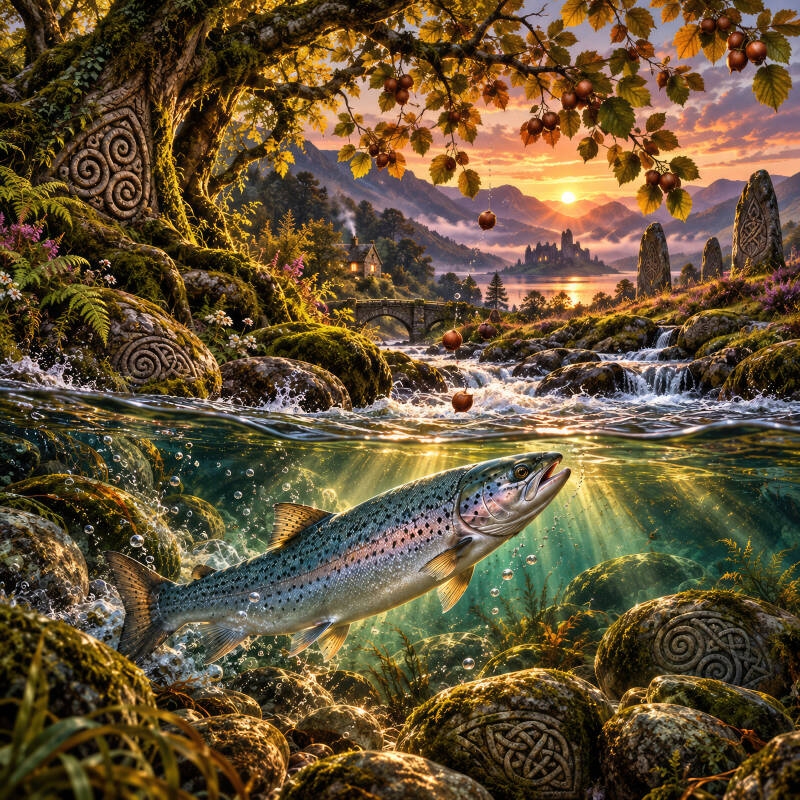
In my Pixie Page Crafts artwork, the salmon becomes part of that mysterious landscape. Hazel branches reach across the water, old stones lie beneath the current and distant hills suggest a world shaped by centuries of storytelling. The inspiration comes particularly from the Irish traditions surrounding wisdom and the remarkable Welsh story of the ancient Salmon of Llyn Llyw.
Rather than trying to give the salmon a single invented “Celtic meaning”, I want the artwork to capture what the old stories themselves suggest: age, memory, mysterious waters and knowledge hidden just beyond ordinary human reach.
The real Atlantic salmon makes that idea even more powerful. Its extraordinary journeys between river and ocean mean that the living animal already travels through worlds largely invisible to us. Folklore simply allows us to imagine what knowledge such a traveller might bring home.
View other Celtic Art Collections
Continue Exploring the Folklore
The salmon is one of many remarkable animals whose stories flow through the folklore of Britain and Ireland. Explore the Hare, Barn Owl, Raven, Fox, Stag, Swan, Wolf, Badger and Wild Boar, each revealing a different relationship between animals, landscape, mythology and the supernatural.
You can discover the complete collection through Animals in Celtic & British Folklore, or explore the mysterious relationship between water and old belief through Sacred Waters, Wells & Rivers.
For those wishing to go deeper into the original stories and folklore studies behind these pages, visit the Pixie Page Crafts Folklore Bookshelf, where I've gathered recommended reading on Celtic mythology, British and Irish folklore, sacred landscapes and traditional belief.
Sources & Further Reading
The Mabinogion — translated by Sioned Davies
For now I'd link this through your Folklore Bookshelf rather than another commercial retailer, since we've already recommended it there. When Bookshop.org approves you, we'll add the affiliate purchase link.
The Mabinogion — see our Folklore Bookshelf
Early Irish Myths and Sagas — Jeffrey Gantz
Penguin's official page for the edition we recommended.
Early Irish Myths and Sagas — Penguin UK
The Boyish Exploits of Finn — medieval Irish tradition
This is particularly good: UCC's CELT project has the text online, and the relevant passage actually tells of Finnéces waiting seven years for the salmon, Fionn burning his thumb while cooking it, and subsequently receiving its knowledge.
Read The Boyish Exploits of Finn — University College Cork
CELT — Corpus of Electronic Texts, University College Cork
This is the main scholarly database containing more than 1,600 historical and literary documents.
Explore CELT — University College Cork
eDIL — Dictionary of the Irish Language
Use the Royal Irish Academy's historical Irish dictionary: