The Púca in Irish Folklore
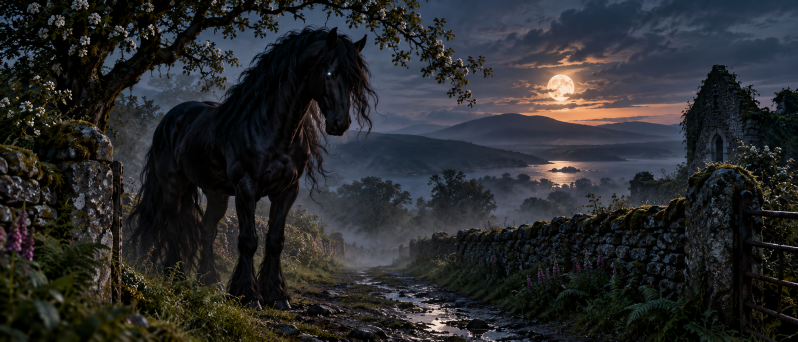
On lonely roads after dark, beside old ruins and across the Irish countryside, generations of storytellers warned of a strange shape-shifting being known as the Púca.
Sometimes it appeared as a great black horse. Elsewhere it might take the form of a goat, dog, strange animal or even a human being. Trying to decide exactly what a púca looked like was part of the problem — the creature was not bound to a single shape.
Stories of the púca could be frightening, mischievous and sometimes surprisingly strange. Travellers might encounter a mysterious horse that carried them on a terrifying ride through the night. Other tales placed the púca near particular roads, ruins and stretches of countryside where local people knew to be cautious after darkness fell.
The creature also became strongly associated with Samhain and the beginning of winter. In Irish tradition, people were warned against eating certain wild fruits after Halloween because the púca was said to have spoiled them.
Yet the púca was not simply an Irish monster.
Like many supernatural beings in traditional folklore, its character changes from story to story. It might frighten, deceive or torment human beings, but other traditions present a creature capable of conversation, assistance or behaviour that is difficult to classify as either entirely good or entirely evil.
That uncertainty is at the heart of the púca.
It belongs to a world where the familiar Irish landscape could become something very different after sunset — and where the horse waiting quietly beside the road might not be a horse at all.
What Is the Púca?
The Púca is one of the most mysterious shape-shifting beings in Irish folklore. Its name appears in several forms, including púca, pooka and phouka, reflecting differences in language, spelling and regional tradition.
Unlike a creature with one fixed appearance, the púca was known for changing its shape.
One of its most famous forms was a large black horse, sometimes encountered wandering along an isolated road after dark. But storytellers also described púcaí appearing as goats, dogs and other animals, while some traditions gave the being a partly human appearance or allowed it to speak with people.
This ability to change form made the púca particularly unsettling. A traveller could not necessarily recognise what stood before them until the encounter had already begun.
Its behaviour was equally unpredictable.
Some stories describe the púca frightening travellers, damaging property or carrying people away on terrifying journeys through the night. Others portray it as mischievous rather than truly malevolent, while a smaller number of traditions describe encounters in which the púca offers advice or even assistance.
There was therefore no simple answer to whether a púca was good or evil.
Like many beings of Irish folklore, it occupied the uncertain territory between the human world and the supernatural — a creature whose intentions depended upon the story, the place and perhaps the person unfortunate enough to meet it.
The Púca as a Black Horse
Perhaps the most famous form taken by the púca was that of a large black horse.
A traveller walking alone after dark might encounter what appeared to be an ordinary horse standing beside the road. But accepting a ride — or attempting to mount the animal — could lead to an experience very different from an ordinary journey home.
Folklore tells of púca horses carrying their riders on wild and terrifying journeys through the night. The creature might race across fields, leap over walls and ditches, plunge through rough countryside or carry its helpless passenger far from where the journey began.
The rider had little control over where they were going.
Eventually the púca might throw its passenger to the ground, leaving the unfortunate traveller frightened, exhausted and sometimes a considerable distance from home.
Stories such as these transformed familiar country roads into places of uncertainty after darkness fell. A horse waiting quietly beside the roadside could represent help to a tired traveller — or the beginning of a supernatural journey.
The black horse also demonstrates something fundamental about the púca. It did not always need to appear obviously monstrous.
The danger came from mistaking something supernatural for something ordinary.
Many Shapes of the Púca
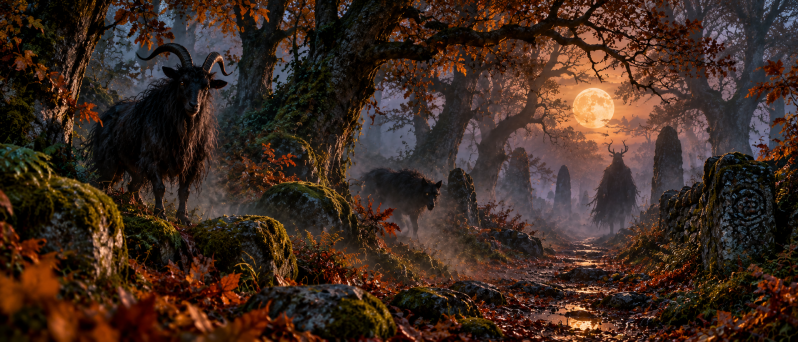
The black horse may be the púca's best-known appearance, but Irish folklore did not restrict the creature to a single form.
Stories collected in different places describe the púca appearing as a goat, dog, horse and other animals. In some accounts it could even assume a human or partly human appearance, although something unusual might betray its supernatural nature.
The details varied considerably from one storyteller and region to another.
This was part of what made the púca so difficult to understand. It was not simply an animal with magical powers but a shape-shifter, capable of appearing in whatever form suited the story or encounter.
A strange animal seen on a lonely road could therefore carry an additional possibility. Was it really an ordinary creature — or had something else chosen that shape?
Shape-shifting appears throughout Irish and wider Celtic storytelling. Humans become animals, supernatural beings disguise themselves, and creatures move between forms in ways that blur the boundary between the natural and supernatural worlds.
The púca belongs comfortably within this tradition.
Its changing appearance also reinforces one of the oldest lessons found in folklore:
Appearances cannot always be trusted.
The Púca, Samhain and the Beginning of Winter
The púca became particularly associated with Samhain, the traditional beginning of winter celebrated around the end of October and beginning of November.
This was a significant turning point in the agricultural year. Harvest work was coming to an end, nights were rapidly growing longer and communities were entering the darker months of winter.
In folklore, it was also a time when the supernatural seemed particularly close.
One tradition warned that after Halloween the púca would spoil wild fruits, making berries that remained on the bushes unsuitable to eat. Different versions describe the creature contaminating or otherwise ruining them during its nocturnal wanderings.
Behind the supernatural explanation may lie a practical seasonal observation. By late autumn, berries left exposed to worsening weather, frost and decay were increasingly likely to be past their best. Folklore gave that change a memorable cause: the púca had claimed them.
The creature's association with this period fits naturally with its wider character. Samhain stood at a boundary between seasons, while the púca itself was a creature of boundaries — between animal and human, ordinary and supernatural, familiar countryside and the mysterious world encountered after darkness.
A lonely road on a summer afternoon was one thing.
The same road on a cold night after Samhain was quite another.
Was the Púca Evil?
It is tempting to describe the púca simply as an evil spirit, but traditional folklore rarely makes things quite so straightforward.
Many stories certainly portray the creature as something to fear. A púca might frighten travellers, carry someone away on a terrifying nocturnal ride or appear unexpectedly on an isolated road. Encountering one after dark was rarely something a person deliberately sought.
Yet other traditions give the púca a very different character.
Some accounts describe púcaí speaking with human beings, offering warnings or giving advice. In other stories their behaviour seems more mischievous than murderous — frightening people, creating confusion or demonstrating supernatural power without necessarily intending to kill anyone.
This uncertainty is characteristic of many supernatural beings found in Irish folklore.
Modern stories often divide characters neatly into heroes and villains, but traditional folklore does not always work that way. A supernatural being might help one person, torment another and simply disappear from a third story without its motives ever being explained.
The púca therefore occupies an uncomfortable middle ground.
It is wild, unpredictable and potentially dangerous, but not necessarily evil in the modern sense of the word.
Perhaps the safest conclusion for anyone travelling an Irish country road after dark was much simpler:
If a mysterious black horse offers you a lift, keep walking.
Poulaphouca — The Púca in the Irish Landscape
The púca did not exist only in stories. Its presence became embedded within the Irish landscape itself.
One striking example is Poulaphouca, also written Pollaphuca, in County Wicklow. The name derives from Irish and is commonly interpreted as “the Púca's hole” or “the Púca's den.”
The place was associated with the River Liffey and the dramatic waterfall that once existed there before the surrounding landscape was transformed by the construction of the Poulaphouca Reservoir in the twentieth century.
Names such as Poulaphouca reveal something important about folklore.
For the people who told these stories, supernatural beings were not necessarily imagined as inhabitants of some distant fantasy world. They belonged to recognisable hills, rivers, roads, rocks and pools.
A dangerous stretch of water might acquire a supernatural story. A strange hollow could become associated with a mysterious being. Once attached to the landscape, the story could survive for generations through the name of the place itself.
This relationship between folklore and landscape can still be seen across Ireland today. Even where the original stories have faded, old placenames sometimes preserve traces of the beings people once believed inhabited the countryside.
In Poulaphouca, the púca has quite literally become part of the map.
The Púca and the Harvest
The púca's connection with autumn was not limited to frightening travellers on dark nights. In some traditions, the creature was also associated with the end of the harvest and the last produce remaining in the fields.
As the agricultural year drew towards winter, crops left behind after the main harvest could acquire a different significance. Folklore sometimes treated what remained as no longer belonging entirely to the human community.
The púca became one explanation for why certain food should no longer be gathered.
This idea is particularly clear in traditions surrounding blackberries and other wild fruits. After Halloween, people in parts of Ireland were warned not to eat berries remaining on the bushes because the púca was believed to have spoiled them.
Similar ideas appear more widely in British and Irish seasonal folklore, where the final fruits of the year could become associated with supernatural beings, changing weather and the transition into winter.
These customs reflect the rhythm of older rural life. Harvest was not simply a date on a calendar. It marked the point at which communities moved from gathering the abundance of summer and autumn towards preparing for the darker months ahead.
The púca belonged perfectly to this moment of uncertainty.
As the fields emptied, the nights lengthened and the last fruit remained on the hedgerows, the human harvest ended and the season of the supernatural began.
The Púca and Other Shape-Shifters
The púca belongs to a much wider tradition of shape-shifting and transformation found throughout Irish, Welsh and British folklore.
Stories repeatedly blur the boundary between human and animal. Supernatural beings disguise themselves, people are transformed into creatures, and animals sometimes reveal themselves to possess powers far beyond the natural world.
Irish mythology contains numerous tales of transformation, while Welsh tradition preserves famous stories such as the transformations of Taliesin. Elsewhere around the coasts of Britain and Ireland, selkie stories describe beings capable of moving between the forms of seal and human.
The púca is unusual because its transformations are not limited to two forms. Depending upon the story, it might appear as a horse, goat, dog, other animal or something resembling a human being.
This made the creature particularly difficult to recognise.
The idea also reflects an important feature of older folklore: the boundaries separating human, animal, landscape and supernatural being were not always imagined as fixed.
A creature might cross those boundaries as easily as a traveller crossed a river or followed a path into the woods.
The púca's changing form therefore places it firmly within the mysterious world of [Shape-Shifting, Magic & Ancient Beliefs] found throughout British and Irish tradition.
The Púca and the Otherworld
The púca is sometimes grouped loosely with the fairy beings of Irish tradition, but attempting to place it into one neat category can be difficult.
That uncertainty is part of its fascination.
The creature shares characteristics with many beings associated with the Irish Otherworld. It can change shape, appear unexpectedly within the human landscape and behave according to rules that ordinary people do not completely understand.
Its favourite places also seem significant. Lonely roads, hills, ancient places and stretches of countryside encountered after dark frequently form the setting for púca stories. These are ordinary landscapes transformed by circumstance — familiar during daylight, but mysterious once darkness falls.
Irish folklore is filled with places where the boundary between worlds appears unusually thin. Ancient mounds, lakes, caves and particular hills could all become associated with supernatural inhabitants or entrances to another realm.
The púca fits naturally into this landscape without needing to be defined simply as a fairy, ghost or demon.
Perhaps that is the point.
The people who told these stories did not always need to explain exactly what the púca was. Knowing that it belonged to the supernatural world — and that encountering one could have unpredictable consequences — was enough.
The púca remained something that existed between categories, between shapes and perhaps between worlds.
The Púca in Folklore Today
The púca has survived far beyond the fireside stories and rural communities in which many of its traditional tales were once told.
Today, the creature continues to appear in books, artwork, fantasy stories and modern interpretations of Irish folklore. Its ability to change shape makes it particularly adaptable: one storyteller can imagine the púca as a magnificent black horse, while another might portray it as a darker and more elusive presence hiding within the landscape.
Modern versions sometimes present the púca as a clearly defined magical creature, but traditional folklore is considerably less tidy.
There is no single appearance, personality or set of rules that explains every púca story.
That uncertainty is worth preserving.
Folklore survived because stories changed as they were told. Different communities remembered different details, local landscapes became attached to particular encounters, and storytellers shaped old traditions for new audiences.
The púca therefore remains what it has perhaps always been — a creature that refuses to stay in one form for very long.
When the Road Becomes Strange
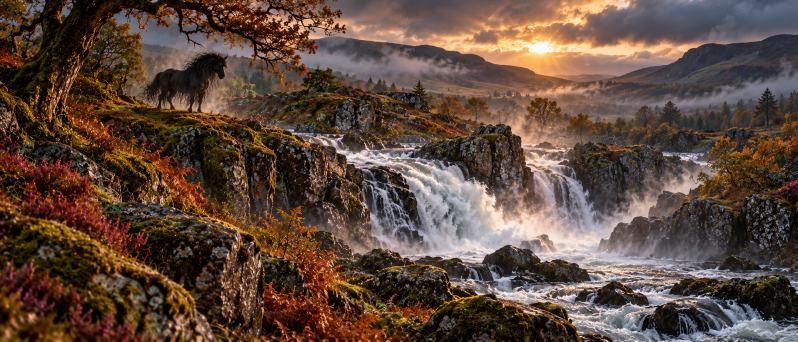
Perhaps the enduring power of the púca lies in the simplicity of the setting.
There is no need for a distant magical kingdom. The story begins on an ordinary road, beside a familiar field or somewhere among the hills.
Then darkness falls.
A horse appears where no horse should be. An animal behaves strangely. Something follows the road through the mist, and suddenly the familiar countryside no longer feels quite so familiar.
For generations, stories of the púca transformed the Irish landscape in precisely this way. They attached mystery to real places and gave supernatural meaning to the changing seasons, lonely roads and unexplained encounters of the night.
Whether remembered as a frightening shape-shifter, a mischievous spirit or something altogether harder to define, the púca remains one of the most distinctive beings in Irish folklore.
And perhaps the old stories still offer sensible advice.
When travelling a lonely road after dark, be careful what you mistake for an ordinary horse.
Sources & Further Reading
-
Dúchas — The Pooka, Main Manuscript Collection (1937) — an excellent primary folklore record from County Galway describing a black horse-like Púca carrying a man away on an uncontrollable night ride. Dúchas
Dúchas — The Pooka (1937) -
Dúchas — The Pooka, Main Manuscript Collection (1939) — a County Wexford tradition describing the Púca in horse form travelling at extraordinary speed and encountering a man walking home. Dúchas
Dúchas — The Pooka (1939) -
Dúchas — The Pooka, Schools' Collection — a County Cavan account in which a traveller mounts a mysterious horse near an old fort and is carried over hill, countryside and water before the creature disappears. Dúchas
Dúchas — The Pooka, Fairy Horse -
Dúchas — Púca archive search — useful for exploring further original accounts preserved in the Main Manuscript Collection, including traditions concerning the Púca, fruit and seasonal customs. Dúchas
Explore Púca records at Dúchas
Explore More Folklore
The Púca belongs to a much wider world of shape-shifters, supernatural beings and mysterious landscapes found throughout British and Irish folklore.
Explore [Shape-Shifting, Magic & Ancient Beliefs] to discover more traditions of transformation, or journey into [The Celtic Otherworld], where the boundaries between the human and supernatural worlds become uncertain.
Discover the traditions of [Samhain], when the Púca was said to wander during the beginning of winter, or explore [Kelpies & Water Horses in British & Irish Folklore] for another collection of mysterious supernatural horses.
You can also return to [Folklore of Britain & Ireland] to explore more legendary beings, ancient beliefs and traditional stories from across these islands.