Folklore of the Welsh Borderlands
Legends, Landscapes and Forgotten Traditions
Along the border between England and Wales lies a landscape of wooded valleys, ancient churches, lonely hills and winding rivers. Here, the countryside carries traces of centuries of history, alongside stories and traditions passed between generations.
From the Golden Valley of Herefordshire to the Black Mountains and the communities of the Welsh Marches, this is a region shaped by changing borders, languages, beliefs and ways of life.
Folklore of the Welsh Borderlands explores the stories associated with these places: supernatural encounters, local customs, mysterious landscapes, traditional beliefs and the people who preserved their memory.
Drawing on historical folklore collections, archival records and local research, this growing series will explore what was recorded, where traditions were known and how stories changed over time.
Some accounts survive in written sources; others belong to the uncertain territory between local memory, legend and history. Wherever possible, we will distinguish the evidence from later interpretations.
Join us as we explore the folklore hidden among the hills, rivers, villages and ancient pathways of the Welsh Borderlands.
Legends, Landscapes and Forgotten Traditions
Along the border between England and Wales lies a landscape of wooded valleys, ancient churches, lonely hills and winding rivers. Here, centuries of history mingle with stories and traditions passed down through generations. From the Golden Valley of Herefordshire to the Black Mountains and the communities of the Welsh Marches, this is a region shaped by changing borders, languages, beliefs and ways of life.
Folklore of the Welsh Borderlands explores the legends, supernatural encounters, local customs and traditional beliefs associated with this remarkable landscape. Drawing on historical folklore collections, archival records and local research, we will investigate where these stories were recorded, who preserved them and how they changed over time.
Some accounts survive in written sources; others occupy the uncertain territory between local memory, legend and history. Wherever possible, we will distinguish documented traditions from later interpretations. Join us as we uncover the folklore hidden among the hills, rivers, villages and ancient pathways of the Welsh Borderlands.
The Welsh Marches — A Landscape Between Two Worlds
The Welsh Marches have long occupied a distinctive place in the history of Britain. Stretching along the borderlands between England and Wales, this region has witnessed centuries of conflict, settlement, cultural exchange and changing political boundaries. Its hills, valleys and scattered communities preserve traces of a complicated past, where English and Welsh languages, customs and traditions have existed alongside one another. The word Marches comes from an old term for a frontier or border territory, although the boundaries of the medieval Marches were never quite the same as the modern border between the two countries.
Following the Norman conquest of England, powerful Marcher lords established territories along the Welsh frontier, building castles and exercising extensive local authority. Yet the history of these borderlands reaches much further back, through earlier Welsh kingdoms, Anglo-Saxon settlements and the communities of prehistoric Britain. Ancient earthworks, hillforts, churches, burial sites and ruined strongholds remain scattered across the landscape, reminders that successive generations have inhabited and interpreted these places in different ways.
For those studying folklore, the Welsh Marches offer a particularly fascinating setting. Stories and traditional beliefs did not necessarily stop at political boundaries, and the region's connections with both Welsh and English culture provide an important context for understanding its legends. Accounts of supernatural encounters, unusual places, protective customs and mysterious happenings can be explored through historical collections and local records. By examining these traditions alongside the landscapes in which they were remembered, we can begin to understand not only the stories themselves, but also the communities that kept them alive.
The Golden Valley — Folklore Among the Hills of Herefordshire
Nestled between the rolling hills of western Herefordshire, the Golden Valley is a landscape of winding lanes, ancient farms, wooded slopes and small villages whose histories reach back through many centuries. Following the valley of the River Dore towards the Welsh border, this peaceful countryside forms part of a region where England and Wales have long influenced one another. Places such as Peterchurch, Dorstone, Ewyas Harold and Michaelchurch Escley belong to a wider landscape shaped by agriculture, religious communities, medieval lordships and the everyday lives of generations who worked the land.
The history of the Golden Valley is written into its buildings and fields. Medieval churches stand among scattered settlements, while old farmhouses, abandoned earthworks and surviving traces of earlier boundaries offer glimpses of the people who lived here before us. At Dorstone, the prehistoric monument known as Arthur's Stone provides a striking reminder that this landscape was important long before the medieval period. Although the monument's familiar name connects it with King Arthur, its Neolithic origins belong to a much earlier chapter of British history. Such places invite us to consider how ancient remains acquired new meanings as later generations encountered them.
For the folklorist, the Golden Valley presents an opportunity to explore how rural communities understood the world around them. Traditional beliefs about animals, weather, seasonal customs, death, healing and the supernatural formed part of life in many British communities, but the details varied considerably from place to place. Historical folklore collections, parish histories, old newspapers and local archives may help us identify which traditions were actually recorded in this part of Herefordshire. Rather than assuming that every ruined building conceals a ghost or every ancient tree was considered sacred, our aim is to discover the stories people genuinely told, the customs they practised and the traces of those beliefs that survive in the historical record.
The Golden Valley is especially important to this collection because it offers the chance to connect written history with the landscape itself. Its churches, ancient pathways, streams and villages can be explored alongside historical maps and documentary sources, allowing us to build a more detailed picture of local tradition. As this research develops, individual places and their recorded stories will become part of a growing archive of Welsh Borderlands folklore, preserving both the remarkable and the everyday beliefs of the communities who called these hills home.
Arthur's Stone — The Giant, the King and the Ancient Tomb
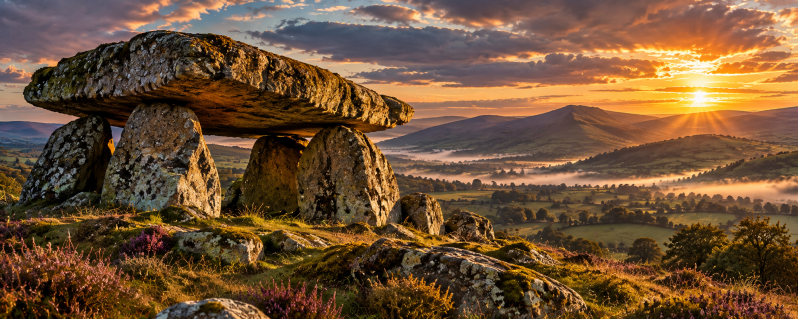
High above the Golden Valley, near the village of Dorstone, stands one of Herefordshire's most remarkable prehistoric monuments. Known as Arthur's Stone, this ancient chambered tomb has watched over the surrounding countryside for more than 5,000 years. Its enormous capstone, estimated to weigh over 25 tonnes, rests upon upright stones that once formed part of a much larger burial monument covered by an earthen mound. Today, the exposed stones create a striking silhouette against the hills, but the monument's original appearance would have been very different. Archaeological investigations have revealed that the structure developed over time, beginning as a dolmen surrounded by a circular arrangement of stones before being enlarged into a long, trapezoidal tomb.
Although Arthur's Stone belongs to the Neolithic period, thousands of years before the age traditionally associated with King Arthur, its name reflects the legends that later generations attached to it. One of the best-known stories tells of Arthur confronting and killing a giant at this very spot. As the creature fell, its elbows supposedly struck a nearby stone, leaving impressions that could still be seen. Another version describes the giant falling backwards onto the great capstone and breaking it. These tales transformed a prehistoric burial monument into a setting for heroic adventure, connecting an ancient and mysterious structure with one of Britain's most enduring legendary figures.
The association between Arthur and the monument is recorded as dating back to before the thirteenth century, although this does not establish when the individual stories first arose. The legend provides a fascinating example of how people explained ancient structures whose original purposes had been forgotten. Enormous stones, apparently arranged by hands of extraordinary strength, invited stories of giants and legendary heroes. For the communities living around Dorstone, Arthur's Stone became more than a surviving monument from prehistory: it was also a place where the distant past could be understood through storytelling.
Modern archaeological research has added another layer to its remarkable history. Excavations have uncovered Neolithic pottery, stone tools, human remains and materials indicating connections with places as distant as northern Wales and Scotland. These discoveries reveal something of the lives, beliefs and wider relationships of the people who built and used the monument. Arthur's Stone therefore brings together two very different kinds of evidence: the physical remains of prehistoric communities and the legends through which later generations interpreted their landscape. Both deserve attention, provided we remember that the story of Arthur and the giant belongs to folklore rather than established historical fact.
The Murdered King of Clodock — A Legend Beside the River Monnow
In the shadow of the Black Mountains, where the River Monnow winds through the quiet countryside near Longtown, stands the ancient church of St Clydawg at Clodock. Its peaceful setting conceals a remarkable story of jealousy, murder and miraculous events, preserved in the medieval Book of Llandaff. According to the legend, Clydawg was a ruler of Ewyas, a territory that once formed part of the Welsh borderlands. Remembered as a just and virtuous king, he attracted the affection of a young woman from a wealthy family who declared that she would marry no one else. Her devotion, however, stirred bitter jealousy in another man, one of the king's own companions, who had hoped to win her hand.
The story tells how Clydawg was waiting for a gathering of hunters beside the River Monnow when his jealous rival attacked and killed him. His companions placed his body upon a cart drawn by oxen, intending to carry him away for burial. Yet when they attempted to cross the river, something extraordinary happened. The oxen stopped, their harnesses broke and no amount of effort could persuade them to move forward. The king's body, which had previously been light enough to carry, had become impossibly heavy. Those present interpreted this as a sign that Clydawg was meant to remain where he lay. He was buried beside the river, and the legend records that a column of fire appeared above his grave during the following night.
A place of worship was subsequently established in his honour, according to the medieval account, and the site became associated with the veneration of St Clydawg. The story did not end there. The Book of Llandaff also preserves a darker tale of two men who swore an oath of peace at the martyr's tomb, only for one to betray and kill the other before suffering a fatal wound himself. Such accounts reveal how the burial place was portrayed not simply as a memorial, but as a sacred location where broken promises and wrongdoing could carry terrible consequences.
The church standing at Clodock today is largely medieval, although evidence suggests that religious activity at the site may be considerably older. Among its most remarkable possessions is a ninth-century inscribed memorial stone, an important survival from the early medieval history of Herefordshire. The stories of Clydawg cannot be treated as verified accounts of sixth-century events: they survive through later religious tradition, and their miraculous details belong to the language of medieval hagiography, or saints' lives. Nevertheless, they provide a fascinating insight into how communities understood sacred places, kingship, martyrdom and divine intervention. Here, beside a quiet river in the Welsh Borderlands, a local legend has endured in written tradition for centuries.
Ewyas Lacy Study Group — Legends and Land Grant Relating to Clodock Church — transcription of W. J. Rees's 1840 translation of the medieval account.
Herefordshire Through Time — Saxon Churches — historical background and the ninth-century inscribed stone.
The Sacred Landscape of Clodock — Where Legend Meets the River
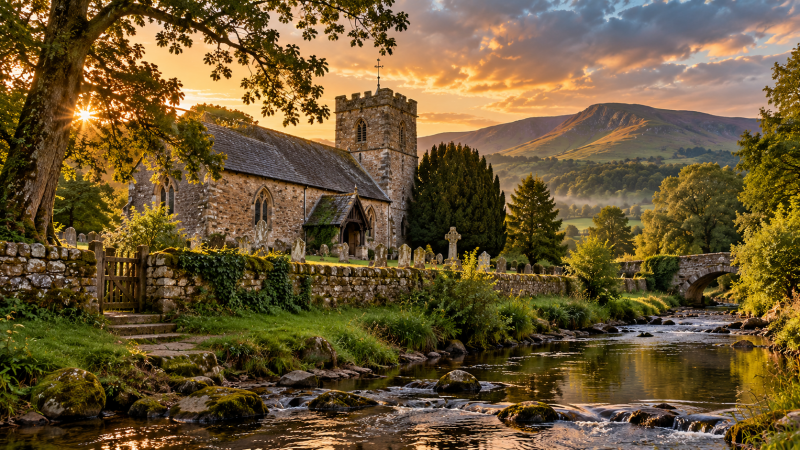
The story of St Clydawg is inseparable from the landscape surrounding Clodock. Situated near the River Monnow, in a valley beneath the eastern slopes of the Black Mountains, the church occupies a place where geography, history and religious tradition have become closely intertwined. In the medieval account preserved in the Book of Llandaff, the river is more than a backdrop to the murder of the king. It marks the point at which his companions were unable to continue their journey with his body, an event interpreted as a sign that he should be buried nearby. The landscape itself therefore becomes an essential part of the legend, giving meaning to the location of the saint's resting place.
In medieval Christian tradition, the burial places of saints and martyrs could become centres of religious devotion, where stories of extraordinary events helped establish the significance of a particular site. The account of Clydawg follows this pattern, describing the mysterious weight of his body, the refusal of the oxen to proceed and the appearance of fire above his grave. Such details should not be read as archaeological evidence of miraculous events, but they reveal how the author presented the burial place as sacred. The story also connects the site with ideas of justice and the consequences of broken promises, particularly through the account of violence following an oath sworn at the martyr's tomb.
The surviving church and its surroundings provide a tangible connection to the long history of worship in this corner of Herefordshire. Although the present building has undergone alterations over the centuries, its dedication to St Clydawg preserves the memory of a figure whose story was recorded in medieval religious literature. The nearby river, the churchyard and the surrounding hills help us understand why this quiet place could become the setting for such an enduring tradition. They also remind us that folklore often belongs not simply to a story, but to a particular landscape through which generations have travelled, worshipped and remembered the past.
Clodock offers a valuable lesson for anyone exploring the folklore of the Welsh Borderlands. A church dedication, an ancient burial tradition and a medieval narrative can be examined together without assuming that every part of the legend is historically verifiable. Equally, we should be cautious about adding supposed holy wells, pagan shrines or supernatural customs without evidence that they were associated with this particular place. The documented story is already remarkable enough: a murdered ruler, a river crossing, a miraculous burial and a church whose name continues to preserve his memory.
The Devil's Farmhand — A Strange Tale from Longtown
Among the supernatural stories associated with the Herefordshire borderlands is a curious tale set on a farm near Longtown, beneath the eastern slopes of the Black Mountains. The story concerns a farmer struggling to complete his seasonal work after one of his best labourers fell ill. With the harvest demanding attention and too few hands available, the arrival of a stranger seeking employment seemed remarkably fortunate. The newcomer called himself John, and although nobody in the area appeared to know him, the farmer agreed to take him on, warning that he expected a full day's work in return for his wages.
At first, John appeared to be the answer to the farmer's troubles. He worked with extraordinary energy, completing difficult tasks with a speed and determination that astonished his employer. Yet his willingness to labour soon became unsettling. The farmer began to suspect that there was something unnatural about the stranger, and his growing unease eventually led him to seek advice from a travelling woman. According to the tale, she suggested an unusual test: the farmer should take a curly hair from his wife's head and order John to hammer it perfectly straight upon the blacksmith's anvil.
The farmer followed her instructions, giving his mysterious employee the seemingly impossible task. For hours, the sound of hammering rang from the forge as John struggled to straighten the hair. Then, suddenly, the noise stopped. When the farmer entered the building, the stranger had disappeared, leaving the stubbornly curled hair behind. Looking outside, he caught sight of John departing into the distance. In the telling of the story, the farmer had escaped a dangerous bargain, and the mysterious labourer was understood to have been the Devil himself.
This tale belongs to a wider family of British and European stories in which a supernatural visitor enters an ordinary household or workplace, only to be defeated through an impossible task. Its setting among the farms of Longtown gives the familiar motif a distinctly local character, reflecting the importance of agricultural labour, the anxieties of harvest time and the traditional belief that danger might arrive disguised as a helpful stranger. A version of the story was published by Eat Sleep Live Herefordshire in August 2024, although its original storyteller and earliest recorded source have not yet been established. Until those details can be traced, it is best understood as a locally attributed folktale preserved in a modern retelling, rather than evidence of a particular historical event.
Source: Devilish Tales from Longtown — Eat Sleep Live Herefordshire (12 August 2024).
St Peter's Well — The Healing Waters of Peterchurch
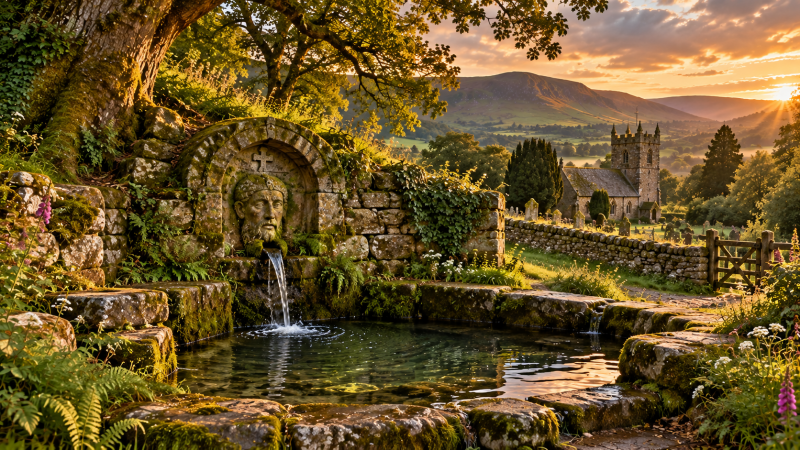
Deep within Herefordshire's Golden Valley, near the village of Peterchurch, lies a spring known as St Peter's Well. Although easily overlooked among the surrounding fields, lanes and wooded hillsides, the well forms part of a long tradition in which natural water sources were regarded as places of healing and spiritual significance. Its reputation has survived in local historical records, offering a fascinating glimpse into the relationship between landscape, illness and traditional belief in this part of the Welsh Borderlands.
St Peter's Well was once associated with healing, and accounts of the site describe a bathing pool used by people suffering from rheumatism. Such practices were part of a much wider tradition of visiting springs and wells in the hope of relief from physical ailments. Before modern medicine became widely available, people often turned to remedies passed down through families and communities, including the use of spring water. The well's reputation does not establish that its waters possessed medicinal properties, but it does show how a particular place could become important through generations of local belief and practice.
The site also has an intriguing physical feature: a carved stone head associated with the well. The carving has been suggested to be of considerable antiquity, possibly predating the Christian dedication of the spring, although its age and original purpose remain uncertain. It would be tempting to describe St Peter's Well as the survival of an ancient Celtic shrine, but without firmer archaeological evidence that interpretation must remain speculative. What can be said is that the spring became associated with St Peter and acquired a place within the religious and healing traditions of the Golden Valley.
St Peter's Well was sufficiently significant to be included among the sites referenced in Ella Mary Leather's The Folk-Lore of Herefordshire, published in 1912. The well also appears in Herefordshire's modern historic environment records, while later descriptions suggest that changes to the water supply have altered its original appearance, including the loss of the former bathing pool. Even so, its history remains a reminder that the folklore of the Welsh Borderlands was not confined to kings, saints and supernatural beings. Sometimes it belonged to ordinary people seeking comfort, relief and hope from the waters of a quiet country spring.
Jack of France — The Devil's Sermon at Dorstone
In the quiet village of Dorstone, beneath the hills of Herefordshire's Golden Valley, an unsettling legend tells of a man known as Jack of France, whose wicked behaviour had made him feared by the people around him. Remembered in local tradition as a troublemaker and a danger to peaceful neighbours, Jack was said to have little regard for the consequences of his actions. Yet one autumn night, as the village lay in darkness, he encountered something that would change his life forever. The story was preserved by the Herefordshire folklorist Ella Mary Leather in her 1912 collection, The Folk-Lore of Herefordshire.
According to the tale, Jack was passing through Dorstone churchyard on All Souls' Eve when he noticed an extraordinary sight. Every window of the church was illuminated, although no ordinary service should have been taking place at such an hour. Curious, he approached and peered inside. The building appeared to be filled with a congregation listening to a preacher dressed in a monk's habit. But this was no familiar sermon. The mysterious figure was announcing the names of those who would die during the coming year, and as Jack watched, the preacher raised his head, revealing the face of the Devil himself.
Jack's terror became complete when he heard his own name spoken among those marked for death. The revelation drove him from the churchyard and back to his home, where he was overcome by fear and remorse. The legend tells that he took to his bed and died, his repentance arriving too late to save him from the fate he believed had been foretold. Whether intended as a warning against wrongdoing or as an expression of older fears surrounding churchyards and the dead, the story brings together several powerful elements of traditional folklore: a forbidden nighttime gathering, the Devil disguised as a religious figure and the terrible knowledge of one's approaching death.
Leather's recording gives this legend particular value because it places the story firmly within the folklore of Dorstone rather than attaching a wandering ghost tale to an arbitrary location. The account should not be treated as evidence that the events actually occurred, but it does preserve a striking example of the supernatural beliefs and cautionary storytelling associated with rural Herefordshire. The setting is especially significant: All Souls' Eve, a churchyard and a congregation of mysterious figures all evoke the traditional relationship between the living, the dead and the sacred spaces where they were remembered. Today, Dorstone's peaceful surroundings offer a remarkable contrast to the darkness of this old tale.
Ella Mary Leather — The Folk-Lore of Herefordshire (1912), page 58. The original edition is available free through Google Play Books.
The Nine Witches of Garway Hill — Witchcraft in the Borderlands
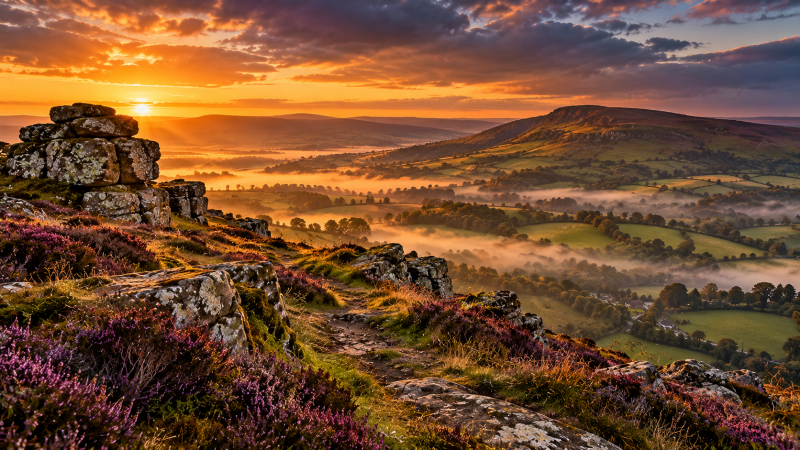
Rising above the countryside of southern Herefordshire, Garway Hill has long occupied a place in the folklore of the Welsh Borderlands. Its open slopes, scattered woodland and far-reaching views create a landscape that feels removed from the villages and farms below. Yet the hill's most intriguing association is not with a ruined castle or an ancient king, but with witches. In her 1912 collection, The Folk-Lore of Herefordshire, Ella Mary Leather preserved a local saying that connected the country between Orcop and Garway with an enduring presence of witchcraft. According to the tradition, there would always be nine witches living somewhere between the bottom of Orcop and the top of Garway for as long as water continued to flow.
The saying is remarkable for its geographical precision. Rather than placing witches in an imaginary wilderness, it locates them within a recognisable stretch of Herefordshire countryside, among communities whose inhabitants would have known the hills, streams, fields and neighbouring settlements intimately. The number nine also gives the tradition a memorable quality, although the surviving saying alone does not establish why that particular number was chosen. There is no need to imagine a documented coven gathering upon the summit or to claim that nine identifiable women practised witchcraft there. What the source preserves is something subtler: a persistent local belief that witches formed part of the familiar human landscape.
Belief in witchcraft remained a significant feature of rural life long after the period of major witch trials had passed. Misfortune, illness, failing livestock and unexplained events could all become associated with suspected supernatural influence, while charms and protective practices offered ways of responding to such fears. Within this wider context, the Garway saying illustrates how a reputation for witchcraft might become attached to an entire district rather than to one particular person. The surrounding hills and valleys were not simply scenery in which stories unfolded; they were places through which communities understood danger, uncertainty and the unseen forces they believed might affect everyday life.
Today, Garway Hill is a peaceful landscape of open countryside and distant views, but the old saying offers a glimpse of a very different way of imagining the area. Its importance lies not in proving that witches once inhabited the hill, but in preserving the words through which local people expressed a longstanding supernatural belief. Recorded by Leather more than a century ago, the tradition remains a distinctive piece of Herefordshire folklore, linking the villages of Orcop and Garway through a curious and memorable association with the mysterious number nine.
Visit Herefordshire — The Herefordshire Trail, May 2022. See the section The Witches of Garway Hill, which credits Ella Mary Leather's 1912 collection.
Soldiers in the Church — A Wartime Tradition of Clodock and Longtown
Among the traditions preserved in the villages beneath the Black Mountains is an unusual story associated with the ancient church at Clodock. According to local folk tradition, soldiers once sought shelter within the church and even brought their horses inside for protection. The account evokes a time when the borderlands between England and Wales were vulnerable to armed conflict, and when the buildings that served peaceful communities could become temporary refuges during periods of danger. Although the story does not identify a particular army or date, it offers a fascinating glimpse into how memories of warfare became attached to familiar places.
Clodock and neighbouring Longtown belonged to the historic lordship of Ewyas Lacy, a frontier territory shaped by centuries of political rivalry and military activity. Longtown Castle, established during the early thirteenth century, formed part of the network of fortifications through which the Marcher lords asserted their authority. The wider district experienced unrest during several medieval conflicts, including periods of rebellion against English rule. In such circumstances, churches, castles and farm buildings could all acquire significance beyond their ordinary purposes, although the surviving evidence does not establish when, or whether, the particular incident remembered at Clodock occurred.
The tradition is recorded in a modern historical study by Nina Wedell, published through the Ewyas Lacy Study Group in 2016. Her research also notes reports of cannonballs supposedly discovered near Longtown Castle, but makes clear that no surviving examples were available to examine. These details are intriguing, yet they cannot be taken as proof of a documented battle or siege at the castle. Instead, they reveal how local memory can preserve suggestions of conflict long after the circumstances that gave rise to a story have been forgotten.
For the people of the Welsh Borderlands, the past was not remembered only through written chronicles or the ruins of castles. It also survived in stories attached to churches, fields, roads and other familiar landmarks. The image of soldiers sheltering with their horses inside Clodock Church is a striking example of such a tradition, connecting the everyday landscape with the uncertainty of medieval warfare. Whether it reflects a particular forgotten event or a more general memory of troubled times remains unknown, but its preservation adds another layer to the history and folklore of this remarkable borderland community.
Ewyas Lacy Study Group — The Origin and Decline of the Borough of Longtown, Nina Wedell (2016).
The Midnight Watch at St Michael's Church — A Village Story from Michaelchurch Escley
In the peaceful village of Michaelchurch Escley, beneath the eastern slopes of the Black Mountains, the old parish church of St Michael has witnessed generations of ordinary village life. Yet among the memories preserved by local residents is an unusual account of a nighttime vigil, a suspected thief and a mystery beneath the church. Unlike the supernatural legends associated with other parts of Herefordshire, this story comes from an oral-history interview with someone who remembered the events of his youth, offering a rare glimpse into the everyday experiences of people living in the Escley Valley during the 1930s.
Woody Cole recalled how his father regularly visited the church on Saturday evenings to wind the clock and light the heating boiler, ensuring that the building would be warm for Sunday worship. The fuel was stored in an underground compartment reached by steps outside the church. One winter, his father noticed that the coke appeared to have been disturbed. Suspecting that somebody was helping themselves to the church's supply, he scattered ashes over the fuel so that any movement would leave visible traces. When the marks confirmed his suspicions, he decided that the best way to identify the culprit was to wait inside the church and catch the visitor in the act.
One Saturday night, father and son settled themselves on a pew at the back of the darkened building and waited. As the hours passed, they grew drowsy, until a noise alerted them to somebody moving near the boiler room. They rose and hurried towards the door, unaware that their heavy, hobnailed farm boots had struck a heating pipe connected to the underground compartment. The resulting noise rang through the building, warning the person below that someone was approaching. By the time they reached the steps, a man was already emerging with a bag over his arm. He claimed that he had merely come to check the boiler, although his explanation was hardly convincing in the middle of the night.
The man was known locally and had recently been employed on work associated with Michaelchurch Court. Although Woody and his father believed they had discovered who was taking the fuel, the accidental warning caused by their boots meant they had not actually caught him stealing anything. The incident survived as one of the many stories passed down through personal recollection rather than written village chronicles. Recorded in a 2005 conversation with Woody and Helen Cole, it provides a wonderfully human picture of Michaelchurch Escley: a working church, an observant villager, a suspicious nighttime visitor and the small details of rural life that might otherwise have disappeared from memory.
Original source: Ewyas Lacy Study Group — Oral History: Michaelchurch Mill and Related Matters.
The Welsh Harp of Michaelchurch Escley — Music in the Tudor Borderlands
In 1582, within the quiet valley of Michaelchurch Escley, a man named Ievan William David left behind a remarkable glimpse of life in the Welsh Borderlands. His possessions were recorded in a probate inventory following his death, among the livestock, grain, household furniture and everyday objects of a rural Tudor household. Yet one item stands apart from the others: a Welsh harp. Its presence offers a fascinating connection to the musical traditions of the border country, where Welsh and English language, culture and customs had long existed alongside one another.
During the sixteenth century, the harp held an important place in Welsh musical culture. Harpers performed in a variety of settings, and music formed part of the traditions through which stories, poetry and cultural memory were preserved. The instrument recorded at Michaelchurch Escley would have belonged to an earlier period of harp making than the large Welsh triple harp familiar today, which became established later. Although the inventory does not describe its construction, the reference suggests that an instrument associated with Welsh musical tradition was present in a household on the Herefordshire side of the border.
The inventory presents an intriguing historical puzzle. Two surviving copies appear to disagree over the harp's value, one giving a figure of eight pounds and the other eight shillings. The difference is considerable, and without examining the original handwriting it is impossible to determine which reading is correct. Nor can we know whether Ievan himself played the instrument, whether another member of his household was a musician or whether the harp had come into his possession through some other means. What matters is that the instrument was considered sufficiently valuable to be included among his recorded belongings.
For anyone exploring the folklore and cultural history of the Welsh Borderlands, this small detail is a reminder that the region's past was shaped by more than castles, battles and supernatural legends. Music, storytelling and the exchange of traditions between neighbouring communities were also part of its history. The Welsh harp of Michaelchurch Escley cannot tell us which melodies were played or which stories might have accompanied them, but its appearance in a document more than four centuries old offers a rare and tangible connection to the cultural world of the Tudor borderlands.
Ewyas Lacy Study Group — Probate Inventory of Ievan William David (1582)