The Hare in British & Irish Folklore
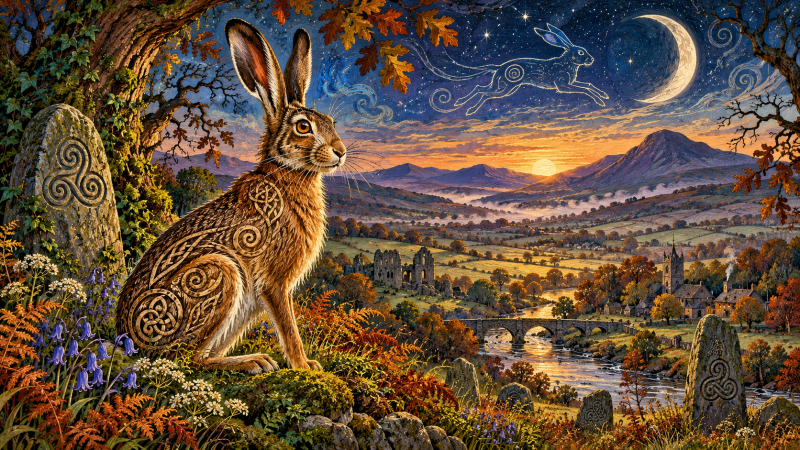
Few animals move through the folklore of Britain and Ireland with quite the same air of mystery as the hare. Swift, elusive and most active around dawn and dusk, the hare has long seemed to belong to the boundary between the familiar countryside and something older and less easily understood.
Across British and Irish tradition, hares appear in stories of witchcraft, transformation, luck, taboo and the supernatural. In some tales a mysterious hare is pursued by hunters only for an injured woman to be discovered bearing the same wound. Elsewhere, harming or eating a hare could be regarded with suspicion, while encounters with hares were sometimes interpreted as omens.
The animal's extraordinary speed and habit of disappearing suddenly across open ground helped give it an almost otherworldly character. Its prominent place in the spring landscape also encouraged later associations with fertility and seasonal renewal, although some popular modern claims about ancient hare symbolism go considerably further than the surviving historical evidence allows.
Rather than representing one single ancient Celtic belief, the folklore of the hare is a layering of traditions accumulated across centuries. Irish storytelling, Scottish and Welsh traditions, English folk belief, witchcraft accounts and later antiquarian writing have all contributed to the animal's remarkable reputation.
The result is an animal poised between the natural and supernatural — familiar in Britain's fields and hills, yet repeatedly imagined as something that might not be quite what it seems.
The Hare and the Supernatural
One of the strongest themes surrounding the hare in British and Irish folklore is its connection with the supernatural. A hare encountered unexpectedly could be more than simply a wild animal. Stories repeatedly blur the boundary between an ordinary creature of the countryside and a human or supernatural being moving in animal form.
This idea was particularly powerful because of the hare's behaviour. Unlike rabbits, hares generally live above ground rather than disappearing into extensive burrow systems. They crouch in shallow depressions known as forms and rely upon camouflage and extraordinary speed to escape danger. To someone crossing a field at dusk, a hare could appear suddenly, race across the landscape and seemingly vanish.
Folklore transformed this natural ability into something mysterious. Hares could appear at significant moments, lead pursuers across unfamiliar country or escape despite apparently impossible odds. In stories told around firesides and farmhouses, the animal became a creature that could cross the uncertain boundary between the everyday landscape and the supernatural world.
This does not mean that people throughout Britain and Ireland shared one universal belief about hares. Traditions differed greatly between regions and periods. What survives instead is a remarkable collection of local stories in which the hare repeatedly appears whenever the ordinary countryside begins to feel slightly strange.
Hares, Witches & Shape-Shifting
Perhaps the most enduring supernatural belief surrounding the hare is its association with witchcraft and shape-shifting. In folklore recorded in different parts of Britain and Ireland, witches were sometimes said to possess the ability to transform themselves into hares, allowing them to travel quickly across the countryside or escape unnoticed.
A recurring type of tale describes hunters or villagers pursuing an unusually elusive hare. The animal is shot, struck or otherwise wounded but manages to escape. Later, an elderly or mysterious woman is discovered nearby suffering from an injury in precisely the same place. The implication is clear: the hare and the woman were believed to have been the same being.
Stories of this kind became especially widespread during periods when fear of witchcraft was strong. The hare's speed, solitary habits and ability to remain almost invisible while crouched in its form made it an ideal animal around which such stories could develop.
Another tradition connected hares with the stealing of milk. In some folk accounts, a witch transformed into a hare and approached neighbouring cattle so that she could magically take their milk or prosperity. Suspicion might therefore fall upon a hare behaving unusually around livestock or farm buildings.
These stories should not be understood as evidence of a single ancient Celtic belief about witches becoming hares. Many of the surviving accounts belong to much later British and Irish folk traditions. What they demonstrate instead is how successfully the hare became woven into centuries of supernatural storytelling.
The Hare in Irish Tradition
The hare occupies a particularly intriguing place in Irish folklore. Rather than having one fixed meaning, it appears in traditions involving the supernatural, transformation, luck and the danger of interfering with creatures whose true nature may not be immediately apparent.
Some Irish folk traditions treated the killing of a hare with unease, particularly when the animal behaved unusually or appeared in circumstances that suggested something supernatural. Stories of women assuming the form of hares also occur in Irish tradition, closely resembling the shape-shifting tales found elsewhere in Britain.
The hare could therefore become a creature that demanded caution. A person pursuing one might believe they were simply hunting an animal, only to discover that the encounter had drawn them into something far stranger. Such stories reinforced an old folkloric lesson: appearances in the landscape could be deceptive.
Hares also appear within the broader imaginative world of Irish storytelling in which animals, people and supernatural beings are not always separated by firm boundaries. Transformation is a recurring feature of medieval Irish literature and later folklore, although individual hare traditions should not automatically be assumed to descend directly from those early texts.
This distinction is important. Modern descriptions sometimes present the hare as possessing one clearly defined role in an ancient “Celtic religion.” The surviving evidence is considerably more complicated — and far more interesting. What we actually find are different traditions from different periods gradually accumulating around one extraordinary animal.
The Hare in Welsh & British Folklore
Across Wales and other parts of Britain, the hare acquired many of the same unsettling associations found in Irish tradition. It could be connected with witchcraft, transformation and encounters in which an apparently ordinary animal behaved in ways that seemed impossible to explain.
Welsh tradition is especially interesting because animals frequently inhabit a landscape already rich with stories of supernatural beings, enchanted places and transformation. Medieval Welsh literature contains numerous examples of humans and animals crossing the boundaries between different forms, although this does not mean that every later Welsh belief concerning hares originated in those early stories.
Elsewhere in Britain, local folklore frequently placed the hare within the everyday world of farms, fields and hunting. This ordinary setting made supernatural hare stories particularly effective. The mysterious animal did not have to inhabit some distant mythical realm — it might appear in the field beyond the farmhouse or race across a familiar road at dusk.
Beliefs varied considerably from place to place. A hare might be considered unlucky in one tradition while elsewhere the animal inspired fascination rather than fear. Fishermen, farmers and hunting communities could each develop their own customs and superstitions surrounding encounters with hares.
This regional variety is one of the most valuable things about British folklore. Rather than searching for a single universal meaning for the hare, the surviving traditions allow us to see how communities repeatedly transformed a familiar native animal into something mysterious.
Hares, the Moon & Spring
Today the hare is frequently associated with the moon, spring, fertility and seasonal renewal. Some of these connections fit naturally with the animal itself. Hares become especially conspicuous during late winter and early spring, when their normally solitary behaviour gives way to dramatic courtship activity in open fields.
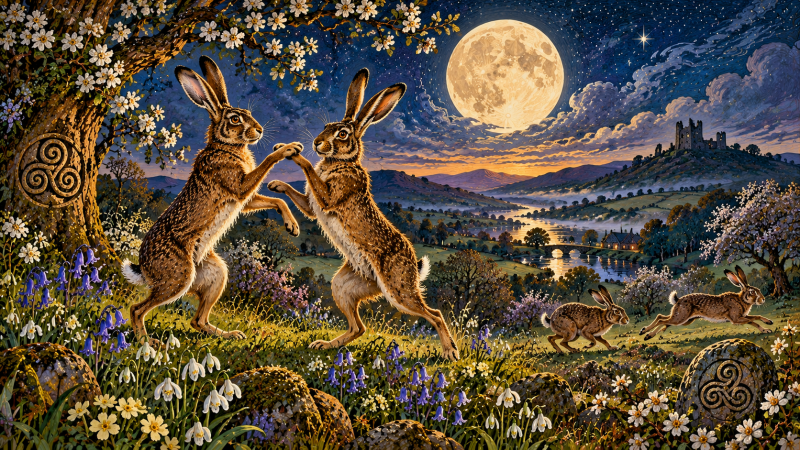
This is the origin of the familiar expression “mad as a March hare.” During the breeding season, hares can be seen chasing one another at remarkable speed and apparently “boxing” by standing upright and striking with their forelegs. The spectacle has fascinated people for centuries and helped make the hare one of the most recognisable animals of the spring countryside.
Connections between hares and the moon also appear in folklore and mythology beyond Britain and Ireland. The animal's nocturnal and crepuscular habits make the association understandable, but claims that the hare was universally regarded as a sacred lunar animal by the ancient Celts should be treated cautiously. Celtic-speaking communities covered enormous distances and many centuries, and their beliefs were never a single unchanging system.
The same caution is needed with the popular modern connection between hares, the goddess Ēostre or Ostara, and Easter. The historical evidence for Ēostre is extremely limited, and there is no surviving ancient account describing a sacred hare belonging to her. Much of the familiar story linking a hare, the goddess and decorated eggs developed much later.
That does not make the hare's association with spring meaningless. Quite the opposite. Anyone watching hares racing and boxing across fields as winter begins to loosen its grip can understand why generations of people have regarded them as creatures of vitality, wildness and seasonal change.
Luck, Omens & Taboos
Like many animals surrounded by supernatural stories, the hare could be interpreted as either fortunate or ominous depending upon the place, circumstances and person encountering it. There was no single British or Irish rule determining whether seeing a hare meant good luck or bad.
In some traditions, a hare crossing a person's path could cause unease, particularly before an important journey or undertaking. The animal's sudden appearance and equally sudden disappearance made it a natural subject for omen traditions. What mattered was often not simply seeing a hare, but where it appeared, when it appeared and how it behaved.
Hares also became surrounded by taboos. In some communities there was reluctance to kill or eat them, while particular families or localities developed their own explanations for why the animal should be spared. Such customs could acquire supernatural explanations over generations.
The hare's association with shape-shifting added another reason for caution. If folklore allowed for the possibility that a hare might actually be a witch or another transformed being, killing one carried a risk far greater than losing an ordinary game animal.
These contradictory beliefs are part of what makes hare folklore so fascinating. The animal could represent vitality and spring in one context, yet become an unsettling omen in another. The hare was never easily reduced to a single meaning — and perhaps that uncertainty is precisely why so many stories gathered around it.
The Hare in the Landscape
The folklore of the hare cannot really be separated from the landscape in which people encountered it. Hares belong to open country — fields, rough grassland, moorland and the edges of cultivated farmland — places where their long ears and powerful legs can suddenly appear above the vegetation before the animal races away across the ground.
For generations living and working in the countryside, encounters with hares were part of everyday life. Yet dawn, dusk, mist and moonlight could transform even familiar fields into uncertain places. A solitary hare sitting motionless in the half-light, then disappearing at extraordinary speed, offered exactly the kind of encounter from which folklore grows.
Many British and Irish supernatural traditions are rooted in this relationship between people and familiar places. Old roads, wells, rivers, hills, woods and fields become significant because stories accumulate around them. The hare fits naturally into this world: a wild creature moving through landscapes that humans know well but never completely control.
This also helps explain why hare stories remained powerful long after belief in witchcraft and shape-shifting declined. You do not need to believe that a hare is supernatural to understand the atmosphere of seeing one unexpectedly on a lonely country road or watching it race across a moonlit field.
The landscape gives the hare its stage; folklore supplies the possibility that there may be more happening upon it than we can see.
Hare Folklore Today
The hare remains one of the most evocative animals in modern British and Irish folklore. Stories that once belonged largely to oral tradition now appear in books, artwork, nature writing and contemporary Pagan and folk-inspired culture, where the animal continues to represent wildness, mystery and the changing seasons.
Modern interpretations often emphasise the hare's connections with the moon, femininity, fertility and ancient Celtic spirituality. These ideas can be beautiful and meaningful, but they do not always reflect what can actually be demonstrated from historical sources. Traditional hare folklore is often stranger and less orderly: witches become hares, hunters encounter animals they cannot catch, wounds pass mysteriously between animal and human, and ordinary fields become places of uncertainty.
That complexity is worth preserving. Folklore becomes more interesting when we allow old stories to retain their contradictions rather than forcing them into a single modern system of symbolism.
The brown hare itself is still very much part of the living countryside of Britain and Ireland. Watching one crouched almost invisibly in a field or racing suddenly across open ground provides a connection with the same animal behaviour that inspired storytellers generations ago.
Perhaps this is why the hare continues to feel different from many other familiar animals. It belongs completely to the natural landscape, yet centuries of storytelling have ensured that it never seems entirely ordinary.
Further Reading
The Leaping Hare — George Ewart Evans & David Thomson
The Leaping Hare is one of the most fascinating books devoted entirely to the animal and the extraordinary body of folklore that surrounds it. First published in the 1970s, it explores the hare through natural history, rural tradition, mythology, witchcraft, poetry and art, drawing particularly on the voices and beliefs of country people.
For anyone wanting to explore the stories behind the mysterious reputation of the hare in greater depth, this is an excellent place to continue.
Find The Leaping Hare on Bookshop.org →
Affiliate disclosure: This page contains affiliate links. If you buy a book through one of these links, Pixie Page Crafts may receive a small commission at no extra cost to you.
Frequently Asked Questions About Hare Folklore
What does the hare symbolise in Celtic folklore?
There is no single ancient Celtic meaning for the hare. Across Irish, Welsh and wider British folklore, hares have been associated with transformation, witchcraft, supernatural encounters, omens and the changing seasons. Some symbolism commonly described as ancient Celtic today comes from much later interpretations.
Were witches believed to turn into hares?
Yes. Stories of witches taking the form of hares occur in British and Irish folk tradition. One particularly common tale describes a hare being wounded and a suspected witch later being discovered with a corresponding injury.
Are hares associated with the moon?
Hares are strongly associated with the moon in modern folklore and spiritual symbolism, and lunar-hare traditions also occur elsewhere in the world. However, claims that the hare was universally a sacred moon animal to the ancient Celts go beyond the surviving evidence.
Is the hare connected with Easter and Ostara?
The connection is much less certain than is often claimed online. The historical evidence concerning the Anglo-Saxon goddess Ēostre is extremely limited, and there is no surviving early account describing a sacred hare belonging to her. The familiar relationship between hares or rabbits, spring and Easter developed through a mixture of traditions over time.
What does seeing a hare mean?
There is no universal traditional meaning. Depending upon the region and period, encountering a hare could be interpreted as an omen, something supernatural or simply an encounter with an elusive wild animal. Modern spiritual interpretations often associate hares with intuition, transformation, fertility and renewal.
From Folklore to Art
The hare's place between the everyday and the mysterious makes it a natural subject for the artwork of Pixie Page Crafts. Its stories contain many of the elements that inspire this collection — moonlit landscapes, old countryside, changing seasons, Celtic patterns and the sense that something ancient might still be hiding within familiar places.
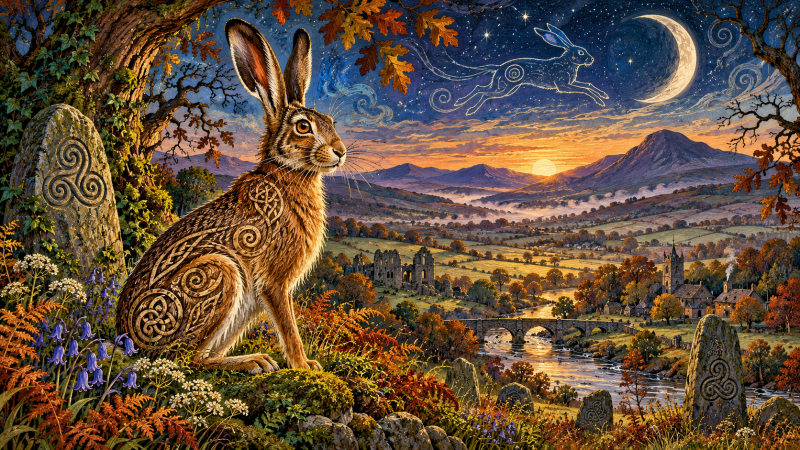
In my Celtic-inspired artwork, the hare is not intended as a reconstruction of a single ancient belief. Instead, the images draw upon the atmosphere created by centuries of folklore: the animal racing across a field at dusk, sitting silently beneath the moon or appearing among old stones and tangled woodland.
The aim is to capture that moment when landscape, wildlife and story begin to overlap — the same uncertain boundary that has made the hare such an enduring figure in British and Irish folklore.
Sources & Further Reading
The Folklore Society
A major resource for the study of folklore, traditional beliefs, customs and vernacular culture. Founded in 1878, its work covers areas including folk narrative, customs, beliefs, traditional arts and folk medicine.
The Folklore Society →
Dúchas — National Folklore Collection of Ireland
An exceptional online archive of Irish oral tradition and folklore. Its collections include manuscripts, photographs, recordings and the enormous Schools’ Collection gathered across Ireland in the 1930s.
Explore Dúchas.ie →
Dúchas — The Schools’ Collection
Particularly useful for researching local beliefs and traditions. More than 50,000 schoolchildren helped collect folklore from parents, grandparents and neighbours between 1937 and 1939.
Explore The Schools’ Collection →
Continue Exploring the Folklore
Animals in Celtic & British Folklore →
Discover the folklore, mythology and traditional beliefs surrounding the animals that appear throughout the stories of Britain and Ireland.
The Folklore Bookshelf →
Explore recommended books covering Celtic mythology, British and Irish folklore, sacred landscapes, folk belief and traditional stories.
Celtic & Pagan Folklore →
Return to the main folklore collection and explore mythology, seasonal traditions, sacred places, supernatural beliefs and the old stories of Britain and Ireland.