The Wild Boar in Celtic & British Folklore
Powerful, unpredictable and formidable when threatened, the wild boar occupies a striking place in the mythology and storytelling traditions of Britain and Ireland. Long after wild boar disappeared from much of the British landscape, stories of supernatural boars, dangerous hunts and extraordinary swine continued to survive in medieval literature and folklore.
In Irish tradition, pigs and boars appear in tales involving kingship, feasting, transformation and the supernatural. In medieval Welsh literature, one of the most remarkable is Twrch Trwyth, the enchanted boar pursued across the landscape by Arthur and his companions in the tale of Culhwch and Olwen.
Yet the wild boar's modern reputation as a universal symbol of ancient “Celtic warrior strength” can sometimes oversimplify a much richer tradition. By looking carefully at surviving medieval texts and later folklore, we can explore what the stories actually tell us — and distinguish them from symbolic interpretations that developed much later.
The Wild Boar in Early Irish Tradition
Pigs and wild boar appear repeatedly in medieval Irish literature, where they can be associated with hunting, feasting, status and the supernatural. Pork was an important food in early medieval Ireland, and stories involving valuable pigs, extraordinary swine and dangerous boars reflect a world in which these animals had both practical and imaginative importance.
One of the most famous supernatural pigs appears in the story of Mac Dathó’s Pig, preserved in the medieval Irish tale Scéla Muicce Meic Dathó. The enormous pig becomes the centre of a dispute between the warriors of Ulster and Connacht over who deserves the champion’s portion — the right of the greatest warrior to receive the finest cut. What begins with a feast develops into boasting, rivalry and violence, revealing how an extraordinary pig could become entwined with ideas of honour and heroic status.
Other Irish traditions connect pigs and boars with transformation and supernatural origins. In some medieval narratives, animals that appear to be ordinary creatures are revealed to have histories involving people, otherworldly beings or magical transformation. The boar therefore belongs to a wider Irish storytelling tradition in which the boundary between human, animal and supernatural existence can be surprisingly fluid.
It is tempting to turn these stories into a simple claim that the boar was a universal Celtic symbol of courage or warfare. The surviving literature is more interesting than that. Boars can be valuable, dangerous, supernatural or transformative depending upon the story, and their significance is best understood within those individual traditions rather than reduced to a single symbolic meaning.
The Wild Boar in Early Irish Tradition
Pigs and wild boar appear repeatedly in medieval Irish literature, where they can be associated with hunting, feasting, status and the supernatural. Pork was an important food in early medieval Ireland, and stories involving valuable pigs, extraordinary swine and dangerous boars reflect a world in which these animals had both practical and imaginative importance.
One of the most famous supernatural pigs appears in the story of Mac Dathó’s Pig, preserved in the medieval Irish tale Scéla Muicce Meic Dathó. The enormous pig becomes the centre of a dispute between the warriors of Ulster and Connacht over who deserves the champion’s portion — the right of the greatest warrior to receive the finest cut. What begins with a feast develops into boasting, rivalry and violence, revealing how an extraordinary pig could become entwined with ideas of honour and heroic status.
Other Irish traditions connect pigs and boars with transformation and supernatural origins. In some medieval narratives, animals that appear to be ordinary creatures are revealed to have histories involving people, otherworldly beings or magical transformation. The boar therefore belongs to a wider Irish storytelling tradition in which the boundary between human, animal and supernatural existence can be surprisingly fluid.
It is tempting to turn these stories into a simple claim that the boar was a universal Celtic symbol of courage or warfare. The surviving literature is more interesting than that. Boars can be valuable, dangerous, supernatural or transformative depending upon the story, and their significance is best understood within those individual traditions rather than reduced to a single symbolic meaning.
Twrch Trwyth — The Great Boar of Welsh Tradition
One of the most extraordinary boars in medieval British literature is Twrch Trwyth, whose story appears in the Welsh tale Culhwch and Olwen. Preserved in medieval manuscripts including the Red Book of Hergest and White Book of Rhydderch, the tale places the legendary King Arthur and his warriors within a strange world of impossible tasks, supernatural creatures and enchanted landscapes.
Culhwch is told that he can marry Olwen only if he completes a seemingly impossible series of tasks demanded by her father, the giant Ysbaddaden Bencawr. Among them is the need to obtain a comb and shears carried between the ears of Twrch Trwyth. The boar is no ordinary animal: the tale identifies him as a king's son who had been transformed into the shape of a swine.
What follows is an enormous hunt. Arthur summons warriors, hunters and hounds, and the pursuit of Twrch Trwyth and his young takes the hunters across Ireland, Wales and into Cornwall. The boars devastate landscapes and kill numerous pursuers as the chase moves from one named location to another, giving the episode the character of both a supernatural adventure and a journey through a legendary geography.
Eventually the comb and shears are seized from Twrch Trwyth, but the boar himself is not simply killed like an ordinary hunted animal. He is driven into the sea off Cornwall, and the tale says that it was never known where he went afterwards. That mysterious ending leaves Twrch Trwyth as something more unsettling than a defeated monster — a supernatural creature that passes beyond the known landscape rather than being completely destroyed.
The Boar Hunt, Landscape & the Supernatural
The pursuit of Twrch Trwyth is remarkable not only because of the creature being hunted, but because the story sends its characters racing through a landscape filled with named rivers, mountains, territories and settlements. Myth and geography become intertwined, allowing extraordinary events to inhabit places that medieval audiences could recognise.
This relationship between story and landscape is common throughout Welsh tradition. A hill, stone, river or place-name could provide a physical anchor for a legendary event, allowing stories to become attached to the countryside itself. The hunt of Twrch Trwyth is an especially dramatic example: the supernatural boar does not remain in some distant mythical realm but crashes through the familiar world.
The episode also reminds us that the wild boar of medieval storytelling was not simply an emblem of bravery. Twrch Trwyth is terrifyingly destructive. Warriors and hounds die during the pursuit, landscapes are crossed and disturbed, and even Arthur's extraordinary company struggles to contain the animal and its offspring.
This combination of immense strength, danger and supernatural origin helps explain why the boar works so effectively within heroic literature. Hunting such a creature becomes a test of the hunters themselves — yet the animal retains an almost untameable quality, particularly in Twrch Trwyth's mysterious disappearance into the sea.
Wild Boar in Later British Folklore
As wild boar became increasingly rare and eventually disappeared from the wild in Britain, the animal did not disappear from storytelling. Memories of formidable boars survived in local legends, place-names and stories in which unusually large or dangerous animals terrorised a particular landscape before being hunted and killed.
Some British traditions developed into stories of monstrous boars, often attached to specific places. These tales frequently follow a familiar pattern: an enormous animal causes destruction or fear, a local hero confronts it, and features of the surrounding landscape become associated with the encounter. Such stories belong to the wider tradition of local monster legends in which extraordinary creatures help explain or give identity to particular places.
One famous example is the Boar of Rievaulx tradition in Yorkshire, while other regions preserved their own tales of dangerous swine and heroic hunts. These later legends should not automatically be treated as remnants of ancient Celtic mythology simply because they feature a boar. Their importance lies instead in showing how the animal continued to occupy the British imagination long after encounters with truly wild boar had become uncommon.
The result is an interesting layering of tradition. Medieval Welsh literature gives us the supernatural Twrch Trwyth; Irish literature preserves extraordinary pigs and boars within heroic and supernatural narratives; and later local folklore transforms the animal again into monsters inhabiting particular British landscapes.
Boar Symbolism and Modern Paganism
Today, the wild boar is often associated with courage, strength, determination, protection and the willingness to stand one's ground. Within some modern Pagan and nature-based spiritual traditions, the boar may also be interpreted as a symbol of connection with the wild landscape, personal sovereignty and fierce protection.
There are historical reasons why strength and danger are natural qualities to associate with the animal. Medieval stories repeatedly portray extraordinary boars as formidable opponents, while hunting a powerful boar could provide an appropriate challenge for legendary heroes. Images of boars also occur in ancient European material culture, including objects from Iron Age contexts.
However, archaeological images and medieval stories do not provide us with a single surviving explanation saying that “the boar meant courage to the Celts.” The peoples now grouped under the broad label Celtic lived across different regions and periods, and the meanings attached to animals could vary considerably.
Modern Pagan interpretations can therefore be meaningful traditions in their own right, but they should not automatically be presented as beliefs inherited unchanged from ancient Celtic religion. The surviving stories give us something richer: a creature associated with danger, transformation, hunting, feasting, supernatural power and the untamed landscape — meanings that shift according to the tale in which the boar appears.
Frequently Asked Questions About Wild Boar Folklore
What did the wild boar symbolise in Celtic tradition?
There was no single universal “Celtic” meaning for the wild boar. Surviving Irish and Welsh literature associates extraordinary pigs and boars with hunting, feasting, danger, transformation and the supernatural. Modern associations with courage and warrior strength can be meaningful interpretations, but should not be treated as one documented belief shared by all ancient Celtic peoples.
Who was Twrch Trwyth?
Twrch Trwyth is a supernatural boar in the medieval Welsh tale Culhwch and Olwen. He is described as having once been a king's son who was transformed into a swine. Arthur and his companions pursue him in an extraordinary hunt in order to obtain objects carried between his ears.
Did King Arthur hunt a wild boar?
In Culhwch and Olwen, Arthur leads the pursuit of Twrch Trwyth and his offspring. This belongs to medieval Welsh Arthurian tradition and is very different from many later portrayals of King Arthur centred primarily on Camelot and the Round Table.
Were wild boar sacred to the Celts?
Boars clearly had an important place in the stories and imagery of several ancient and medieval European cultures, but describing them simply as “sacred to the Celts” goes beyond what the surviving evidence can demonstrate. Their significance varied according to place, period and context.
From Folklore to Art
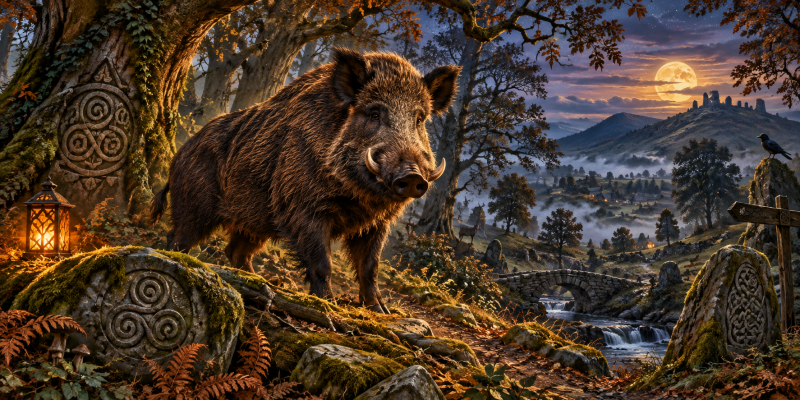
The wild boar is a wonderful subject for folklore-inspired art because it carries such a powerful sense of the untamed landscape. Heavy-set, watchful and emerging from woodland shadow, it seems perfectly at home among ancient trees, moss-covered stones and the half-hidden paths of old stories.
In my Pixie Page Crafts artwork, I draw inspiration from this atmosphere rather than trying to illustrate a single fixed “Celtic meaning”. The boar can stand at the boundary between the familiar countryside and the legendary landscape — a creature reminiscent of the dangerous hunts, transformations and supernatural encounters found within Welsh and Irish storytelling.
The artwork throughout Pixie Page Crafts is inspired by folklore rather than intended as a historical reconstruction. My aim is to capture the feeling these stories leave behind: ancient woodland, mysterious animals, distant lights and the possibility that somewhere beyond the next hill, the ordinary world might become something stranger.

The Wild Boar — original Pixie Page Crafts artwork inspired by the wild boar traditions of Britain and Ireland, including the supernatural landscapes of medieval Welsh and Irish storytelling.
Continue Exploring the Folklore
The wild boar is only one of the remarkable animals woven through the folklore of Britain and Ireland. Explore the Hare, Barn Owl, Raven, Fox, Stag, Swan, Wolf and Badger, each with its own stories, traditions and connections to the landscapes in which those tales developed.
You can discover them all in Animals in Celtic & British Folklore, or travel deeper into the supernatural traditions of these islands through The Celtic Otherworld.