Fairies, Spirits & the Fae
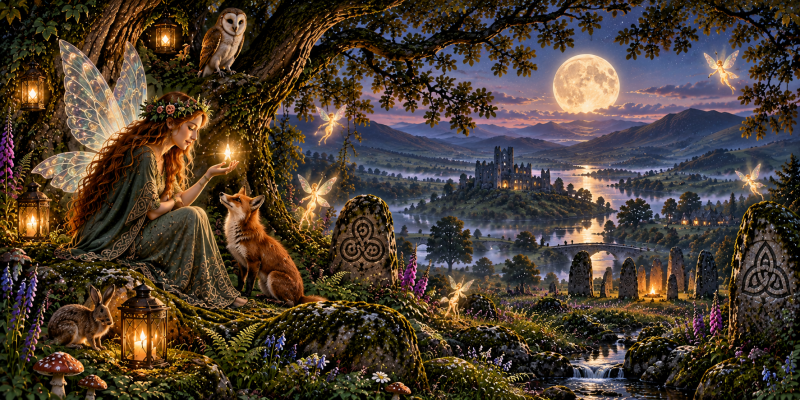
Mysterious Beings of the Celtic Lands
Forget, for a moment, the tiny winged fairies of children's books.
The supernatural beings found in the older folklore of Ireland, Wales, Scotland and Britain could be beautiful, frightening, generous, dangerous or simply impossible to understand.
They were associated with ancient hills, burial mounds, lonely roads, woodland, rivers and wild places. Some stories describe magnificent supernatural people living beneath the landscape. Others tell of strange music heard at night, mysterious lights, disappearing travellers and encounters with beings who seemed to belong to another world.
They were not always good.
They were not always evil.
And perhaps most importantly, they were not human.
What Are the Fae?
Today, the Fae is commonly used as a broad term for supernatural beings associated with fairy tradition.
Historically, however, Britain and Ireland possessed many different traditions rather than one single race of creatures called “the Fae.”
Ireland had traditions surrounding the Aos Sí.
Scotland developed rich traditions of its own.
Wales had the Tylwyth Teg.
Cornwall became famous for its piskies, while parts of England told stories of pixies, brownies, boggarts, hobgoblins and countless local spirits.
Their characteristics varied enormously. Some resembled humans. Some were small. Some appeared as mysterious animals. Some changed their appearance.
And some were never clearly seen at all.
The Aos Sí — People of the Mounds
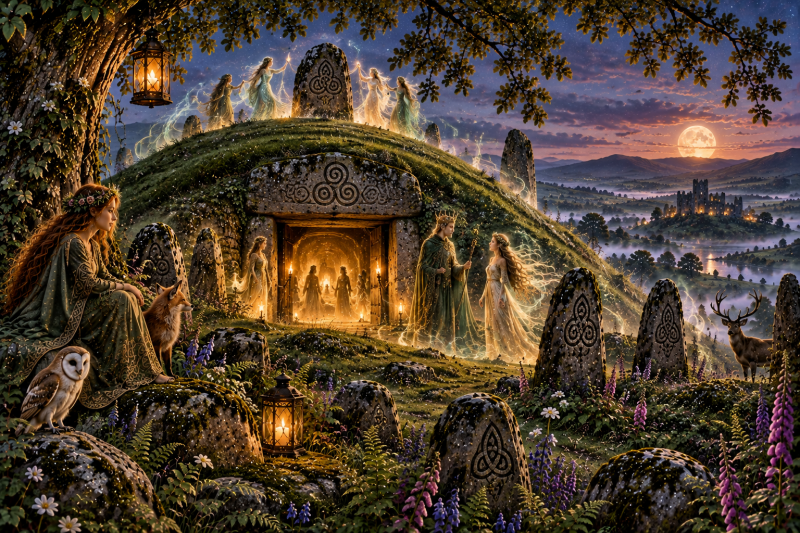
One of the most important traditions comes from Ireland.
The Aos Sí are supernatural beings strongly associated with the sídhe — ancient mounds and places within the landscape.
Many of these monuments were already thousands of years old when medieval Irish stories were written down.
Their original builders had vanished into the distant past.
But the mounds remained.
Stories eventually transformed some of these mysterious ancient places into entrances to supernatural dwellings.
Beneath an apparently ordinary grassy hill might lie magnificent halls inhabited by beings belonging to another world.
This connection between ancient monuments and supernatural inhabitants became one of the most enduring ideas in Irish folklore.
Fairy Hills and Ancient Places
Certain hills, mounds and ancient monuments acquired particularly powerful reputations.
Later folklore sometimes warned people against damaging them.
A farmer might avoid disturbing a particular mound.
A road or boundary might bend around an unusual place.
A solitary hawthorn growing nearby could acquire its own reputation as a fairy tree.
These traditions demonstrate how folklore could directly influence people's relationship with the landscape.
To someone unfamiliar with the stories, it might simply be a grassy hill.
To someone who grew up hearing them, disturbing it might seem extremely unwise.
Fairies Were Not Always Friendly
Modern popular culture has transformed fairies considerably.
The familiar image of a tiny, beautiful woman with butterfly-like wings owes much to relatively recent art, literature and children's stories.
Traditional fairy folklore could be considerably darker.
Fairies might reward kindness or punish disrespect.
Stories warned against entering certain places, interfering with fairy gatherings or behaving carelessly around locations associated with supernatural beings.
Humans entering fairy realms could discover that time behaved differently there.
Food, music and dancing appear frequently in such stories.
What seems like a wonderful encounter may eventually reveal an unsettling consequence.
The message behind many tales is remarkably consistent:
Treat the unknown with respect.
Fairy Music and Dancing
Music is one of the most beautiful recurring features of fairy folklore.
Stories tell of travellers hearing extraordinary music emerging from hills or lonely places after darkness.
Sometimes people follow the sound.
That is rarely where the story ends.
Fairy dancing also appears frequently, particularly in later folklore.
Circular marks or rings appearing in grass became known as fairy rings, although we now understand that many are produced naturally by fungi growing beneath the soil.
To generations unfamiliar with the biological explanation, a mysterious circle appearing overnight could easily suggest that something unusual had happened there.
And folklore provided the answer.
The fairies had been dancing.
Time Beyond the Human World
As with stories of the Celtic Otherworld, fairy folklore sometimes plays strange games with time.
Someone may join a supernatural gathering believing that only a few hours have passed.
When they finally return home, they discover that years have gone by.
Friends have aged.
Buildings have changed.
People they knew may be long dead.
This theme appears in different forms across European folklore and gives fairy stories an unsettling quality.
The supernatural realm may appear beautiful.
But humans do not belong there.
The Tylwyth Teg — The Fair Folk of Wales
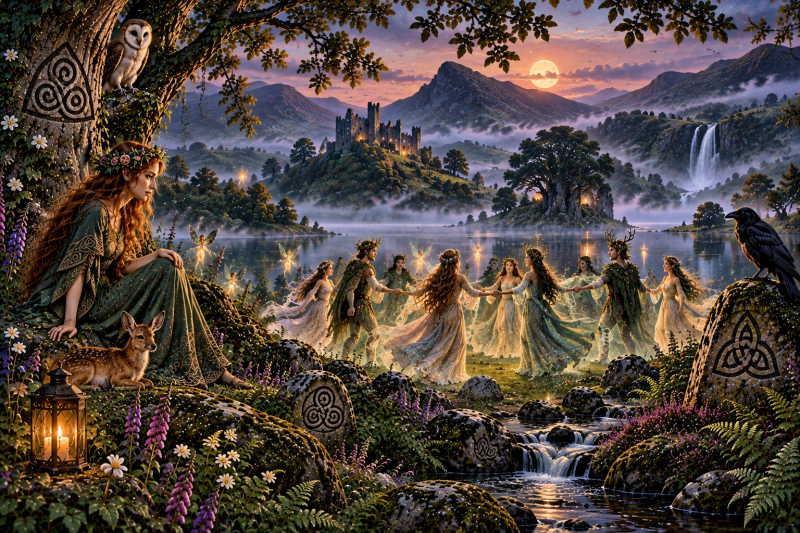
Welsh folklore contains traditions surrounding supernatural beings known as the Tylwyth Teg, often translated as the Fair Folk or Fair Family.
Stories vary greatly between places and periods.
They may be associated with lakes, hills, caves and isolated landscapes.
Welsh traditions also contain numerous tales involving supernatural women connected with lakes and water.
As elsewhere, attempting to compress all these beings into one simple description loses much of what makes the folklore interesting.
Local stories matter.
A creature known in one valley may behave very differently from a supposedly similar being somewhere else.
Pixies and Piskies
In southwest England, particularly Cornwall and Devon, traditions developed around beings commonly known as piskies or pixies.
They became famous for confusing travellers.
Someone who became mysteriously lost might be described as pixy-led.
A familiar path suddenly seemed unfamiliar.
A traveller wandered in circles.
Landmarks disappeared.
Eventually they might discover themselves somewhere completely unexpected.
Today we might blame darkness, fog, exhaustion or poor navigation.
But folklore offered a much more entertaining explanation.
The pixies had led you astray.
Brownies and Household Spirits
Not every supernatural being lived in remote woodland.
Some came much closer to home.
Scottish and northern English folklore contains traditions surrounding brownies, household spirits sometimes believed to perform work around farms or homes.
A brownie could help with chores while the household slept.
But there were rules.
Treating the being incorrectly, insulting it or sometimes attempting to reward it in the wrong way could cause it to disappear.
Stories about household spirits reveal something interesting about folklore.
The supernatural did not always exist far away.
Sometimes it lived beside the fireplace.
Changelings
Some fairy traditions became considerably darker.
Stories of changelings described supernatural beings supposedly substituting one of their own for a human child or, in some traditions, an adult.
Historically these beliefs could have tragic consequences.
Illness, disability or unusual behaviour that people did not understand could sometimes be interpreted through supernatural explanations.
Today these stories need to be approached carefully and compassionately.
They remind us that folklore could provide explanations for frightening events in periods when medicine and scientific understanding were limited.
Not every old belief was harmless.
Fairies and the Wild Landscape
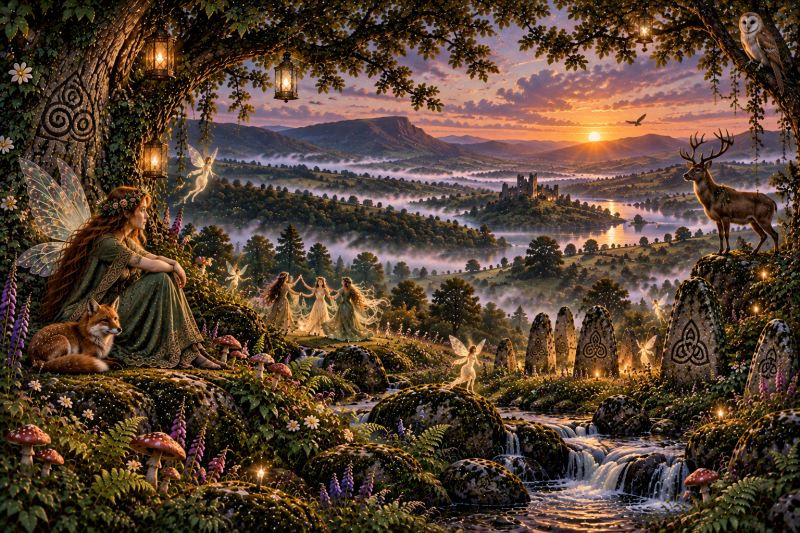
One theme appears again and again throughout fairy folklore:
wild places matter.
Ancient woodland.
Remote hills.
Caves.
Rivers.
Lakes.
Springs.
Islands.
Old paths.
Burial mounds.
These are landscapes that feel slightly removed from ordinary human life.
Many are also boundaries.
A shoreline sits between land and water.
Twilight lies between day and night.
A cave leads from daylight into darkness.
An ancient mound sits between the world of the living and memories of people who lived thousands of years before us.
Folklore thrives in these uncertain spaces.
Spirits of Water
Water possesses its own extraordinary collection of supernatural traditions.
Scotland is famous for tales of the kelpie, a dangerous supernatural water being frequently appearing in horse-like form.
Other traditions tell of water horses, mysterious women, spirits and creatures inhabiting lakes and rivers.
Welsh and Irish folklore contain their own rich traditions surrounding supernatural water beings.
These stories probably survived so successfully partly because water genuinely is dangerous.
A beautiful lake can conceal enormous depth.
A calm river can contain powerful currents.
Folklore transformed these invisible dangers into creatures people could understand and remember.
Spirits of the Forest
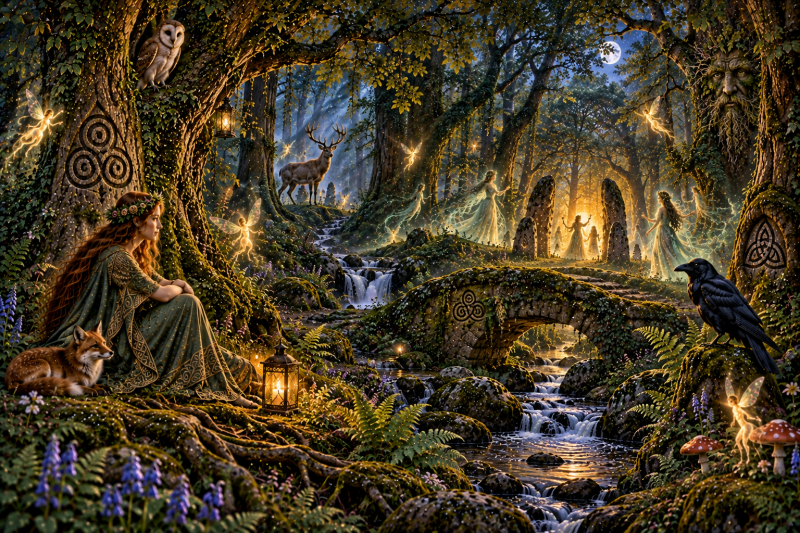
Forests also provide perfect homes for supernatural beings.
They obscure our view.
Paths disappear among trees.
Sounds travel strangely.
Branches move in darkness.
Animals remain unseen only metres away.
A person walking alone through woodland at twilight experiences a world very different from the same place at midday.
Stories naturally filled those shadows.
Whether described as fairies, spirits, witches or strange creatures, supernatural inhabitants turned woodland into somewhere that demanded attention and respect.
The Fae and Animals
Animals frequently appear alongside supernatural traditions.
A mysterious hare might not be an ordinary hare.
A black dog encountered on a lonely road might be something far stranger.
A beautiful white animal could lead a hunter away from familiar territory.
Birds might act as messengers or guides.
These stories blur the boundary between wildlife, transformation and the supernatural.
They also remind us how little of the animal world earlier people could observe.
A creature disappearing into woodland genuinely entered a world humans could not follow.
Protection Against Fairies
People developed numerous customs intended to protect themselves from supernatural beings.
Iron became particularly famous in later fairy folklore.
Certain plants and trees acquired protective reputations.
Rowan was widely associated in later Scottish and British tradition with protection against harmful supernatural influences and witchcraft.
People might also avoid particular locations or activities.
Such customs varied enormously by region.
There was never one universal book of fairy rules.
Folklore belonged to communities, and every community could tell the story differently.
Did People Really Believe in Fairies?
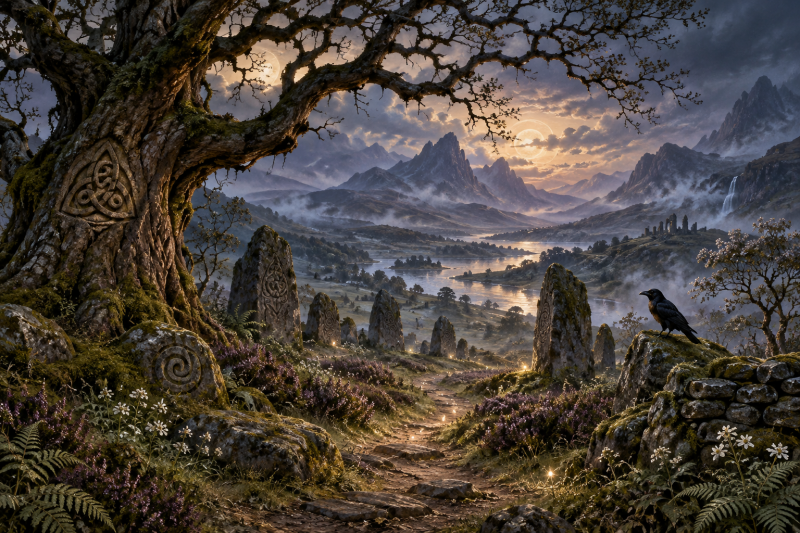
There is no simple answer.
Some clearly did.
Others may have treated the stories cautiously — perhaps not entirely believing them but seeing little reason to take unnecessary risks.
Others undoubtedly enjoyed them simply as stories.
Belief exists on a spectrum.
Even today people behave similarly.
Someone might say they don't believe in ghosts while still feeling uncomfortable spending a night alone in a supposedly haunted house.
Folklore survives remarkably well in that space between belief and doubt.
Fairies and Modern Paganism
Fairies and nature spirits remain important within some modern Pagan and spiritual traditions.
Modern interpretations may describe the Fae as nature spirits, Otherworld beings or intelligences associated with particular landscapes.
These beliefs are diverse and personal.
They should not automatically be presented as identical to ancient Celtic religion or historical fairy folklore.
Modern Paganism is another chapter in the continuing history of these ideas.
Old stories inspire new interpretations.
And the folklore continues changing.
Respecting the Wild Places
Perhaps there is something surprisingly modern hidden inside the old stories.
Don't damage the ancient tree.
Don't pollute the spring.
Don't destroy the mysterious mound.
Don't wander carelessly into dangerous places.
Respect the landscape.
Whatever supernatural explanations once accompanied these warnings, the underlying lesson remains useful.
The forests, rivers, wildlife and ancient monuments surrounding us deserve protection.
We don't need to believe fairies inhabit an old hawthorn to recognise that cutting it down unnecessarily would make the landscape poorer.
Somewhere Beyond the Trees
Perhaps fairies have survived in our imagination because they represent something we are reluctant to lose.
Mystery.
The possibility that the world contains more than we immediately understand.
Modern life explains extraordinary things.
We know why fairy rings appear.
We understand how mist forms.
We can map forests using satellites and illuminate darkness with the press of a button.
Yet walk alone beside an ancient woodland as daylight disappears and something changes.
The familiar landscape becomes uncertain.
A branch moves.
An owl calls somewhere beyond the trees.
Mist begins gathering beside the river.
And for just a moment it becomes very easy to understand why generations before us imagined another world moving quietly beside our own.
Perhaps that is where the Fae truly live today.
Not necessarily beneath ancient hills or beyond magical doorways —
but within that small part of us that still hopes the world has a few mysteries left.
Walk gently through the old places. You never know who was there first. 🌿