The Elder Tree in British & Irish Folklore
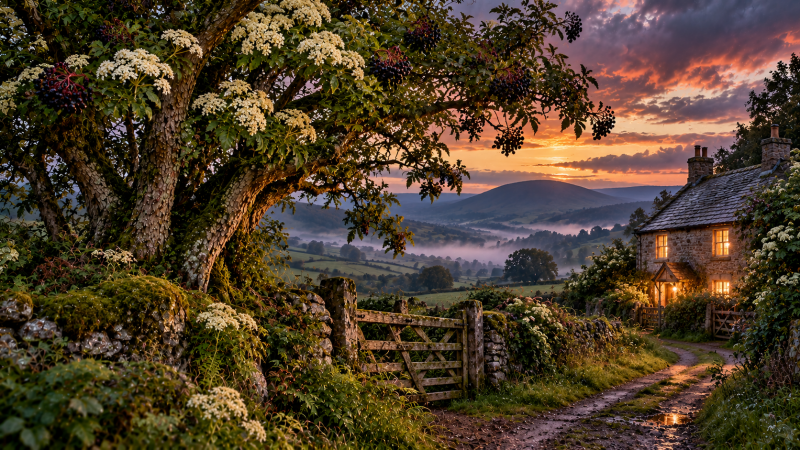
Few trees in British and Irish folklore possess a reputation as contradictory as the elder. Growing beside cottages, farm buildings, hedgerows and waste ground, it was an ordinary part of the rural landscape — yet generations of folklore surrounded it with warnings, protective customs and supernatural associations.
Elder could be regarded as a tree capable of protecting a household from witchcraft and harmful influences, while at the same time traditions warned against cutting, burning or damaging it carelessly. In some accounts, permission was even sought before branches were taken from the tree.
Its flowers and berries were valued in food, drink and traditional remedies, while the hollow stems and easily worked wood found numerous practical uses. Yet elder also became associated with witches, spirits, death and mysterious beings believed to inhabit or guard the tree.
Not all of these traditions originated in the same place. British, Irish, Scandinavian and continental European elder folklore has frequently been blended together in modern retellings. By separating these different strands, a much richer picture emerges of a tree that could be useful, protective and deeply unsettling all at once.
The Elder Tree — A Tree You Shouldn't Cut?
One of the most persistent traditions surrounding elder concerns the danger of cutting or damaging the tree without good reason. In parts of Britain and elsewhere in northern Europe, elder could be treated almost as though it possessed a personality of its own.
Folklore warned that cutting an elder might bring bad luck, illness or misfortune upon the person responsible or their household. Traditions varied considerably between regions, and not every community regarded the tree in exactly the same way.
Some accounts describe people asking permission before taking elder wood. A person might address the tree before cutting a branch, explaining why the wood was needed or asking forgiveness for taking it. Such customs belong to a wider tradition in which particular trees and plants were approached with caution and respect.
These beliefs did not necessarily prevent people from using elder. Its flowers, berries and wood were valuable, and the tree frequently grew close to human settlement. The important distinction was often between careful use and unnecessary destruction.
Elder therefore occupied a curious position in rural folklore. It could grow beside the house and provide useful food and remedies, yet still be treated as something that should never be taken entirely for granted.
The Elder Mother — Who Lived Within the Tree?
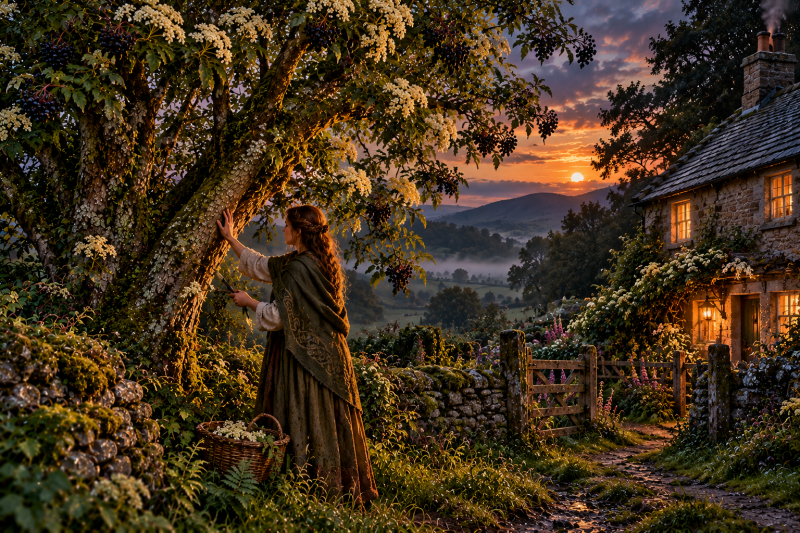
One of the best-known supernatural traditions surrounding elder is the belief that the tree could be inhabited or guarded by a female spirit, often known today as the Elder Mother.
The particularly famous Hyldemoer, or Elder Mother, belongs to Danish and Scandinavian tradition. People were said to treat an elder with respect and, in some accounts, ask the spirit's permission before cutting its wood. Failure to do so could risk angering the being associated with the tree.
This tradition has frequently been absorbed into modern writing about Celtic and British tree folklore. It is therefore worth making an important distinction: the Danish Elder Mother should not simply be described as an ancient Celtic goddess or spirit. Her best-known traditions come from a different cultural setting.
Britain nevertheless developed its own supernatural beliefs surrounding elder. Folklore could treat the tree as inhabited, dangerous to offend or connected with witches and spirits. These traditions share interesting similarities with the Elder Mother without proving that they all originated from one ancient belief.
What they reveal is a wider idea found throughout European folklore: certain old trees were not merely pieces of vegetation. They could be imagined as possessing a presence of their own, deserving permission, caution and respect before their branches were taken.
Elder, Witches & Witchcraft
Elder developed a particularly complicated relationship with witchcraft in British and European folklore. Remarkably, the same tree could be associated with witches while also being used as protection against them.
Some traditions claimed that witches could inhabit elder trees, gather beneath them or use elder wood in magical practices. In other accounts, harming an elder risked bringing supernatural retaliation or misfortune upon the person responsible.
Yet elder could also serve the opposite purpose. Branches, leaves or pieces of the tree were sometimes associated with protecting homes and buildings from witchcraft and harmful influences. Elder growing near a house could therefore be viewed not as a threat but as a form of protection.
This apparent contradiction is common in folklore. Objects believed to possess supernatural power were not necessarily regarded as simply “good” or “evil”. The same plant might protect one person, threaten another or require particular rules to be observed when it was used.
Elder's reputation therefore depended heavily upon context. It was a useful tree growing close to human settlement, but folklore placed an invisible boundary around it: treat it correctly and it might protect you; disrespect it and misfortune might follow.
Should You Burn Elder Wood?
Among the warnings surrounding elder, one of the most persistent concerns burning its wood. In parts of British folklore, putting elder on the household fire was regarded as unlucky or even dangerous.
Explanations varied. Where elder was believed to possess a spirit or supernatural presence, burning the wood could be interpreted as an offence against whatever inhabited or protected the tree. Elsewhere, the prohibition survived simply as an inherited rule: elder was not a wood that should be burned in the house.
Later retellings sometimes claim that burning elder would summon the Devil, attract witches or bring death into the household. Such dramatic explanations should be treated cautiously because folklore changed considerably between regions and generations.
There may also have been practical influences behind the tradition. Elder wood has a relatively soft, pithy centre and was not among the most desirable woods for sustained household fires. Practical experience and supernatural explanation could easily become intertwined over time.
Whatever its origin, the warning adds to the elder's unusual reputation. People could harvest its flowers and berries and use its branches, yet destroying the tree or casually throwing its wood onto the fire might cross a boundary that tradition said was better left alone.
Elderflowers, Berries & Traditional Uses
Despite its supernatural reputation, elder was also an extremely useful plant. Its fragrant elderflowers were gathered in early summer, while the dark berries ripening later in the year provided another valuable seasonal harvest.
Elderflowers have long been used in drinks and preparations, while elderberries were made into wines, syrups, preserves and other foods. The tree therefore belonged as much to the kitchen and cottage garden as it did to stories of witches and spirits.
Elder also has a long history in traditional herbal practice. Flowers and berries were incorporated into preparations used for a variety of everyday complaints. Historical folk remedies should not automatically be treated as proven modern medicine, but they demonstrate how familiar and useful the plant was to rural households.
The hollow young stems had practical uses too. Once the soft pith was removed, elder stems could be fashioned into simple pipes, whistles and other small objects.
This everyday usefulness makes the darker folklore particularly interesting. Elder was not a mysterious tree encountered only in remote woodland. It often grew right beside people's homes, providing food and useful materials while simultaneously carrying traditions that warned those same people to treat it with respect.
Elder, Death & Burial Traditions
Elder also became associated with death, funerals and burial customs, adding another layer to a tree already surrounded by contradictory beliefs.
In some British traditions, elder branches or leaves were connected with funerals and graves. Accounts vary considerably by region and period, but the tree could appear among the plants associated with mourning, protection of the dead and the boundary between the living and those who had passed away.
Such traditions should not automatically be interpreted as evidence that elder was an ancient Celtic “tree of death”. Funeral customs involving plants developed and changed over centuries, often combining local folk belief with Christian practices and practical traditions.
The elder's ability to regenerate vigorously may also have contributed to later symbolism surrounding death and renewal. An old or damaged elder can send up fresh shoots, creating an obvious natural image of new growth emerging from apparent decay.
This combination of associations — protection and danger, usefulness and taboo, death and regeneration — is precisely what makes elder folklore so fascinating. The tree rarely fits comfortably into a single symbolic category.
Elder in British & Irish Folklore
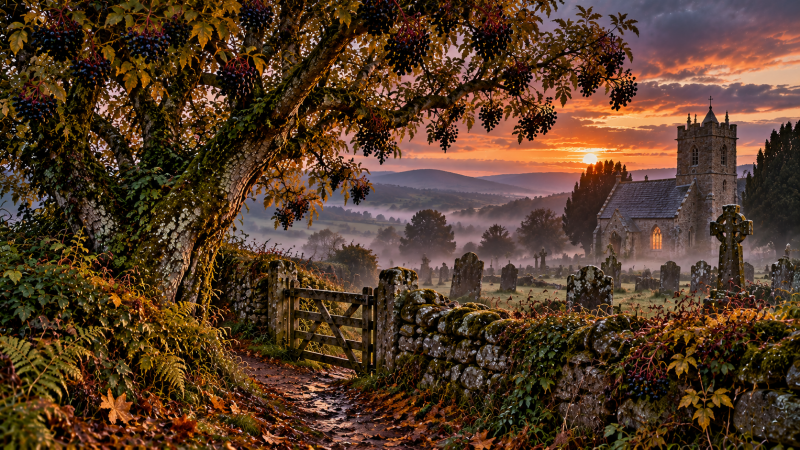
Across Britain and Ireland, elder belonged to the familiar landscape of hedgerows, farmyards, cottage gardens and woodland edges. Its closeness to human settlement helped generate a remarkable collection of traditions surrounding protection, witchcraft, luck and the consequences of damaging the tree.
British folklore often presents elder as a tree that should be approached cautiously. Traditions warning against cutting or burning elder existed alongside beliefs that the tree could protect a household from harmful supernatural influences. In some places, an elder growing near the home was therefore allowed to remain even when other vegetation was cleared.
Irish folk tradition likewise preserved numerous beliefs concerning particular trees and the dangers of interfering with them. Elder appears within this wider landscape of plant lore, although it is important not to transfer every English, Scottish or Scandinavian elder tradition directly into an Irish setting.
This regional variation matters. Folklore was rarely a single system shared unchanged across Britain and Ireland. A belief recorded in one county might be unknown only a relatively short distance away, while apparently similar customs could acquire entirely different explanations.
Elder therefore provides an excellent example of how folklore really works: local traditions overlap, travel and change, eventually creating a much larger collection of stories around an otherwise familiar tree.
Elder Symbolism & Modern Paganism
In modern Paganism, witchcraft and Celtic-inspired spirituality, elder has become associated with protection, transformation, healing, death, renewal and respect for the spirit of the natural world.
Some of these associations have strong connections with older folklore. Traditional warnings against cutting elder, beliefs that the tree could protect homes from harmful influences, and its connection with witchcraft all provide genuine historical material upon which modern interpretations could develop.
Elder's natural growth also lends itself to symbolism of regeneration. The tree can recover vigorously after damage and produce fresh shoots, encouraging modern associations with renewal, resilience and the continuing cycle of life.
Contemporary practitioners may also incorporate elderflowers, berries or wood into seasonal and spiritual practices. These traditions belong to living modern spirituality and should not automatically be described as rituals inherited unchanged from ancient Celtic peoples.
The elder is particularly interesting because its symbolism remains contradictory. It can represent protection while simultaneously carrying warnings; healing while being associated with death; and everyday usefulness alongside supernatural danger. Rather than weakening its folklore, these contradictions are precisely what make the tree so distinctive.
What Does the Elder Tree Symbolise?
Elder has no single historical meaning, but surviving folklore repeatedly connects the tree with protection, witchcraft, caution, death and renewal.
In British folk tradition, elder could protect a household from harmful influences while also being regarded as dangerous to cut or burn carelessly. European traditions added stories of spirits inhabiting or guarding the tree, including the Scandinavian Elder Mother.
Its flowers and berries also made elder a valuable household plant, connecting it with food, traditional remedies and the seasonal cycle. Its ability to regenerate after damage later provided a natural symbol of resilience and renewal.
Modern Pagan traditions have developed these older themes further, often associating elder with transformation, healing, ancestors and spiritual protection.
It is therefore more accurate to think of elder symbolism as something that accumulated through centuries of local tradition rather than as one fixed ancient “Celtic meaning”.
Explore Related Folklore
Elder's unusual combination of protection, witchcraft, spirits and warnings about disturbing the tree connects it with a much wider world of British and Irish folk belief. Explore the traditions surrounding magical practices, supernatural beings and other trees whose folklore developed over centuries.
Shape-Shifting, Magic & Ancient Beliefs — explore witchcraft, transformation, protective traditions and supernatural belief.
Fairies, Spirits & the Fae — discover traditions surrounding supernatural beings and the wild places associated with them.
The Hawthorn in British & Irish Folklore — another tree surrounded by warnings about cutting or disturbing it, making this an especially useful connection.
Sources & Further Reading
Dúchas — National Folklore Collection of Ireland
A major searchable collection of Irish folklore, including traditional beliefs concerning trees, plants, supernatural protection and rural customs.
Dúchas — National Folklore Collection
Tobar an Dualchais / Kist o Riches
A large archive of Scottish oral tradition and folklore, useful for exploring regional beliefs surrounding plants, witchcraft and traditional rural life.
Woodland Trust — Elder
Background on elder (Sambucus nigra), including identification, ecology, traditional uses and folklore.
Royal Botanic Gardens, Kew — Sambucus nigra
Botanical reference material for the European elder.