Sacred Waters, Wells & Rivers
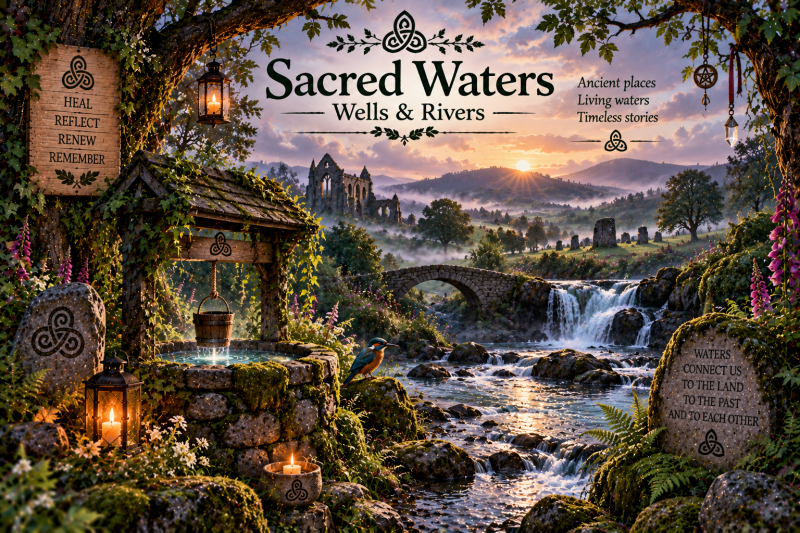
Where Water Meets the Otherworld
Across Britain and Ireland, water has long carried meanings that reach far beyond the practical need for drinking, farming or travel. Springs emerge mysteriously from the earth, rivers carve paths through ancient landscapes, and deep lakes conceal worlds that cannot be seen from the shore. It is little wonder that such places became surrounded by stories of healing, prophecy, supernatural beings and entrances to somewhere beyond the ordinary world.
For communities living close to the land, water could give life and take it away. A spring might continue flowing through drought, a river could provide food and fertile ground, while floods, storms and deep pools could be unpredictable and dangerous. These qualities helped make water a natural focus for stories, customs and beliefs that developed over many generations.
Some wells became destinations for pilgrimage and healing. Rivers were associated with goddesses, wisdom and boundaries, while lakes and coastal waters became home to strange horses, mysterious women and beings capable of moving between different worlds. Offerings were left beside springs and pools, ribbons were tied to nearby trees, and particular waters acquired reputations that could survive for centuries.
Christian traditions later became intertwined with many of these places, particularly through holy wells associated with saints. Yet beneath the changing names and customs, one idea appears again and again: water could mark a place where the familiar world touched something older, stranger and sacred.
Why Water Became Sacred
Water has qualities that naturally lend themselves to stories of mystery and transformation. It can disappear beneath the earth and emerge again as a spring, change from a quiet stream into a destructive flood, or reflect the sky so perfectly that the surface seems almost like an opening into another world. Before the workings of underground water systems were understood, a spring rising unexpectedly from the ground must have seemed particularly remarkable.
Water was also essential to survival. Settlements developed around reliable springs and rivers, crops depended upon rainfall, and animals gathered at familiar watering places. A source that continued to flow when others failed could become especially important to a community, and over generations practical importance could become entwined with stories of healing, protection or supernatural power.
Yet water was never entirely safe. Rivers could sweep travellers away, bogs could conceal dangerous ground, and apparently peaceful lakes contained depths that could not easily be explored. The same water that sustained a community could therefore inspire both reverence and fear — qualities that appear repeatedly in folklore.
This combination of life, danger and mystery helps explain why wells, rivers, lakes and springs became such powerful places in traditional belief. Water stood at the centre of everyday existence while remaining unpredictable and partly hidden, making it a natural boundary between what people understood and what they could only imagine.
Springs & Holy Wells
Across Britain and Ireland, thousands of springs and wells have acquired reputations as special places. Some became associated with healing, others with particular saints, while certain waters were traditionally visited at particular times of year. People travelled to them seeking cures, protection, good fortune or simply to take part in customs that generations before them had observed.
Many surviving holy wells are now connected with Christianity and bear the names of saints, but the history of individual sites can be complicated. It is tempting to assume that every Christian holy well must have replaced an earlier Pagan sacred place, yet the evidence does not always allow such a simple conclusion. What we can say is that reverence for particular springs and water sources became deeply embedded in the traditional landscapes of Britain and Ireland.
Visiting a well could involve much more than drinking its water. At some sites people followed particular routes around the well, recited prayers, washed an affected part of the body or left a small offering behind. Certain wells were visited on specific feast days or other traditional occasions, turning the landscape around the spring into a gathering place for the wider community.
These customs transformed an ordinary water source into something far more meaningful. The spring became a place where landscape, belief and human hope met, and this may help explain why so many holy wells continued to attract visitors even as the beliefs surrounding them changed.
Healing Waters & Pilgrimage
Among the most persistent traditions surrounding sacred water is the belief that particular springs and wells possessed healing qualities. People might travel considerable distances to visit a well associated with a specific illness, washing in the water, drinking from it or carrying some home. The reputation of a healing spring could spread far beyond the community in which it was located.
In Ireland, visits to holy wells became part of local pilgrimage traditions, often involving a prescribed series of prayers or movements known as making the “rounds.” Visitors might walk around the well or nearby features in a particular direction, stopping at certain points to pray. Such customs varied considerably from one place to another, reminding us that there was never a single universal ritual followed at every sacred well.
Similar beliefs survived in parts of Britain, where particular springs became associated with ailments ranging from eye problems to skin complaints. Whether the water itself contained minerals thought to be beneficial or its reputation rested entirely upon tradition, generations of visitors could reinforce the belief that a particular place possessed unusual powers.
For the people who made these journeys, however, the importance of the well was not necessarily something that could be separated neatly into medicine, religion and folklore. The journey, the landscape, the water and the act of seeking help all formed part of the experience. Healing began with the belief that this particular place mattered.
Coins, Pins and Offerings
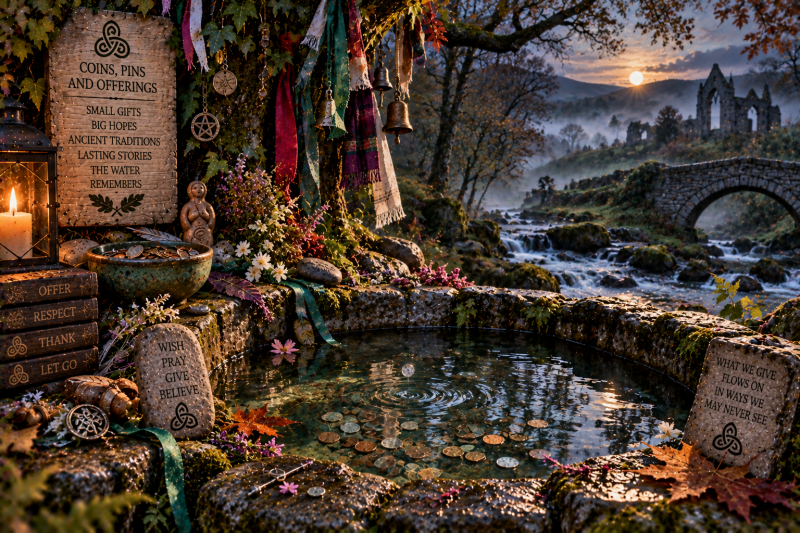
Water has attracted offerings for a very long time. Archaeologists have recovered weapons, jewellery, coins and other objects from rivers, lakes, bogs and springs across Britain and Ireland, although the reasons individual objects entered the water are not always possible to determine. Some deposits appear deliberate and may have had ritual significance, while others could have been lost, discarded or placed there for reasons that have not survived in the historical record.
Later folklore provides clearer examples of people deliberately leaving small objects at particular wells and springs. Coins, pins and other personal items could be deposited while making a wish, seeking healing or observing a local custom. At some wells the offering formed part of a much wider tradition involving prayers, particular movements around the site or visits on certain days of the year.
The familiar modern practice of throwing a coin into water and making a wish may feel connected to these much older customs, but we should be cautious about describing it as an unchanged survival from ancient times. Traditions evolve, disappear and reappear in different forms. What remains striking is the recurring human impulse to leave something behind when asking something of a special place.
An offering also changes the relationship between visitor and landscape. Rather than simply taking water or requesting help, the visitor gives something in return. Whether the object was valuable, symbolic or extremely small, the act expressed an idea found repeatedly in folklore: when approaching a place believed to possess power, you did not always arrive empty-handed.
Wishing Wells — Asking Something of the Water
The idea of throwing a coin into a well and making a wish is so familiar today that it can seem like little more than a playful custom. Yet it reflects a much older and broader idea: that particular waters were places where a person might make a request, seek good fortune or hope for some change in their circumstances.
Not every wishing-well tradition has the same origin, and we should be cautious about tracing the modern custom directly back to a single ancient practice. Wells and springs accumulated different beliefs in different communities, and customs changed considerably over time. What survived was the simple but powerful idea that an unusual or special source of water might somehow receive a person's hopes.
The coin itself also gives the act a small sense of exchange. Something is placed into the water before the wish is made, echoing the wider tradition of leaving offerings at wells, springs and other watery places. Over generations, religious meanings, local folklore and simple superstition could overlap until the original reason for the custom was no longer remembered.
Even now, people who would never describe themselves as superstitious will sometimes pause beside a wishing well, throw in a coin and silently ask for something they desire. The old belief may have faded, but the instinct to whisper a hope into the water has proved remarkably difficult to lose.
Rag Trees and Clootie Wells
One of the most visually distinctive customs associated with sacred wells is the practice of leaving pieces of cloth on nearby trees. These places are often known as clootie wells, from a Scots word for a piece of cloth or rag. Visitors traditionally dipped a strip of fabric into the water and attached it to a branch, often while seeking healing for themselves or another person.
In some traditions, the cloth represented the illness or problem being left behind. As the natural fabric gradually weathered and decayed, the ailment was believed to weaken with it. This helps explain why removing a rag from such a place could be regarded as deeply inappropriate: the object was no longer simply a scrap of material but part of the person's appeal for healing.
Clootie-well traditions are particularly associated with Scotland, although customs involving cloth, ribbons and other objects attached to trees can also be found elsewhere. Over time, however, modern visitors have sometimes replaced biodegradable pieces of natural fabric with synthetic ribbons, plastic objects and other materials that do not decay. What begins as an attempt to participate in an old custom can therefore unintentionally damage the very landscape that gives the tradition its meaning.
For anyone visiting such a place today, respecting the site is more important than recreating a ritual for the sake of it. Existing offerings can be observed without disturbing them, while the well, trees and surrounding land should be left unharmed. A tradition rooted in reverence for a place should never become the reason that place is damaged.
Water Spirits and Supernatural Horses
Not every story associated with Britain's and Ireland's waters concerned healing or sacred places. Rivers, lochs and lonely pools could also be home to dangerous supernatural beings. Scottish kelpies and each-uisge, the Welsh ceffyl dŵr and other mysterious water horses were said to emerge from these landscapes, sometimes appearing as beautiful horses or even taking human form.
Explore Kelpies & Water Horses in British & Irish Folklore →
Wells and Ancient Trees
Sacred wells and ancient trees often appear together in the landscapes of British and Irish folklore. A spring might rise beneath the roots of an old tree, while hawthorn, ash and other species could become closely associated with the customs surrounding a particular well. Over generations, the tree and the water could effectively become parts of the same sacred place.
There are practical reasons why the two are natural companions. Springs create damp ground where vegetation flourishes, while a large tree provides a visible landmark that can make a small or hidden water source easier to recognise. Yet folklore added another layer of meaning. Trees themselves could be associated with protection, healing or supernatural beings, making a spring beneath an ancient tree especially evocative.
At some wells, branches became places for attaching cloth, ribbons or other offerings, linking tree traditions with the customs of the water below. Elsewhere, local stories warned against damaging particular trees or disturbing the landscape surrounding a well. Such beliefs could turn an otherwise ordinary corner of the countryside into a place treated with unusual respect.
Together, the tree above and the water below create one of the most enduring images in sacred landscape folklore: roots reaching into the earth while a spring rises from beneath them. One reaches downward, the other flows outward, joining the hidden world beneath the ground with the landscape above.
Rivers — Roads Through the Landscape
Long before modern roads crossed Britain and Ireland, rivers helped shape the way people travelled, settled and understood the landscape. Communities grew beside them, fertile valleys followed their courses, and waterways provided routes through country that could otherwise be difficult to cross. A river was therefore much more than a source of water: it was part of the structure of everyday life.
Rivers also created natural boundaries. Crossing one could mean entering another territory, leaving familiar ground behind or passing through a place where journeys briefly became uncertain. Fords, bridges and riverbanks consequently appear again and again in traditional stories, sometimes as locations for encounters with supernatural beings or moments when an ordinary journey takes an unexpected turn.
The character of a river could change dramatically along its course. A quiet stream might become a deep pool, a waterfall or a dangerous stretch of fast-moving water, while floods could transform familiar countryside almost overnight. Such unpredictability made rivers both useful and formidable, capable of sustaining communities while reminding people that the landscape could never be entirely controlled.
In mythology and folklore, these qualities allowed rivers to become roads, boundaries and living presences within the landscape. Some even acquired stories explaining how they were created or linking them with supernatural figures. One of the most famous examples flows through Irish tradition: the River Boyne and the story of Boann.
In Irish and Welsh tradition, rivers are sometimes connected with powerful female figures whose stories become inseparable from the waters themselves. Rather than appearing simply as scenery, the river can possess an identity, a history and a name bound to myth. The flowing water becomes part of the story of the landscape.
Several important rivers preserve names associated with female figures from early tradition. In Ireland, the Boyne is connected with Boann, while the Shannon is associated with Sinann, both of whom appear in medieval Irish literature in stories explaining the origins of their rivers. These tales belong to a wider tradition of explaining prominent features of the landscape through encounters with supernatural knowledge, sacred places and powerful waters.
Such stories should not necessarily be read as straightforward evidence that every river was once worshipped as a goddess in exactly the way we might imagine today. Much of what survives was recorded centuries after Ireland's conversion to Christianity, and mythology, place-name tradition and later interpretation have become closely intertwined. Even so, the surviving stories reveal how strongly rivers could be personified and woven into the identity of a place.
A river therefore became more than water moving through the countryside. Its bends, springs and currents could belong to a story remembered alongside the landscape itself. Nowhere is this more beautifully illustrated than in the tradition of Boann, the Well of Segais and the creation of the River Boyne.
Boann and the River Boyne
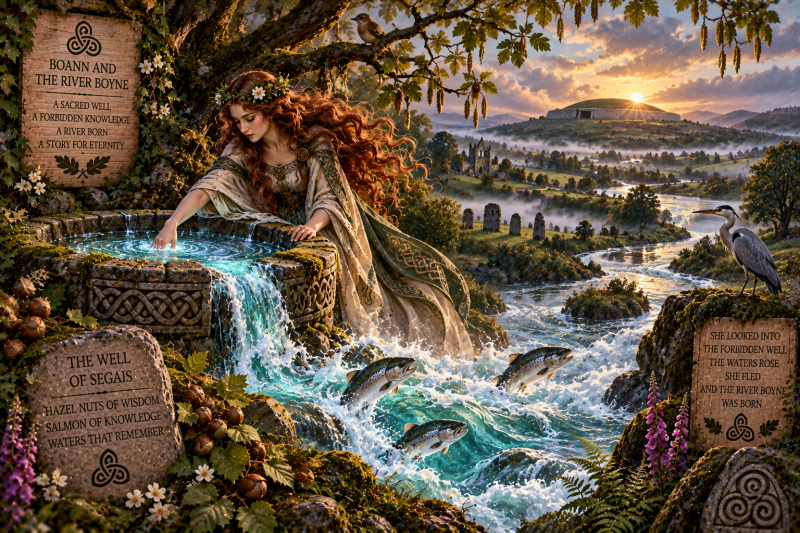
One of the best-known Irish stories connecting a river with a supernatural female figure concerns Boann and the River Boyne. The tale survives in medieval Irish literature, including traditions associated with Dindshenchas — writings concerned with the origins and meanings of places in the Irish landscape. In these accounts, the creation of the Boyne is connected with Boann's encounter with a mysterious well.
The well is often identified as the Well of Segais, a source associated with supernatural wisdom. Hazel trees were said to grow around it, their nuts falling into the water where they were eaten by salmon. The well therefore belonged to a powerful cluster of ideas found elsewhere in Irish tradition: sacred water, hazel trees, poetic knowledge and the Salmon of Wisdom.
Boann approaches the forbidden or dangerous well, and the waters rise against her. They burst from their source and pursue her across the landscape until they eventually reach the sea, creating the River Boyne along their course. Different surviving versions vary in their details, but the central image remains extraordinary: a hidden source of supernatural water breaking free and becoming one of Ireland's great rivers.
The story transforms geography into mythology. The Boyne is no longer simply a river flowing through the landscape; its course becomes the visible trace of an ancient story about knowledge, boundaries and waters that cannot easily be controlled. It also connects beautifully with other strands of Irish folklore, where wisdom is discovered beside water and the natural landscape preserves the memory of events from the mythological past.
The Well of Wisdom
The mysterious Well of Segais, sometimes described as a well of wisdom, is one of the most evocative places in Irish mythological tradition. It was said to be surrounded by hazel trees whose nuts contained extraordinary knowledge. When the nuts fell into the water, salmon ate them, linking the well with another enduring symbol of Irish tradition — the Salmon of Wisdom.
The connection between hazel, water and knowledge appears repeatedly in Irish literature. Wisdom was not imagined simply as something learned from books or teachers; it could exist within the natural world, hidden in a sacred source, contained within a hazelnut or acquired through an encounter with a salmon. The landscape itself could therefore become a source of knowledge available only to those able — or permitted — to reach it.
Yet the stories surrounding such knowledge also contain warnings. The Well of Segais was not an ordinary spring from which anyone could simply drink. In the traditions surrounding Boann, approaching its power has dramatic consequences, reminding us that supernatural knowledge could be dangerous as well as desirable.
This makes the well a powerful example of the way water functions in Irish mythology. Beneath an apparently simple spring lies the possibility of wisdom, transformation and danger, while the water flowing from it ultimately becomes part of the landscape itself. The sacred source is both a place of knowledge and a boundary that should not be crossed lightly.
Lakes and the Hidden World
Lakes occupy a particularly mysterious place in the folklore of Britain and Ireland. Unlike rivers, which visibly travel across the landscape, the depths of a lake remain hidden beneath an apparently still surface. Mountains, clouds and trees may be reflected perfectly in the water while an unseen world lies below, making lakes natural settings for stories of submerged kingdoms, supernatural beings and entrances to places beyond ordinary human experience.
In Irish and Welsh tradition, bodies of water sometimes mark boundaries between the human world and supernatural realms. Strange figures may emerge from lakes, enchanted places may lie beyond or beneath them, and a journey towards the water can become the beginning of an encounter with something otherworldly. These stories do not all belong to a single belief system, but they share the powerful idea that the surface of the water conceals more than it reveals.
British tradition contains similar imagery. Perhaps the most famous example appears in Arthurian legend, where the mysterious Lady of the Lake is associated with the giving and receiving of Excalibur. Elsewhere, lonely pools and lakes became connected with spirits, dangerous creatures and local legends that warned people to treat deep or unfamiliar waters with respect.
A lake therefore creates an almost perfect folkloric boundary. A person can stand at its edge and see the landscape reflected back at them, yet remain unable to see clearly into the depths below. In stories where water separates the ordinary world from the supernatural one, the lake becomes not merely a place in the landscape, but a threshold into the unknown.
Offerings Beneath the Water
Rivers, lakes, springs and bogs across Britain and Ireland have produced remarkable archaeological discoveries. Weapons, tools, jewellery, metalwork and other valuable objects have been recovered from watery places, sometimes in circumstances suggesting that they were deliberately deposited rather than simply lost. Some objects were placed beyond easy recovery, raising the possibility that entering the water was precisely the point.
Among the most striking examples are weapons and finely made metal objects dating from the Bronze and Iron Ages. Rivers such as the Thames have yielded swords, spearheads and other artefacts, while lakes, bogs and wetlands elsewhere have preserved objects for centuries beneath mud and water. Archaeologists must interpret such finds carefully: an object discovered in a river is not automatically a religious offering, and the intentions of the people who placed it there cannot always be recovered.
Nevertheless, repeated deposits at particular watery locations suggest that some rivers, lakes and wetlands held significance beyond their everyday practical use. Giving up a valuable object by placing it permanently beneath the water may have formed part of ritual activity, commemoration or beliefs that are now difficult to reconstruct. The water itself may have mattered because it represented a boundary, a powerful natural place or a means of removing an object permanently from the human world.
These discoveries give the folklore of sacred water an intriguing archaeological counterpart. They do not prove that later legends and customs are direct survivals of prehistoric beliefs, but they show that people have treated watery places as suitable locations for meaningful deposits for thousands of years. Beneath apparently quiet rivers and lakes, traces of those choices can still survive.
Bog Bodies and Sacred Wetlands
Bogs and wetlands occupy an unusual position in the landscapes of Britain and Ireland. Neither completely solid ground nor open water, they form environments where the familiar boundaries between land and water become uncertain. Their waterlogged, oxygen-poor conditions can also preserve organic material for extraordinary lengths of time, sometimes leaving traces of people who lived more than two thousand years ago.
Among the most remarkable discoveries are bog bodies — human remains naturally preserved within peat. Famous Irish examples include Old Croghan Man and Clonycavan Man, both dating from the Iron Age. The circumstances surrounding some bog bodies suggest violent deaths, and archaeologists have explored the possibility that certain individuals were deliberately placed in wetlands as part of ritual or ceremonial activity.
Interpretation requires caution, however. Bog bodies come from different periods and circumstances, and there is no single explanation for why people ended up in these landscapes. Murder, punishment, accident, burial and ritual deposition have all been considered in different cases. Archaeological evidence can reveal injuries, diet, clothing and even aspects of a person's final hours, but it cannot always tell us what the people responsible believed.
What these discoveries do show is that wetlands could become places where human lives, valuable objects and unusual acts intersected. Combined with the weapons, jewellery and other artefacts recovered from watery environments, bog bodies add another mysterious layer to our understanding of ancient landscapes. The bog was not simply empty ground between settlements; sometimes it was a place where something important was deliberately left behind.
Fords — Crossing the Water
Before bridges became common, a ford could be one of the most important points in a landscape. Roads and tracks naturally converged upon places where a river was shallow enough to cross, bringing travellers, livestock, traders and sometimes armies to the same narrow stretch of water. Controlling a ford could therefore mean controlling movement through the surrounding countryside.
In folklore and early literature, however, crossing water can carry meanings beyond the practical journey from one bank to another. A ford lies between two pieces of dry land, creating a temporary passage through a river that would otherwise form a barrier. This made it a natural setting for meetings, challenges and moments when a traveller passed from familiar territory into somewhere less certain.
Irish heroic literature makes particularly memorable use of fords. In the Táin Bó Cúailnge, the hero Cú Chulainn fights a succession of opponents at river crossings, most famously his tragic combat with his foster-brother Ferdiad. Here the ford becomes more than scenery: it is the place where a boundary must be defended and where crossing carries consequences.
Fords therefore occupy a fascinating position between geography and story. They were practical gateways through the landscape, but they could also become places of danger, encounter and transition. To cross the water was to leave one bank behind before reaching the safety of the other.
Bridges and Folklore
A bridge solves one of the oldest problems created by a river: how to reach the opposite bank without entering the water. Yet in folklore, bridges often retain something of the uncertainty once associated with the crossing itself. Suspended between two banks and carrying travellers above moving water, they are natural settings for stories about dangerous encounters, supernatural beings and journeys from one place to another.
Across Britain and Ireland, old bridges have accumulated local legends of ghosts, strange animals, fairies and other mysterious figures. Some stories warn of creatures waiting beneath or beside a bridge, while others describe apparitions encountered by travellers crossing after dark. The details vary enormously from place to place, but the setting remains remarkably effective: a lonely bridge creates a narrow passage where turning back may feel just as unsettling as continuing forward.
Bridges also feature in wider European folklore, where tales sometimes explain their construction through bargains with supernatural beings or the Devil. Stories of so-called Devil's Bridges frequently grew around structures whose position, age or engineering appeared remarkable to later generations. Such legends should not be treated as evidence about how the bridges were actually built, but they reveal how unusual structures could inspire supernatural explanations.
Like the ford before it, the bridge is therefore more than a practical crossing place. It joins two sides of a landscape while remaining suspended above the boundary between them. In folklore, the safest way across the water could still become a place where the ordinary journey met something strange.
Waterfalls — The Voice of the River
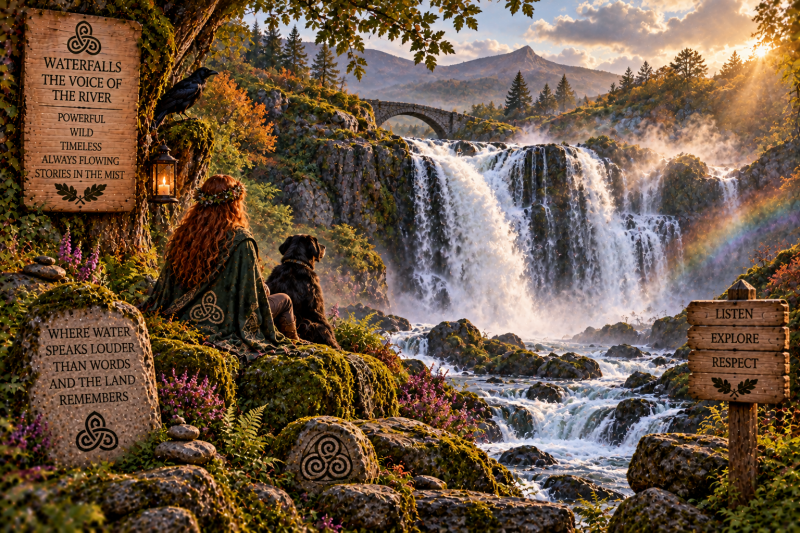
A waterfall transforms the character of a river. Water that may have travelled quietly through the landscape suddenly becomes loud, powerful and unpredictable, filling the surrounding air with spray and making conversation difficult above the roar. Before a waterfall can even be seen, it can often be heard through woodland or across a valley, giving it a presence quite unlike an ordinary stretch of river.
It is easy to understand why dramatic waterfalls and deep pools became places around which stories gathered. Mist hangs above the water, rock faces create hidden spaces, and the constant movement of the falls can make the landscape appear almost alive. Local traditions sometimes associated such places with spirits, fairies or other supernatural beings, while dangerous pools beneath waterfalls naturally acquired warnings of their own.
Waterfalls also demonstrate something central to the folklore of water: its ability to change character without ever ceasing to be the same element. A peaceful stream can become a torrent, disappear into spray and continue again below as a river. That combination of transformation and power made waterfalls natural places for people to experience both the beauty and danger of the landscape.
Standing beside a great waterfall, it is difficult to regard water as something passive. It shakes the ground, fills the air and reshapes the rock beneath it. If rivers were imagined as living presences within the landscape, the waterfall was where their voice became impossible to ignore.
The Lady of the Lake
Few figures demonstrate the mysterious role of water in British legend more clearly than the Lady of the Lake. Best known from the traditions surrounding King Arthur, she is associated with an enchanted realm connected with water and, most famously, with the sword Excalibur. Yet the Arthurian stories developed over many centuries, and different medieval writers gave the mysterious women associated with lakes different names, roles and histories.
In one of the most enduring episodes, Arthur receives Excalibur through a supernatural encounter connected with a lake. At the end of his reign, the sword is returned to the water, where a mysterious hand rises from beneath the surface to receive it. The image is striking: an extraordinary object enters the human world from a watery supernatural realm and ultimately returns to the place from which it came.
Later Arthurian tradition increasingly developed the identity of the Lady of the Lake, sometimes naming her Nimue, Ninianne, Viviane or variations of those names. Depending upon the version, she may appear as Arthur's ally, the guardian or foster-mother of Lancelot, or a powerful enchantress connected with Merlin. There is therefore no single definitive Lady of the Lake story; she is the product of a long and changing literary tradition.
For this page, however, her importance lies in the landscape surrounding her. Once again, water marks the boundary between the ordinary human world and a mysterious realm from which supernatural figures and magical objects can emerge. The lake hides its secrets beneath the surface, revealing them only when the story allows the two worlds to meet.
Water Spirits
The waters of Britain and Ireland are inhabited by a remarkable variety of supernatural beings in folklore. Rivers, lakes, pools and coastal waters became the homes of creatures that might help, deceive or endanger anyone who encountered them. Their stories vary enormously between regions, reflecting the landscapes and communities in which they were told rather than a single shared system of belief.
Some of the most dramatic are the [kelpies and water horses] associated particularly with Scottish tradition. These supernatural creatures could appear beside rivers and lochs, sometimes taking the form of an attractive horse before carrying an unfortunate rider towards the water. Related traditions appear elsewhere, although names, appearances and behaviour change from one region to another.
Around the northern coasts of Scotland, particularly Orkney and Shetland, the sea became home to the [selkies]. These mysterious seal-people could shed their skins and take human form on land. Unlike the threatening water horse, selkie stories are often filled with longing and separation, especially when a selkie's skin is hidden and the creature is prevented from returning to the sea.
Other traditions tell of mermaids, lake-dwellers and local spirits whose stories may belong to a particular river, pool or stretch of coastline. Together they reveal how easily unfamiliar or dangerous waters could become inhabited in the imagination. Where the water became deep enough to hide what lay beneath its surface, folklore was ready to populate the unseen world below.
Around the northern coasts of Scotland, the sea is also home to the [selkies], mysterious seal-people capable of shedding their skins and taking human form. Their stories explore a very different relationship with water — one shaped by transformation, freedom and the longing to return to the sea.
Selkies in Scottish & Northern Isles Folklore
The Sacred Spring and Christianity
As Christianity became established across Britain and Ireland, springs and wells continued to occupy an important place in local communities. Many became associated with saints, churches and pilgrimage traditions, acquiring stories of miraculous healing or events connected with holy figures. Some remain known by the names of saints today, preserving a relationship between Christianity, water and landscape that has lasted for centuries.
It is often suggested that Christian missionaries simply took over existing Pagan sacred wells and replaced older deities with saints. In some places earlier significance is certainly possible, and archaeological or historical evidence may point towards long use of a particular landscape. Yet it is difficult to demonstrate this history for every holy well, and the origins of individual sites should be considered separately rather than assuming that they all followed the same path.
What is clearer is that older customs and Christian practices could become closely intertwined. Visiting a well for healing might involve Christian prayers and the invocation of a saint while also including local traditions surrounding particular days, routes, trees or offerings. To the people participating in them, these customs did not necessarily belong to neatly separated categories of religion and folklore.
The survival of sacred wells therefore tells us something fascinating about the adaptability of traditional places. Beliefs changed, saints acquired new associations and rituals evolved, yet people continued returning to particular sources of water generation after generation. The meaning of the spring could change while the spring itself remained sacred.
Water and Divination
Water has also been associated with attempts to glimpse what is hidden or yet to come. A still pool creates a natural reflective surface, and wells, springs and other bodies of water became connected in various traditions with omens, prophecy and divination. The mysterious depths beneath the reflection made water an especially powerful setting for imagining that knowledge might be revealed from somewhere beyond ordinary sight.
Practices involving reflective surfaces are sometimes described as scrying, in which a person gazes into water, glass, crystal or another surface in the hope of perceiving images or signs. Folklore also contains simpler customs in which the behaviour of water, objects placed upon it or events occurring at a particular well were interpreted as indications of luck, relationships, health or future events. Such traditions varied considerably by place and period.
Water and prophecy also meet within mythology. Sacred wells may contain hidden knowledge, while supernatural figures associated with rivers or other watery places sometimes possess wisdom unavailable to ordinary people. The Well of Segais and its connection with poetic knowledge provides a particularly striking Irish example, linking water once again with the idea that wisdom can exist within the landscape itself.
Whether practised seriously, preserved as a seasonal custom or remembered only in folklore, these traditions share the same compelling image: a person looking into water and hoping to see more than their own reflection. The surface becomes a boundary between what is known and what might still be revealed.
Selkies — Between Land and Sea
Around the northern coasts of Scotland, particularly in Orkney and Shetland, folklore tells of seals capable of shedding their skins and taking human form. Known as selkies, these mysterious beings belong to both sea and shore, crossing between the two whenever they leave the water and remove the sealskin that allows them to return.
Their stories make the shoreline itself a boundary. The selkie can enter the human world, form relationships and even live for years on land, but the sea remains home. In the best-known tales, a human hides a selkie woman's sealskin and prevents her from returning to the water. When she eventually discovers it, she leaves the human world behind and returns to the sea.
This makes selkie folklore particularly relevant to the wider traditions surrounding sacred and supernatural waters. Unlike the dangerous kelpie lurking beside a river or loch, the selkie crosses willingly between water and land until that freedom is taken away. The sea becomes more than the creature's habitat; it represents identity, belonging and the ability to move between worlds.
Water and the Moon
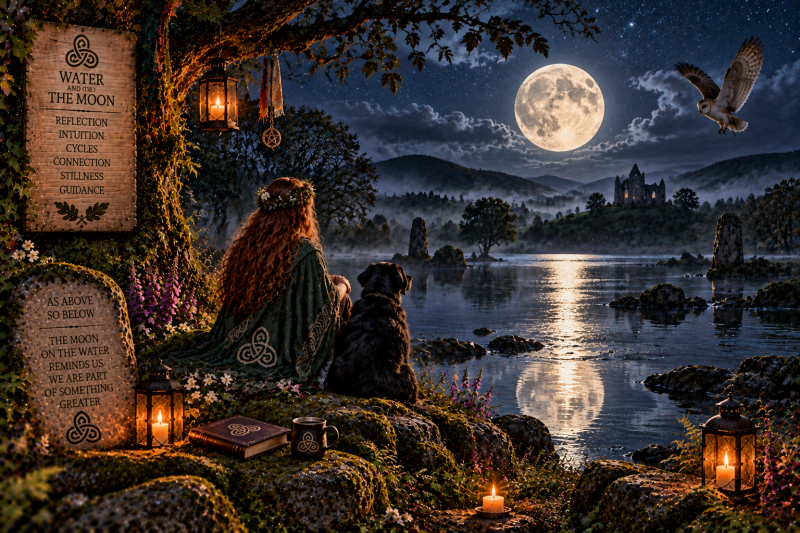
Few natural sights are as evocative as moonlight reflected across water. On a clear night, a river, lake or quiet stretch of sea can appear transformed, its surface catching the light while everything beyond it disappears into darkness. It is easy to understand why the Moon and water became such powerful companions in folklore, poetry and traditional imagination.
There is also a very real connection between them. The gravitational pull of the Moon is one of the principal forces driving the Earth's tides, causing coastlines to change continually as the sea advances and retreats. For communities whose lives depended upon fishing, boats and coastal travel, observing the relationship between the Moon and the changing sea was practical knowledge as well as something capable of inspiring stories.
Folklore has added many other meanings to moonlit water. Reflections, changing tides and the darkness beyond the shore provide natural settings for stories of supernatural encounters, while later magical and Pagan traditions have also associated particular lunar phases with ritual and symbolism. As with many traditional beliefs, these associations vary between periods and communities and should not be treated as one universal ancient system.
Yet the image itself remains powerful. A familiar stretch of water can look entirely different beneath a full moon, with the reflected light creating what seems almost like a pathway across its surface. Where folklore imagines water as a boundary between worlds, moonlight makes that boundary appear strangely possible to cross.
Rivers Remember
A river may appear timeless, but the landscape around it is filled with traces of the people who lived beside its banks. Settlements grew near reliable water, roads followed valleys, mills depended upon flowing rivers and bridges determined where generations of travellers crossed. Place names, ruins and archaeological discoveries can preserve fragments of these relationships long after the people themselves have disappeared.
Rivers can also conceal pieces of the past. Objects lost or deliberately deposited in the water may remain beneath mud and gravel for centuries, while changing channels and periods of drought can occasionally reveal things that had long been hidden. Archaeological finds recovered from rivers therefore provide glimpses of trade, warfare, travel, ritual and ordinary daily life across many different periods.
Folklore preserves another kind of memory. Stories become attached to particular bends, pools, bridges and crossing places, sometimes surviving long after their original meaning has become uncertain. A dangerous stretch of water may acquire a supernatural explanation, while an unusual rock, ruined bridge or deep pool can become the setting for a story repeated within the surrounding community.
In that sense, the idea that rivers remember is more than poetic language. Water continually moves onward, but the landscape through which it flows accumulates human stories. Archaeology preserves some of them beneath the surface, place names preserve others, and folklore carries still more from one generation to the next. The river changes constantly, while the stories along its banks can endure for centuries.
Sacred Water in Modern Paganism
Water continues to hold spiritual significance within many forms of modern Paganism. Practices vary enormously between individuals and traditions, but water may be used for cleansing, blessing, offerings, meditation or simply as a focus for connecting with the natural world. Springs, rivers, lakes and the sea can all become meaningful places, particularly when they form part of a landscape with which someone has developed a personal relationship.
Some modern Pagans visit holy wells and other traditional water sites, while others incorporate bowls of water, collected rainwater or water from a meaningful natural source into their practice. The changing seasons can also influence these traditions, with particular attention given to rainfall, flowing rivers, tides or the return of springs and streams after winter.
It is important, however, to distinguish modern spiritual practice from documented historical belief. Contemporary Paganism draws inspiration from many sources, including folklore, mythology, archaeology, reconstructed traditions and modern environmental spirituality. A ritual practised today should not automatically be described as something performed by the ancient Celts simply because it involves a sacred spring or river.
Perhaps the strongest connection between older traditions and modern practice is therefore not a particular ritual, but an attitude towards place. Water remains something people can approach with gratitude, curiosity and respect. The stories may be ancient and the practices may be modern, but the river, spring and sea continue to inspire a sense that the natural world deserves attention rather than simply use.
Protecting Sacred Waters
Many of the wells, springs, rivers and lakes surrounded by folklore are still real places that can be visited today. Some remain important pilgrimage sites, while others survive quietly beside footpaths, beneath old trees or within landscapes that have changed dramatically around them. Their continued survival depends not only upon preserving the stories attached to them, but also upon caring for the water and land themselves.
Unfortunately, attempts to participate in traditional customs can sometimes cause damage. Synthetic ribbons, plastic objects, candles, coins and other modern offerings may pollute water or harm nearby trees and wildlife. Even practices undertaken with respectful intentions can become destructive when hundreds of visitors repeat them over many years.
The simplest approach is often the most respectful: leave the place as you found it. Existing historic customs can be appreciated without adding objects to the landscape, and litter can be taken away rather than leaving something behind. Where a well or sacred site is actively managed, visitors should also follow the guidance of its custodians and local community.
Folklore teaches us that particular landscapes mattered deeply to the people who told stories about them. Protecting those places gives that idea a practical meaning today. If a spring, river or ancient well is worth calling sacred, it is also worth leaving clean, healthy and undamaged for whoever comes after us.
How to Experience Sacred Water
You do not need to perform a ritual or follow a particular spiritual tradition to understand why certain waters became important to earlier generations. Sometimes the best way to experience a sacred spring, old well or river is simply to spend time there. Listen to the water, notice the surrounding trees and rocks, and consider how the place might have appeared to people who visited it centuries before.
If the site has a known history, learning about it beforehand can completely change the experience. A small spring beside a footpath becomes more interesting when you know that generations once travelled there seeking healing, while an ordinary-looking river takes on another dimension when its name appears in mythology or local legend. Folklore can make familiar landscapes visible in a different way.
There is no need to leave coins, ribbons or other offerings behind. Taking photographs, sketching the landscape, recording the story in a notebook or simply remembering the visit allows you to connect with a place without altering it. At fragile sites, this is often far more respectful than attempting to recreate a custom whose original meaning may no longer be fully understood.
Perhaps that is the simplest way to approach sacred water today: arrive curious, learn the stories, spend time with the landscape and leave it as you found it. The spring does not need another ribbon and the river does not need another coin. Sometimes paying attention is offering enough.
The Water Beneath the Hill
A spring emerging from beneath a hillside can appear remarkably simple: clear water slipping between stones before becoming a stream and beginning its journey through the landscape. Yet for people who did not know the hidden routes water takes underground, such a place could easily inspire wonder. The water seemed to emerge directly from somewhere unseen beneath the earth.
Across Britain and Ireland, folklore repeatedly places mystery beneath familiar landscapes. Hills may conceal fairy dwellings or entrances to another world, while wells and springs provide openings through which hidden water reaches the surface. When these ideas meet, the spring becomes more than a geological feature. It can seem like a point of contact between the visible landscape and whatever might lie beyond it.
Science now allows us to understand much more about rainfall, aquifers and underground water systems, but that knowledge does not make a spring any less extraordinary. Water may have travelled through layers of rock for years before appearing suddenly at the surface, beginning a journey that eventually carries it into streams, rivers and the sea.
Perhaps this is why sacred-water traditions have endured for so long. Beneath the stories of goddesses, healing wells, selkies, hidden knowledge and supernatural creatures lies something entirely real: water emerges from places we cannot see, crosses the landscape and disappears towards places beyond our sight. Folklore simply asked what else might travel with it.
Sources & Further Reading
-
Dúchas — National Folklore Collection of Ireland: an excellent primary archive for traditional accounts of holy wells, healing, making the “rounds”, offerings and local water customs recorded from communities around Ireland. Dúchas
Explore Holy Well folklore at Dúchas -
Dúchas — St John's Well, Knockbarron: a particularly useful 1934 record describing rounds at a holy well, drinking and carrying away its water, and offerings including medals, pennies, ribbons and beads beside an ash tree. Dúchas
Read the St John's Well record -
University College Cork — Irish Sagas: academic material containing the medieval Dindshenchas tradition surrounding Boann, the Well of Segais and the origin and names of the River Boyne. iso.ucc.ie
Explore the Boann material at UCC -
National Museum of Ireland — Bog Bodies Research Project: research into Old Croghan Man and Clonycavan Man, the two Iron Age bog bodies discovered in 2003 and scientifically investigated by a multidisciplinary team. National Museum of Ireland
National Museum of Ireland — Bog Bodies Research Project -
National Museum of Ireland — Kingship and Sacrifice: explores the archaeological interpretation of Irish bog bodies alongside weapons, boundary markers and other deposits recovered from wetland contexts. Importantly, the museum presents ritual sacrifice as an archaeological theory, rather than treating it as unquestioned fact. National Museum of Ireland
National Museum of Ireland — Kingship and Sacrifice
Explore More Folklore
Sacred waters belong to a much wider landscape of British and Irish folklore. Follow the stories beyond the riverbank to discover supernatural water horses, seal-people who cross between sea and shore, hidden realms beyond the human world and animals associated with wisdom and ancient tradition.
[Kelpies & Water Horses in British & Irish Folklore →]
Discover the dangerous supernatural horses said to haunt lochs, rivers and lonely stretches of water.
[Selkies in Scottish & Northern Isles Folklore →]
Explore the haunting stories of seal-people who shed their skins to walk in human form along the shores of Orkney and Shetland.
[The Celtic Otherworld →]
Journey into traditions of mysterious realms existing beyond — and sometimes remarkably close to — the ordinary human world.
[The Salmon in Celtic & Irish Folklore →]
Discover the connection between salmon, sacred water, wisdom and some of the most enduring stories in Irish tradition.
[Sacred Trees & Ancient Landscapes →]
Explore the folklore surrounding ancient trees, sacred places and the natural landscapes in which many of these traditions developed.
[Explore Folklore of Britain & Ireland →]
Continue exploring legends, supernatural beings, ancient beliefs and traditional stories from across Britain and Ireland.