Ancient Stories, Sacred Landscapes and the Magic of the Natural World

Long before our modern towns, roads and cities shaped the landscape, people lived much closer to the rhythms of the natural world. Forests provided shelter and fuel, rivers offered water and food, animals shared the surrounding countryside, and the changing seasons influenced almost every aspect of daily life.
It is hardly surprising that nature became deeply woven into mythology, folklore and traditional belief.
Across Ireland, Wales, Scotland, England and the wider Celtic world, generations of stories grew around wild animals, ancient trees, rivers, springs, mountains, caves and mysterious places in the landscape. Some survive in medieval literature, others were preserved through later folklore, while many changed as they were passed from one generation to another.
Together they reveal a world in which the landscape was far more than simply a backdrop to human life.
A Landscape Filled with Stories
Walk through an old landscape and it is easy to understand how stories could grow around it.
A lonely hill rising through the mist, an ancient tree standing by itself in a field, a dark pool hidden beneath woodland or the remains of an ancient burial mound can all seem mysterious even today.
For earlier communities, such places could accumulate stories over generations.
Certain hills became associated with legendary figures. Ancient monuments attracted tales of fairies, giants or supernatural events. Springs and wells became places of healing and pilgrimage. Caves, lakes and islands could represent journeys into strange and unfamiliar worlds.
The landscape became a kind of living map of stories.
Sacred Places

Some locations acquired particular spiritual or cultural importance.
Water is a striking example. Springs, wells, rivers and lakes appear repeatedly in the mythology and folklore of Britain and Ireland. Archaeological discoveries also show that people sometimes deliberately placed valuable or meaningful objects into watery locations.
Later traditions developed around holy wells, where visitors might seek healing, leave offerings or follow particular customs.
Trees could also become important landmarks. Individual trees might be associated with local stories, meetings, boundaries or sacred places, while woodland itself provided an ideal setting for tales of supernatural encounters.
These traditions did not remain unchanged. Older customs could disappear, survive in altered forms or become intertwined with Christianity and later folklore.
Animals Between the Wild and Human Worlds

Wild animals occupy a particularly fascinating place in Celtic mythology and folklore.
The raven, hare, stag, boar, horse, salmon, swan and other creatures appear in stories in which the boundary between human beings, animals and the supernatural can become surprisingly uncertain.
Transformation is a recurring theme.
Characters may take animal form, supernatural beings may appear as animals, and encounters with unusual creatures can signal that something extraordinary is about to happen.
Later folklore added further layers.
Hares became connected with stories of witchcraft and transformation. Ravens carried associations with battle, death and prophecy. Foxes gained reputations for cunning and intelligence, while owls became creatures of darkness, silence and mystery.
Not every association commonly described today can be traced directly to ancient Celtic religion. Many developed much later.
That distinction is part of what makes the folklore so interesting.
The Otherworld
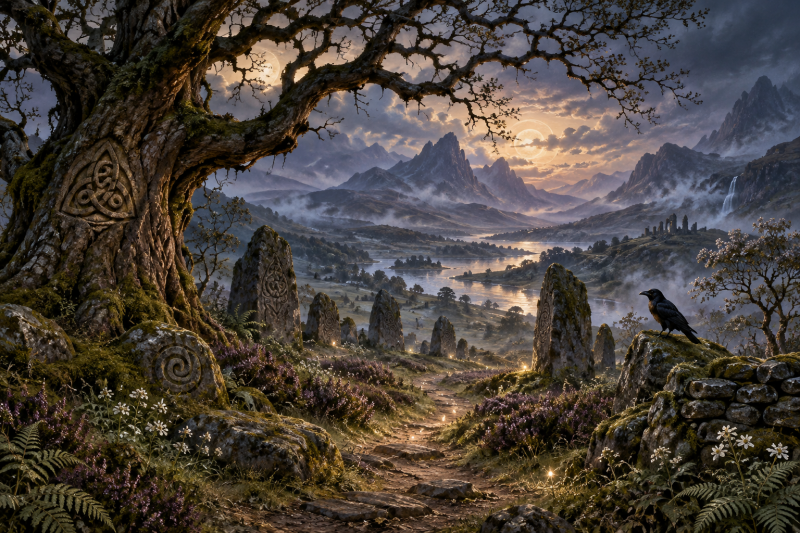
Some of the most extraordinary stories preserved from the Celtic world describe places beyond ordinary human experience.
Irish tradition contains numerous tales involving supernatural realms inhabited by remarkable beings. Heroes might reach them by travelling across the sea, entering an ancient mound or following a mysterious stranger.
Welsh medieval literature contains its own encounters with strange realms, supernatural figures and landscapes where the normal rules of everyday life no longer seem to apply.
Time itself may behave differently.
A visitor can experience what seems like a short period away, only to discover that much longer has passed in the human world.
These stories helped create the enduring image of an Otherworld existing tantalisingly close to our own.
Fairies, Spirits and Mysterious Beings
The fairies of traditional folklore were often very different from the tiny winged figures familiar from modern children's books.
Across Britain and Ireland, traditions developed around mysterious beings associated with hills, ancient mounds, wild places and particular features of the landscape.
Some could reward kindness.
Others might punish disrespect.
People were sometimes warned against disturbing particular places, travelling certain routes at particular times or interfering with locations traditionally associated with supernatural beings.
Whether such stories were believed literally, treated cautiously or simply enjoyed as tales varied enormously between communities and periods.
But their survival demonstrates just how deeply folklore could become attached to a landscape.
Living by the Seasons
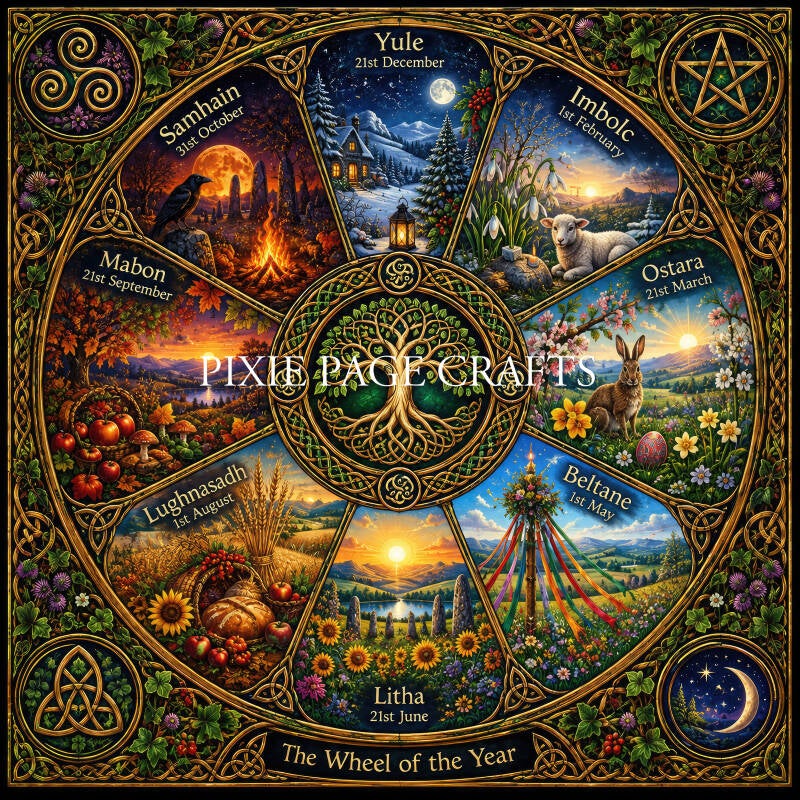
The changing year was impossible for earlier rural communities to ignore.
Spring brought new growth and livestock. Summer offered long days and growing crops. Autumn meant harvest and preparation, while winter brought darkness, cold and uncertainty.
Seasonal customs naturally developed around these turning points.
Several important festivals recorded in medieval Irish tradition — particularly Samhain, Imbolc, Beltane and Lughnasadh — later became especially influential in discussions of Celtic seasonal traditions.
Modern Pagan practice has expanded these ideas into the Wheel of the Year, an eight-festival cycle celebrating seasonal change.
Ancient evidence and modern Pagan practice are not always the same thing, but both demonstrate the enduring human desire to recognise our place within the changing natural world.
Where History and Folklore Meet
One of the challenges — and pleasures — of exploring Celtic and Pagan folklore is separating different layers of tradition.
The ancient Celtic-speaking peoples did not leave behind a single book explaining their religion and beliefs.
What survives comes from a mixture of archaeology, classical accounts, medieval literature, place names, later folklore and traditional customs.
These sources were created at different times and for different reasons.
Modern Pagan traditions have added another fascinating chapter to that story, sometimes reviving older customs and sometimes creating new practices inspired by the past.
For that reason, it is useful to distinguish between what we know from historical evidence, what survives as later folklore and what belongs primarily to modern spiritual interpretation.
Doing so doesn't make the stories less magical.
It makes their journeys through history even more interesting.
The Magic of the Natural World
Perhaps the strongest thread connecting all these traditions is the landscape itself.
The animals have changed little.
Ravens still call from the treetops. Hares still race across open fields. Owls still hunt silently after darkness falls. Rivers continue their journeys through valleys, ancient trees survive beside roads and villages, and the moon still rises over landscapes where people have lived for thousands of years.
Our explanations for the world may have changed enormously, but our fascination with it has not.
That is what makes these old stories so compelling.
They allow us to look at familiar animals and landscapes through the eyes of generations who came before us — people who wondered about the same darkness, watched the same seasons change and told stories about the mysteries they encountered.
Throughout Pixie Page Crafts, we'll explore those stories individually: the animals, the Otherworld, sacred trees and waters, fairies and spirits, seasonal traditions and the remarkable folklore of Britain and Ireland.
Because sometimes an old woodland is more than a collection of trees, a raven is more than a black bird in the sky, and an ancient path feels as though it might have one more story left to tell.
There is always another tale hiding in the landscape. 🌿