The Celtic Otherworld
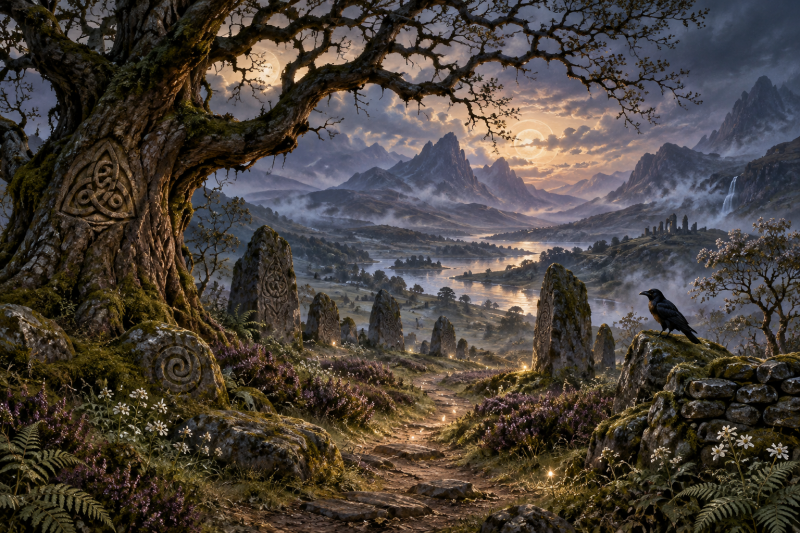
Beyond the Veil of the Human World
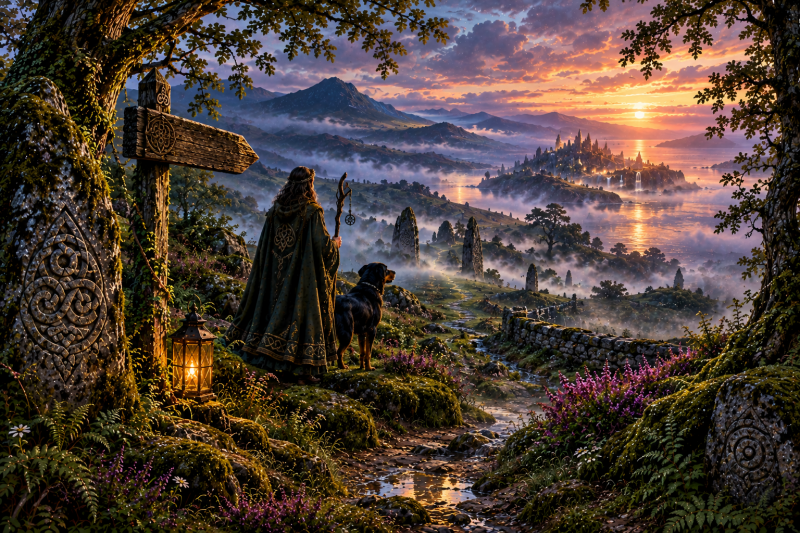
Imagine walking through a mist-covered valley as evening begins to fall. An ancient burial mound rises beside the path, a river disappears between dark trees and distant hills fade into the twilight.
To us, these are simply features of the landscape.
But within the mythology and folklore of the Celtic-speaking world, familiar landscapes could sometimes lead somewhere extraordinary.
Stories preserved in Ireland and Wales describe mysterious realms inhabited by supernatural beings, powerful figures and strange creatures. These places might lie beneath ancient mounds, beyond the sea or somewhere just beyond the boundaries of the ordinary human world.
Today we often refer to these mysterious realms collectively as the Celtic Otherworld.
It was not necessarily imagined as a distant heaven or an underworld of the dead. Instead, the Otherworld could exist remarkably close to our own — separated perhaps by little more than water, mist, a hillside or an unseen boundary.
What Was the Celtic Otherworld?
There was never one single Celtic religion or one universally agreed description of an Otherworld.
The cultures of ancient Ireland, Britain and continental Europe varied enormously, and much of what survives about mythology in Ireland and Wales was written down centuries after the arrival of Christianity.
Nevertheless, medieval Irish and Welsh literature preserves numerous stories involving supernatural realms existing beyond ordinary human experience.
These worlds are often places of beauty, abundance, youth, feasting and extraordinary beings.
But they could also be unpredictable.
A human entering such a realm might discover that the normal rules governing distance, time and even mortality no longer applied.
The Otherworld was somewhere wonderful — but it was not necessarily somewhere a human belonged.
The Otherworld of Irish Tradition
Some of the richest surviving Otherworld traditions come from medieval Irish literature.
Different stories use different names and descriptions rather than presenting one single supernatural kingdom.
One famous name is Tír na nÓg, usually translated as the Land of Youth.
It is particularly associated with the later story of Oisín, the legendary warrior and poet who travels with the beautiful Otherworld woman Niamh to a land where youth and happiness appear to endure.
Other Irish texts describe extraordinary islands across the western sea.
There is also Mag Mell, the Plain of Delight, portrayed in medieval literature as a beautiful supernatural realm free from many of the hardships of ordinary human existence.
Another important concept is the síd, referring to ancient mounds and the supernatural beings associated with them.
Over time, the Aos Sí became deeply embedded in Irish folklore as mysterious beings associated with ancient places and the landscape.
Ancient Mounds and Hidden Entrances
Across Ireland stand thousands of prehistoric monuments that were already unimaginably ancient when many medieval stories were first written down.
Passage tombs and burial mounds such as Newgrange had been constructed thousands of years earlier.
Later generations naturally wondered about these mysterious structures.
Folklore and mythology gradually connected ancient mounds with supernatural inhabitants.
In stories, a mound might conceal an entrance to another realm. What appeared from the outside to be an ordinary grassy hill could contain magnificent halls and supernatural beings.
This association between ancient monuments and another world became remarkably persistent.
Long after knowledge of the original builders had disappeared, the monuments remained — and stories filled the silence surrounding them.
Across the Western Sea
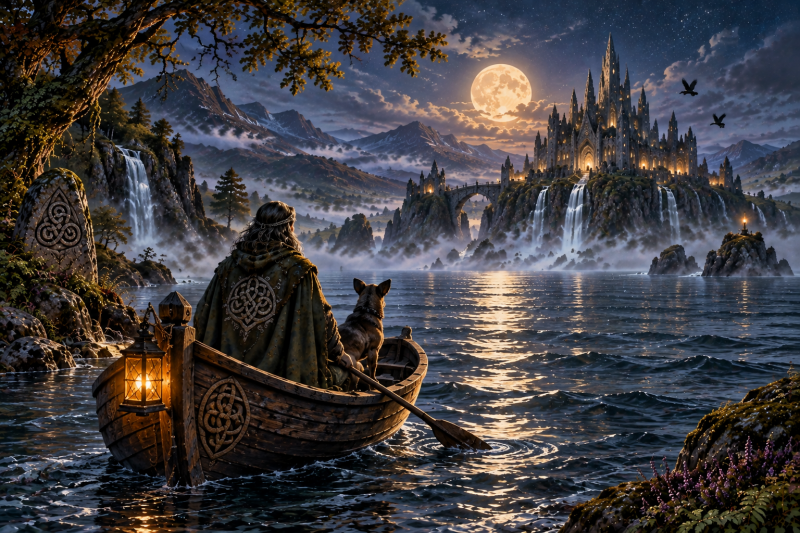
Water frequently separates the human world from supernatural realms.
Irish stories sometimes describe journeys across the sea toward extraordinary islands where travellers encounter beautiful landscapes, strange inhabitants and events impossible in the ordinary world.
The direction west became particularly evocative.
Watching the sun disappear into the Atlantic must have made the western horizon an extraordinary sight to generations living along Ireland's coast.
Beyond it lay an unknown world.
Stories of voyages into mysterious western seas appear in medieval Irish literature, where travellers encounter islands governed by very different rules from those of home.
The journey itself becomes a crossing from the familiar into the unknown.
When Time Behaves Differently
One of the most captivating ideas associated with Otherworld stories is that time does not always pass normally.
A visitor might believe they have spent only a short period away, only to discover that many years have passed in the human world.
The story of Oisín is perhaps the best-known example.
After living in Tír na nÓg, Oisín eventually longs to see Ireland again. He is warned not to touch the ground when he returns.
Ireland has changed.
The people and companions he knew are gone, and generations have passed.
When Oisín eventually touches Irish soil, the years that had seemingly left him untouched suddenly catch up with him.
It is a haunting idea:
A paradise where time cannot harm you — until you return home.
Annwn — The Welsh Otherworld
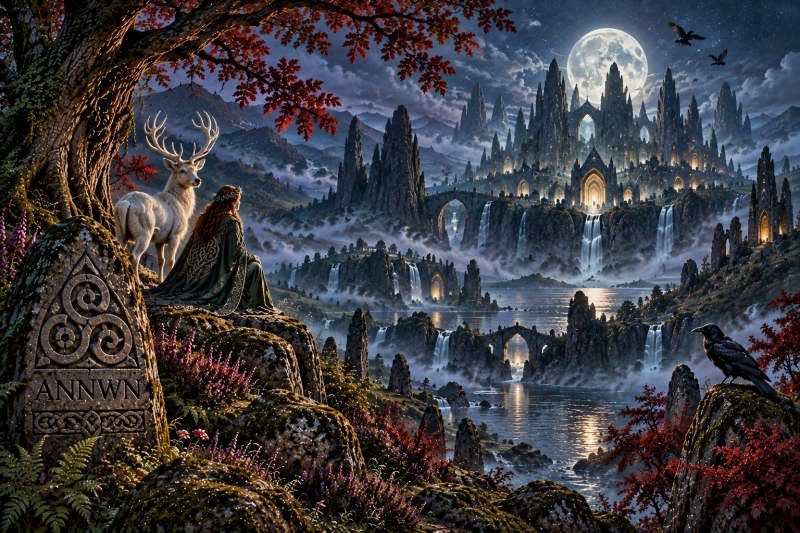
Ireland was not alone in preserving traditions of mysterious supernatural realms.
Welsh medieval literature contains the concept of Annwn — sometimes written Annwfn — an Otherworld associated with supernatural figures and extraordinary places.
Annwn appears in important Welsh literary traditions, including material associated with the Mabinogi and the mysterious early medieval poem Preiddeu Annwfn — The Spoils of Annwn.
Descriptions vary between texts.
Rather than thinking of Annwn as simply a Celtic version of heaven or hell, it is better understood as a supernatural realm whose nature changed across different stories and periods.
As in Irish tradition, the boundary between the human landscape and this strange world can sometimes feel surprisingly thin.
The Otherworld and the Fae
Over many centuries, older supernatural traditions became intertwined with the enormous body of fairy folklore found throughout Britain and Ireland.
Fairies in traditional folklore were often very different from the harmless winged creatures popularised in later children's stories.
They could be beautiful, powerful and mysterious.
Some stories warned against entering fairy places, disturbing particular mounds or accepting food from supernatural beings.
Other tales described humans hearing extraordinary music, witnessing strange gatherings or disappearing into another realm.
The idea remained remarkably similar:
Another world exists beside ours, and occasionally the boundaries between the two become uncertain.
Thin Places
You will sometimes hear certain landscapes described today as “thin places” — locations where the boundary between this world and another supposedly becomes especially narrow.
The phrase is popular in modern Celtic spirituality, but we should be careful about presenting it as an ancient universal Celtic belief.
Nevertheless, the idea fits remarkably well with much older folklore.
Ancient mounds, caves, islands, wells, lakes, forests and remote hills repeatedly appear as locations where humans encounter something supernatural.
These are naturally liminal places — locations sitting between familiar categories.
The shoreline lies between land and sea.
Twilight lies between day and night.
A doorway lies between inside and outside.
An island lies between isolation and connection.
Perhaps this helps explain why such places became powerful settings for stories.
Samhain and the Otherworld
Modern descriptions often claim that at Samhain the “veil between the worlds was at its thinnest.”
The historical reality is more complicated than that familiar phrase suggests.
Samhain was an important seasonal festival in medieval Irish tradition, and supernatural events certainly appear in stories associated with the period.
Later traditions surrounding Halloween also contain ideas involving spirits, divination and supernatural encounters.
However, the exact modern phrase about a “thinning veil” should not simply be treated as a quotation from ancient Celtic religion.
It is better to say that Samhain accumulated strong associations with supernatural activity and boundaries between worlds, which later traditions and modern Paganism developed further.
The distinction does not make the tradition any less fascinating.
It allows us to see how folklore evolves.
Sacred Water and Otherworldly Journeys
Rivers, lakes, wells and springs occupy an important position throughout Celtic mythology and later folklore.
Archaeology shows that people in prehistoric and Iron Age Britain and Ireland sometimes deliberately deposited valuable objects into watery places.
Later legends connected particular lakes, rivers and wells with supernatural beings, healing and extraordinary events.
Water naturally creates a boundary.
Stand beside a still lake and you can see another landscape reflected beneath its surface.
Cross a river and you physically leave one piece of land for another.
Sail across the sea and the familiar world eventually disappears behind you.
It is easy to understand why storytellers repeatedly used water as a gateway to mystery.
Animals at the Boundary
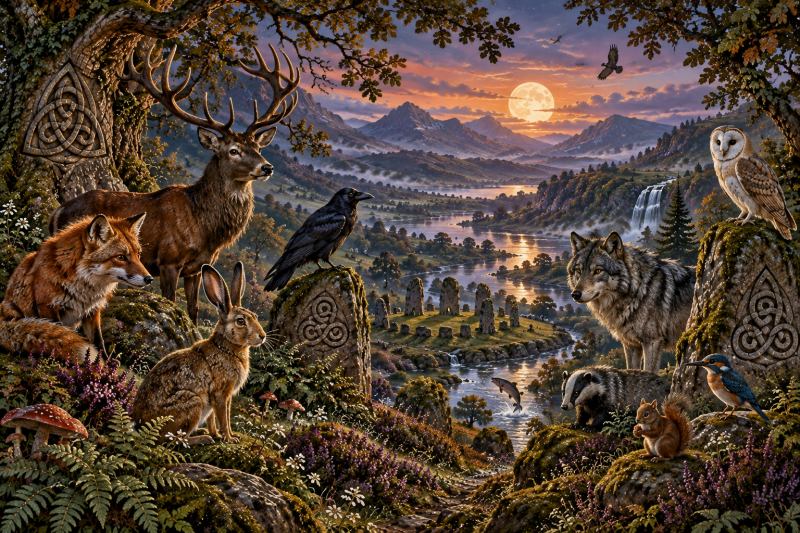
Animals also move between the ordinary and supernatural worlds of Celtic storytelling.
A mysterious animal may lead a hunter away from familiar territory.
A supernatural figure may assume animal form.
Birds can travel between earth and sky, while creatures such as salmon disappear beneath the surface of rivers into a world humans cannot see.
White animals, particularly when described with unusual colouring such as white bodies and red ears, sometimes appear in medieval Welsh supernatural narratives.
Animals therefore make perfect guides into Otherworld stories.
They inhabit the same landscape as humans while experiencing parts of it completely beyond our reach.
Was the Otherworld the Land of the Dead?
Sometimes — but not simply.
Modern retellings frequently describe the Celtic Otherworld as though it were straightforwardly the Celtic equivalent of an afterlife.
The surviving material is much more complicated.
Supernatural realms can contain beings who are certainly not ordinary living humans, and ideas concerning death and the supernatural sometimes overlap.
But heroes can travel to Otherworld realms while still alive, interact with their inhabitants and sometimes return.
The Otherworld might therefore be better imagined not as one destination for the dead, but as a collection of supernatural realms existing beyond normal human experience.
Different stories understood those realms differently.
From Ancient Mythology to Later Folklore
One reason Celtic Otherworld traditions are so fascinating is that they have never remained frozen in time.
Prehistoric monuments survived into later landscapes.
Medieval writers recorded stories inherited from earlier traditions while living in Christian societies.
Those stories continued changing through oral folklore.
Fairy traditions became attached to ancient monuments and particular landscapes.
Victorian writers and artists reimagined Celtic mythology again.
Modern Pagan and Celtic-inspired spiritual traditions have continued the process.
What we call the Celtic Otherworld today therefore contains many layers accumulated across centuries.
Separating those layers allows us to appreciate both the history and the folklore.
The Otherworld in the Landscape Today
Perhaps the most beautiful aspect of these stories is that the landscapes remain.
The same Atlantic Ocean still meets Ireland's western coast.
Ancient burial mounds continue to rise from green fields.
Rivers disappear between wooded valleys.
Mist still gathers around mountains.
Owls hunt after sunset, ravens cross the sky and hares vanish into long grass.
We may understand these things differently from the people who told the old stories, but landscapes can still inspire exactly the same sense of mystery.
Stand beside an ancient mound at twilight or watch mist drift across a distant valley and it becomes easy to understand why generations imagined another world somewhere beyond the familiar one.
Perhaps that is why stories of the Otherworld have survived for so long.
They take something everyone understands — the feeling that there are places just beyond our knowledge — and turn it into a world of possibilities.
Where the Path Disappears
The Celtic Otherworld was never one clearly mapped kingdom with a single entrance.
It existed across stories.
Beyond the western sea.
Beneath ancient hills.
Across mysterious water.
Within supernatural halls.
And perhaps, most importantly, just beyond the edge of the familiar landscape.
That uncertainty is part of its magic.
A path disappears between ancient trees.
Mist covers the mountains.
The last light fades behind the hills.
And for just a moment, it becomes possible to imagine that the old stories might have been pointing toward somewhere after all.
Some paths lead home. Others disappear into legend. 🌿