The Hawthorn in British & Irish Folklore
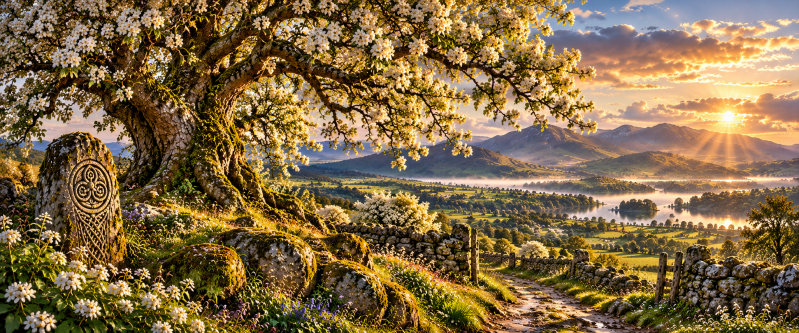
Few trees have gathered as much folklore around them as the hawthorn. Its white blossom transforms hedgerows in spring, yet for generations the tree has also been surrounded by stories of fairies, sacred places, seasonal customs and the consequences of disturbing particular trees.
In Ireland especially, lone hawthorns became strongly associated with the Aos Sí, the supernatural beings commonly translated into English as fairies. Certain trees were treated with considerable caution, and traditions warned against cutting or damaging them. Similar beliefs surrounding hawthorn, luck and the supernatural can be found elsewhere across Britain and Ireland.
Yet the hawthorn was not simply a tree of warnings. Its flowering was closely associated with May and the coming of summer, and hawthorn blossom played a part in seasonal celebrations and customs. This combination of beauty, celebration and supernatural danger gave the tree an unusually complex place in folklore.
There was never one universal ancient “Celtic meaning of hawthorn”. What survives instead is something much more interesting: layers of Irish and British folklore, medieval and later tradition, seasonal custom and modern interpretation.
Hawthorn and the Fair Folk
Of all the beliefs surrounding hawthorn, its connection with the fairy world is perhaps the most famous. This association became particularly strong in Irish folklore, where certain lone hawthorns were regarded as fairy trees and treated with considerable caution.
A solitary hawthorn growing in a field, beside an old track or close to an ancient site could become the focus of local tradition. Such trees were sometimes believed to stand near places frequented by the Aos Sí — the supernatural beings of Irish tradition often described in English as fairies.
Stories warned that cutting down or damaging a fairy thorn could bring illness, failed crops, livestock problems or other misfortune upon the person responsible. Whether everyone literally believed such warnings is impossible to know, but the traditions were powerful enough that particular trees could survive while the landscape around them changed.
The connection between hawthorn and the supernatural was not identical everywhere. Some traditions concerned individual trees rather than hawthorn as a species, and stories varied considerably between regions. This is important: folklore rarely operated as a single set of rules followed throughout Ireland or Britain.
The result was a tree occupying an unusual boundary. Hawthorn was part of the everyday agricultural landscape — growing in hedges and fields — yet a particular old thorn standing alone could belong, at least in local imagination, to an entirely different world.
Why Were Lone Hawthorns Left Standing?
One of the most striking sights in the Irish countryside is a solitary hawthorn standing in the middle of an otherwise open field. While there can be perfectly practical reasons for an individual tree to survive, folklore provided another powerful reason for leaving some of them undisturbed.
A hawthorn believed locally to be a fairy tree was not something to interfere with casually. Stories of misfortune following the cutting of such trees circulated through communities and became attached to particular places. In this way, an ordinary feature of the landscape could acquire a reputation that lasted for generations.
These traditions are especially interesting because folklore could influence the physical landscape itself. A field might be cleared, boundaries altered and farming methods changed while an old thorn remained standing. The story associated with the tree effectively became another reason for preserving it.
Not every lone hawthorn was considered a fairy tree, however, and the survival of an isolated tree should not automatically be interpreted as evidence of supernatural belief. Local history matters. What makes the tradition fascinating is that particular trees could become landmarks where place, memory and folklore were inseparable.
Hawthorn, May Day & the Coming of Summer

Hawthorn's flowering was one of the most conspicuous signs of late spring in the British and Irish countryside. Its branches covered in white blossom became closely associated with May, seasonal celebration and the arrival of summer.
Hawthorn blossom was sometimes known as May blossom, and flowering branches featured in May customs in parts of Britain and Ireland. Greenery and flowers were gathered to decorate homes and communities, reflecting a much wider tradition of marking the changing season with plants from the surrounding landscape.
The relationship between hawthorn and May was not entirely straightforward. Folklore could distinguish between bringing flowering branches into a community as part of seasonal celebration and bringing hawthorn inside the home, which in some traditions was considered unlucky. As so often happens in folklore, customs varied according to place and period.
Modern Pagan traditions frequently connect hawthorn with Beltane, love, fertility and the beginning of summer. These associations draw upon genuine historical connections between hawthorn, May and seasonal customs, but modern interpretations should not automatically be treated as a single unchanged belief inherited from the ancient Celtic world.
Hawthorn therefore reveals something important about seasonal folklore: people did not need a calendar to tell them that the year was turning. The flowering hedgerows themselves announced that summer was approaching.
Hawthorn in the Home — Luck and Misfortune
Hawthorn presents one of the contradictions that make traditional folklore so interesting. Flowering branches could form part of May celebrations, yet in some parts of Britain and Ireland bringing hawthorn blossom inside the house was regarded as unlucky.
Traditions varied from place to place. Some warnings associated the blossom with illness or death, while elsewhere the concern seems simply to have been that hawthorn belonged outdoors and should not be brought into the domestic space. This was not a universal rule, and surviving folklore should not be treated as though every community shared exactly the same belief.
There may even be a natural detail behind part of hawthorn's unsettling reputation. The flowers contain compounds that can produce an odour sometimes compared with decaying flesh, particularly when blossom is kept in a warm enclosed room. To people living much closer to illness and death than most of us do today, that smell may have strengthened existing associations.
The contrast is striking: outside, hawthorn blossom could announce May, fertility and the return of summer; inside, the same flowers might be treated with suspicion. Folklore frequently contains precisely these kinds of contradictions.
Hawthorn, Hedges & Boundaries
Although folklore often focuses on ancient or solitary hawthorns, most people in Britain and Ireland would have encountered the tree in a much more ordinary setting — the hedgerow. Hawthorn's dense growth and sharp thorns made it particularly useful for creating living boundaries around fields, lanes and settlements.
This practical role gives another dimension to the tree's folklore. A hedge physically marked the point where one piece of land ended and another began. Gates, field edges and old tracks were places of passage, and folklore frequently gathered around such boundaries and thresholds.
Hawthorn therefore occupied both a practical and imaginative borderland. It could separate pasture from road or one farm from another, while stories associated particular trees with fairy paths, ancient places and encounters with the supernatural.
It is tempting to interpret every hawthorn hedge as an ancient sacred boundary, but the history is more complicated. Huge numbers of hawthorns were deliberately planted as agricultural hedges, particularly as Britain's landscape was reorganised through enclosure. The folklore surrounding exceptional trees existed alongside this very practical use of the species.
That combination is part of what makes hawthorn so interesting: it was simultaneously an everyday working tree and one of the most mysterious trees in British and Irish folklore.
Hawthorn in Irish Folklore & the Landscape
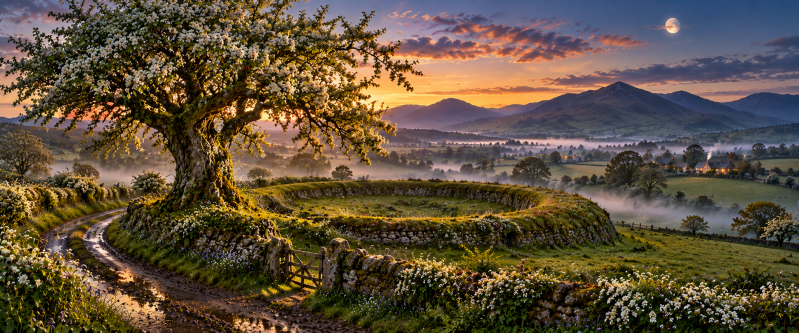
In Ireland, traditions surrounding particular hawthorn trees became closely connected with the landscape itself. A lone thorn might stand beside an old road, on farmland or near an archaeological monument, and stories concerning the Aos Sí could become attached to both the tree and the place around it.
Hawthorns were also sometimes found close to ringforts, ancient enclosed settlements that later folklore frequently associated with the fairy world. These archaeological sites became widely known as fairy forts, and disturbing either the fort or significant trees growing nearby could be regarded as dangerous.
Such traditions survived well into modern Ireland. Stories continued to circulate of landowners, workers and communities reluctant to remove particular hawthorns because of their reputation. One celebrated modern example occurred in County Clare, where plans for a road improvement in the late 1990s were altered following controversy surrounding a hawthorn identified locally with fairy tradition.
Cases such as this should not be taken to mean that every Irish person believed literally in fairy trees. Their importance lies elsewhere: folklore remained sufficiently embedded in local identity and landscape that an individual tree could still command extraordinary attention in the modern world.
Hawthorn therefore provides a remarkable example of folklore surviving not only in books and stories, but in the physical landscape — in trees left standing, places avoided and traditions remembered.
Hawthorn Symbolism & Modern Paganism
In modern Paganism and Celtic-inspired spirituality, hawthorn has acquired a rich collection of symbolic associations. It is commonly connected with Beltane, love, fertility, protection, boundaries and the fairy world, drawing partly upon older folklore surrounding May blossom, seasonal customs and supernatural trees.
Hawthorn's position in the landscape makes many of these modern interpretations understandable. It flowers dramatically as spring gives way to summer, forms dense boundaries between fields and has centuries of recorded folklore connecting particular trees with supernatural places.
Modern traditions sometimes describe hawthorn as a tree standing between worlds or as a gateway to the Otherworld. Such ideas fit beautifully with older fairy-tree traditions, but they should not automatically be presented as a single belief held throughout the ancient Celtic world. Much of today's hawthorn symbolism combines historical folklore with later interpretation and contemporary spiritual practice.
This distinction does not make modern traditions less meaningful. Instead, it allows us to see how folklore continues to develop. The hawthorn that once stood beside farms, roads and fairy forts remains a powerful symbol precisely because new generations continue to find meaning in the older stories surrounding it.
The Hawthorn in Folklore — What Does It Symbolise?
There is no single historical meaning of the hawthorn, but several themes appear repeatedly across British and Irish folklore. The tree became associated with fairies and the supernatural, May and the arrival of summer, boundaries, protection, luck and misfortune.
In Irish folklore, particular hawthorns could be connected with the Aos Sí and places regarded as belonging to the fairy world. In seasonal tradition, the white blossom became one of the characteristic signs of May and approaching summer. Meanwhile, the tree's widespread use in hedgerows made hawthorn a literal marker of boundaries across the countryside.
Modern Pagan and Celtic-inspired traditions have expanded these associations to include love, fertility, spiritual protection and connections with the Otherworld. Some of these ideas have roots in older customs, while others represent later interpretations of the folklore.
Rather than asking for one fixed “Celtic meaning of hawthorn”, it is therefore more accurate to think of the tree as carrying different meanings in different traditions — sometimes celebratory, sometimes protective and sometimes distinctly dangerous to disturb.
Explore Related Folklore
- Fairies, Spirits & the Fae — discover the Aos Sí, Tylwyth Teg and the supernatural beings associated with wild places.
- The Celtic Otherworld — explore traditions of mysterious realms existing beyond the ordinary human world.
- Beltane — Fire, May & the Coming of Summer — discover the seasonal traditions associated with the beginning of summer.
- Trees & Plants in British, Irish & Celtic Folklore — return to our growing collection of tree and plant folklore.
- Shape-Shifting, Magic & Ancient Beliefs — explore supernatural traditions from across Britain and Ireland.
Sources & Further Reading
Dúchas — The Schools’ Collection
A major collection of Irish folklore recorded in the 1930s, containing traditions concerning fairy trees, hawthorn, supernatural places and local beliefs.
Dúchas — National Folklore Collection
The National Folklore Collection, University College Dublin
One of the world's most important archives of Irish oral tradition and folklore.
National Folklore Collection, UCD
The Woodland Trust — Hawthorn
Useful background on hawthorn itself, including its ecology, history and traditional associations.