The Rowan in British, Irish & Scottish Folklore
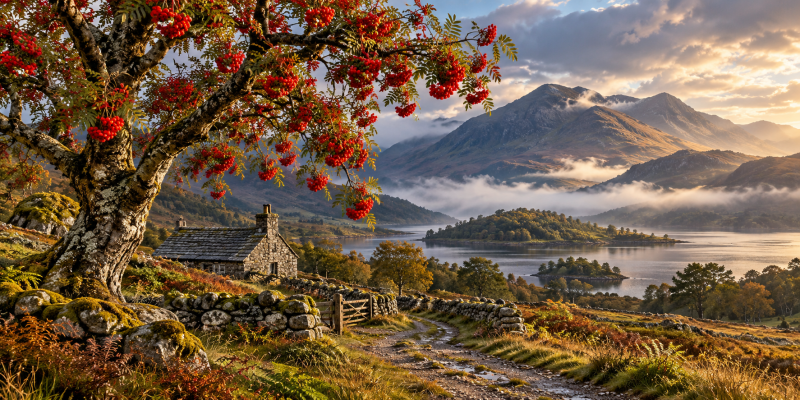
With its delicate leaves and vivid clusters of red berries, the rowan is one of the most distinctive trees of the upland landscapes of Britain and Ireland. For centuries it has also carried a remarkable reputation as a tree of protection, particularly in Scottish folklore.
Rowan trees were associated with beliefs concerning witchcraft, harmful supernatural influences and the protection of homes, farms and livestock. Branches, berries and small pieces of rowan wood appear in recorded folk practices, while individual trees growing beside houses and farm buildings could themselves become part of local tradition.
The tree also appears in Irish tradition and acquired wider associations with magic, enchantment and supernatural places. As these traditions developed, rowan became one of the trees most readily incorporated into later Celtic symbolism and modern Pagan practice.
Yet there was never one universal ancient “Celtic meaning of rowan.” The surviving evidence instead reveals different traditions from different places and periods — particularly a rich body of Scottish protective folklore that deserves to be understood in its own right.
The Rowan — A Tree of Protection
Of all the traditions surrounding rowan, protection is among the most persistent. Across parts of Scotland and elsewhere in Britain and Ireland, rowan was believed to offer protection against witchcraft, enchantment and harmful supernatural influences.
The tree could be valued simply by growing near a house or farm, while pieces of rowan were also incorporated into protective customs. Twigs, branches and wood might be placed around buildings, carried by people or used in objects intended to guard livestock and the household.
In Scottish tradition especially, rowan trees growing close to homes were sometimes treated with considerable respect. Cutting or damaging such a tree could be regarded as unwise, particularly where generations of a family had allowed it to remain beside a house or farm.
Rowan's striking red berries may have contributed to its reputation. Red itself acquired protective associations in many European folk traditions, although it would be too simple to claim that the colour alone explains the tree's importance.
What survives is not evidence for one universal ancient Celtic system of tree symbolism, but something more tangible: recorded traditions in which ordinary people used and respected rowan as a defence against forces they feared or could not explain.
Rowan Crosses, Red Thread & Protective Charms
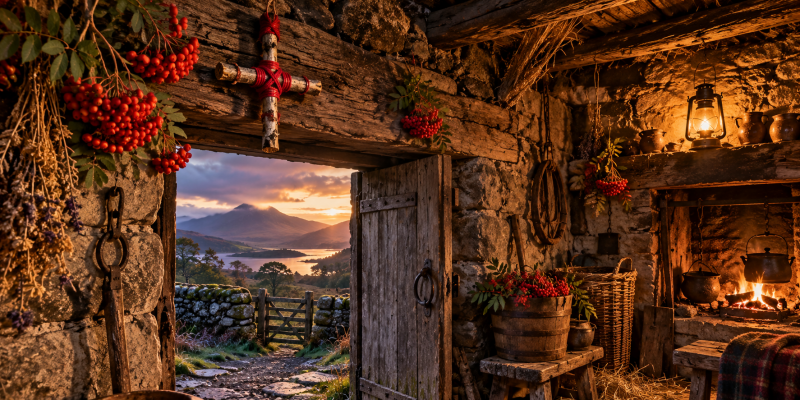
Rowan was not only valued as a living tree. Its wood was also used in protective objects and charms intended to guard people, animals and buildings from harmful influences.
One of the best-known traditions involved making a small cross from rowan twigs. In Scottish folk practice, two pieces of rowan could be bound together, sometimes with red thread or wool, and placed in the home, byre or stable. Such objects belonged to a much wider collection of protective customs intended to defend households and livestock from witchcraft or supernatural harm.
Rowan might also be carried by travellers or incorporated into everyday objects. The important element was not necessarily an elaborate ritual; often it was simply the presence of the wood itself that was considered protective.
Red thread appears repeatedly in British and Irish protective folklore, although customs differed considerably between regions. When combined with rowan — a tree already possessing a strong protective reputation — it created a particularly memorable folk charm.
These traditions remind us that folklore was not confined to stories told beside the fire. It could become something physical: a few pieces of wood tied together and hung quietly in a farm building because generations of people believed that doing so might keep misfortune away.
Rowan, Livestock & the Farm
Protective beliefs surrounding rowan were particularly important in rural communities, where the health of cattle and other livestock could determine a family's livelihood. Illness, poor milk production or unexplained changes in an animal's behaviour might sometimes be attributed to witchcraft, the evil eye or supernatural interference.
Rowan became one of the materials used to guard against such dangers. Branches or pieces of the wood could be placed in byres and stables, while rowan charms were sometimes associated with cattle and dairy work. Customs differed from place to place, but the underlying idea was remarkably persistent: the tree could help protect valuable animals from unseen harm.
These beliefs make more sense when viewed within the world in which they developed. Before modern veterinary medicine, disease or the sudden loss of livestock could be frightening and difficult to explain. Protective customs offered people something practical they could do when faced with uncertainty.
Rowan therefore belonged not only to stories of magic and supernatural beings but to the ordinary working landscape — the farmyard, cattle shed, field and doorway. Folklore was woven into everyday life.
Rowan in Irish Mythology & Folklore
Rowan also appears in Irish tradition, although its role should not simply be treated as identical to the protective customs recorded in Scotland. Irish stories sometimes place remarkable rowan trees within landscapes of magic, danger and the supernatural.
One particularly striking tradition concerns magical rowan berries. In medieval Irish storytelling, extraordinary trees and their fruit could possess qualities far removed from those of an ordinary woodland tree. Rowan berries appear in tales involving supernatural beings, guarded places and heroic adventures.
The rowan therefore fitted naturally into a storytelling world in which particular trees, wells, islands and landscapes might possess unusual powers. What mattered was often not that every rowan tree was considered magical, but that an exceptional tree could become central to a story.
Later Irish folklore also contains protective traditions surrounding rowan, adding another layer to the tree's reputation. As elsewhere, however, beliefs varied between communities and periods rather than forming one universal system of “Celtic tree lore”.
Taken together, the Irish and Scottish traditions show how the same familiar tree could acquire different but overlapping reputations — protective in everyday folk practice, yet mysterious and sometimes magical within traditional storytelling.
The Rowan Tree in Scottish Folklore
Few places developed such a strong body of rowan tradition as Scotland. Across the Highlands and elsewhere, the tree became closely associated with the protection of homes, farms, livestock and the people who lived among them.
Rowan trees were often allowed to grow near houses and farm buildings, and local tradition could discourage people from cutting them down. A mature rowan beside an old croft was therefore more than an attractive feature of the landscape: in some communities it could carry generations of inherited belief.
Scottish folklore frequently placed rowan among the defences against witchcraft and harmful magic. Its wood could be used in protective charms, while branches and twigs might be placed around buildings or associated with cattle. These practices belonged to a wider world of folk belief in which iron, particular plants, spoken charms and other objects could also provide protection.
Traditions were not identical throughout Scotland. Some were highly local, and many of the accounts that survive were recorded comparatively recently rather than in the ancient Celtic period. This distinction matters because the familiar description of rowan as an “ancient Celtic sacred tree” can make a complicated history appear much simpler than the evidence allows.
What can be said with much greater confidence is that rowan occupied an important place in Scottish folk tradition. Its reputation was maintained not through a single ancient doctrine, but through countless smaller customs associated with homes, animals, families and particular places.
Why Was Rowan Considered Protective?

It is difficult to identify a single reason why rowan developed such a powerful protective reputation. Folklore rarely has one simple origin, and beliefs surrounding the tree probably accumulated gradually as traditions were passed from one generation to another.
The rowan's brilliant red berries certainly made it conspicuous. Red has appeared as a protective colour in numerous European folk traditions, particularly in charms involving thread, cloth and other small objects. This may have reinforced the tree's existing reputation, although it cannot by itself explain how the belief began.
Rowan berries also carry a small five-pointed, star-like mark opposite the stalk. Modern books and websites sometimes describe this as a natural pentagram and claim that it explains the tree's ancient magical significance. The mark is real, but claims that ancient Celtic peoples specifically interpreted it as a pentagram require much more caution.
The tree's protective reputation was strengthened by practice. If families planted or preserved rowan near a house, placed its wood in farm buildings and made protective charms from its twigs, each generation encountered the tree already surrounded by tradition.
Rowan's importance may therefore be better understood not as the result of one forgotten ancient belief, but as the accumulation of colour, custom, landscape and generations of folk practice.
Rowan Symbolism & Modern Paganism
Rowan remains an important tree in modern Paganism, witchcraft and Celtic-inspired spirituality. Today it is commonly associated with protection, courage, intuition, magic and defence against harmful influences.
Of these associations, protection has particularly strong roots in recorded folklore. The historical use of rowan around homes, livestock and farm buildings provides a clear connection between older folk practice and its continuing reputation as a protective tree.
Other modern interpretations have developed around the tree's appearance and traditional reputation. Its bright red berries, ability to grow in exposed upland landscapes and long association with supernatural protection have encouraged ideas of resilience, spiritual strength and the ability to withstand adversity.
Rowan also appears in modern systems of Celtic tree symbolism and sometimes in interpretations of the so-called Celtic Tree Calendar. These systems can be meaningful within contemporary spiritual practice, but they should not automatically be treated as surviving calendars or belief systems used by the ancient Druids.
Rowan therefore provides a good example of folklore continuing to evolve. Modern practitioners have not simply preserved an unchanged ancient tradition; they have taken older stories and customs and given them new meanings within living spiritual traditions.
What Does the Rowan Tree Symbolise?
There is no single historical meaning of the rowan tree, but protection is one of the strongest themes found in surviving British and Irish folklore. Rowan was particularly associated with guarding homes, livestock and people against witchcraft, enchantment and other harmful influences.
Scottish traditions gave the tree an especially strong protective reputation. Rowan wood could be used in charms and crosses, while trees growing near houses and farms were sometimes preserved and treated with respect.
In Irish tradition, rowan also appears in stories involving magical trees, extraordinary berries and supernatural landscapes. These traditions add themes of magic and enchantment to the tree's wider folklore.
Modern Pagan and Celtic-inspired traditions commonly associate rowan with protection, courage, intuition, resilience and spiritual defence. Some of these ideas clearly build upon older folklore, while others are more recent interpretations.
Rather than describing rowan as having one fixed “Celtic meaning”, it is more accurate to see it as a tree whose reputation developed through centuries of storytelling, protective customs and everyday folk practice.
Explore Related Folklore
Shape-Shifting, Magic & Ancient Beliefs — explore traditions of magic, transformation and supernatural belief across Britain and Ireland.
Fairies, Spirits & the Fae — discover the supernatural beings and traditions associated with wild and ancient places.
The Celtic Otherworld — explore the mysterious otherworldly landscapes found throughout Celtic tradition.
Sources & Further Reading
Dúchas — The Schools’ Collection
A major collection of Irish folklore gathered from schoolchildren and their communities during the 1930s. It contains numerous accounts concerning trees, protective customs, supernatural beliefs and traditional practices.
Dúchas — National Folklore Collection
National Folklore Collection — University College Dublin
An important archive for Irish oral tradition, customs and folk belief.
National Folklore Collection, UCD
Tobar an Dualchais / Kist o Riches
A particularly useful resource for the Scottish side of the article, preserving thousands of recordings relating to Scottish folklore, tradition and oral history.
Trees for Life — Rowan
Useful background on the rowan itself and its place in Scotland's native woodland.