Samhain — The Beginning of Winter
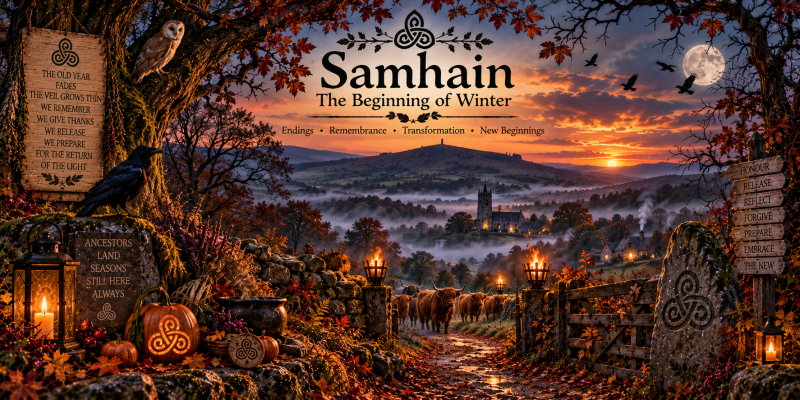
When the Dark Half of the Year Begins
The countryside has changed almost beyond recognition. Fields that were golden at Lughnasadh now lie bare. Apples have been gathered from orchards, leaves cover woodland paths and the brilliant colours of Mabon are fading into the browns and greys of late autumn. Mist settles in the valleys, rain darkens the tree trunks and sunset seems to arrive earlier every evening.
Around 1 November, the traditional Gaelic festival of Samhain marked the beginning of winter. Celebrations and customs were associated particularly with the evening before, 31 October, as the old day was understood to begin at sunset in Gaelic tradition. Samhain stood opposite Beltane within the seasonal year: Beltane opened the summer half, while Samhain opened the winter half.
Samhain is one of the four major Gaelic seasonal festivals, alongside Imbolc, Beltane and Lughnasadh. Of all the festivals now included in the modern Pagan Wheel of the Year, it has perhaps accumulated the greatest mixture of history, folklore, modern spirituality and popular legend.
Today Samhain is often associated with ancestors, death, spirits, divination, fire and remembrance. Behind those modern associations lies something even more fundamental: the arrival of winter and the need to prepare for the hardest part of the year.
What Is Samhain?
The Irish name Samhain is also the modern Irish word for November. The festival appears repeatedly within medieval Irish literature and was clearly regarded as an important seasonal turning point.
Samhain did not represent winter in the astronomical sense used by modern meteorology. Instead, it belonged to an older seasonal understanding of the year in which the beginning of November marked entry into the dark winter half.
The agricultural world supported this division perfectly. Growth had slowed dramatically, grazing was becoming poorer, daylight was disappearing and winter weather was approaching.
The year was moving inward.
People returned towards hearth and home.
Samhain and Beltane — The Two Great Gateways
Samhain and Beltane stand opposite one another across the Wheel of the Year.
At Beltane, cattle traditionally moved towards summer grazing and the countryside exploded into leaf and flower. At Samhain, livestock returned from summer pasture, vegetation died back and communities prepared for winter.
One opened the light half.
The other opened the dark half.
Both became associated with fire, protection and supernatural belief.
This relationship makes Samhain easier to understand. It was not simply an isolated festival of ghosts. It formed part of a seasonal system through which people understood the changing year.
The Last Harvest
By Samhain, much of the harvest had already been gathered.
Grain harvesting began around Lughnasadh. Fruit, nuts and other crops followed through the period surrounding Mabon. By late October, attention increasingly turned towards what remained and what would be needed for winter.
Food had to be stored carefully.
Livestock had to be assessed.
Fuel had to be gathered.
Buildings needed to be ready for bad weather.
There was no supermarket waiting if supplies ran low in February.
The approaching winter made preparation a matter of survival.
Samhain therefore carries a very different feeling from the abundance of Lughnasadh.
The question is no longer simply “What has the land produced?”
It becomes:
“Do we have enough?”
Cattle Coming Home
Livestock played an enormously important role in traditional Gaelic society.
During the warmer months, cattle could graze away from the main settlement. As winter approached, animals were brought back from seasonal pastures.
This movement was practical, but it also marked the changing year.
The landscape that had supported animals through summer could no longer provide the same abundance.
Winter required different decisions.
Which animals could be fed through the cold months?
Which would be kept for breeding?
Which could not be supported?
These were difficult but necessary questions.
Samhain stood at the point when the abundance of summer had to be transformed into survival through winter.
Winter Slaughter and Food
Before modern refrigeration and year-round animal feed, autumn was traditionally an important time for slaughtering livestock that could not economically be kept through winter.
Meat could then be preserved through salting, drying, smoking or other methods.
This practical reality contributed to the atmosphere of the season.
Death was not hidden from daily life.
It was part of agriculture.
People understood very directly that surviving winter could require the death of animals raised through the year.
Modern Samhain symbolism often discusses death in spiritual or metaphorical terms.
Historically, death was also part of the practical farming calendar.
The Fires of Samhain
Like Beltane, Samhain became associated with fire.
Accounts and later traditions describe communal fires and seasonal customs involving flame.
Fire had obvious practical importance at the beginning of winter. The household hearth provided warmth, light and the ability to cook food during the darkest months.
But fire also carried symbolic power.
It could purify.
Protect.
Transform.
Illuminate.
At the gateway into winter, fire stood against the growing darkness.
Modern Samhain celebrations often continue this imagery through bonfires, candles and lanterns.
The symbolism remains powerful because the seasonal reality remains unchanged.
Outside, darkness grows.
Inside, we make light.
The Supernatural at Samhain
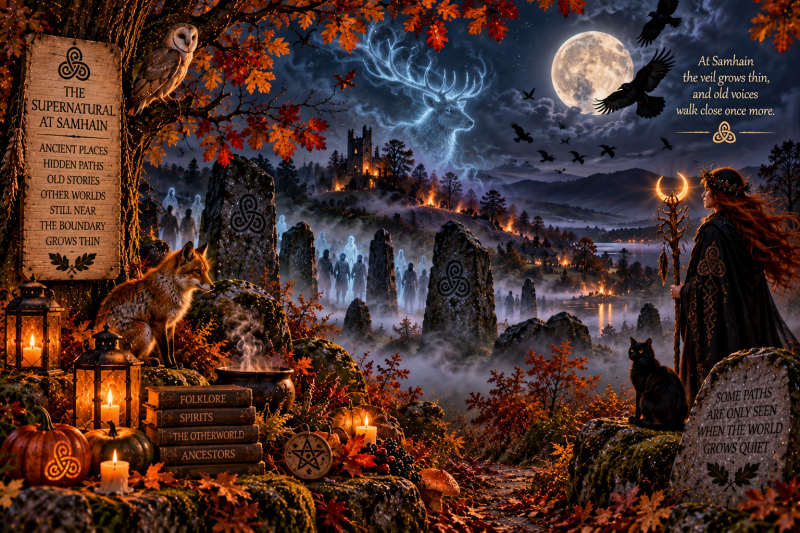
Samhain became strongly associated with supernatural events within Irish literature and later folklore.
Stories describe unusual encounters, otherworldly beings and strange happenings around this seasonal boundary.
This fits a much wider pattern within folklore.
Boundaries are dangerous.
The boundary between land and water.
Between daylight and darkness.
Between one year and another.
Between summer and winter.
Places and moments that exist between two states often acquire supernatural significance.
Samhain stood at one of the greatest boundaries of all.
The old summer had ended.
Winter had begun.
Was the Veil Between Worlds Really Believed to Be Thin?
Modern Pagan writing frequently says that at Samhain “the veil between the worlds is thinnest.”
It is a beautiful phrase, but it should not automatically be presented as an ancient Celtic quotation or universal historical belief.
There certainly are old traditions connecting Samhain with supernatural beings, the Otherworld and unusual encounters.
However, the familiar language of a literal “thinning veil” belongs largely to later interpretation and modern spirituality.
The historical traditions are more varied and interesting.
People did not necessarily imagine another world separated from ours by something resembling a curtain.
In many stories, the supernatural world was already present.
It existed in hills.
Water.
Ancient mounds.
Wild places.
And sometimes the boundaries simply became easier to cross.
The Aos Sí — The People of the Mounds
Irish folklore contains countless traditions concerning the Aos Sí, supernatural beings associated with ancient mounds and the Otherworld.
English translations often call them fairies, although that word can suggest something much smaller and friendlier than many traditional stories describe.
The Aos Sí could be beautiful, powerful and dangerous.
They might reward respectful behaviour or punish insult and interference.
At Samhain, stories involving such beings became particularly appropriate because the festival itself represented a boundary in time.
The landscape had become darker.
Vegetation disappeared.
Ancient earthworks became more visible.
The countryside seemed to reveal an older world beneath the summer growth.
Ancient Mounds in the Winter Landscape
Late autumn transforms ancient monuments.
During summer, an old mound may almost disappear beneath grass, flowers and surrounding vegetation.
By Samhain, the landscape has been stripped back.
Trees lose their leaves.
Bracken collapses.
Grass becomes shorter.
Mist gathers around the earth.
Ancient burial mounds, standing stones and ruined structures suddenly seem much more prominent.
For communities who already told stories about supernatural inhabitants of ancient places, winter must have intensified their atmosphere.
The land itself appeared to remember.
Ancestors and the Dead
Modern Samhain celebrations frequently focus upon remembering ancestors and people who have died.
People may display photographs, light candles, prepare favourite foods or simply spend time thinking about those no longer present.
Historical traditions surrounding the dead at this season are complicated and became intertwined over centuries with Christian observances such as All Saints' Day and All Souls' Day.
It is therefore difficult to assign every later custom neatly to either Pagan or Christian origins.
What is clear is that late autumn became strongly associated with remembrance.
The landscape itself encourages it.
Leaves fall.
Plants die back.
The year grows old.
Absence becomes visible everywhere.
The Empty Chair
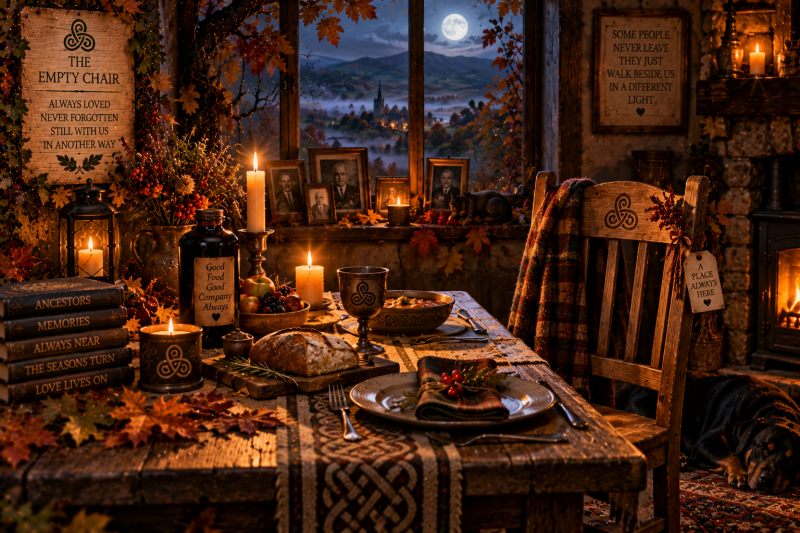
One of the simplest modern Samhain symbols is an empty place at the table.
A chair may be left unoccupied or a small portion of food placed aside in memory of someone who has died.
Different forms of remembrance exist across many cultures, and not every such custom should be labelled an ancient Celtic Samhain practice.
But the image is powerful.
An empty chair represents someone who once occupied a place within everyday life.
It turns memory into something visible.
For many people, this quiet form of remembrance means more than elaborate ritual.
Food for the Dead?
Stories and modern accounts sometimes describe food being left for spirits or the dead at Samhain.
Food offerings certainly appear within many folk and religious traditions, but individual claims about ancient Samhain practices need careful treatment.
Later Halloween customs also included food being given to visitors, poor people, children or performers.
Over centuries, traditions overlap.
The important point is that food carried social and symbolic meaning.
Sharing food strengthens relationships among the living.
Offering food to someone absent extends that relationship beyond ordinary boundaries.
At the beginning of winter, when stored food became precious, giving some away was meaningful.
Divination — Looking Into the Future
Samhain and later Halloween traditions became strongly associated with divination.
People wanted to know what the coming year might bring.
Marriage.
Health.
Weather.
Fortune.
Death.
Many later customs used ordinary household objects such as apples, nuts, mirrors, fire and water.
Some divination games eventually became entertainment, particularly for young people.
Others retained a more serious atmosphere.
The timing makes sense.
Samhain marks a threshold.
When standing between one seasonal year and another, people naturally look forward and ask:
What comes next?
Apples, Nuts and Fortune Telling
Apples and nuts appear repeatedly within later Halloween divination customs.
Nuts could be placed near a fire and interpreted according to how they burned or moved.
Apple peels could be thrown and their shapes interpreted.
Games involving apples became part of seasonal gatherings.
Today these traditions may seem quaint, but they reveal something wonderfully human.
People have always tried to find certainty inside uncertainty.
Winter was unpredictable.
Relationships were unpredictable.
Life itself was unpredictable.
Divination offered stories through which people could imagine the future.
The Dumb Supper
Some modern Pagan Samhain celebrations include a Dumb Supper, a meal eaten partly or entirely in silence in remembrance of the dead.
The word “dumb” here uses an older meaning connected with silence rather than intelligence.
Participants may set places for deceased relatives or friends and eat quietly while remembering them.
The exact historical origins and development of this practice are debated, so it is better understood as part of later folk and modern Pagan tradition rather than confidently described as an ancient Celtic ceremony.
Whatever its age, the idea is simple and moving.
For one meal, silence creates space for memory.
Samhain and Halloween
No discussion of Samhain can avoid Halloween.
The relationship between the two is real, but much more complicated than the claim that “Halloween is simply the Celtic festival of Samhain.”
Modern Halloween developed through many historical layers.
Samhain traditions contributed to the seasonal background.
Christian observances surrounding All Hallows' Eve, All Saints and All Souls contributed others.
British and Irish folk customs added more.
Immigration carried traditions to North America.
Commercial culture transformed them again.
The Halloween celebrated today is therefore not one unchanged ancient festival.
It is the result of centuries of cultural mixing.
All Hallows' Eve
The name Halloween comes from All Hallows' Eve, the evening before All Saints' Day.
“Hallow” is an older word meaning a holy person or saint.
As Christian calendars developed, the beginning of November became associated with commemorating saints and the dead.
These observances existed alongside older seasonal customs.
Over time, traditions influenced one another.
This is why trying to divide every Halloween custom into purely “Pagan” or purely “Christian” categories often creates misleading answers.
Folklore is rarely that tidy.
People inherit customs from many sources and make them their own.
The Origins of Trick-or-Treating
Modern trick-or-treating developed from several traditions rather than one single ancient ritual.
British and Irish customs included guising, in which people dressed in disguise and visited homes, sometimes performing songs, jokes or other entertainment in return for food or gifts.
There were also traditions of souling, associated with the Christian season of All Souls, in which people went from house to house receiving food.
These customs changed dramatically after travelling across the Atlantic.
Eventually they helped create the modern Halloween tradition familiar today.
The result is a perfect example of folklore evolving.
Old customs do not simply survive.
They transform.
Masks and Disguises
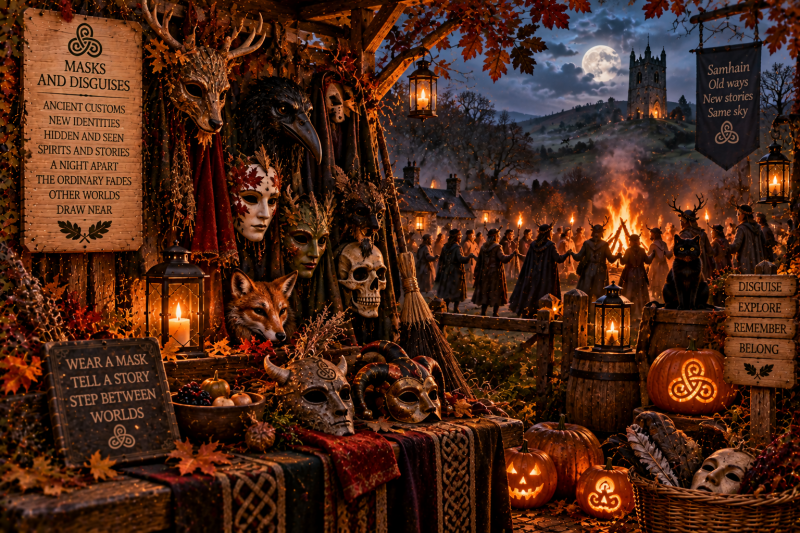
Disguise has long been part of winter and seasonal folk traditions.
At Halloween, masks and costumes became especially important.
Modern explanations sometimes claim people originally dressed as spirits so ghosts would mistake them for one of their own. Such explanations are often repeated with more certainty than the historical evidence allows.
What we do know is that guising and costumed visiting became important features of later Halloween traditions.
Disguise temporarily changes identity.
For one night, ordinary rules become flexible.
A neighbour becomes a ghost.
A child becomes a witch.
A human becomes something from another world.
That transformation fits Samhain's atmosphere perfectly.
From Turnips to Pumpkins
Before the glowing pumpkin became the universal face of Halloween, people in Britain and Ireland carved lanterns from turnips and other root vegetables.
Some surviving examples and later accounts show how unsettling these lanterns could look.
When Irish and other immigrants carried Halloween traditions to North America, pumpkins offered a much larger and easier material to carve.
The pumpkin eventually became dominant.
Today the jack-o'-lantern is recognised around the world.
Yet the older turnip lantern tells a different story.
Smaller.
Rougher.
Stranger.
And perhaps considerably more frightening.
The Jack-o'-Lantern
The name jack-o'-lantern was historically connected with mysterious lights seen at night and with folklore surrounding wandering figures and supernatural illumination.
Over time, the term became attached to carved lanterns.
A candle placed inside a hollowed vegetable transforms an ordinary object into a glowing face.
The symbolism could hardly suit the season better.
A harvested crop.
A human face.
A flame.
Darkness.
Life and death contained inside one object.
Bonfires in the Darkness
Imagine a bonfire on a cold late-October evening.
Beyond the circle of light, fields disappear into darkness.
Smoke moves through bare branches.
People gather close to the warmth.
Fire creates a temporary boundary.
Inside is community, conversation and light.
Outside is the unknown.
This simple experience may help explain why fire appears so frequently within seasonal tradition.
Human beings have gathered around flames for longer than recorded history.
At Samhain, when darkness suddenly dominates the evening, the meaning of fire becomes impossible to ignore.
The Raven and the Crow
Ravens and crows fit naturally into Samhain imagery.
Their black feathers, intelligence and distinctive calls have surrounded them with folklore across many cultures.
In Irish mythology, ravens and crows can appear in stories associated with warfare, prophecy and powerful supernatural figures such as the Morrígan.
But these birds are not merely symbols.
They are extraordinarily intelligent animals living alongside us.
Autumn fields often make them particularly visible.
A flock of crows crossing a grey November sky requires very little imagination to become part of folklore.
The Morrígan and Samhain
The Morrígan is one of the most complex figures in Irish mythology, associated with warfare, sovereignty, prophecy and supernatural power.
Modern Pagan traditions sometimes connect her strongly with Samhain.
There are genuine mythological reasons why she fits the darker atmosphere of the season, and events involving the Morrígan occur within narratives connected with Samhain.
However, she should not simply be reduced to a “Samhain goddess” or “goddess of death.”
Irish mythology is far more complicated than neat modern categories suggest.
The Morrígan is powerful precisely because she resists simple definitions.
Owls in the Winter Night
As evenings lengthen, owls become part of the soundscape of the dark half of the year.
A tawny owl calling from woodland can transform an ordinary night.
Owls acquired associations with wisdom, death, mystery and supernatural knowledge in different cultures, though these meanings vary considerably.
Within a Samhain landscape, the owl represents something simpler as well.
While humans retreat indoors, another world becomes active.
Night is not empty.
It belongs to different creatures.
The Bare Trees
Perhaps nothing changes the atmosphere of the countryside more dramatically than the loss of leaves.
A woodland that was almost impenetrably green at Beltane becomes open.
Branches appear against the sky.
Old nests become visible.
Ruins hidden during summer emerge from vegetation.
The shape of the land becomes easier to see.
Trees themselves seem skeletal.
This visual transformation undoubtedly contributes to the atmosphere we associate with Samhain.
The world has not died.
It has revealed its bones.
The First Frost
Around this part of the year, many places experience their first significant frosts.
Grass turns white.
Fallen leaves become edged with ice.
Puddles freeze.
Spider webs glitter in early sunlight.
Frost announces that winter is no longer something distant.
Cold has arrived.
For gardeners and farmers, frost can end the growing season for vulnerable plants.
For wildlife, it changes food availability.
For humans, it is another unmistakable message.
Prepare.
The Wild Hunt
Across parts of northern European folklore appear stories of a supernatural procession racing through the night sky or across the landscape, often called the Wild Hunt.
The details vary greatly between cultures and periods.
Different leaders were named.
Different explanations were given.
The Hunt might be connected with storms, the dead, supernatural riders or omens.
Although it should not simply be labelled an ancient Celtic Samhain tradition, the Wild Hunt fits naturally into the folklore of the approaching winter.
Imagine hearing a violent storm crossing the hills on a dark November night.
Wind screams through trees.
Branches crash.
Animals call.
Without modern explanations, the sky itself could seem alive.
The Road at Night
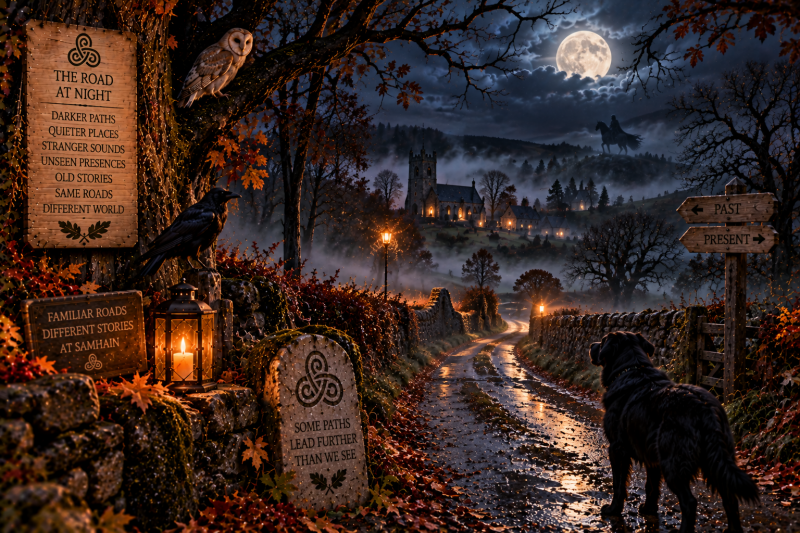
Rural roads change after sunset in late autumn.
Hedges become walls of darkness.
Mist gathers in hollows.
A distant light can appear much closer than it really is.
Animals suddenly cross the road.
Sounds become difficult to identify.
For generations travelling at night could be genuinely dangerous.
It is no surprise that roads accumulated stories of ghosts, phantom animals, fairy encounters and mysterious lights.
Folklore often grows where visibility ends.
Samhain provides plenty of darkness for stories to grow.
Remembering Those Who Came Before
Perhaps the most meaningful modern Samhain tradition is simply remembering.
Not necessarily famous ancestors.
Not legendary kings.
Ordinary people.
Parents.
Grandparents.
Friends.
Neighbours.
People whose names may survive only in photographs or family stories.
Every generation occupies the landscape briefly and then passes it onwards.
The fields remain.
The rivers continue.
Trees outlive us.
Samhain offers a moment to recognise that we are part of something much longer than one lifetime.
The Beginning of Winter
Samhain is often described as a festival of endings.
But its traditional meaning also contains a beginning.
Winter begins.
This changes the way we see the festival.
The dying vegetation is not simply death.
It is preparation.
Leaves fall and enrich the soil.
Seeds wait underground.
Animals change behaviour.
Trees conserve energy.
The landscape withdraws.
Winter is not an empty gap between autumn and spring.
It is a necessary part of the cycle.
Samhain in Modern Paganism
Modern Pagans celebrate Samhain in many different ways.
Some hold formal rituals or gather around fires. Others create ancestor altars, light candles, visit graves, prepare seasonal meals, practise divination or simply spend time remembering people who have died.
Some celebrations are joyful.
Others are quiet.
Some combine Pagan practice with familiar Halloween traditions.
There is no single universal Samhain ceremony.
For many people, its deepest meaning lies in recognising death, memory and renewal as parts of the same cycle.
Ancient Tradition and Modern Meaning
Samhain has genuine historical roots as an important Gaelic seasonal festival.
But not everything now associated with it is ancient.
The phrase “veil between worlds,” modern ancestor altars, pumpkins, contemporary ritual practices and many popular explanations developed through later folklore or modern Paganism.
Meanwhile Christian observances, British and Irish folk traditions and North American Halloween culture added further layers.
Separating these strands does not remove the magic.
It reveals something more interesting.
For more than a thousand years, people have continued finding meaning in the same dark turning point of the year.
The customs changed.
The landscape did not.
How to Experience Samhain
Go outside near the end of October as evening approaches.
Walk somewhere familiar.
Notice how different it looks compared with Beltane.
Listen beneath bare trees.
Look for the last berries in the hedgerows.
Watch crows crossing the evening sky.
Feel the temperature falling after sunset.
If there is mist, notice how quickly familiar landmarks disappear.
Then return home.
Light a fire or candle.
Prepare something warm.
Think about the people who once sat beside fires of their own while winter gathered outside.
You do not need to believe in ghosts to feel the power of the season.
When the Last Light Disappears
Imagine standing beside an old lane on the evening of 31 October.
Bare branches stretch above the hedgerows.
A few orange leaves still cling to an ancient oak.
Beyond the field, smoke rises from a chimney.
Crows cross the fading sky.
Somewhere in the woodland, an owl calls.
The last sunlight disappears behind the hills.
Mist begins gathering beside the river.
For a moment the landscape seems completely still.
Behind you lies the year of growth.
Imbolc's first snowdrops.
Ostara's returning light.
Beltane's hawthorn blossom.
Litha's endless evening.
Lughnasadh's golden fields.
Mabon's overflowing orchard.
All of it has led here.
Ahead lies winter.
Yule waits somewhere in the darkness, when the sun will finally reach its lowest point and begin its return.
But that comes later.
Tonight belongs to the threshold.
To memory.
To fire.
To those who walked these paths before us.
And to the strange, beautiful darkness from which another year will eventually grow.
This is Samhain — when summer finally releases its hold upon the land, the old year passes into memory, and the Wheel turns once more into winter. 🎃🔥