The Eagle in Celtic & British Folklore
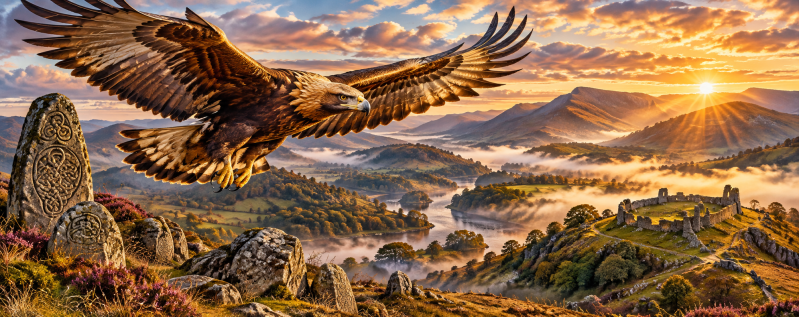
Few birds command a landscape quite like the eagle. Flying high above mountains, valleys and coastlines, it occupies a world that humans can see but cannot naturally enter. Its enormous wings, exceptional eyesight and position above the landscape have made the eagle a powerful presence in stories and symbolism across many cultures.
Eagles also appear in the medieval traditions of Britain and Ireland. One of the most fascinating is the Eagle of Gwernabwy in the Welsh tale Culhwch and Olwen. During the search for the missing Mabon son of Modron, Arthur's companions consult a succession of extraordinarily ancient animals. The eagle is among the oldest and most knowledgeable of them.
Irish tradition also contains stories involving eagles, including tales in which humans and animals undergo remarkable transformations. These stories place the eagle within a much wider medieval world of shape-changing, ancient memory, wilderness and encounters between human beings and the natural world.
Today the eagle is frequently interpreted as a symbol of strength, freedom, vision and spiritual insight. Some of these meanings arise naturally from the bird's behaviour, while others belong to much later spiritual traditions. By returning to the surviving stories, we can separate documented folklore from modern interpretation and discover an eagle every bit as fascinating as the symbolism later attached to it.
The Eagle of Gwernabwy — One of the Ancient Animals of Wales
One of the most memorable eagles in medieval Welsh literature appears in Culhwch and Olwen. As Arthur's companions search for Mabon son of Modron, they must discover where Mabon has been imprisoned. Their search leads them to a remarkable sequence of animals whose immense ages give them memories reaching far beyond those of human beings.
After consulting the Blackbird of Cilgwri, the Stag of Rhedynfre and the Owl of Cwm Cawlwyd, the search eventually reaches the Eagle of Gwernabwy. Like the creatures before it, the eagle has lived for an extraordinary length of time and remembers changes to the landscape that occurred across generations.
The eagle cannot itself reveal Mabon's location, but it remembers an encounter with an enormous salmon. Long before, the eagle had attempted to seize this salmon from the waters of Llyn Llyw and was nearly defeated in the struggle. The two eventually made peace, and the eagle therefore knows where the ancient salmon can be found.
This moment links two of the most remarkable animals in the tale. The Eagle of Gwernabwy leads the searchers to the Salmon of Llyn Llyw, which ultimately possesses the knowledge needed to locate Mabon. The animals form a chain of memory, each carrying knowledge from a world older than the people questioning them.
The eagle's importance therefore comes not simply from strength or majesty, but from age, memory and its knowledge of the wild landscape. This is rather different from the modern idea of the eagle merely representing freedom or spiritual vision, and it gives us a glimpse of the much richer role animals could play in medieval Welsh storytelling.
The Eagle, Age and Ancient Memory
The Eagle of Gwernabwy belongs to a fascinating tradition in which animals become witnesses to stretches of time far greater than a human lifetime. Their age allows them to remember landscapes that have changed, creatures that have disappeared and events that have passed beyond ordinary human memory.
In Culhwch and Olwen, this idea is built gradually. Arthur's companions move from one ancient animal to another, each believed to be older and therefore potentially more knowledgeable than the last. The journey eventually leads from the eagle to the Salmon of Llyn Llyw and, finally, to the information needed to find Mabon.
There is something particularly fitting about giving such a role to an eagle. From high above the ground, an eagle can survey enormous stretches of country. Mountains, rivers, forests and valleys become parts of a single landscape beneath its wings. Although the medieval tale does not explicitly tell us that this viewpoint represents supernatural vision, the eagle's place within the story naturally reinforces its sense of distance, wilderness and extraordinary experience.
The tale also reminds us that knowledge is shared between animals. The eagle does not know everything. Instead, it remembers another creature that may know more. Even an animal of immense age must turn to the salmon, creating a world in which different creatures possess different memories of the landscape.
Rather than simply portraying animals as symbols for human qualities, the story gives them their own histories and relationships. The Eagle of Gwernabwy has fought, survived, remembered and formed an alliance with another ancient creature. It belongs to a landscape that existed long before the heroes arrived to ask their questions.
Eagles and Transformation in Irish Tradition
Transformation is one of the recurring wonders of medieval Irish storytelling. Human beings may pass through different forms, animals may possess extraordinary histories, and identity can survive across periods of time far beyond an ordinary human life. The eagle appears within this remarkable world of shape-changing and ancient memory.
One important example is the story of Tuan mac Cairill. In the medieval tale Scél Tuáin meic Chairill, Tuan survives through successive ages of Ireland by passing through a series of forms. His transformations include a stag, a wild boar, a great bird — commonly understood in translations as an eagle — and eventually a salmon.
Through these changing forms, Tuan witnesses successive peoples arriving in Ireland. His transformations allow the story to carry memory across enormous stretches of legendary history. The animals are therefore more than disguises: each form becomes part of a life extending beyond normal human experience.
The eagle fits naturally within this sequence. Where the stag belongs to the forest and the boar to the wild ground, the great bird occupies the sky and experiences the landscape from an entirely different perspective. Eventually Tuan enters the water as a salmon, continuing the remarkable movement between different realms of the natural world.
As with the Eagle of Gwernabwy, the strongest connection here is not a simple claim that “the eagle meant” one particular thing to ancient Celtic peoples. Instead, the surviving literature connects the eagle with transformation, longevity and extraordinary experience — themes considerably richer than reducing the bird to a single symbolic meaning.