The Wolf in British & Irish Folklore
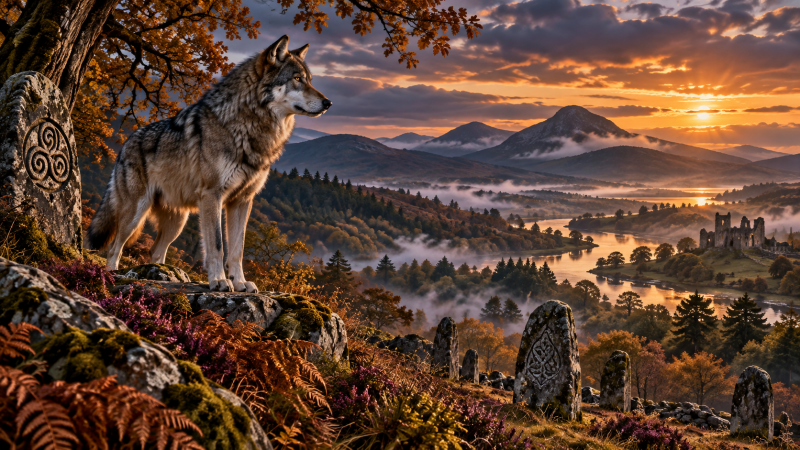
Few animals have inspired such a complicated mixture of admiration and fear as the wolf. Intelligent, social and extraordinarily adaptable, wolves once inhabited the wild landscapes of Britain and Ireland, where their presence inevitably brought them into both conflict and fascination with people.
Long after wolves disappeared from these islands, they continued to survive in stories. Irish tradition contains remarkable tales involving wolves and human transformation, while medieval writers recorded accounts in which the boundary between wolf and person became disturbingly uncertain.
Perhaps the most extraordinary is the medieval story of the Werewolves of Ossory, recorded by Gerald of Wales. Far from the familiar image of a savage monster under a full moon, his account describes people condemned to live temporarily in wolf form — including an encounter between a travelling priest and a dying female werewolf.
Wolves also appear around saints and religious legends. St Patrick became connected with later traditions concerning wolves and transformation, while St Columba appears in a story involving a wolf on the island of Iona. Such tales reveal how the wolf survived within Christian storytelling as well as older traditions.
Modern Celtic and Pagan imagery often presents the wolf as a symbol of loyalty, instinct, freedom, guardianship and connection with wilderness. Some of these interpretations are inspired by genuine characteristics of wolves, but they should not automatically be treated as universal beliefs held by ancient Celtic peoples.
To understand the wolf's real place in folklore, we therefore need to look beyond the modern idea of the “Celtic wolf spirit”. The surviving stories are stranger, more varied and considerably more interesting.
The Werewolves of Ossory
One of the strangest wolf stories associated with medieval Ireland concerns the Werewolves of Ossory. The account was written by the cleric Gerald of Wales (Giraldus Cambrensis) in his Topographia Hibernica, composed in the late twelfth century.
Gerald tells of a priest travelling through Ireland with a young companion. While camping in woodland, they are approached by a wolf that, astonishingly, begins to speak with a human voice. Rather than attacking them, the animal explains that he is actually a man from Ossory.
According to the wolf, a curse had been placed upon his people. At regular intervals, a man and a woman were forced to leave their human bodies behind and live in the form of wolves. If they survived their years in animal form, they could eventually return home and two others would take their place.
The male wolf has sought out the priest because his female companion is dying. He asks the priest to accompany him and administer the Christian rites to her before death. When the priest hesitates to believe that the dying wolf is truly human, the male wolf performs an extraordinary act: he pulls back part of her wolf skin, revealing the form of an elderly woman beneath.
The episode is very different from the werewolf stories familiar from later horror fiction. There is no full moon, silver bullet or uncontrollable monster. Gerald's wolves remain rational human beings capable of speech, religious belief and concern for one another.
Gerald presented the story as something worthy of serious discussion rather than simply as entertainment. For the medieval writer, the troubling question was not merely whether people could become wolves, but what such a transformation meant for the relationship between the human body, the soul and divine power.
The Werewolves of Ossory therefore provide a remarkable example of how wolf folklore could intersect with medieval Christianity. Whatever we make of Gerald's extraordinary account today, it preserves a very different kind of werewolf from the creature created by modern popular culture.
Explore further: Discover more stories of transformation and the Celtic Otherworld →
Wolves, Warriors and Transformation in Irish Tradition
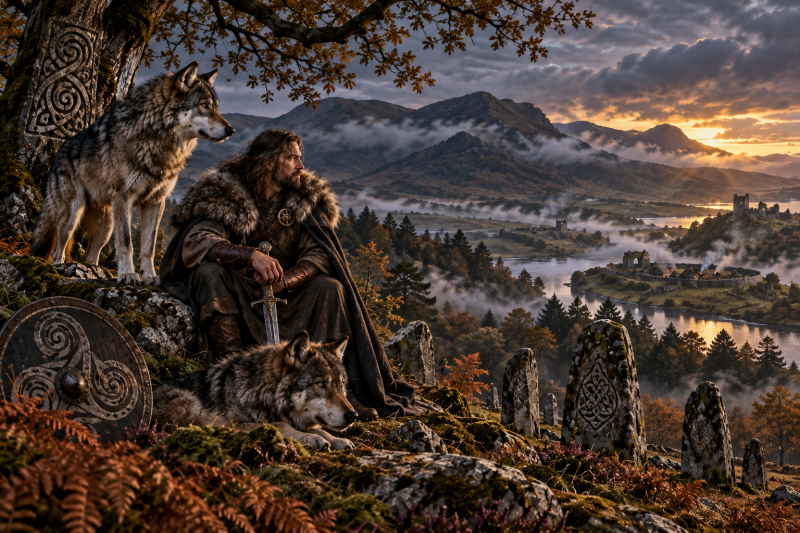
The Werewolves of Ossory were not the only place where wolves and human identity became intertwined in Irish tradition. Wolves appear within a much broader world of stories involving warriors, wilderness and transformation, although the surviving material does not support the idea of one universal ancient “Celtic wolf belief”.
The Irish language itself preserves an interesting association between wolves and the wild. Older terms for the wolf could carry connections with dangerous or untamed animals, while medieval literature was produced in a landscape where wolves were still very real creatures rather than animals known only through stories.
Warriors and outlaws could also be imagined through animal qualities. The wolf's ability to survive beyond settlements, hunt effectively and move through wild country made it a powerful comparison for people existing outside ordinary society. This did not necessarily mean that such people were believed literally to become wolves.
Transformation stories complicate the picture further. Medieval Irish literature contains humans assuming animal forms through magic, curses or supernatural circumstances. The wolf could therefore belong to a storytelling world in which the boundary between human and animal was not always permanent.
Later interpretations sometimes turn these scattered traditions into claims about ancient Celtic “wolf warriors”, wolf cults or universal wolf spirit guides. Such ideas should be treated cautiously. The surviving evidence is far more fragmented — but also more interesting — than a single system of wolf symbolism.
What repeatedly emerges is the wolf as an animal of the edge of the human world: intelligent and social, yet living beyond the safety of settlement. That position made it especially suited to stories about exile, danger, transformation and people who themselves existed beyond ordinary boundaries.
Saints and Wolves
As Christianity spread through Ireland and Britain, wolves did not disappear from storytelling. Instead, they entered the legends surrounding saints, monasteries and holy people. In these stories the wolf could remain dangerous and unpredictable, but encounters with saints often demonstrated a different relationship between humanity, wilderness and divine authority.
One surviving tradition associated with St Columba tells of a wolf on the island of Iona. In Adomnán's Life of St Columba, a man is sent into the wilderness to find a suitable piece of wood. Columba warns him that a wolf will encounter him during the journey. Rather than simply describing the animal as evil, the story presents the meeting as something foreseen by the saint and occurring within a landscape where wild animals and human beings still lived remarkably close to one another.
Wolves also became connected with traditions surrounding St Patrick, although stories attributed to him come from different periods and should not all be treated as historical accounts of the fifth-century missionary. One remarkable later tradition concerns people transformed into wolves following a curse associated with the saint — a motif that became entangled with Irish werewolf lore.
Christian legends elsewhere in Europe sometimes portrayed saints calming wolves, protecting communities from them or establishing peace between dangerous animals and people. Such stories allowed the wolf to represent the frightening wilderness while simultaneously demonstrating that even the wildest creature remained part of the created world.
These traditions are particularly interesting because they show folklore changing rather than simply being replaced. Wolves that once belonged to landscapes of warriors, hunters and supernatural transformation could also enter a Christian storytelling world of saints, miracles and moral lessons.
By the medieval period, the wolf therefore occupied several imaginative worlds at once: it was a genuine predator, an animal of the wilderness, a creature associated with transformation and a powerful character in religious legend.
When Wolves Still Roamed Britain and Ireland
The wolves of British and Irish folklore were not imaginary inhabitants of some distant mythical wilderness. For much of human history, wolves genuinely shared these islands with people. Their presence would have been familiar to generations of farmers, hunters and travellers, particularly in remote forests, mountains and less densely settled country.
Wolves once occurred throughout Britain, but centuries of hunting, habitat change and persecution steadily reduced their numbers. As woodland was cleared and livestock farming expanded, conflict between wolves and people increased. Rewards and organised efforts to kill wolves helped drive them from the landscape.
Wolves became increasingly rare in Ireland during the seventeenth century as organised persecution intensified. The exact date of their final disappearance is uncertain, although a traditional account places the last Irish wolf at Mount Leinster in 1786.
Ireland retained wolves considerably longer. The animal became so closely associated with the country that early modern writers sometimes described Ireland as particularly wolf-ridden. During the seventeenth century, organised hunting and substantial bounties contributed to a rapid decline. Wolves are generally considered to have disappeared from Ireland by the end of the seventeenth or beginning of the eighteenth century, although tales of individual survivors continued afterwards.
Their disappearance changed the meaning of the wolf within folklore. An animal that had once represented a genuine presence beyond the settlement gradually became something encountered mainly through stories, place-names, manuscripts and inherited memory.
This historical background helps explain why older wolf traditions can feel so different from modern symbolism. Medieval people did not need to imagine what it might be like to hear wolves beyond the edge of inhabited land. For many communities, that possibility had once been part of the real landscape.
Wolf Symbolism and Modern Paganism
Within modern Paganism and Celtic-inspired spirituality, the wolf has become a powerful symbol of instinct, loyalty, family, independence and connection with wilderness. These interpretations combine observations of real wolf behaviour with imagery drawn from mythology, folklore and modern spiritual practice.
Loyalty and family are especially common associations. Wolves are highly social animals whose packs are generally family groups, with parents and their offspring cooperating in raising young and defending territory. This has made the wolf an appealing modern symbol of devotion, cooperation and protecting those closest to us.
At the same time, popular culture frequently celebrates the “lone wolf” as a symbol of independence and self-reliance. Real wolf behaviour is more complicated. Wolves normally depend heavily upon social relationships, although individuals may leave their family group and travel considerable distances while searching for territory or a mate.
Instinct and wilderness form another important part of modern wolf symbolism. Because wolves disappeared from Britain and Ireland centuries ago, they can now represent a lost wild landscape — forests and mountains in which humans were not the only large predators moving through the night.
Some contemporary Pagan traditions also associate wolves with guardianship, spiritual journeys, transformation and the ability to move confidently through darkness or uncertainty. Irish stories involving human beings and wolves provide fascinating historical material for modern interpretation, particularly the traditions surrounding Ossory.
However, there was no single documented ancient “Celtic wolf symbol” carrying one fixed meaning of loyalty, strength or spiritual guidance. Irish literature, medieval Christian writing, historical encounters with wolves and modern Pagan spirituality belong to different periods and traditions.
The wolf's continuing symbolic power may ultimately come from that complexity. It can represent both community and independence, danger and protection, the familiar family group and the wilderness beyond human settlement.
Frequently Asked Questions About Wolf Folklore
What did the wolf symbolise to the Celts?
There is no evidence for one universal Celtic meaning of the wolf. Wolves appear in Irish and other medieval traditions involving wilderness, warriors, transformation and supernatural events, while many familiar meanings such as loyalty, guardianship and spiritual guidance belong largely to modern interpretation.
Were there really werewolves in Irish folklore?
Ireland has an extraordinary medieval werewolf tradition. Gerald of Wales recorded a twelfth-century account of people from Ossory who were temporarily forced to live in wolf form. His story is very different from the full-moon werewolf familiar from modern horror.
What were the Werewolves of Ossory?
According to Gerald of Wales, a man and woman from Ossory were periodically condemned to leave human society and live as wolves. His most famous episode describes a speaking male wolf asking a travelling priest to administer Christian rites to his dying female companion.
Did wolves once live in Britain and Ireland?
Yes. Wolves were native to both Britain and Ireland and survived alongside people for centuries. Persecution, hunting and changes to the landscape eventually eliminated them, with wolves surviving considerably longer in Ireland and Scotland than in England.
Are wolves sacred in modern Paganism?
Wolves can hold considerable spiritual significance within some modern Pagan and nature-based traditions, where they may represent instinct, family, protection or wilderness. These are living modern beliefs rather than evidence for one universal ancient Celtic wolf religion.
From Folklore to Art
Few animals create such an immediate sense of wilderness as the wolf. Even though wolves disappeared from Britain and Ireland centuries ago, their presence still feels perfectly at home among ancient forests, mist-covered mountains and lonely tracks through the landscape.
My wolf-inspired artwork draws upon that meeting point between real natural history and centuries of storytelling. Ancient stones, woodland, moonlight and distant mountains create landscapes in which the wolf feels both completely natural and slightly mysterious.
The stories surrounding wolves are especially inspiring because they resist one simple interpretation. The wolf can be feared as a predator, admired for its intelligence and family bonds, or transformed through folklore into something standing between the human world and the wild.
Wolf-Inspired Celtic Art
Explore artwork inspired by wolves, Celtic landscapes, ancient folklore and the lost wilderness of Britain and Ireland.
Continue Exploring the Folklore
Animals in Celtic & British Folklore →
Return to the main collection and discover the stories surrounding other animals and birds.
The Stag in Celtic & British Folklore →
Explore deer mythology, Cernunnos, the white stag and the mysterious world of the wild forest.
The Raven in Celtic & British Folklore →
Discover ravens, the Morrígan, Brân the Blessed and centuries of mythology and folklore.
The Celtic Otherworld →
Explore supernatural landscapes, transformation and traditions surrounding the world beyond the ordinary.
Sources & Further Reading
The history of the wolf in Britain and Ireland brings together medieval literature, saints' lives, folklore and natural history. The sources below provide further reading for some of the traditions and historical claims discussed on this page.
The Werewolves of Ossory
The extraordinary story of the Werewolves of Ossory was recorded by Gerald of Wales (Giraldus Cambrensis) in the late twelfth-century Topographia Hibernica (The Topography of Ireland). His account describes a priest encountering a speaking wolf who claims to be a human living temporarily in wolf form.
For the bibliography entry use:
Gerald of Wales — Topographia Hibernica (The Topography of Ireland), late 12th century.
St Columba and Wolves
Stories involving animals and the natural world appear in Adomnán's Life of St Columba, written around a century after Columba's death. It is an important early source for traditions that developed around the saint and life on and around Iona.
Adomnán of Iona — Vita Columbae (Life of St Columba), late 7th century.
Wolves in Ireland
Wolves were once part of the Irish landscape. The National Museum of Ireland notes evidence of wolves in Ireland going back tens of thousands of years and explains that persecution and rewards for killing wolves contributed to their eventual disappearance. The Museum gives 1786 as the traditional date for the last Irish wolf, reportedly killed around the Mount Leinster area.
National Museum of Ireland — Grey Wolf and extinction in Ireland
Wolves in Britain
Wolves were also once native to Britain. The Natural History Museum describes wolves among Britain's lost large carnivores and explains that persecution intensified from the Middle Ages as agriculture and settlements expanded.