The Stag in Celtic & British Folklore
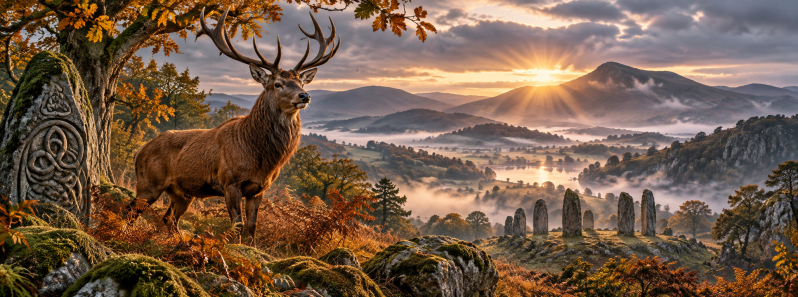
Few animals have made as powerful an impression on the landscapes and stories of Britain and Ireland as the deer. Among them, the great red deer stag — crowned with branching antlers and heard roaring across the hills during the autumn rut — has long inspired stories of wilderness, hunting, kingship and the supernatural.
Deer appear repeatedly in Irish and Welsh literature, medieval legend and later British folklore. Sometimes they are quarry pursued by hunters; elsewhere an unusual deer leads people away from the familiar world and towards mysterious places, remarkable encounters or supernatural events.
The stag's appearance undoubtedly contributed to its reputation. Each year its antlers are cast and regrown, eventually developing into the impressive crowns carried by mature males. Combined with the animal's strength, speed and association with forests and remote hills, this made the stag a compelling figure for storytellers and artists.
Modern Pagan and popular “Celtic” symbolism often associates the stag with strength, fertility, regeneration, the forest and the cycle of the seasons. Some of these ideas draw inspiration from genuine ancient imagery and mythology, but others are much newer interpretations.
The story of the stag is therefore more interesting than a simple list of symbolic meanings. By separating surviving mythology, recorded folklore, ancient imagery and modern spirituality, we can see how a real wild animal became one of the most enduring figures in the imaginative landscape of Britain and Ireland.
Deer in Celtic Mythology
There was no single mythology shared unchanged by all the peoples now described as Celtic. Much of what survives about deer comes instead from particular medieval Irish and Welsh texts, written down centuries after the pre-Christian societies from which some of their stories may ultimately have developed.
Within these traditions, deer frequently appear in stories involving hunting, wilderness and encounters with the supernatural. A hunt can begin in the ordinary landscape but lead its participants towards something unexpected — a mysterious animal, an unfamiliar place or a figure whose identity is not immediately clear.
Irish tradition provides particularly memorable examples. In stories surrounding Fionn mac Cumhaill and the Fianna, deer belong naturally to the wild landscape inhabited by hunters and warriors. One famous tradition tells of Sadhbh, a woman transformed into a deer through enchantment. After Fionn's hunting dogs recognise that the deer is no ordinary animal, Sadhbh regains human form and becomes part of Fionn's story.
Their son is Oisín, one of the great figures associated with the Fianna. His name is traditionally understood in connection with a young deer or fawn, reinforcing the importance of deer imagery within the stories surrounding him.
Welsh literature offers another striking example. At the beginning of the First Branch of the Mabinogi, Pwyll, Prince of Dyfed, is hunting when he encounters another hunter's strange pack of hounds pursuing a stag. His decision to interfere with the hunt leads to his meeting with Arawn, ruler of Annwn, and begins an extraordinary story involving the Otherworld.
These stories do not prove that deer possessed one universal sacred meaning throughout the ancient Celtic world. What they do show is something more useful: deer repeatedly appear at moments when hunting, wilderness and the supernatural meet.
The White Stag and the Otherworld
Few animals seem more suited to folklore than a white deer appearing unexpectedly in a dark forest. Its unusual colour immediately separates it from the ordinary landscape, and stories across different periods have used white deer and white stags as mysterious creatures that draw hunters and travellers away from familiar ground.
In medieval storytelling, the pursuit of an extraordinary animal often does more than begin a hunt. It can lead a character into an unfamiliar landscape, towards a supernatural encounter or into circumstances that change the course of the story. The animal effectively becomes a guide between the everyday world and somewhere stranger.
This idea fits particularly well with surviving Welsh material in which hunting can bring people into contact with the Otherworld. In the First Branch of the Mabinogi, Pwyll's encounter during a stag hunt ultimately brings him face to face with Arawn, ruler of Annwn. The stag itself is not described as a magical white stag, however, so the story should not be turned into something the medieval text does not actually say.
White deer also became important in later medieval European literature, including romance and hunting stories. Their rarity made them ideal symbols of something exceptional and almost impossible to possess. A hunter might pursue such an animal only to discover that the chase mattered more than the capture.
Modern Celtic and Pagan imagery has strengthened the connection between the white stag and ideas such as the Otherworld, spiritual journeys and crossing boundaries. These interpretations can be powerful, but they combine several layers of tradition rather than representing one universal ancient Celtic belief.
Perhaps that is why the image remains so compelling. A white stag disappearing between ancient trees naturally invites pursuit — not necessarily because we expect to catch it, but because folklore makes us wonder where it might lead.
The Stag, Cernunnos and the Horned God
Few ancient figures have become as closely associated with modern Celtic imagery as Cernunnos. He is commonly depicted today as a mysterious antlered god of forests, animals, fertility and the wild. The surviving archaeological evidence, however, tells us considerably less about him than many modern descriptions suggest.
The name Cernunnos is known from only a small number of ancient inscriptions. The most famous appears on the Pillar of the Boatmen, a Gallo-Roman monument discovered beneath Notre-Dame in Paris. The surviving relief shows an antlered male figure accompanied by the inscription usually reconstructed as Cernunnos.
Another extraordinary image appears on the Gundestrup Cauldron, discovered in Denmark but decorated with imagery often connected with the Iron Age Celtic world. One panel depicts an antlered figure seated among animals, holding a torc in one hand and a horned serpent in the other. The figure is frequently identified as Cernunnos, although no inscription on the cauldron actually names him.
Because antlers are such a striking feature, later interpretations naturally connected Cernunnos with deer, wilderness, fertility and cycles of nature. Some of these interpretations may be reasonable possibilities, but we do not possess an ancient text explaining exactly who Cernunnos was, what myths were told about him or precisely what his antlers represented.
It is also important to distinguish ancient Cernunnos from the Horned God of modern Pagan and Wiccan traditions. Modern spiritual traditions may draw inspiration from ancient horned and antlered imagery, but the Horned God as understood today should not simply be presented as an unchanged deity worshipped throughout the ancient Celtic world.
What survives is tantalising rather than complete: a name, several remarkable images and an antlered figure whose original stories have largely disappeared. Perhaps that uncertainty is partly why Cernunnos continues to inspire such fascination.
The Stag in British Folklore
Deer have occupied an important place in the British landscape for centuries. They were animals of the forest and open hill, but they were also closely connected with hunting, land ownership and royal power. In medieval England, forests were not simply areas of woodland: they could be territories governed by special forest laws designed partly to protect game animals such as deer.
This made the stag more than simply a wild animal. To encounter, pursue or kill a deer could carry social as well as practical significance. Hunting became associated with status and privilege, while stories about deer naturally developed around forests, estates and the people permitted — or forbidden — to hunt within them.
Folklore also gave unusual deer a more mysterious character. A stag appearing unexpectedly, behaving strangely or proving impossible to capture could transform an ordinary hunt into the beginning of a supernatural story. White deer were especially suited to this role because their rarity immediately marked them as extraordinary.
Christianity added another layer to European deer traditions. Medieval legends concerning saints sometimes feature a stag bearing a miraculous sign between its antlers, most famously in stories associated with Saint Eustace and, in later tradition, Saint Hubert. These are Christian rather than specifically Celtic stories, but they helped strengthen the stag's wider association with revelation and spiritual transformation.
The stag therefore stood at the meeting point of several worlds: the genuinely wild animal of Britain's forests and hills, the prestigious quarry of the hunt, the extraordinary creature of storytelling and, occasionally, an animal through which the supernatural revealed itself.
The Red Deer — Britain's Great Wild Stag
The red deer is one of the most impressive wild mammals found in Britain and Ireland. Mature males can carry magnificent branching antlers, giving the stag the instantly recognisable appearance that has inspired artists and storytellers for centuries.
Autumn brings one of the great spectacles of the deer year: the rut. During this breeding season, stags roar to advertise their presence and compete with rivals. Males may parallel-walk to assess one another and, when neither gives way, clash antlers in dramatic contests for access to females.
To people living close to wild landscapes, the sound alone must have been memorable. The deep roar of a stag travelling across a misty valley or through woodland at dawn can seem remarkably atmospheric even when its biological purpose is completely understood.
Antlers provide another extraordinary feature. Unlike permanent horns, deer antlers are grown and later cast. A stag sheds its antlers and grows a new set, which initially develops beneath a covering of soft tissue known as velvet. As the antlers mature, the velvet is lost and the hardened bone is exposed.
This annual cycle makes the modern association between antlers and renewal or regeneration understandable. We should be cautious about claiming that ancient people definitely interpreted the process in exactly the same symbolic way, however. The natural phenomenon is certain; the meanings different societies attached to it are much harder to reconstruct.
Understanding the real stag therefore adds something important to its folklore. Its enormous antlers, seasonal transformations, autumn roaring and ability to disappear into forest or mountain country already make it an extraordinary animal without requiring supernatural explanation.
Stag Symbolism and Modern Paganism
The stag has become a powerful symbol within modern Paganism, nature spirituality and contemporary Celtic-inspired art. Its imposing antlers, seasonal behaviour and association with forests and wild landscapes make it a natural image for strength, independence and the untamed natural world.
Strength and leadership are among the most common modern interpretations. During the autumn rut, mature stags compete for mates and command attention through their size, antlers and extraordinary roaring calls. It is easy to understand how these characteristics developed into symbols of confidence, authority and endurance.
The annual growth and shedding of antlers has also encouraged associations with renewal, regeneration and the cycles of nature. A stag can lose the feature that most defines its appearance and then grow an entirely new set, providing a striking natural image of change and renewal.
Within modern Pagan traditions, the stag may also represent the wild masculine, fertility, the forest and humanity's relationship with the natural world. Antlered imagery is sometimes connected with Cernunnos or with the Horned God found in some contemporary Pagan and Wiccan traditions.
These ideas can carry genuine spiritual significance for people today, but they should not automatically be described as a single ancient “Celtic meaning of the stag”. Ancient images, medieval stories, later folklore and modern Pagan practice come from different periods and should be understood on their own terms.
The stag's continuing power as a symbol perhaps comes from something simpler and much older than any single interpretation: encountering a mature stag in a wild landscape is impressive. For generations, people have taken that experience and transformed it into stories, art and belief.
Frequently Asked Questions About Stag Folklore
What does a stag symbolise?
Today, the stag commonly symbolises strength, independence, renewal, wilderness and connection with nature. Meanings vary considerably between cultures and periods, however, so these modern associations should not all be presented as ancient beliefs.
What is the Celtic meaning of a stag?
There was no single universal “Celtic meaning” of the stag. Deer appear in surviving Irish and Welsh stories involving hunting, transformation and supernatural encounters, while antlered figures also occur in ancient continental Celtic imagery. These traditions are related to different places and periods rather than one unified system of symbolism.
Is Cernunnos a stag god?
Cernunnos is an ancient antlered deity known from a small number of inscriptions and images. He is frequently described today as a god of animals, forests and fertility, but no surviving ancient text gives us a complete explanation of his identity or tells us that he was specifically a “stag god”.
What does a white stag symbolise?
In later storytelling and modern symbolism, the white stag can represent mystery, an extraordinary quest or a journey beyond the familiar world. White deer occur in several layers of European tradition, so the idea should not be treated as exclusively Celtic or given one universal meaning.
Why are stags associated with renewal?
One obvious reason is their antlers. Stags cast and regrow them in a recurring natural cycle. Modern symbolism often interprets this as regeneration and renewal, although we cannot assume ancient societies necessarily gave the process exactly the same meaning.
From Folklore to Art
Few animals fit the world of Pixie Page Crafts as naturally as the stag. It belongs to real forests, mountains and misty valleys, yet centuries of mythology and folklore have given it a presence that seems to reach beyond the ordinary landscape.
The branching antlers of a mature stag echo the shapes of trees, while its seasonal life connects naturally with the changing colours and atmosphere of the year. Ancient stones, autumn woodland, distant mountains and quiet paths all provide landscapes in which the stag feels completely at home.
My stag-inspired artwork draws upon this meeting point between wildlife, landscape and folklore. Rather than illustrating one particular ancient belief, the images are intended to capture the feeling behind the stories — that moment when an encounter with a wild animal makes a familiar landscape suddenly seem much older and more mysterious.
Stag-Inspired Celtic Art
Explore artwork inspired by the stag, ancient landscapes, Celtic folklore and the wild places of Britain and Ireland.
Continue Exploring the Folklore
Animals in Celtic & British Folklore →
Return to the main guide and discover the stories surrounding other animals and birds.
The Celtic Otherworld →
Explore traditions surrounding Annwn, the Otherworld and the mysterious landscapes beyond the ordinary world.
The Raven in Celtic & British Folklore →
Discover ravens, the Morrígan, Brân the Blessed, prophecy and centuries of British and Irish folklore.
The Fox in British & Irish Folklore →
Explore traditions of cunning, shapeshifting, witchcraft and the elusive red fox
Sources & Further Reading
The relationship between deer, mythology and folklore stretches across many different periods. The sources below include medieval Welsh and Irish tradition, archaeological evidence for ancient antlered imagery, academic research and modern natural-history information. Together they help distinguish surviving evidence from later interpretations.
The First Branch of the Mabinogi — Pwyll and Arawn
The First Branch begins with Pwyll hunting in Glyn Cuch, where he encounters a stag being pursued by an extraordinary pack of white, red-eared hounds. His actions lead to his meeting with Arawn and his involvement with Annwn. Importantly, the medieval story describes the hounds as supernatural-looking; it does not say that the stag itself is white.
Read the First Branch material from Oxford University Press
Deer, Fionn and the Fianna
Irish tradition contains numerous connections between deer and the Fianna. Ask About Ireland discusses stories involving deer transformation and supernatural encounters, including the tradition in which Fionn's lover Sadhbh, mother of Oisín, takes the form of a deer.
Ask About Ireland — Magic and Supernatural Motifs
Oisín and the Deer Tradition
The Dictionary of Irish Biography records Oisín as a major figure of the Fianna cycle and notes traditions in which his mother could take the form of a doe or was magically transformed into one. It also explains the connection between his name and “little deer”.
Dictionary of Irish Biography — Oisín
Cernunnos and the Pillar of the Boatmen
One of the most important pieces of evidence for Cernunnos is the first-century Pillar of the Boatmen, discovered beneath Notre-Dame in Paris. The Musée de Cluny identifies one of its surviving figures as Cernunnos. The monument combines Gallic and Roman divinities and dates to the reign of Tiberius.
Musée de Cluny — Pillar of the Boatmen
The Gundestrup Cauldron
The National Museum of Denmark describes the famous Gundestrup Cauldron panel as showing an antlered god surrounded by animals. The museum cautiously suggests that the figure may have represented power over nature and wild animals. The cauldron was probably produced between about 150 BC and the beginning of the Common Era in an area where Celtic and Thracian cultures met.
National Museum of Denmark — The Gundestrup Cauldron
Red Deer — The British Deer Society
The British Deer Society provides detailed information about red deer in Britain. Red deer are Britain's largest land mammal, and during the autumn rut stags compete through roaring, displays, parallel walking and sometimes fighting.
British Deer Society — Red Deer
The Antler Cycle
The British Deer Society also documents the annual antler cycle. Deer cast their antlers and regrow them beneath a covering of velvet before the hardened antlers are cleaned. This gives us a firm natural-history basis for the renewal imagery discussed in the article, without needing to claim ancient people necessarily interpreted it in exactly the same way.