Animals in Celtic Mythology & Folklore
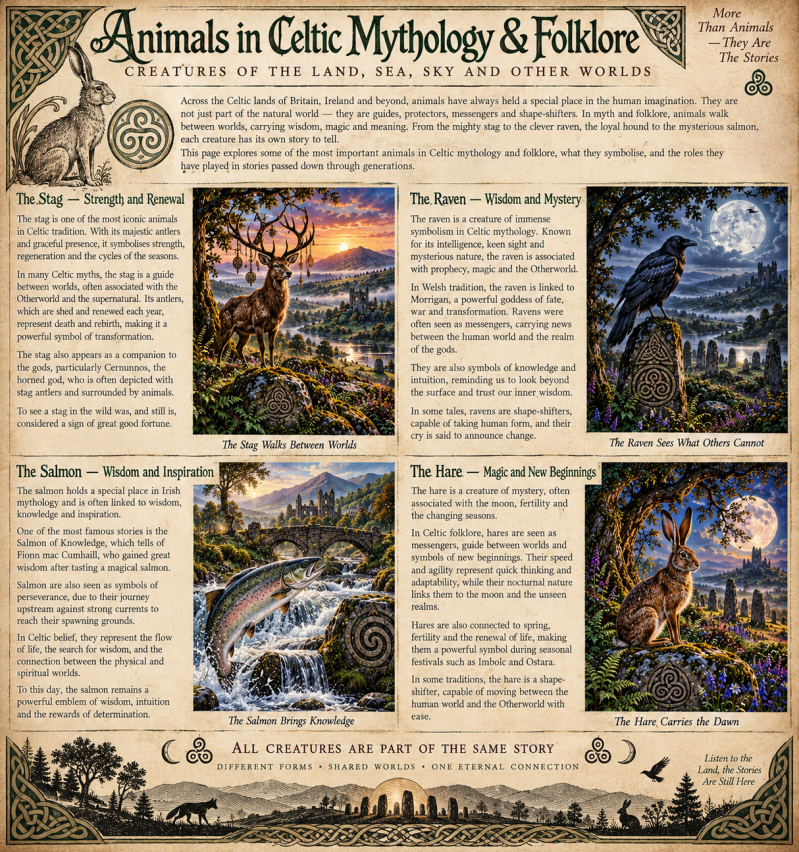
Creatures of the Land, Water, Sky and Otherworld
Across the Celtic-speaking lands of Ireland, Wales, Scotland and Britain, animals have occupied a remarkable place in mythology and folklore.
Ravens appear beside powerful supernatural figures. Salmon possess extraordinary knowledge. Hares become entangled with stories of transformation and witchcraft. Great boars are hunted by legendary heroes, while horses carry travellers toward places beyond the ordinary human world.
These creatures were not simply symbols with one fixed meaning. Their roles changed between stories, regions and centuries.
Some associations survive in medieval literature. Others belong to much later folk traditions, while still more have become important within modern Paganism.
Together they reveal something fascinating about the relationship between people and the wild animals that shared their landscape.
Animals Between Two Worlds
Animals experience the world differently from us.
Birds disappear into the sky. Fish vanish beneath dark water. Nocturnal creatures emerge while humans sleep. Migrating animals disappear for months before mysteriously returning.
For earlier communities, these behaviours naturally inspired stories.
Throughout Celtic mythology, animals sometimes appear at moments when a character is about to leave the familiar world behind.
A hunt might begin with the pursuit of an unusual animal.
A mysterious bird might lead someone towards an unexpected encounter.
A human might be transformed into an animal or discover that the creature before them is not quite what it appears.
Animals therefore became perfect inhabitants of the uncertain boundary between the human world and the supernatural.
The Stag — Wildness, Majesty and the Forest
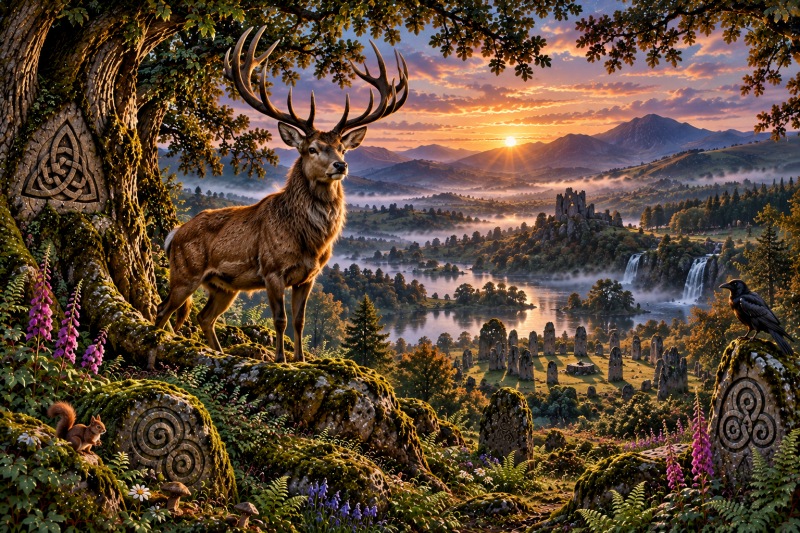
Few animals create an impression quite like a mature red deer stag.
Its enormous antlers rise above its head like the branches of a tree, growing and being shed again as part of a natural cycle.
Deer appear throughout medieval Irish and Welsh literature, particularly in stories involving hunting and encounters within wild landscapes.
One of the most famous images associated with Celtic religion comes not from Britain or Ireland but from the Gundestrup Cauldron, discovered in Denmark. One of its panels depicts an antlered figure often identified with Cernunnos, a deity known from inscriptions found elsewhere in the ancient Celtic world.
Exactly what this figure represented remains debated.
Nevertheless, the association between antlers, animals and supernatural imagery is striking.
Later folklore and modern Pagan traditions have increasingly treated the stag as representing wild nature, strength, renewal and connection with the forest.
Whatever symbolism we place upon it today, encountering a stag standing silently at the edge of woodland still carries something of that ancient sense of wildness.
Explore the Stag in Celtic Mythology & Folklore →
The Raven — Battle, Intelligence and Mystery
The raven is one of the most memorable birds appearing in Irish mythology.
Large, intelligent and unmistakably black, ravens and their relatives naturally attracted attention.
They were also familiar sights around battlefields and places where animals or humans had died, creating an understandable connection between these birds and death.
Irish mythology contains particularly strong associations between the Morrígan and ravens or crows.
The Morrígan is a complicated supernatural figure associated with conflict, sovereignty, prophecy and fate. Different medieval texts portray her in different ways, and modern simplified descriptions rarely capture the full complexity of the surviving traditions.
Nevertheless, corvids became deeply associated with the imagery surrounding battle and supernatural power.
Ravens themselves are extraordinarily intelligent animals.
They solve problems, remember individuals, communicate with one another and display complex social behaviour.
Perhaps that intelligence contributes to their enduring reputation as birds that seem to know more than they reveal.
Explore Raven Symbolism in Celtic Mythology →
The Salmon — Keeper of Wisdom
One of the most beautiful animal stories in Irish tradition concerns a fish.
The legendary Salmon of Knowledge is connected with the story of the young Fionn mac Cumhaill.
According to the tale, the salmon gained extraordinary wisdom after eating hazelnuts associated with a magical source of knowledge.
The poet Finegas sought the salmon for years and eventually caught it.
Young Fionn was instructed to cook the fish but not eat it.
While cooking, he burned his thumb and instinctively placed it in his mouth.
Through this small accident, Fionn received the wisdom intended for his teacher.
The salmon therefore became closely connected in later retellings with knowledge, inspiration and wisdom.
But there is also something wonderfully appropriate about choosing a salmon for such a story.
Salmon perform astonishing migrations, leaving rivers for the ocean before eventually finding their way back towards the waters where their lives began.
Long before modern science explained how remarkable this journey really is, people watching salmon return upstream must have wondered where they had been.
The Hare — Transformation and Mystery
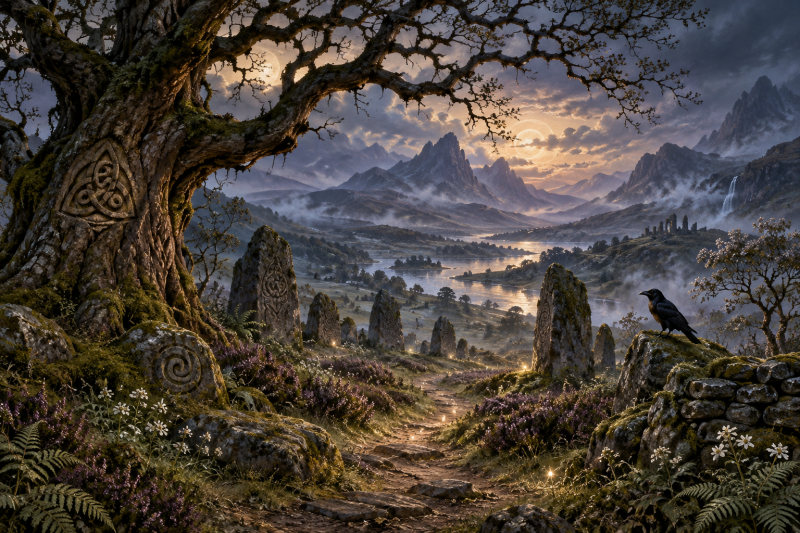
Few British animals have accumulated as much folklore as the hare.
Fast, elusive and often most active around dawn and dusk, hares can behave in ways that seem wonderfully strange.
In spring they chase one another across open fields and famously appear to “box,” creating the behaviour behind the expression mad as a March hare.
Later British and Irish folklore developed particularly strong connections between hares and witchcraft and shape-shifting.
Stories told of witches taking the form of hares, sometimes being injured while in animal form and later discovered carrying an identical wound as humans.
These stories belong largely to later folklore rather than providing simple evidence of ancient Celtic religious beliefs.
The distinction is important.
Yet the hare also appears within much older Celtic contexts, demonstrating that the animal had attracted human attention long before the later witchcraft stories developed.
Its speed, secrecy and ability to disappear rapidly into the landscape make it almost inevitable that stories would follow it.
Explore the Hare in Celtic Mythology & Pagan Folklore →
The Boar — Ferocity and the Heroic Hunt
Wild boar once roamed the forests of Britain and Ireland.
Powerful, unpredictable and potentially dangerous when threatened, they made formidable opponents.
Boars consequently appear frequently in heroic Celtic literature.
One of the most famous examples occurs in the Welsh tale Culhwch and Olwen, where the hunting of the supernatural boar Twrch Trwyth becomes an enormous adventure involving Arthur and his warriors.
The animal is no ordinary boar.
The hunt ranges across landscapes and involves numerous heroes, transforming the pursuit into something far greater than an ordinary hunting expedition.
Boar imagery also appears in ancient Celtic art and objects from continental Europe.
It is easy to understand the appeal.
The boar represented an animal capable of challenging even an armed hunter.
In storytelling, that makes it the perfect opponent for a hero.
The Horse — Power, Travel and the Supernatural
Horses transformed human life.
They enabled faster travel, increased mobility and became enormously valuable symbols of wealth and status.
It is therefore unsurprising that horses appear prominently in Celtic mythology.
The continental Celtic goddess Epona is particularly associated with horses and was worshipped across a surprisingly wide geographical area during the Roman period.
Welsh tradition gives us Rhiannon, a mysterious and powerful woman whose first appearance in the Mabinogi involves an extraordinary horse that cannot seemingly be caught despite travelling at an effortless pace.
Irish tradition also contains numerous supernatural horses and horse-associated figures.
Horses could therefore represent far more than transportation.
They could carry a traveller from the familiar world towards somewhere entirely unexpected.
The Swan — Beauty and Transformation
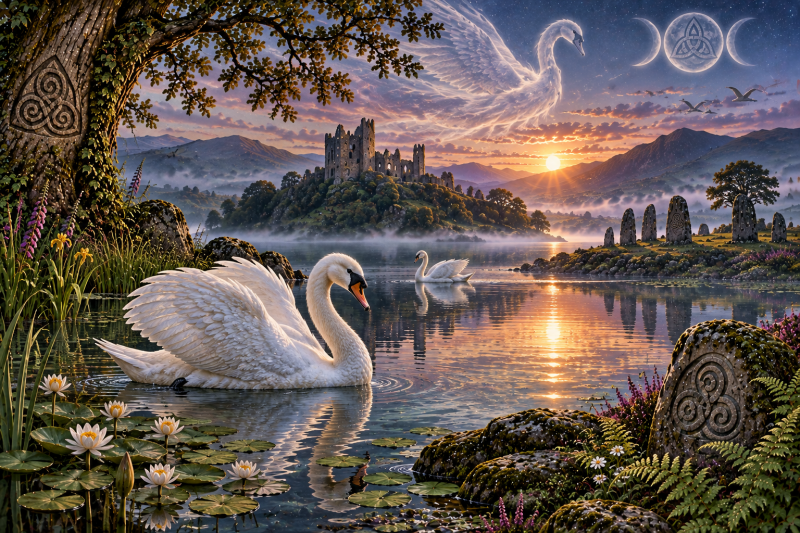
Swans seem almost designed for mythology.
Large and graceful, brilliant white against dark water and capable of moving between land, water and sky, they naturally possess a strangely otherworldly quality.
Transformation into swans appears in Irish storytelling.
The famous Children of Lir tells of children transformed into swans and condemned to spend centuries upon different waters before eventually returning to human form.
The surviving story contains layers of mythology and later Christian influence.
Yet its central image remains extraordinarily powerful:
human beings trapped within beautiful wild creatures while generations pass around them.
Swans consequently became strongly associated in later interpretation with transformation, sorrow, love and the passage of time.
The Wolf — The Wild Beyond the Settlement
For much of human history in Britain and Ireland, wolves were real neighbours.
They inhabited forests and remote landscapes beyond settlements and farmland.
That inevitably gave them a powerful position in storytelling.
Irish personal and tribal names sometimes contain elements connected with wolves, and wolf imagery appears in medieval material.
Later European folklore increasingly portrayed wolves as dangerous creatures lurking beyond civilisation.
Modern culture has added still more layers, often treating the wolf as a symbol of freedom, wilderness, loyalty and independence.
When exploring Celtic wolf symbolism, however, we need to distinguish these modern ideas from what can actually be demonstrated historically.
The real wolf is fascinating enough.
It represents a landscape that humans never completely controlled.
Explore Wolves in Celtic Mythology & Folklore →
The Owl — Creature of the Night
Owls occupy a world humans rarely experience.
They hunt silently in darkness, appear suddenly from trees and can disappear again almost without sound.
Unsurprisingly, they accumulated an enormous variety of beliefs.
Welsh mythology gives us perhaps the most famous owl-related figure in Celtic literature: Blodeuwedd.
In the Fourth Branch of the Mabinogi, Blodeuwedd is created from flowers to become the wife of Lleu Llaw Gyffes.
Following betrayal and tragedy, she is transformed into an owl.
Later folklore and modern Pagan interpretations have added numerous symbolic meanings to owls, particularly wisdom, mystery, intuition and the Otherworld.
Not all of these meanings can be traced directly to ancient Celtic belief.
But anyone who has heard an owl calling from a dark woodland can understand why the bird became surrounded by mystery.
Explore the Barn Owl in Celtic & Pagan Folklore →
The Fox — Cunning, Adaptability and the Wild Edge
Foxes occupy an unusual position between wilderness and human settlement.
They live in woodland, farmland, villages and even the centres of modern cities.
Their intelligence and adaptability have made them successful wherever humans have changed the landscape.
Folklore consequently developed around their reputation for cleverness and cunning.
However, many popular claims about a specific ancient “Celtic fox symbolism” are difficult to demonstrate from early sources.
Much of what is presented online as ancient Celtic belief actually combines later European folklore with modern spiritual interpretation.
That does not make fox folklore less interesting.
Quite the opposite.
It allows us to follow how the reputation of a real animal developed across generations.
Explore Foxes in Celtic Mythology & Folklore →
Animals, Shape-Shifting and Transformation
One theme repeatedly encountered in Celtic literature is transformation.
Humans become animals.
Supernatural beings appear in animal forms.
Characters experience several different lives.
Perhaps the most extraordinary example is the Welsh figure Taliesin, whose legendary story contains a dramatic sequence of transformations.
Irish mythology also contains characters moving between human and animal forms.
Transformation allowed storytellers to explore the boundary between humanity and nature.
What would the world look like through another creature's eyes?
Could someone escape danger by becoming something else?
Could an animal standing beside a path actually be more than it appeared?
Such questions turned familiar wildlife into potential participants in extraordinary stories.
Animals Were Not a Celtic Zodiac
Today you will sometimes encounter charts assigning every person a “Celtic spirit animal” according to their birthday.
These can be enjoyable as modern spiritual or creative systems, but they should not automatically be presented as authentic ancient Celtic traditions.
There is no good evidence for a historical Celtic animal zodiac matching many of the systems circulated online today.
Similarly, animals did not necessarily have one fixed symbolic meaning shared across every Celtic-speaking culture.
A raven could mean different things within different stories.
A horse could be sacred in one context and simply valuable livestock in another.
Folklore is rarely tidy.
And that's precisely what makes it interesting.
Modern Paganism and Animal Symbolism

Animals remain enormously important within modern Pagan and nature-based spiritual traditions.
People may feel particularly connected with a certain species or use animal imagery within artwork, meditation, ritual or personal symbolism.
The stag may represent wilderness.
The raven may represent mystery.
The hare may evoke moonlight and transformation.
The owl may represent the unseen world.
These interpretations can be meaningful without needing to claim that every association comes directly from an ancient Celtic source.
Modern traditions are part of the continuing story of folklore.
They show that animals still help us think about our relationship with nature.
The Real Animals Behind the Legends
Perhaps the most important thing to remember is that these creatures are not merely symbols.
They are living animals.
Ravens form relationships and solve problems.
Salmon navigate extraordinary journeys between river and ocean.
Hares race across fields at remarkable speeds.
Stags compete during the autumn rut.
Owls hunt almost silently.
Foxes adapt to landscapes transformed by humans.
The behaviour that once inspired mythology continues around us today.
Learning the folklore can therefore change the way we see wildlife.
A raven flying overhead becomes connected with stories thousands of years old.
A hare disappearing across a field carries generations of strange tales behind it.
A stag standing among autumn trees reminds us that wild animals have occupied these landscapes far longer than we have.
Creatures of the Same Landscape
Perhaps animals became so important in folklore because they remind us that the landscape has never belonged to humans alone.
The forests, rivers, mountains and coastlines of Britain and Ireland are shared worlds.
People watched animals moving through them and created stories to explain what they saw.
Some of those stories became mythology.
Others became superstition.
Others survived simply because they were too good to forget.
Throughout Pixie Page Crafts, we'll explore these animals individually — separating ancient sources from later folklore while discovering the extraordinary stories that accumulated around each creature.
Because behind every legendary animal stands something equally remarkable:
a real creature that once made someone stop, watch and wonder.
The animals were here before the stories — but the stories help us see them differently. 🌿