The Swan in Celtic & Irish Folklore
Few birds have gathered such a rich collection of stories around them as the swan. Graceful on the water yet capable of travelling enormous distances through the sky, swans have long seemed to belong to two worlds — the familiar landscape of lakes and rivers and the mysterious realm of myth.
In Irish tradition especially, swans appear in remarkable stories of transformation, enchantment and loss. Human beings are changed into swans, supernatural figures take the form of birds, and beautiful white wings conceal identities that cannot immediately be recognised.
The best-known example is the tragic story of the Children of Lir, in which four children are transformed into swans and condemned to spend centuries upon the waters of Ireland. But this famous tale is only one part of a much broader tradition connecting swans with transformation and the supernatural.
Swans also appear in stories associated with figures such as Óengus and Caer Ibormeith, where transformation takes a very different form. Here the swan becomes connected not simply with sorrow, but with love, beauty and movement between human and supernatural existence.
As with the raven and stag, however, there was no single universal ancient “Celtic meaning of the swan”. Medieval literature, later folklore and modern Pagan symbolism represent different layers of tradition. Looking at them separately reveals something far richer than a simple list of symbolic meanings.
The Children of Lir
Among all the swan stories of Ireland, none is more famous than the Children of Lir. It tells of four children — Fionnuala, Aodh, Fiachra and Conn — whose lives are transformed by jealousy, magic and an extraordinarily long exile upon the waters of Ireland.
According to the tale, the children are the sons and daughter of Lir. After the death of their mother, Lir marries again. Their stepmother, Aoife, eventually becomes jealous of the affection shown to the children and uses magic against them, transforming all four into swans.
Yet Aoife cannot completely destroy them. The children retain their human minds, their voices and their ability to sing. Their enchantment condemns them to spend centuries in swan form, moving between three different bodies of water.
Their first period is spent on Lough Derravaragh in County Westmeath. They are later forced onto the Sea of Moyle, the dangerous waters between Ireland and Scotland, before finally travelling to the western coast of Ireland. The changing landscapes make their exile feel immense: peaceful inland water gives way to cold seas, storms and isolation.
One of the most haunting elements of the story is the children's song. Although trapped in the bodies of swans, their beautiful voices remain, and those who hear them are said to be comforted or enchanted by their music. Their voices preserve something recognisably human through centuries of transformation.
Eventually the enchantment ends, but the conclusion is not simply a return to the life they lost. Christianity enters the later form of the story, and when the swans finally regain human form they are no longer children but extraordinarily old people. Their world has disappeared during the centuries of their exile.
The story therefore carries themes far beyond transformation alone. It is about family, jealousy, endurance, exile, the passing of time and the loss of home. The swans remain together while generations of human beings and entire ages pass around them.
Today the Children of Lir are often presented as survivors of an extremely ancient pre-Christian Celtic myth. The surviving tale, however, comes through the medieval Irish literary tradition and contains unmistakably Christian elements. Like much Irish mythology, it is better understood as a story preserved and reshaped across generations rather than as an unchanged record of a single ancient belief.
Óengus and Caer Ibormeith — The Swan and the Dream
Another remarkable Irish story connects swans not with punishment and exile, but with dreams, love and supernatural transformation. It concerns Óengus, sometimes called Aengus Óg, a figure of the Tuatha Dé Danann, and a mysterious young woman named Caer Ibormeith.
Óengus begins to dream repeatedly of a beautiful young woman whom he has never met. She appears beside his bed, but disappears before he can reach her. His longing becomes so intense that he falls ill, and a search begins to discover whether the woman from his dreams truly exists.
Eventually she is identified as Caer Ibormeith. But Caer is no ordinary woman. At Samhain, she and her companions take the form of swans, and Óengus is told that if he can recognise her among them, he may claim her.
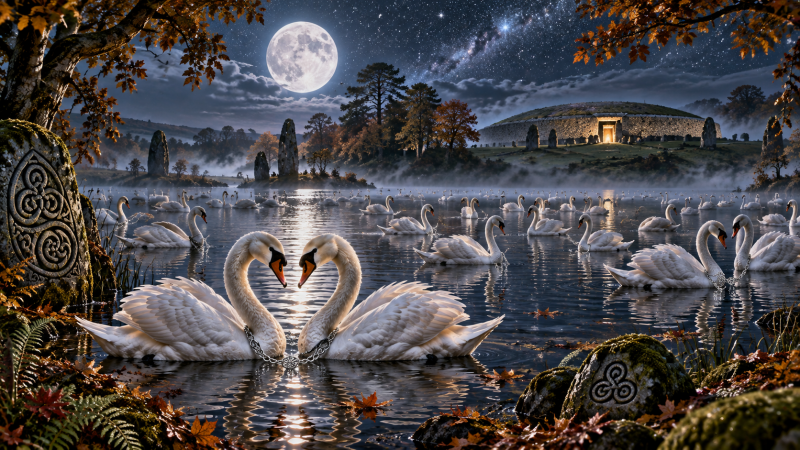
When Óengus reaches the lake, he finds 150 swans joined in pairs by silver chains, with Caer among them. He recognises and calls to her. Rather than forcing Caer back into human form, Óengus transforms into a swan himself.
The two fly away together, eventually reaching Brú na Bóinne, traditionally associated with Óengus. Their singing is said to have been so beautiful that those who heard it fell asleep for three days and three nights.
The story creates a very different image of swan transformation from the Children of Lir. Here transformation allows two worlds to meet. Óengus does not rescue Caer from being a swan; he joins her in her transformed state.
Swans consequently become part of a story about love, dreams, music and movement between forms. It is one of the clearest examples of why we should resist reducing an animal in mythology to one simple symbolic meaning. In one Irish tale swan transformation creates centuries of suffering; in another, it makes union possible.
Swans, Transformation and the Otherworld
Transformation is one of the strongest themes surrounding swans in medieval Irish storytelling. Again and again, the boundary between human and bird proves surprisingly thin. A beautiful swan encountered upon a lake may not necessarily be what it first appears.
This makes the swan particularly suited to stories involving the supernatural. On land it can seem heavy and awkward, yet on water it moves with remarkable grace, while in flight it can travel far beyond the landscape in which it was first encountered. To storytellers, an animal capable of moving so naturally between land, water and sky offered an extraordinary image of crossing boundaries.
The stories of the Children of Lir and Caer Ibormeith demonstrate that transformation itself did not have one fixed meaning. For Lir's children, becoming swans is a curse that separates them from their home and human lives. For Caer and Óengus, swan form becomes part of their union.
Swans could therefore occupy a space between the ordinary and extraordinary without simply being labelled “Otherworld animals”. Medieval Irish stories contain supernatural beings, transformations and journeys that resist such neat categories.
Modern retellings frequently describe the swan as a universal Celtic symbol of the Otherworld, the soul or spiritual transformation. These interpretations fit beautifully with some of the surviving stories, but we should distinguish them from evidence that all ancient Celtic peoples shared one fixed belief about swans.
What the surviving tales demonstrate more securely is that swans provided Irish storytellers with a powerful way of exploring identity, transformation, separation and movement between different states of existence.
Swans in British & Irish Folklore
Beyond medieval Irish mythology, swans continued to attract stories and beliefs throughout Britain and Ireland. Their brilliant white plumage, great size and graceful movement across water made them unusually conspicuous birds, while their long lives and strong pair bonds encouraged people to see them as creatures of permanence and devotion.
One of the oldest ideas associated with swans is the “swan song” — the belief that a swan, normally thought to be relatively silent, produces an exceptionally beautiful song shortly before death. The tradition is ancient and extends far beyond Britain and Ireland. It eventually gave us the expression “swan song” for the final performance or achievement of a person's life.
Swans also acquired an unusual relationship with royalty in England. The Crown's historic rights over certain unmarked mute swans developed alongside the keeping and marking of swans by privileged owners. The surviving tradition of Swan Upping on the River Thames is a reminder of this much older history.
This has produced the popular claim that “the King owns all the swans in Britain.” The reality is more complicated. The Crown's traditional ownership applies to unmarked mute swans in open water, with the right now principally exercised on particular stretches of the River Thames and surrounding tributaries. Swans elsewhere are not simply the King's private property.
There is nevertheless a very modern and very real reason swans are protected. Wild swans, their nests and eggs receive legal protection in Britain. That protection comes from wildlife law rather than from the folklore surrounding royal ownership.
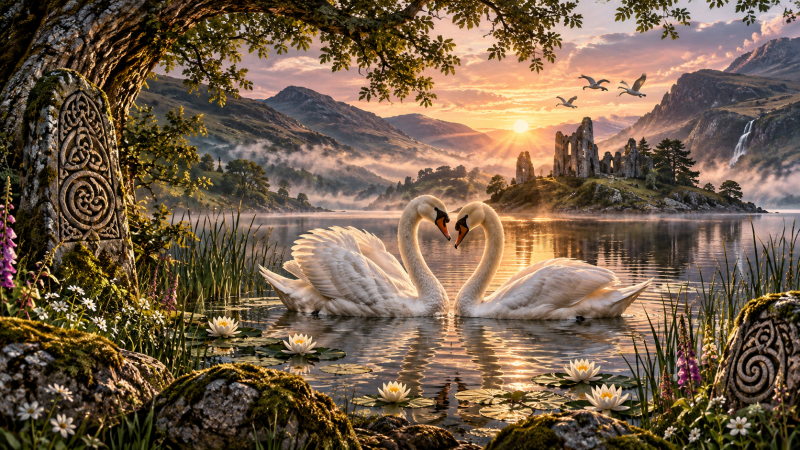
Swans have also become powerful modern symbols of love and fidelity, partly because pairs can form enduring bonds. The familiar sight of two swans facing one another with curved necks has strengthened the romantic association, even though the heart shape itself is largely a modern visual interpretation.
As with so much animal folklore, the swan we recognise today is therefore made from many layers: a real wild bird, a creature of medieval transformation stories, an animal surrounded by royal traditions and a modern symbol of love, beauty and devotion.
The Swan in Modern Pagan Symbolism
Within modern Paganism and contemporary Celtic-inspired spirituality, the swan has become associated with transformation, love, intuition, beauty and emotional depth. These meanings are partly inspired by surviving mythology and partly by observations of the bird itself.
Transformation is perhaps the strongest connection. Irish stories repeatedly blur the boundary between human and swan, most famously through the Children of Lir and Caer Ibormeith. For modern readers, these tales make the swan a natural symbol of changing identity and passing from one state of existence into another.
Water adds another layer of meaning. Swans spend much of their lives upon lakes, rivers and wetlands, environments that modern spiritual traditions often associate with emotion, intuition and the hidden depths of the self. Their seemingly effortless movement across the surface has consequently inspired imagery of calmness and grace even when unseen effort lies beneath.
Love and partnership have also become strongly associated with swans. Their pair bonds and elegant courtship behaviour have helped create one of the most recognisable modern symbols of devotion — two swans facing one another, their curved necks suggesting the shape of a heart.
Some modern Pagan interpretations connect swans with the Otherworld, divine femininity, the soul or spiritual awakening. Such ideas can be meaningful contemporary beliefs, and some clearly draw inspiration from older stories of supernatural transformation. They should not, however, automatically be described as beliefs shared by all ancient Celtic peoples.
Perhaps the swan's enduring symbolic power comes from the same quality that made it so effective in mythology. It seems simultaneously familiar and extraordinary: a large wild bird capable of appearing serene upon dark water before rising suddenly into the sky.
Frequently Asked Questions About Swan Folklore
What do swans symbolise in Celtic mythology?
There is no single universal Celtic meaning of the swan. Surviving Irish stories strongly connect swans with transformation, enchantment, love, separation and supernatural figures. Modern symbolism has developed these themes further.
What is the story of the Children of Lir?
The Children of Lir tells of Fionnuala, Aodh, Fiachra and Conn, four children transformed into swans by their jealous stepmother Aoife. They endure a centuries-long exile upon the waters of Ireland before the enchantment eventually ends.
Who were Óengus and Caer Ibormeith?
In Irish tradition, Óengus dreams of the mysterious Caer Ibormeith and eventually discovers her among a company of swans. After recognising her, Óengus takes swan form himself and the two fly away together.
Are swans connected with the Celtic Otherworld?
Swans occur in Irish stories involving supernatural beings and transformation, making the connection understandable. However, describing the swan as a universal ancient Celtic “Otherworld symbol” goes beyond what the surviving evidence allows us to say confidently.
Does the King own all the swans in Britain?
No. The Crown has historic rights concerning certain unmarked mute swans, particularly associated today with parts of the River Thames. This is quite different from the popular claim that every wild swan in Britain belongs personally to the monarch.
Do swans really sing before they die?
The famous “swan song” is an ancient literary and folkloric tradition rather than a reliable description of normal swan behaviour. The expression survives today to describe someone's final performance, work or achievement.
From Folklore to Art
Few birds lend themselves to folklore-inspired art as naturally as the swan. White plumage against dark water, reflections beneath moonlight and the sweeping shape of wings in flight can transform an ordinary lake or river into something that feels almost otherworldly.
My swan-inspired artwork draws particularly upon the landscapes and atmosphere of Irish mythology — still lakes, ancient stones, mist, moonlight and distant hills. The intention is not to illustrate one fixed ancient meaning, but to capture the sense of mystery found in stories such as the Children of Lir and Óengus and Caer Ibormeith.
These stories are especially inspiring because beauty and sadness often exist together. The same swan can represent enchantment and imprisonment, love and separation, or the possibility of moving between one form of existence and another.
Swan-Inspired Celtic Art
Explore artwork inspired by swans, Irish mythology, ancient landscapes and the folklore of Britain and Ireland.
Continue Exploring the Folklore
Animals in Celtic & British Folklore →
Return to the main collection and discover the folklore surrounding ravens, hares, owls, foxes, stags and other animals.
The Celtic Otherworld →
Explore Annwn, supernatural landscapes and traditions surrounding the mysterious world beyond the ordinary.
The Stag in Celtic & British Folklore →
Discover deer mythology, the white stag, Cernunnos and centuries of stag symbolism.
The Raven in Celtic & British Folklore →
Explore ravens, the Morrígan, Brân the Blessed and the bird's remarkable place in mythology and folklore.
Sources & Further Reading
Swan folklore brings together medieval Irish literature, later storytelling, royal tradition and natural history. The sources below provide further reading on the surviving Irish tales and on the history and legal protection surrounding swans in Britain.
The Children of Lir
Oidheadh Chloinne Lir — The Fate of the Children of Lir — survives as an Irish literary tale of the four children transformed into swans. University College Cork's CELT project catalogues the historic 1883 edition and translation by Eugene O'Curry and Richard J. O'Duffy.
University College Cork — CELT Translated Texts
The Crown and Britain's Mute Swans
The popular statement that “the King owns all British swans” greatly oversimplifies the tradition. The Crown retains the right to claim ownership of unmarked mute swans in open waters, but today that right is principally exercised on particular stretches of the River Thames.
The Royal Family — Swan Upping and the history of royal swans
Swan Upping
Swan Upping developed from the Crown's historic ownership rights and is now an annual census and conservation activity on the Thames. The tradition can be traced back to the medieval period, when mute swans were highly valued.
The Royal Family — Swan Upping
Swans and Wildlife Protection
Mute swans are wild birds and receive protection under modern wildlife legislation independently of royal ownership traditions. Government wildlife guidance and licensing rules regulate activities involving wild birds, and mute swans receive additional restrictions in some circumstances.
GOV.UK — Wild bird licensing and protection
One thing I want to improve before publication
Our Óengus and Caer Ibormeith section is good, but I don't want to give you a mediocre web source just to fill the bibliography. The strongest approach is to keep the section but later add a proper academic/primary-text reference when we find one.
The Crown section, meanwhile, is well supported: the Royal Household itself confirms that the King's right concerns unmarked mute swans in open waters and is mainly exercised on parts of the Thames.