The Blackbird in Celtic & British Folklore
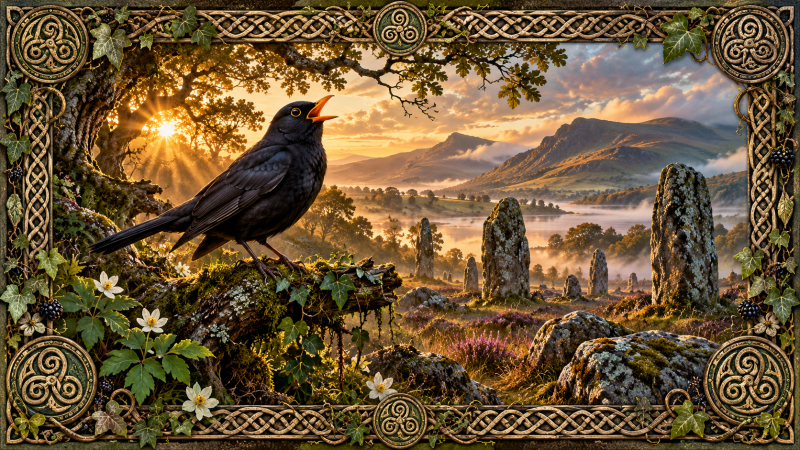
Few sounds are as characteristic of the British countryside as the song of the blackbird. Heard from gardens, woodland edges and hedgerows at dawn and dusk, its rich, flute-like call has accompanied people for countless generations.
It is perhaps unsurprising that such a familiar bird found its way into stories and traditions. In medieval Welsh literature in particular, the blackbird appears as a creature of extraordinary age, while magical birdsong forms part of some of the most mysterious tales associated with the Welsh Otherworld.
Yet, as with many animals in folklore, the modern symbolism surrounding the blackbird is not always the same as the traditions found in historical sources. Exploring the older stories reveals something more interesting: a bird connected with ancient memory, enchanted landscapes and the mysterious boundary between the ordinary and supernatural worlds.
The Blackbird of Cilgwri — One of the Oldest Animals
One of the most remarkable blackbirds in British folklore appears in the medieval Welsh tale Culhwch and Olwen, preserved in the collection of stories commonly known today as the Mabinogion.
During Culhwch's seemingly impossible quest to win Olwen, a group of heroes must find Mabon ap Modron, a mysterious figure who was taken from his mother when he was only three nights old.
Nobody knows where Mabon is imprisoned. To find him, the heroes seek the knowledge of increasingly ancient animals.Among the first they encounter is the Blackbird of Cilgwri.
The blackbird describes how incredibly long it has lived. According to the tale, when it first arrived at the place where it lives, there was a smith's anvil there. Over the immense span of the bird's lifetime, it has worn the anvil away with its beak.
Yet even this extraordinarily ancient creature does not know where Mabon can be found. The search therefore continues to animals older still.
The Oldest Animals of Britain
The episode creates one of the most memorable sequences in Welsh mythology. The heroes travel from one ancient creature to another, seeking someone old enough to remember what happened to Mabon. The animals include the Blackbird of Cilgwri, the Stag of Rhedynfre, the Owl of Cwm Cawlwyd, the Eagle of Gwernabwy, and finally the Salmon of Llyn Llyw.
Each creature represents a greater depth of time and memory. This makes the blackbird part of a remarkable mythological idea: the landscape itself remembers. Animals that have inhabited mountains, valleys, forests and rivers for unimaginable lengths of time become living witnesses to events forgotten by humanity.
The Blackbird and Ancient Memory
The Blackbird of Cilgwri is particularly interesting because its importance does not come from physical strength. It is important because of its age. The image of the bird slowly wearing away an anvil with its beak transforms something small and familiar into a measure of almost incomprehensible time. Mountains change. Forests grow. Human generations disappear.
The blackbird remains.
This is very different from many modern interpretations that simply assign animals a list of symbolic meanings. The medieval story gives us something richer: the blackbird belongs to a world in which animals possess knowledge unavailable to human beings.
Birds, Music and the Welsh Otherworld
Birdsong also occupies an extraordinary place in Welsh mythology. Perhaps the most famous supernatural birds are the Birds of Rhiannon, mysterious creatures whose song possesses remarkable powers.
In the Mabinogi, their music is described as capable of enchanting those who hear it. In later Welsh material associated with Branwen ferch Llŷr, the survivors of the disastrous expedition to Ireland spend years listening to the Birds of Rhiannon while remaining strangely removed from the normal passage of time.
The texts do not clearly identify Rhiannon's birds as blackbirds, so it would be misleading to claim that they are.
Nevertheless, their stories demonstrate the extraordinary importance of magical birdsong within medieval Welsh storytelling — a tradition that gives useful context to the blackbird's own place within this mythological landscape.
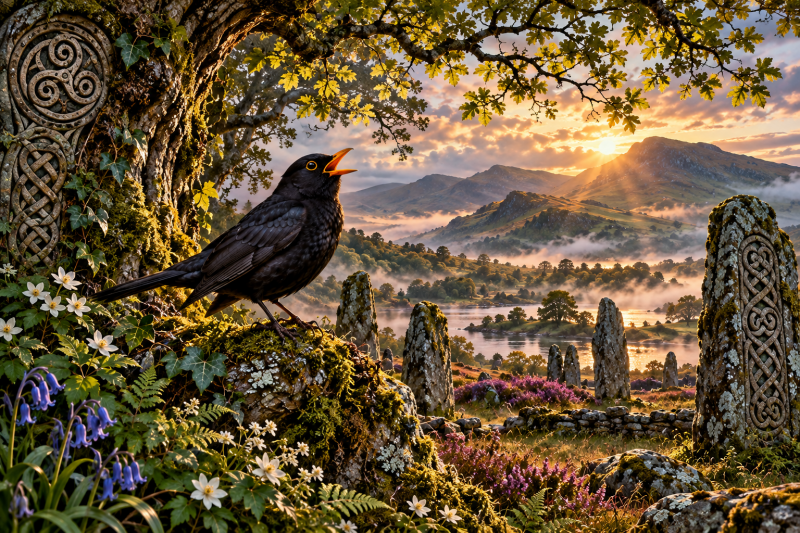
A Bird Between Two Worlds
Across folklore, birds naturally lend themselves to stories about boundaries.
They live upon the earth yet disappear effortlessly into the sky. Their songs may be heard from deep within woodland while the bird itself remains invisible.
For people living in landscapes without modern mechanical noise, birdsong would have been an even more noticeable part of everyday life.
The blackbird is especially evocative.
Its song is often heard around dawn and evening — moments when day becomes night or darkness becomes light.
It is easy to understand why later storytellers, poets and modern spiritual traditions have interpreted such birds as creatures belonging somewhere between the familiar landscape and something more mysterious.
But these later interpretations should be distinguished from claims about what ancient Celtic people definitely believed.
Was the Blackbird Sacred to the Celts?
Blackbirds and other birds appear within surviving medieval Celtic-language literature, and the Blackbird of Cilgwri has an unmistakable role in Welsh tradition as an extraordinarily ancient creature.
What Does a Blackbird Symbolise Today?
Modern folklore, literature and spiritual traditions have given the blackbird many additional associations.
It can represent mystery, intuition, transformation, knowledge and the unseen world. Its dark plumage has encouraged associations with night and secrecy, while its beautiful song provides a striking contrast to its appearance.
Some modern Pagan traditions also interpret the blackbird as a guide between worlds or a symbol of hidden knowledge.
These interpretations can be meaningful, but they should not automatically be presented as beliefs held by ancient Celtic peoples.
The historical traditions and the modern symbolism are both worth exploring — as long as we recognise the difference between them.
The Blackbird in the Landscape
Perhaps the blackbird's greatest connection with folklore is also the simplest. It is still here. Blackbirds continue to sing from hedgerows, gardens, churchyards, woodland and farmland throughout Britain and Ireland. That creates a remarkable connection between the landscapes described in old stories and those we inhabit today. A person reading the story of the Blackbird of Cilgwri can close the book, step outside and potentially hear the song of the same species. Few things demonstrate the continuing relationship between wildlife, landscape and folklore quite so beautifully.
Somewhere Between Memory and Myth
The blackbird does not need an invented collection of mystical powers to earn its place among the remarkable animals of Celtic and British folklore. One medieval Welsh story has already given it something extraordinary. It made the blackbird older than human memory.
The Blackbird of Cilgwri belongs to a landscape inhabited by creatures that remember what people have forgotten — ancient witnesses through whom heroes can reach backwards into the deepest layers of the mythical past. And perhaps that is why the blackbird remains such a fitting creature for folklore.
Small, familiar and easily overlooked, it sits in the branches above us and sings a song that seems as though it might have been heard in the same valleys a thousand years ago.
Sources & Further Reading
Explore More Animal Folklore
The Stag in Celtic & British Folklore →
Discover the stag in mythology and folklore, from the wild hunt and ancient forests to ideas of kingship, transformation and the Otherworld.
The Raven in Celtic & British Folklore →
Explore the raven’s connections with Irish mythology, the Morrígan, Brân the Blessed, battlefields, prophecy and supernatural tradition.
The Hare in British & Irish Folklore →
Discover centuries of strange beliefs surrounding the hare, including witchcraft, transformation, the moon and the mysterious landscape.
The Wolf in British & Irish Folklore →
Explore the wolf’s place in Irish and British tradition, including warriors, wilderness, transformation and tales of Irish werewolves.
The Swan in Celtic & Irish Folklore →
Discover the beautiful but sometimes tragic stories surrounding swans, transformation and the Otherworld in Irish mythology.
The Fox in British & Irish Folklore →
Explore traditional beliefs about the fox, from cunning and rural superstition to unusual fishing folklore from the west of Ireland.
The Badger in British & Irish Folklore →
Discover the badger’s connections with strength, the underground world and centuries of rural storytelling.
The Barn Owl in British & Irish Folklore →
Explore the mysterious reputation of the barn owl and the beliefs inspired by its nocturnal life, eerie calls and ghostly appearance.
The Blackbird in Celtic & British Folklore →
Discover the blackbird in Welsh and Irish tradition and its connections with ancient landscapes, enchanted birds and the Otherworld.
The blackbird's most important appearance in medieval Welsh tradition occurs in Culhwch and Olwen, one of the earliest surviving Arthurian tales. During the search for Mabon ap Modron, the heroes consult a succession of extraordinarily ancient animals, beginning with the Blackbird of Cilgwri before travelling to the Stag, Owl, Eagle and finally the Salmon. Modern academic discussion confirms this sequence and its role in the tale.
Culhwch and Olwen — The Blackbird of Cilgwri
The Blackbird of Cilgwri describes its enormous age through the memorable story of an anvil that has been worn down by the repeated pecking of its beak. Despite its incredible age, the blackbird cannot remember Mabon and directs the search onwards to the still older Stag of Rhedynfre.
The Mabinogion — Sioned Davies
For anyone wishing to explore these stories further, Sioned Davies's translation of The Mabinogion is an excellent modern edition. It contains Culhwch and Olwen as well as the Four Branches and other medieval Welsh tales that provide the wider literary world surrounding the Blackbird of Cilgwri.
Find the book here at Bookshelf.org
The Birds of Rhiannon
The famous Birds of Rhiannon belong to the wider tradition of supernatural birds in medieval Welsh literature. In the Second Branch of the Mabinogi, their extraordinary song alters normal experience; they are also mentioned in Culhwch and Olwen. Academic discussion describes their supernatural singing and its effects.
Further Academic Reading
For readers wishing to explore Culhwch and Olwen in greater depth, academic studies examine the tale's language, geography, mythology and its connections with Irish literature. Patrick Sims-Williams's work on Irish influence in medieval Welsh literature includes a substantial study of Culhwch and Olwen.