The Raven in Celtic & British Folklore
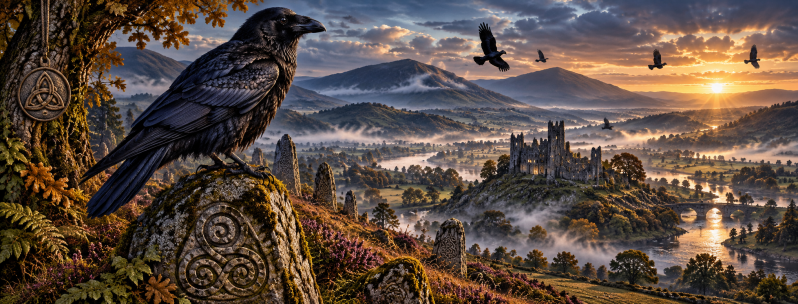
Few birds have captured the human imagination quite like the raven. Large, intelligent and strikingly black, ravens have shared the landscapes of Britain and Ireland with people for thousands of years. Their intelligence, remarkable calls and habit of appearing around wild and sometimes desolate places have helped make them powerful figures in story and folklore.
In the mythology of Ireland and Wales, ravens and other members of the crow family appear alongside warriors, kings and supernatural figures. They became associated with battle and death, but their stories are considerably richer than the familiar idea of the raven simply being a dark omen.
Some of the strongest associations come from medieval Irish literature, particularly traditions surrounding the Morrígan, a complex supernatural figure connected with warfare, fate and sovereignty. Welsh tradition provides another famous connection through Brân the Blessed, whose very name is associated with the raven or crow.
Over later centuries, ravens continued to appear in British and Irish folklore, while new legends developed around castles, prophecy and misfortune. Modern Paganism and popular culture have added further layers of symbolism.
To understand the raven's place in folklore, it is therefore useful to separate what survives in medieval literature and recorded folk tradition from later interpretations. The result is not a single ancient “meaning of the raven”, but a remarkable collection of stories stretching across centuries.
Ravens in Celtic Mythology
The peoples we now describe as Celtic did not leave behind a single collection of beliefs about ravens. What survives instead comes from different places and periods, particularly medieval Irish and Welsh literature, much of it written down centuries after the pre-Christian societies from which some of the stories may have developed.
Ravens and other members of the crow family nevertheless appear repeatedly within these traditions. Their presence is particularly striking in stories involving warfare, death, kingship and supernatural events. This may partly reflect something people could observe in the real world: ravens are intelligent scavengers and would have been familiar sights around battlefields and places where animals or people had died.
It is therefore misleading to speak of one universal ancient “Celtic meaning” for the raven. Instead, different stories give the bird different roles. Sometimes ravens accompany supernatural figures; elsewhere they appear around warriors, prophecy or death. In Welsh tradition, even the name of one of its great legendary figures — Brân — has a linguistic connection with the raven or crow.
These surviving traditions provide something more interesting than a simple list of symbols. They show how a familiar wild bird became woven into stories about the boundary between the ordinary world and forces that people could not easily explain.
The Morrígan, Ravens and the Battlefield
One of the strongest connections between ravens, supernatural power and warfare in Irish tradition comes from the stories surrounding the Morrígan. She appears in medieval Irish literature as a complex supernatural figure associated with conflict, fate, sovereignty and the fortunes of warriors.
The relationship between the Morrígan and birds is sometimes simplified today into the claim that she was simply a “raven goddess”. The surviving literature presents a more complicated picture. She and closely related figures can appear in different forms and are associated with birds of the crow family in scenes connected with battle and death.
One of the best-known examples occurs in the Táin Bó Cúailnge — the great Irish epic commonly known as The Cattle Raid of Cooley. The Morrígan becomes involved in the conflict surrounding the hero Cú Chulainn, appearing at different moments as adversary, supernatural presence and foreteller of events.
At the end of Cú Chulainn's life, a bird settling upon him forms part of one of Irish mythology's most memorable images. His enemies are reluctant to approach until they are convinced that the seemingly unstoppable warrior is truly dead. Such scenes helped strengthen the enduring relationship between corvids, battlefields and supernatural forces in later interpretations of Irish mythology.
There was also a very practical reason that ravens and crows could become associated with warfare. Scavenging birds would have been drawn to places where people and animals had died. For communities familiar with both warfare and the natural world, the sight of dark birds gathering after violence would have been powerful and unsettling.
The Morrígan's association with corvids therefore belongs within a much larger tradition involving warfare, prophecy, death and supernatural power. Calling her simply a “raven goddess” misses much of the complexity that makes her such a fascinating figure in Irish mythology.
Brân the Blessed — The Raven of Welsh Tradition
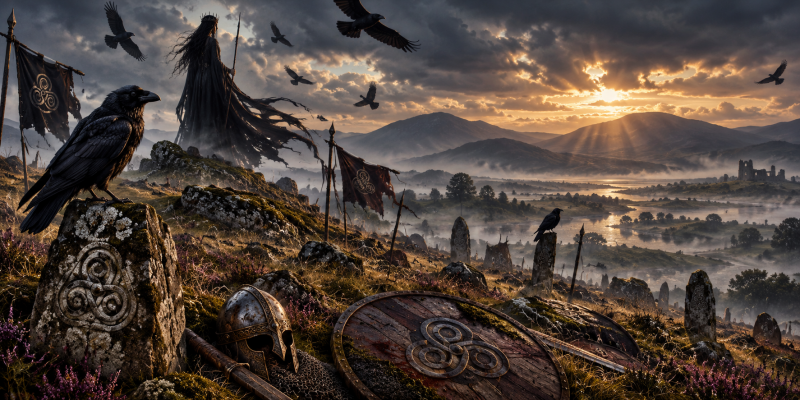
Across the Irish Sea, Welsh tradition gives us another remarkable connection between ravens and the legendary past. Brân the Blessed, or Bendigeidfran in Welsh, is one of the great figures of medieval Welsh literature and appears most famously in the Mabinogion tale usually known as Branwen Daughter of Llŷr.
Brân is portrayed as a gigantic king of Britain, so enormous that no ordinary house can contain him. His story eventually leads to a disastrous expedition to Ireland after his sister Branwen suffers mistreatment following her marriage to the Irish king Matholwch.
The Welsh name Brân means “raven” or “crow”, creating one of the clearest linguistic connections between a legendary figure and the bird. However, this does not necessarily mean that Brân should simply be interpreted as an ancient “raven god”. As with many figures preserved in medieval Celtic literature, attempts to reconstruct earlier religious beliefs from the surviving stories must be treated cautiously.
One of the strangest parts of Brân's story occurs after he is mortally wounded in Ireland. He instructs his surviving companions to cut off his head and carry it back to Britain. According to the tale, the severed head continues to speak and entertain his companions during their long journey.
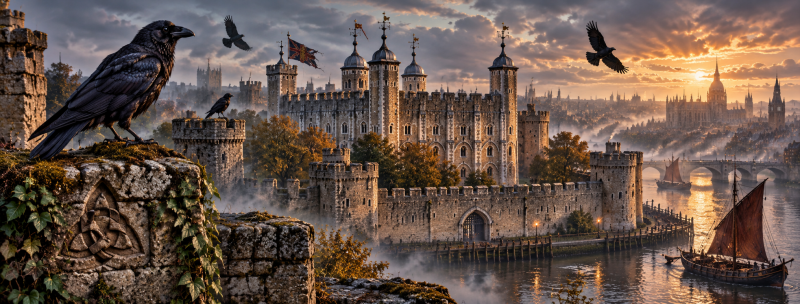
Eventually the head is buried at the White Hill in London, traditionally associated with the site where the Tower of London now stands, facing towards France. The story says that while Brân's head remained there, it protected Britain from invasion.
Centuries later, this medieval story became intertwined in popular imagination with the famous ravens of the Tower of London and the legend that Britain will fall if the ravens ever leave the Tower. The two traditions are often presented as though they have always been one story, but the familiar Tower raven legend appears to be considerably later than the medieval tale of Brân.
Brân's story is therefore a good example of how folklore evolves. A medieval Welsh tale, the meaning of a name, a famous London landmark and a later raven legend have gradually become connected in the popular imagination.
Ravens at the Tower of London
Few raven legends in Britain are as famous as the story surrounding the Tower of London. According to the familiar tradition, at least six ravens must remain at the Tower or both the fortress and the kingdom itself will fall. Today the ravens are one of the Tower's most recognisable features and are cared for by a dedicated Ravenmaster.
The legend is sometimes described as an ancient tradition stretching back for many centuries, and it is occasionally connected with Brân the Blessed because his severed head was said in medieval Welsh tradition to have been buried at the White Hill in London. The historical evidence, however, is much less straightforward.
While ravens have certainly lived in Britain for a very long time, researchers have questioned how old the specific Tower legend really is. The familiar story about keeping six ravens at the Tower appears to have become firmly established much later than the medieval story of Brân, particularly during the nineteenth and twentieth centuries.
A popular version of the legend credits King Charles II with ordering that ravens should be protected at the Tower after being warned that the monarchy and kingdom would fall if the birds disappeared. This makes a wonderful story, but evidence for such an order from Charles II is uncertain.
That does not make the legend unimportant. Folklore does not have to be thousands of years old to become meaningful. The Tower ravens demonstrate how new traditions can grow around historic places and eventually become so familiar that they seem ancient.
Today the ravens themselves are very real. They are individually known, cared for at the Tower and have become living symbols of one of Britain's most famous historic sites. Their presence continues a story in which history, legend and the natural world have become almost impossible to imagine separately.
Ravens, Death and Omens in British Folklore
Long after the medieval stories of Brân and the Morrígan were written down, ravens continued to occupy an uneasy place in British folk belief. Their black plumage, deep croaking calls and association with wild landscapes made them natural subjects for stories concerning death, warning and misfortune.
Some of these beliefs almost certainly grew from observation. Ravens are scavengers and historically would have appeared around dead livestock, battlefields and other places where carcasses were available. To people living much closer to death and the natural world than most of us do today, the sudden gathering of ravens could easily acquire an ominous meaning.
Ravens and their smaller relatives in the crow family also became associated with signs and predictions. The number of birds seen, the direction from which they approached or unusual behaviour could sometimes be interpreted as an omen. Such traditions varied considerably from place to place, however, and it would be misleading to describe them as one universal British belief.
The raven's reputation was not entirely sinister. Its intelligence, watchfulness and ability to survive in harsh landscapes also inspired admiration. As with many animals in folklore, the same creature could represent danger in one story and knowledge, protection or supernatural insight in another.
This ambiguity is an important part of the raven's enduring appeal. The bird was neither simply “good” nor “evil”. Instead, it occupied the uncertain territory that folklore so often explores — between life and death, the familiar and the unknown, and the natural world and the supernatural.
The Raven as a Bird of Prophecy and Intelligence
Long before modern science began studying raven intelligence, people living alongside these birds would have noticed that they behaved differently from many other animals. Ravens watch, investigate, remember and learn. Their behaviour can sometimes appear almost deliberate, making it easy to understand why earlier communities might have regarded them as unusually knowledgeable birds.
In folklore, this intelligence could take on supernatural qualities. A raven appearing unexpectedly, calling repeatedly or following travellers might be interpreted as carrying a warning or possessing knowledge unavailable to humans. Birds themselves already occupied a remarkable position in traditional imagination: they could walk upon the earth and then disappear into the sky, seemingly moving between different realms with ease.
Modern research has confirmed that ravens are exceptionally intelligent members of the corvid family. They can solve problems, learn from experience, remember individuals and interact socially in remarkably sophisticated ways. Although these scientific discoveries should not be projected backwards as explanations for every ancient story, they demonstrate that the behaviour which fascinated earlier observers was very real.
This combination of intelligence and mystery helps explain why ravens became such convincing birds of prophecy. A creature that appeared to watch people, remember events and react intelligently to its surroundings could easily seem to know more than an ordinary animal should.
Folklore transformed those observations into stories. The raven became not merely a bird that witnessed events, but sometimes a creature capable of anticipating them — standing symbolically at the boundary between knowledge and prophecy.
Ravens and the Otherworld
In Celtic mythology and later folklore, boundaries are rarely as fixed as they first appear. Rivers, mist, caves, ancient mounds and lonely stretches of landscape could all become places where the ordinary world seemed to meet something older and stranger. Animals and birds frequently appear within stories set around these boundaries.
Ravens fit naturally into this landscape of uncertainty. Their ability to travel great distances, disappear across mountains and return unexpectedly, combined with their dark appearance and remarkable intelligence, helped make them convincing inhabitants of stories concerned with supernatural forces and worlds beyond everyday human experience.
Irish and Welsh traditions do not provide us with a simple rule stating that every raven was a messenger from another world. That idea owes much to later interpretation. Nevertheless, ravens appear within a wider body of mythology filled with transformation, prophecy, supernatural beings and journeys beyond the familiar human landscape.
This is one reason the raven remains such a powerful image today. A raven perched upon an ancient stone, disappearing into mist or calling across an empty valley seems perfectly at home in stories where the boundary between this world and another has become uncertain.
Explore further: Discover the Celtic Otherworld →
The Raven in Modern Paganism and Symbolism
The raven remains an important symbol within many forms of modern Paganism, nature spirituality and Celtic-inspired practice. Today it may be associated with transformation, intuition, wisdom, protection, prophecy and the mysteries of death and rebirth.
Some modern practitioners also feel a particular connection between the raven and the Morrígan. This draws inspiration from medieval Irish traditions in which the Morrígan and related figures are associated with warfare, death and birds of the crow family. Modern spiritual interpretations, however, should not automatically be treated as identical to the beliefs of people living in pre-Christian Ireland.
This distinction matters. There was no single surviving ancient handbook explaining that a raven always represented one particular idea. The meanings now attached to ravens have developed from a mixture of medieval literature, recorded folklore, observation of the natural bird, later occult traditions, modern Pagan practice and popular culture.
That does not make modern symbolism meaningless. Folklore has always changed as stories pass between generations. New interpretations become part of the continuing cultural life of an animal, just as older stories were themselves retold and reshaped.
Perhaps the raven's greatest symbolic strength is therefore its ambiguity. It can represent death without simply representing evil, wisdom without being gentle, and transformation without promising that change will be easy. It remains a creature of boundaries — between wilderness and settlement, life and death, knowledge and mystery.
What Does Seeing a Raven Mean?
Seeing a raven can feel like a memorable encounter, particularly when the bird appears alone in a dramatic landscape or seems to pause and watch from a nearby tree or rooftop. It is therefore unsurprising that people have attached meanings to such encounters for centuries.
In folklore and modern spiritual traditions, seeing a raven may be interpreted as a sign of change, heightened awareness, mystery or the need to pay attention to what is happening around you. Some modern Pagan interpretations connect ravens with intuition, transformation or messages from the spiritual world.
There is, however, no single traditional meaning that applies whenever somebody sees a raven. Beliefs surrounding ravens have varied enormously between cultures, regions and periods of history. A raven regarded as an ominous presence in one tradition might be respected for intelligence, protection or knowledge in another.
There is also a simpler explanation worth remembering: ravens are real wild birds going about their lives. They may be searching for food, communicating with another raven, defending territory or simply investigating something that has caught their attention.
Perhaps that reality does not diminish the experience at all. Knowing that ravens are exceptionally intelligent animals can make an unexpected encounter even more remarkable. Whether someone views the moment through folklore, spirituality or natural history, the raven remains one of Britain's most extraordinary birds.
Frequently Asked Questions About Raven Folklore
What does a raven symbolise in Celtic mythology?
There is no single universal “Celtic” meaning for the raven. In surviving Irish and Welsh traditions, ravens and other corvids appear in stories involving warfare, death, supernatural power and legendary figures. Modern associations with prophecy, transformation and wisdom draw upon these traditions but also include later interpretations.
Is the raven associated with the Morrígan?
Yes, although the relationship is more complicated than the common description of the Morrígan as simply a “raven goddess”. Medieval Irish literature connects the Morrígan and related figures with warfare, death and birds of the crow family. Modern Pagan traditions have developed this association further.
What is the connection between Brân and ravens?
Brân the Blessed, or Bendigeidfran, is a major figure in medieval Welsh tradition. His name Brân means “raven” or “crow” in Welsh. His severed head was said to have been buried at the White Hill in London to protect Britain, although the later legend of the Tower of London ravens should not automatically be treated as part of the original medieval story.
Are ravens a bad omen?
Ravens have sometimes been regarded as omens of death or misfortune, particularly because of their dark appearance and their natural behaviour as scavengers. However, raven traditions are far more varied than this. Ravens have also been associated with intelligence, knowledge, protection and supernatural insight.
What does it mean when you see a raven?
There is no universal supernatural meaning to seeing a raven. Modern spiritual interpretations may associate an encounter with transformation, intuition or change, while traditional beliefs vary greatly. From a natural-history perspective, you are encountering one of the most intelligent members of the crow family.
From Folklore to Art
The raven is exactly the kind of creature that inspires the artwork of Pixie Page Crafts. Its intelligence, dark beauty and centuries of stories make it a natural inhabitant of the misty valleys, ancient stones, moonlit woodlands and mysterious landscapes that appear throughout my work.
Rather than illustrating one particular legend, my raven artwork draws upon the atmosphere surrounding these old stories — the sense of standing somewhere between the familiar natural world and the landscapes of mythology and folklore.
Ravens are real and remarkable British birds, but they also carry centuries of human storytelling with them. It is that meeting of wildlife, landscape and folklore that inspires much of the art I create.
Raven-Inspired Celtic Art
Explore artwork inspired by ravens, Celtic folklore, ancient landscapes and the mysterious natural world.
Continue Exploring the Folklore
Animals in Celtic & British Folklore →
Return to the main guide and discover the stories surrounding other animals and birds.
The Celtic Otherworld →
Explore the mysterious world beyond the ordinary landscape in Celtic tradition.
The Barn Owl →
Discover the folklore surrounding one of Britain's most mysterious nocturnal birds.
The Hare →
Explore centuries of stories concerning transformation, witchcraft and the elusive hare.
Sources & Further Reading
The stories surrounding ravens have developed across many centuries, and modern interpretations do not always reflect what appears in the surviving historical sources. The following sources provide further reading on the medieval Irish and Welsh traditions, the Tower of London ravens and the remarkable intelligence of real ravens.
The Second Branch of the Mabinogi — Branwen ferch Llŷr
The University of Cambridge's Department of Anglo-Saxon, Norse & Celtic provides material from the medieval Welsh text and explains its manuscript tradition. The surviving complete versions are preserved in the fourteenth-century White Book of Rhydderch and Red Book of Hergest.
University of Cambridge — Branwen ferch Llŷr
Branwen, Brân and the Mabinogi
Eryri National Park provides an accessible account of the Second Branch, including Bendigeidfran (Brân), Branwen, Matholwch and the disastrous expedition to Ireland.
Eryri National Park — Branwen, Daughter of Llŷr
The Morrígan and the Táin tradition
Ask About Ireland's material on the Táin includes the Morrígan appearing as a black bird and warning the Brown Bull of the approaching conflict. This is particularly useful for distinguishing what the literary tradition actually contains from later simplified “raven goddess” descriptions.
Ask About Ireland — Morrigan and the Bull
The Ravens of the Tower of London
Historic Royal Palaces, which manages the Tower, explains the famous tradition that the kingdom will fall if the six resident ravens leave, along with the story traditionally connecting their protection with Charles II.
Historic Royal Palaces — The Ravens
Pika et al. — “Ravens parallel great apes in physical and social cognitive skills”
This peer-reviewed Scientific Reports study tested common ravens' physical and social cognition. The researchers found sophisticated cognitive abilities and, in their tests, performance broadly comparable with adult great apes across the same cognitive scales.
Scientific Reports — Raven cognition study
Thomas Bugnyar — “Why are ravens smart?”
A 2024 review in the Journal of Ornithology examines decades of research into raven intelligence, including social relationships, memory and the challenges ravens face in their natural lives.
Journal of Ornithology — Why are ravens smart?