The Fox in British & Irish Folklore
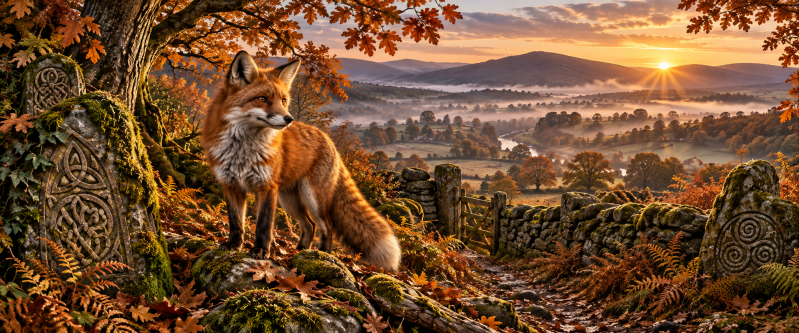
Few wild animals have lived as closely alongside people while retaining such an air of mystery as the red fox. Found across much of Britain and Ireland, the fox has adapted to farmland, woodland, mountains and, more recently, towns and cities. Yet for centuries it has also inhabited another landscape — the world of folklore.
The fox's intelligence, stealth and largely nocturnal habits made it an obvious subject for storytelling. A fox can appear at the edge of a field and vanish through a hedge moments later, leaving little indication of where it went. To earlier rural communities, behaviour like this helped give the animal a reputation for cunning, secrecy and an almost uncanny ability to escape danger.
British and Irish traditions surrounding foxes are varied. Stories connect them with cleverness and trickery, while other beliefs place foxes alongside witchcraft, transformation and the supernatural. In some tales the fox is an animal to be admired; in others it is regarded with suspicion.
As with many animals in folklore, modern interpretations sometimes describe the fox as having one fixed ancient “Celtic meaning”. The surviving evidence is considerably more complicated. Traditions changed between regions and generations, and some beliefs recorded in comparatively recent centuries have later been presented as though they were ancient.
Exploring the fox therefore means looking at several different layers: the real behaviour of the animal, recorded British and Irish folk belief, older stories, later interpretations and the symbolism that continues to surround the fox today.
The Fox in British Folklore
The red fox has shared the British landscape with people for thousands of years. Its ability to survive close to farms and settlements while remaining difficult to approach has helped give it a distinctive place in rural folklore. People knew the fox well enough to recognise its habits, yet rarely well enough to remove its sense of mystery.
Cleverness is perhaps the characteristic most frequently associated with the fox. This reputation has an obvious basis in the animal's real behaviour. Foxes are adaptable hunters and scavengers, capable of finding food in woodland, farmland and human settlements. Their ability to escape pursuit and exploit opportunities made them natural characters in stories about cunning and survival.
Rural beliefs also gave the fox more mysterious qualities. Its scream could be startling when heard at night, while an animal suddenly crossing a road or appearing near a house might attract particular attention. As with many folk beliefs, the meaning attached to such encounters differed between places and periods rather than following one universal tradition.
The fox also occupied an unusual position in human attitudes toward wildlife. It could be admired for intelligence and beauty while simultaneously being regarded as a threat to poultry and livestock. Later traditions surrounding fox hunting added another complicated layer to its cultural history.
This mixture of admiration, suspicion and conflict helped ensure that the fox never became an ordinary animal in the British imagination. It remained the clever survivor — living alongside people, learning their habits and repeatedly escaping back into the landscape.
Foxes, Witches and Shapeshifting
One of the darker strands of fox folklore concerns witchcraft and transformation. In parts of Britain and Ireland, folk belief sometimes imagined witches as being capable of taking animal form, allowing them to travel unseen, escape pursuit or carry out supernatural acts.
Hares are particularly famous in British and Irish shapeshifting traditions, but foxes also became associated with the mysterious possibility that an animal encountered at night might not be entirely what it appeared to be. Such stories belonged to a much wider world of belief in which the boundaries between human beings, animals and supernatural forces could become uncertain.
These tales often followed familiar patterns. An unusually bold or elusive animal might be pursued or injured, only for a person suspected of witchcraft to later appear with a corresponding wound. Stories of this kind were told about several animals and became a recurring way of expressing the belief that a human being could temporarily assume animal form.
The fox was particularly suited to such stories. Mostly active around dusk and during the night, able to move quietly through hedgerows and woodland, and remarkably difficult to catch, it already possessed qualities that could seem almost supernatural. Its eerie calls after dark only strengthened the atmosphere surrounding it.
It is important, however, not to turn these scattered traditions into the claim that the fox was universally regarded as a sacred “Celtic shapeshifter”. British and Irish folklore varied greatly from region to region, and many surviving accounts were recorded long after the medieval period.
What these stories do reveal is how easily the real behaviour of an elusive wild animal could become intertwined with beliefs about witchcraft and transformation. The fox occupied precisely the sort of twilight territory in which folklore flourished — visible for a moment, and then gone.
The Fox in Irish Folklore
In Irish tradition, the fox was well known as an intelligent and elusive animal. As elsewhere in Europe, its reputation for cunning was strengthened by its real ability to evade people, find hidden routes through the landscape and survive remarkably close to human settlements.
One of the most interesting Irish connections is linguistic. The Irish word for fox is sionnach, and the animal appears in Irish place-names and surnames. This reminds us that the fox belonged not only to stories but to the everyday cultural landscape in which those stories developed.
Irish storytelling also contains the wider theme of humans and supernatural beings crossing the boundary between human and animal form. Foxes should not automatically be treated as central to every Irish shapeshifting tradition, but their secretive behaviour made them particularly suitable inhabitants of stories involving disguise, escape and encounters in lonely places.
As Christianity and older folk traditions existed alongside one another, animals could acquire contradictory reputations. A fox might be admired for cleverness in one tale and condemned for deception or theft in another. Farmers who lost poultry to foxes naturally viewed the animal very differently from storytellers fascinated by its ability to outwit its pursuers.
This complexity is important when exploring Irish animal folklore. There was no single ancient Irish doctrine explaining what the fox “symbolised”. Instead, its reputation developed through language, storytelling, rural experience and generations of people observing the same remarkably adaptable animal.
The Fox as Trickster and Clever Survivor
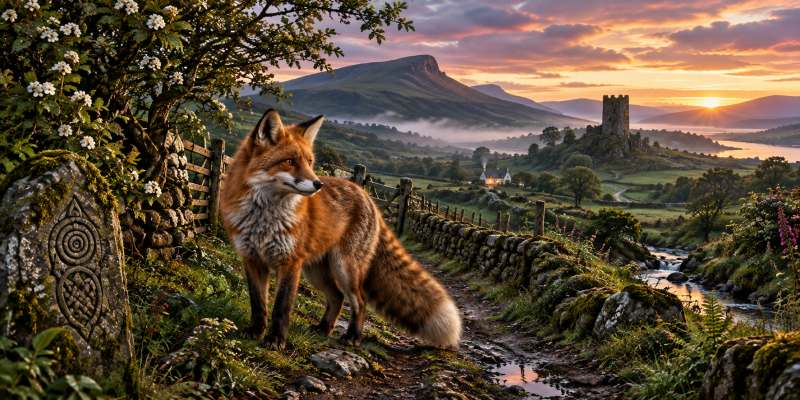
The fox's reputation for cunning is one of the most persistent ideas surrounding the animal. Across Britain, Ireland and much of Europe, stories repeatedly portray the fox as a creature that survives not through strength, but through intelligence.
This reputation probably owes much to observation. Foxes are opportunistic animals. They investigate new food sources, remember useful locations and adapt remarkably well when their surroundings change. A farmer attempting to protect poultry or someone pursuing a fox across the countryside could easily come away with the impression that the animal had deliberately outwitted them.
Folktales transformed these qualities into character. The fictional fox could deceive stronger animals, escape seemingly impossible situations and turn another character's confidence or greed against them. In such stories, physical power was often less important than knowing when to hide, when to run and when to take advantage of an opportunity.
The idea of the fox as a trickster should nevertheless be treated carefully. There was no single ancient British or Irish belief declaring the fox to be a universal “trickster spirit”. Much of the familiar literary image of the cunning fox belongs to a wider European storytelling tradition that developed and changed over many centuries.
What makes the association so enduring is how closely it resembles the real animal. Even without folklore, watching a fox quietly navigate a field, disappear through a seemingly impenetrable hedge or successfully live in the middle of a modern town makes its centuries-old reputation for adaptability remarkably easy to understand.
Foxes as Omens and Signs
Unexpected encounters with wild animals have often attracted meaning in folklore, and the fox is no exception. A fox appearing suddenly on a road, crossing a traveller's path or calling near a house could become memorable enough to inspire stories about luck, warning and events yet to come.
The difficulty is that folk beliefs were rarely consistent. An encounter regarded as fortunate in one place might be interpreted very differently somewhere else. Traditions also changed over time, making it misleading to claim that seeing a fox always represented one particular message throughout Britain or Ireland.
The fox's behaviour probably contributed greatly to these beliefs. Foxes are most active around dusk and during the night, when an unexpected encounter can feel particularly striking. Their ability to remain motionless while watching a person before disappearing into cover can give even an ordinary meeting an unusual atmosphere.
Modern spiritual traditions have expanded these ideas considerably. Today, seeing a fox is sometimes interpreted as representing adaptability, intelligence, independence or the need to approach a difficult situation carefully. These can be meaningful personal interpretations, but they should not automatically be presented as ancient Celtic beliefs.
Folklore and natural history can comfortably exist alongside one another. A fox crossing your path does not require a supernatural explanation — but understanding the centuries of stories surrounding the animal can make the encounter feel considerably richer.
What Does Seeing a Fox Mean?
There is no universal supernatural meaning attached to seeing a fox. In modern symbolism, the encounter is sometimes associated with cleverness, adaptability, awareness and finding an alternative route through a problem.
Historical folklore is far less straightforward. Beliefs varied according to region, period and circumstance, and the fox could be admired for intelligence while also being regarded with suspicion because of its association with livestock losses, nocturnal activity and elusive behaviour.
If you encounter a fox today, the simplest explanation is usually that you have crossed paths with an extremely adaptable wild animal. Yet the fact that people have been attaching stories to encounters like yours for centuries is part of what makes seeing one so memorable.
The Fox in Modern Paganism and Symbolism
The fox has become a popular symbol within modern Paganism, nature spirituality and other forms of contemporary spiritual practice. Its intelligence, independence and ability to thrive in very different environments make it a natural symbol of adaptability and resourcefulness.
Some people interpret the fox as a reminder to observe carefully before acting. Rather than confronting an obstacle directly, the fox can symbolise finding another path — using patience, awareness and intelligence instead of force.
Its association with twilight and nighttime has also contributed to modern ideas surrounding mystery, intuition and the unseen. A fox appearing briefly at dusk before disappearing into woodland fits easily into spiritual imagery concerned with boundaries, transformation and journeys between the familiar and unknown.
These interpretations should be distinguished from documented historical folklore. Descriptions of the fox as an ancient universal Celtic symbol of intuition, spiritual guidance or transformation often go considerably further than the surviving evidence allows.
Modern symbolism is nevertheless part of the continuing story of folklore. People still observe wild animals, attach meaning to encounters with them and create new stories inspired by their behaviour. In that sense, the relationship between people and foxes continues much as it has for generations — the stories change, but the animal remains.
Foxes, Twilight and the Folklore of Wild Places
There is something about the fox that seems particularly suited to the edges of the day. Dawn and dusk are times when familiar landscapes change character: shadows lengthen, birds fall quiet or begin their morning calls, and animals hidden during daylight start to emerge.
Foxes frequently inhabit these transitional hours. A glimpse of red fur beside a hedgerow or a pair of eyes watching from the edge of woodland can transform an ordinary landscape for a few moments.
Folklore repeatedly gathers around such boundaries — woodland edges, crossroads, rivers, ancient ruins and the transition between daylight and darkness. These are places where stories allow the familiar world to brush against something mysterious.
The fox needs no supernatural powers to belong within that tradition. Its real behaviour already gives it everything a storyteller requires: secrecy, intelligence, beauty and an extraordinary ability to appear without warning and disappear just as quickly.
Frequently Asked Questions About Fox Folklore
What does a fox symbolise?
The fox is commonly associated with intelligence, cunning, adaptability and independence. Modern spiritual interpretations may also connect it with intuition and transformation. Historically, however, fox symbolism varied between places and periods, so there was no single meaning shared across Britain and Ireland.
Are foxes associated with witchcraft?
Foxes do appear within some traditions concerning witchcraft and animal transformation. British and Irish folklore contains stories in which people believed to possess supernatural abilities could take animal form, although hares are particularly prominent in such accounts. Fox traditions should therefore be understood as part of a much wider body of shapeshifting folklore rather than evidence of one universal belief.
Are foxes important in Celtic mythology?
Foxes occur within the wider folklore and cultural traditions of Britain and Ireland, but it is misleading to describe the fox as having one universal ancient “Celtic meaning”. Irish, Welsh, Scottish and other traditions developed differently, and many popular claims about Celtic fox symbolism are modern interpretations rather than ideas clearly documented in early sources.
Is seeing a fox a good omen?
There is no single traditional answer. Folk beliefs concerning encounters with foxes varied considerably. Modern interpretations sometimes regard seeing a fox as a reminder to remain alert, adaptable or resourceful, but these meanings should not automatically be presented as ancient beliefs.
Why are foxes associated with cunning?
The association probably owes much to the fox's real behaviour. Foxes are intelligent and highly adaptable animals capable of finding food in many environments and avoiding danger. Generations of storytellers transformed these characteristics into tales in which the fox survives by outwitting stronger animals or people.
From Folklore to Art
The fox captures much of what inspires the artwork of Pixie Page Crafts. It is a familiar animal of the British and Irish countryside, yet an unexpected encounter with one can still make an ordinary landscape feel mysterious.
That combination of the real and the imagined lies at the heart of much of my work. Ancient stones, woodland paths, misty valleys and changing seasons are not intended simply as fantasy scenery. They reflect the kinds of landscapes in which stories were told, beliefs developed and generations of people encountered the wildlife around them.
The fox fits naturally into these landscapes. Its rich red coat brings colour to autumn woodland, while its secretive behaviour makes it equally at home beside moonlit ruins, old tracks and quiet fields at dusk.
My fox-inspired artwork draws upon that meeting point between wildlife, landscape and folklore — not attempting to illustrate one particular legend, but creating a world in which those old stories still feel close.
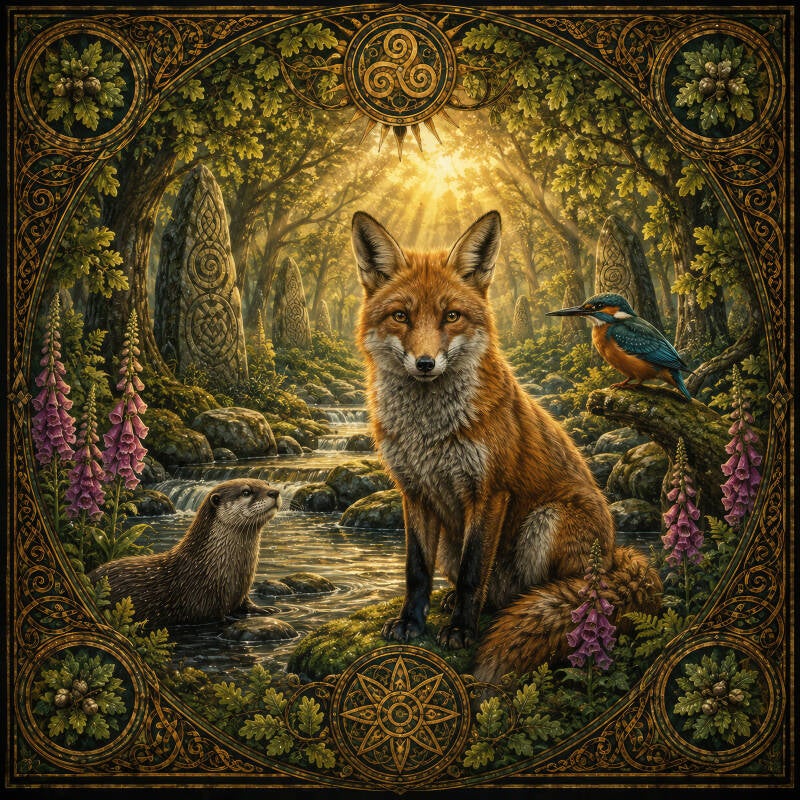
Fox-Inspired Celtic Art
Explore artwork inspired by the fox, Celtic and British folklore, ancient landscapes and the changing seasons.
Continue Exploring the Folklore
Animals in Celtic & British Folklore →
Return to the main animal folklore guide and discover the stories surrounding other animals and birds.
The Raven in Celtic & British Folklore →
Discover the raven's connections with the Morrígan, Brân the Blessed, prophecy and British folklore.
The Hare →
Explore traditions surrounding one of the most mysterious animals in British and Irish folklore.
The Celtic Otherworld →
Discover the mysterious landscapes and supernatural traditions of the Celtic Otherworld.
Sources & Further Reading
Fox folklore has developed from centuries of storytelling, observation and rural belief. The sources below include recorded Irish folklore alongside modern natural-history information, helping distinguish documented traditions from later interpretations.
The National Folklore Collection's online archive contains a remarkable collection of fox stories gathered in Ireland during the 1930s. Its fox material includes tales explicitly concerned with the animal's cleverness, deception and ability to escape difficult situations. More than 150 fox-related stories appear in this part of the collection.
Explore the fox stories at Dúchas.ie
Fox Folklore from County Galway
The Moycullen Heritage archive records the fox as sionnach or an maidrín rua and describes the contradictory attitude towards it: disliked because of the threat to poultry and livestock but respected for its cunning. Particularly interesting is a recorded fishing superstition in which seeing or mentioning a fox could be considered unlucky.
Moycullen Heritage — Sionnach/Fox
Galway Fishing Folklore
Galway City Museum also records the old Claddagh fishing tradition that four-legged animals should not be mentioned by name at sea. The fox was particularly feared: according to the museum's folklore material, merely seeing or mentioning one could be enough for fishermen to abandon a trip.
Galway City Museum — Folklore material
The Red Fox in Britain — The Mammal Society
The Mammal Society describes the red fox (Vulpes vulpes) as a highly adaptable generalist found in environments ranging from farmland and mountains to British cities. It also notes its characteristic scream and its tendency to be particularly active around dawn and dusk — real behaviours that help explain why foxes have provided such rich material for folklore.
The Red Fox in Ireland — Vincent Wildlife Trust
Vincent Wildlife Trust provides information on the fox's ecology and history in Ireland. It notes evidence suggesting that red foxes may have naturally colonised Ireland during the early post-glacial period, rather than necessarily being introduced by ancient humans as previously proposed.