The Badger in British & Irish Folklore
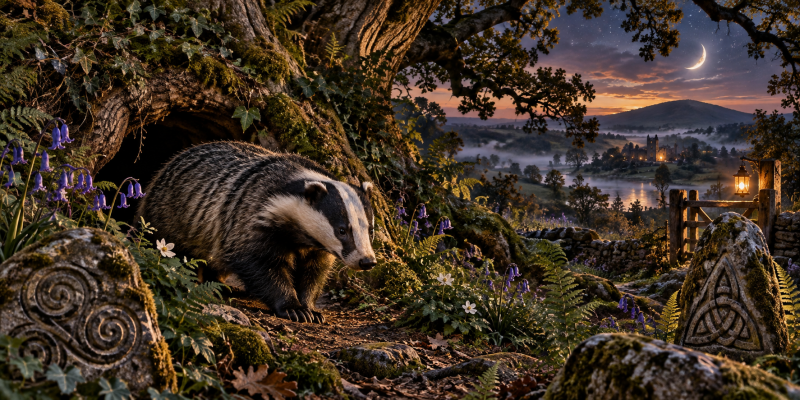
Few British woodland animals are as distinctive as the badger. With its black-and-white face, powerful body and secretive nocturnal life, the badger has lived alongside people in Britain and Ireland for thousands of years. Yet because it spends much of its life underground and emerges mainly after darkness falls, encounters with it have always carried a certain sense of mystery.
Badgers appear in folklore rather differently from wolves, ravens or hares. There is no single great body of ancient “Celtic badger mythology”. Instead, their story is scattered through Irish names and traditions, medieval literature, rural beliefs, hunting customs and later folklore.
One particularly interesting connection appears in early Irish tradition. The personal name Brocán derives from broc, the Irish word for badger, demonstrating how familiar and culturally recognisable the animal was. Badgers also appear within medieval Irish material in ways that connect the animal with the landscape, food and human interaction.
In Britain, generations of rural communities developed their own beliefs about badgers. Their extraordinary underground setts, some occupied by successive generations for very long periods, gave the animal an unusually strong association with particular pieces of land. Folklore and later popular tradition consequently came to portray the badger as stubborn, secretive and deeply rooted in its home territory.
Not every part of this history is gentle. Badgers were subjected to centuries of persecution and badger-baiting, a blood sport in which captured animals were forced to fight dogs. Changing attitudes towards animal welfare eventually brought legal protection, and today badgers and their setts receive particularly strong protection in Britain.
Modern Pagan and nature-based spirituality has added another layer, often interpreting the badger as a symbol of determination, boundaries, protection, grounding and connection with the earth. These can be meaningful contemporary interpretations, but they should not be mistaken for one universal belief held by ancient Celtic peoples.
The real folklore of the badger is therefore quieter than some modern mythology suggests — but no less fascinating. It is the story of an animal living beneath ancient woodland and farmland, sharing the same landscape with generations of people while remaining largely hidden from view.
The Badger in Early Irish Tradition
The badger was a familiar animal in early Ireland, but its place in surviving literature is more complicated than modern lists of “Celtic animal meanings” often suggest. There is no evidence that every Celtic community regarded the badger as possessing one fixed sacred meaning. Instead, references to badgers occur within a wider world in which animals, people and particular landscapes were closely connected.
The Irish word for badger is broc, a very old word that also appears in personal and place-names. The name Brocán, for example, is derived from the same root. Such names do not prove that the badger was worshipped or universally regarded as sacred, but they demonstrate how firmly the animal belonged within the cultural vocabulary of early Ireland.
Badgers also appear in medieval Irish literature as real creatures of the countryside rather than purely supernatural animals. This is important because the distinction between folklore and everyday life was not always as clear as modern retellings can make it seem. The people who created these stories inhabited landscapes in which encounters with wild animals were ordinary possibilities.
The badger's underground existence nevertheless made it an unusual neighbour. A sett could contain numerous entrances and tunnels beneath woodland, banks or fields, creating an entire hidden world below familiar ground. It is easy to understand why later storytellers and modern spiritual traditions found symbolic possibilities in an animal that disappeared beneath the earth during daylight and emerged after dark.
Modern writers sometimes describe the badger as an ancient Celtic symbol of courage, tenacity, healing or earth wisdom. These interpretations may be valuable within contemporary spirituality, but the historical evidence does not justify presenting them as a single documented belief shared throughout the ancient Celtic world.
What the older evidence gives us is subtler: an animal sufficiently familiar to enter language, names and literature, yet secretive enough to retain an enduring atmosphere of mystery.
Badgers, Setts and the Hidden World Beneath the Earth
Much of the badger's mystery begins with something entirely natural: its remarkable underground home. Badgers live in burrow systems known as setts, which can contain several entrances connected by tunnels and sleeping chambers beneath the ground.
Some established setts can be used by successive generations for many years. Paths become worn through the surrounding vegetation, earth is repeatedly excavated from entrances, and the sett gradually becomes a permanent feature of the landscape. In an old woodland or hedgerow, the inhabitants may change while the underground home remains.
This hidden existence gives the badger a very different character from animals encountered openly during daylight. A badger may spend the day beneath a familiar bank or ancient tree and emerge only as evening settles across the landscape. To someone walking the same countryside by day, an entire community of animals can therefore exist almost invisibly beneath their feet.
That relationship with the earth has inspired later symbolic interpretations of the badger as an animal of grounding, home, protection and hidden knowledge. Its sett can easily become a metaphor for roots, ancestry and the unseen foundations upon which visible life depends.
There is also an obvious temptation to connect this underground existence with Celtic stories of the Otherworld and supernatural places beneath hills or within the landscape. Such imagery works beautifully in modern folklore-inspired art and spirituality, but we should be careful: there is no good evidence that ancient Celtic peoples generally regarded badger setts themselves as entrances to the Otherworld.
The reality is fascinating enough. Beneath woodland paths, fields and hedgerows lies a world most people rarely see — tunnels occupied after darkness by an animal whose ancestors inhabited these landscapes long before many of the roads, farms and settlements surrounding them today.
Badgers in British Rural Folklore
In British rural tradition, the badger belonged to the familiar but largely unseen life of the countryside. Farmers, gamekeepers, woodsmen and travellers might recognise a sett, footprints or well-worn badger paths without frequently seeing the animal itself. Most badger activity takes place after dusk, helping to give it a secretive reputation.
The badger's physical appearance also made it unmistakable. Its bold black-and-white facial markings, low powerful body and surprisingly formidable strength distinguished it from other British mammals. When cornered, a badger could defend itself vigorously, contributing to a longstanding reputation for toughness and determination.
Folklore surrounding badgers varies considerably from place to place. Later collections of rural belief contain associations with luck, weather and encounters on roads or paths, but such traditions should not be treated as one universal British belief. Folk traditions were often intensely local, and the same animal could be interpreted differently from one community to another.
Badgers also became closely connected with ideas of home and territory. Their established setts and repeated use of familiar paths make them creatures strongly tied to particular places. In later storytelling this has helped create an image of the badger as an old, settled inhabitant of the countryside — stubborn perhaps, but dependable and difficult to dislodge.
That character became especially familiar through British literature. Mr Badger in Kenneth Grahame's The Wind in the Willows lives underground in the Wild Wood and is portrayed as private, formidable, practical and deeply knowledgeable about his surroundings. Published in 1908, the character is literature rather than ancient folklore, but he helped shape the way generations of readers imagined the British badger.
Behind these stories lies the real animal: largely nocturnal, powerful, social and intimately connected with the land surrounding its sett. The mixture of observation and storytelling has allowed the badger to become one of the most recognisable characters of the British countryside.
Badger-Baiting and Persecution
The relationship between people and badgers has not always been peaceful. For centuries, badgers were hunted and persecuted, sometimes because they were regarded as pests and sometimes purely for entertainment.
One of the cruellest practices was badger-baiting. A badger would be captured and placed into an enclosed space, where dogs were encouraged to attack it. The badger's strength, powerful jaws and determination to defend itself were precisely the characteristics that made the animal attractive to those organising these contests.
Badger-baiting became part of a wider history of animal blood sports in Britain. Although attitudes towards such practices gradually changed, illegal persecution did not disappear immediately with legislation. Badgers continued to suffer from digging, baiting and other forms of deliberate cruelty.
Today the situation is very different. In Britain, badgers receive specific legal protection, and their setts are protected as well as the animals themselves. Activities that intentionally kill, injure or take badgers, or damage, destroy or obstruct their setts, can constitute offences except in circumstances permitted by law.
The protection of the sett is particularly significant. It recognises that conserving an animal such as the badger involves protecting the underground home upon which the social group depends, not simply protecting individual animals encountered above ground.
This darker history also adds context to the badger's modern image as a symbol of resilience and determination. Those symbolic meanings are contemporary interpretations, but the real animal's ability to defend itself and persist despite centuries of persecution certainly helps explain why they feel so appropriate.
Badger Symbolism and Modern Paganism
Within modern Paganism and nature-based spirituality, the badger has become associated with determination, protection, boundaries, grounding and a strong connection with home and the earth. Many of these interpretations are inspired by the real behaviour of the animal rather than by one surviving ancient system of badger symbolism.
Determination and persistence are perhaps the easiest associations to understand. Badgers are powerful animals capable of digging through substantial quantities of earth, defending themselves when necessary and maintaining established territories and underground homes.
The sett has also encouraged modern associations with home, security and grounding. Much of a badger's life revolves around an underground network hidden beneath the visible landscape. For some modern spiritual traditions, this provides a natural metaphor for roots, stability and maintaining a secure foundation.
Boundaries and protection form another common interpretation. Badgers occupy established ranges, follow familiar paths and can defend themselves vigorously when threatened. Symbolically, the badger can therefore represent knowing when to stand one's ground and protecting the things that matter.
Its underground life has also encouraged associations with earth spirituality, introspection and hidden knowledge. A badger disappearing beneath ancient woodland lends itself naturally to imagery of entering darkness before returning again to the world above.
These interpretations can be meaningful within modern Pagan practice, but they should not automatically be labelled ancient Celtic beliefs. The surviving historical evidence does not give us a universal Celtic doctrine in which the badger represented grounding, protection or spiritual wisdom.
The distinction does not make modern symbolism less valuable. Folklore has never been completely static. People continue to observe animals, tell stories about them and find new meanings in their behaviour — just as generations before them did.
Frequently Asked Questions About Badger Folklore
What does a badger symbolise?
In modern symbolism, badgers are commonly associated with determination, resilience, protection, boundaries, home and connection with the earth. These meanings are largely contemporary interpretations inspired by the animal's behaviour.
What is the Celtic meaning of the badger?
There is no evidence for one universal ancient Celtic meaning of the badger. Badgers were familiar animals in Ireland and appear in language, names and medieval material, but modern claims that they universally represented courage, healing or earth wisdom go beyond the surviving evidence.
What is the Irish word for badger?
The Irish word for badger is broc. The word has a long history and also appears in names, demonstrating the badger's longstanding presence within Irish language and culture.
Are badgers connected with the Otherworld?
Modern folklore-inspired spirituality sometimes connects the badger's underground life with the Otherworld or hidden realms beneath the landscape. It is an evocative association, but there is no strong evidence that ancient Celtic peoples generally regarded badger setts as entrances to the Otherworld.
Why are badgers associated with determination?
Badgers are powerful digging animals and can defend themselves strongly when threatened. Their physical toughness, established setts and persistence have helped make determination and resilience particularly popular modern symbolic meanings.
Are badgers protected in Britain?
Yes. Badgers and their setts receive specific legal protection in Britain. The precise rules differ between jurisdictions, so activities that could disturb a badger or sett should be checked against current wildlife legislation and official guidance.
From Folklore to Art
The badger brings a very different atmosphere to folklore-inspired art. Unlike the stag standing dramatically on an open hillside or the swan crossing a moonlit lake, the badger belongs to the shadows beneath trees — old roots, woodland paths, moss-covered banks and the hidden entrances of underground setts.
My badger-inspired artwork draws upon this quieter side of the British and Irish landscape. Ancient woodland, tangled roots, ferns, weathered stones and twilight provide a setting that reflects both the real habitat of the animal and the mystery that generations of people have attached to creatures encountered mainly after dark.
The badger is particularly suited to the world of Pixie Page Crafts because its story connects wildlife, landscape and folklore without needing to become high fantasy. Sometimes the knowledge that an unseen animal is living beneath an ancient woodland path is mysterious enough.