The Horse in Celtic & British Folklore

Few animals were as important to the peoples of ancient Britain and Ireland as the horse. Horses carried warriors, pulled chariots, represented wealth and status, and became woven into stories of kingship, supernatural journeys and the mysterious world beyond ordinary human experience.
In Welsh and Irish tradition, horses appear beside some of the most memorable figures in mythology. Rhiannon arrives riding a mysterious white horse that no pursuer can catch, while the Irish figure Macha is forced into a devastating race against the king's horses. Beyond Britain and Ireland, the horse-goddess Epona was worshipped across parts of the Celtic and Roman worlds, demonstrating just how powerful the relationship between people and horses could become.
Yet the horse of folklore was not always a comforting creature. Across Britain and Ireland, traditions also tell of strange horses associated with lakes, rivers and lonely places — supernatural beings capable of carrying unsuspecting travellers into danger. From treasured companions to creatures of the Otherworld, horses occupied a remarkable position between the everyday landscape and the supernatural.
The surviving stories reveal something more interesting than a single fixed idea of what the horse “symbolised.” They show an animal associated at different times with status, movement, sovereignty, danger, transformation and the crossing of boundaries — an animal whose importance in everyday life helped give it an equally powerful place in mythology and folklore.
The Horse in the Ancient Celtic World
The horse was far more than a means of transport in ancient Britain and Ireland. Owning horses required resources, land and considerable care, making them valuable animals that could reflect the wealth and standing of their owners. Horses also transformed travel and warfare, carrying riders and drawing chariots across landscapes that would otherwise have taken far longer to cross.
Archaeology shows just how striking the relationship between people and horses could be. One of Britain's most famous ancient monuments, the Uffington White Horse in Oxfordshire, was cut into the chalk hillside during the late Bronze Age or early Iron Age. Its enormous, flowing form has overlooked the Vale of White Horse for thousands of years, although we cannot know with certainty what the people who created it believed it represented.
Horses also appear on Iron Age coins and other objects from Britain and continental Europe, sometimes rendered in highly stylised forms. Rather than proving that every horse carried one universal religious meaning, these objects demonstrate how frequently the animal entered the visual world of communities traditionally described as Celtic.
That importance continued into later mythology. In surviving Welsh and Irish literature, extraordinary horses carry heroes, accompany supernatural figures and sometimes seem capable of crossing boundaries ordinary people cannot. The everyday importance of the horse and its mythological importance became deeply intertwined.
Rhiannon and the Mysterious Horse
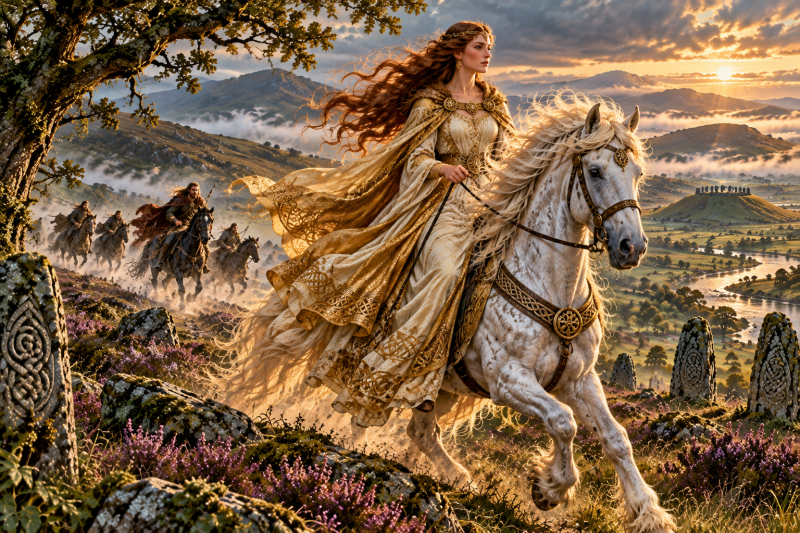
One of the most memorable appearances of a horse in Welsh mythology comes in the First Branch of the Mabinogi. Pwyll, Prince of Dyfed, sees a mysterious woman dressed in shining gold riding a great pale horse near the ancient mound of Gorsedd Arberth. Although she appears to travel at a calm and steady pace, none of Pwyll's horsemen can catch her.
For several days Pwyll attempts to pursue the mysterious rider, but even his fastest horses cannot close the distance. Eventually, rather than trying to outrun her, he simply calls out and asks her to stop. She does so immediately, famously telling him that it would have been better for his horse had he asked sooner.
The rider is Rhiannon, one of the great female figures of Welsh medieval literature. Her extraordinary entrance immediately places her apart from the ordinary human world. The strange impossibility of catching her horse, together with her appearance near a mound, has encouraged generations of scholars to consider whether elements of an older supernatural tradition survive within her story.
Rhiannon's connection with horses continues later in the tale. After being falsely accused of causing the disappearance of her newborn son, she is punished by being made to sit beside the gate of the court and offer to carry visitors upon her back like a horse. Eventually her innocence is revealed and her child, Pryderi, is restored to her.
Modern interpretations sometimes describe Rhiannon simply as a “Celtic horse goddess.” We should be more careful on Pixie Page Crafts. The medieval Welsh text never actually calls her a goddess. There are compelling reasons for scholars to explore connections between Rhiannon and earlier horse traditions, but separating what the surviving story actually says from later interpretation makes the folklore much more interesting.
Macha and the Race Against the Horses
One of the most dramatic horse stories in early Irish literature concerns Macha, a mysterious woman who appears in the tale commonly known as The Debility of the Ulstermen. She comes to live with a widower named Crunniuc, and while she remains with him his household prospers.
Trouble begins when Crunniuc attends an assembly held by the king of Ulster. Watching the king's horses race, he boasts that his wife can run faster than them. His claim reaches the king, who orders Macha to prove it despite her being heavily pregnant.
Macha begs for the race to be postponed until after she has given birth, but her request is refused. Forced to compete, she races against the king's horses and outruns them. At the finish she gives birth to twins and cries out in anguish, placing a curse upon the men of Ulster that will cause them to suffer the weakness of childbirth at their time of greatest need.
The story became connected with Emain Macha, the great royal site traditionally associated with the kings of Ulster and identified with archaeological Navan Fort in County Armagh. Macha herself is a complex figure who appears in several forms across medieval Irish literature, making it difficult to reduce her to a simple modern label such as a “horse goddess.”
Her story nevertheless demonstrates just how deeply horses could become entwined with ideas of kingship, power, status and the supernatural. The king's prized horses represent prestige and authority, yet Macha's extraordinary ability overwhelms them — and the king's refusal to show compassion brings disastrous consequences.
Epona — Horses, Protection and the Celtic-Roman World
While Rhiannon and Macha survive within medieval Welsh and Irish literature, Epona comes to us largely through archaeology and inscriptions from the Roman world. She was a deity closely associated with horses, ponies and mules, and images of her frequently show her seated or standing beside horses, sometimes holding fruit, grain or a cornucopia.
Evidence for Epona has been discovered across a remarkably wide area of the Roman Empire, particularly in Gaul and the Rhineland. Her worship also spread among people connected with the Roman military, helping her cult travel far beyond the regions where it probably originated. Unusually for a deity of Celtic origin, Epona was even honoured at Rome itself.
Her name is generally understood as deriving from the Gaulish word for horse, making the connection unusually clear. Archaeological representations suggest associations not only with horses themselves but also with protection, abundance and the people whose livelihoods depended upon these valuable animals.
Epona is especially useful when exploring Celtic horse traditions because, unlike many modern claims about supposed “Celtic animal meanings,” we have physical evidence for her worship. Inscriptions, sculptures and figurines allow us to see how important the relationship between horses, people and religion could become within the Celtic-Roman world.
However, we should avoid simply treating Epona, Rhiannon and Macha as three versions of the same goddess. Comparisons between them can be fascinating, but they come from different places, periods and surviving traditions. Keeping those distinctions gives us a much clearer picture of the extraordinary place occupied by horses across the ancient and medieval Celtic world.
The Water Horse — When the Horse Became Dangerous
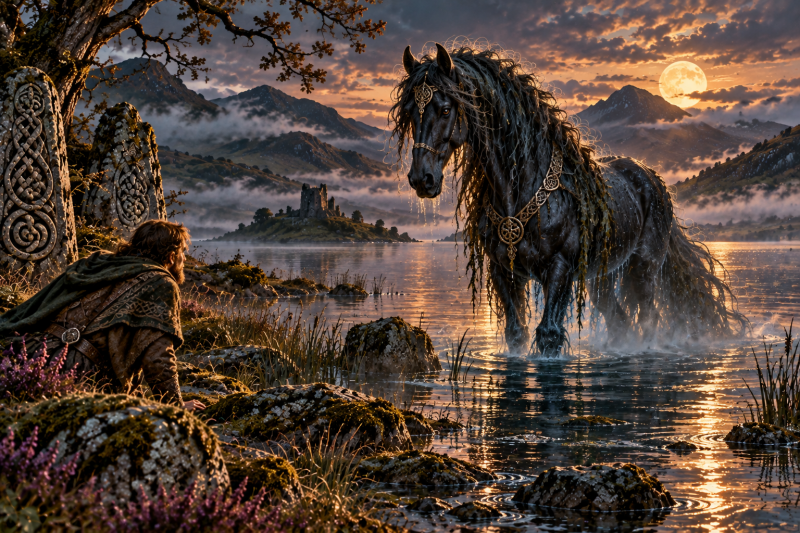
Not every supernatural horse in British and Irish folklore was a creature to admire. Around lonely lochs, lakes and rivers, stories developed of mysterious horses that could lure people towards the water — sometimes with terrifying consequences.
In Scottish tradition, one of the best-known is the each-uisge, the supernatural water horse associated particularly with lochs and the sea. It could appear as a magnificent horse and tempt an unsuspecting traveller to climb onto its back. Once mounted, escape might become impossible as the creature carried its victim towards the water.
The kelpie is another famous Scottish supernatural horse, although the traditions surrounding these creatures have often become mixed together in modern retellings. Kelpies are particularly associated with rivers and streams, while the each-uisge is traditionally connected more strongly with lochs and the sea. Folklore was never perfectly uniform, however, and stories varied considerably between communities and storytellers.
Ireland possesses its own traditions of supernatural water horses, including the each uisce, while Welsh folklore contains numerous dangerous beings associated with lakes, rivers and other bodies of water. These stories belong to a much wider tradition in which water could mark a boundary between the familiar landscape and something mysterious or threatening beyond it.
Perhaps these tales also carried a practical warning. Deep pools, fast rivers, remote lochs and unpredictable stretches of water could be genuinely dangerous places. A story about a beautiful horse waiting beside the water would have given that danger a memorable supernatural form.
Horses, the Otherworld and the Journey Between Worlds
Throughout Celtic storytelling, extraordinary horses frequently appear at moments when characters travel beyond the ordinary human landscape. They may carry heroes across enormous distances, approach mysterious mounds or accompany figures whose origins lie somewhere beyond the familiar world.
In Irish mythology, one of the most famous examples is Niamh Chinn Óir and Oisín. Niamh comes from Tír na nÓg, the legendary land of youth, and invites Oisín to accompany her. They travel across the sea on a magnificent horse to a realm where ageing and ordinary human time appear to have little power.
When Oisín eventually longs to see Ireland again, he is allowed to return but warned not to touch the ground. Ireland has changed beyond recognition and centuries have passed. When Oisín falls from the horse and touches the earth, the years that have been held at bay suddenly overtake him.
Stories such as this make the horse a perfect creature for journeys between worlds. A real horse could carry a person farther and faster than they could travel alone; in storytelling, that ability could be magnified until the horse carried its rider across seas, centuries and supernatural boundaries.
This does not mean that every horse in Celtic tradition represented the Otherworld. But again and again, extraordinary horses appear where the familiar landscape gives way to somewhere stranger — reinforcing their remarkable position between the everyday lives of people and the imagined worlds of mythology.
The Uffington White Horse — A Mystery Cut into the Hillside
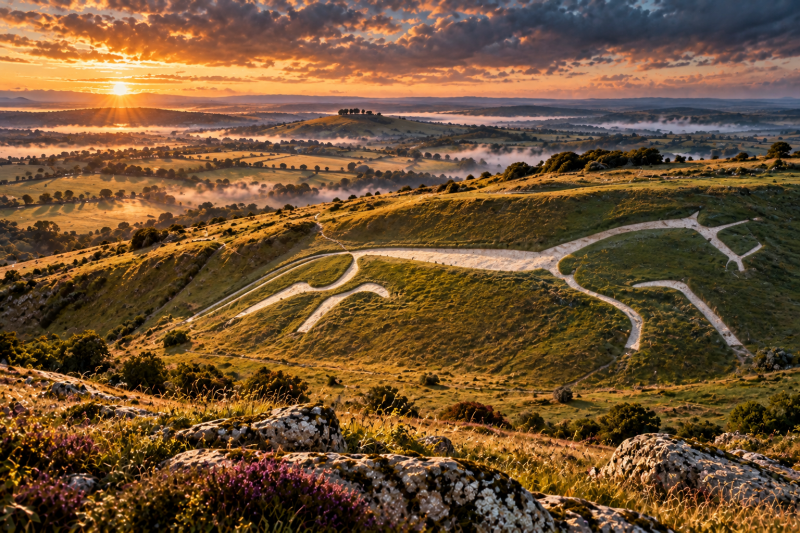
High on the Berkshire Downs in Oxfordshire lies one of Britain's most remarkable ancient monuments: the Uffington White Horse. Measuring around 110 metres from head to tail, its long flowing body was created by cutting trenches into the hillside and filling them with the brilliant white chalk beneath the turf.
Modern archaeological dating places the creation of the horse in the late Bronze Age or early Iron Age, making it roughly 3,000 years old. Its highly stylised form is very different from a realistic picture of a horse, yet its sweeping lines have made it one of the most recognisable prehistoric figures in Britain.
Exactly why the horse was created remains uncertain. Suggestions have ranged from religious or tribal significance to connections with territory, status and the surrounding landscape. What matters is that we do not pretend to know more than the evidence tells us. No surviving ancient explanation tells us who made the horse or precisely what it meant to them.
Its location makes the mystery even more intriguing. The figure lies close to Uffington Castle, an Iron Age hillfort, while the surrounding landscape contains prehistoric burial mounds and the dramatic natural valley known as The Manger. Later folklore accumulated around the horse and the landscape, giving an already ancient monument new stories as generations passed.
Perhaps most remarkable is the fact that the White Horse survived at all. For centuries local communities periodically cleared away vegetation and renewed the chalk — a tradition known as scouring the horse. Without repeated human intervention, the figure would gradually have disappeared beneath the grass.
The Uffington White Horse therefore connects several layers of the story we're telling on Pixie Page Crafts: prehistoric Britain, horses, landscape, archaeology and later folklore, all occupying the same hillside across thousands of years.
What Did the Horse Represent?
It is tempting to give the horse a single meaning in Celtic tradition — perhaps freedom, strength or sovereignty — but the surviving evidence tells a much richer story. The meaning of a horse depended upon the story, place and period in which it appeared.
For people living in ancient Britain and Ireland, horses were valuable real animals. They offered speed and mobility, carried riders, drew vehicles and could demonstrate wealth and status. It is therefore unsurprising that such an important animal also found its way into mythology, art and supernatural tradition.
In the stories of Rhiannon and Macha, horses become entangled with power, status and extraordinary women. With Epona, we find clear archaeological evidence of religious devotion centred upon a deity closely associated with horses. In tales of Tír na nÓg, an extraordinary horse can carry a rider beyond the boundaries of the ordinary world.
Yet the water-horse traditions reveal a very different side. The beautiful horse beside a lonely loch might not offer freedom at all, but danger. Familiarity could become deception, and the animal that normally carried a person safely across the landscape could instead carry them somewhere from which they might never return.
Perhaps that variety is the most important thing to remember. There was no single “Celtic meaning of the horse.” Across thousands of years of archaeology, mythology and folklore, horses became associated with prestige, travel, warfare, supernatural journeys, danger, power and the mysterious landscape itself.
Explore More Animal Folklore
The horse is only one of many animals woven through the mythology and folklore of Britain and Ireland. From birds associated with battle and prophecy to creatures of the forest, rivers and mountains, each animal developed its own place within centuries of storytelling and traditional belief.
The Stag in Celtic & British Folklore →
Discover the stag in mythology and folklore, from the wild hunt and ancient forests to ideas of kingship, transformation and the Otherworld.
The Raven in Celtic & British Folklore →
Explore the raven’s connections with Irish mythology, the Morrígan, Brân the Blessed, battlefields, prophecy and supernatural tradition.
The Hare in British & Irish Folklore →
Discover centuries of strange beliefs surrounding the hare, including witchcraft, transformation, the moon and the mysterious landscape.
The Wolf in British & Irish Folklore →
Explore the wolf’s place in Irish and British tradition, including warriors, wilderness, transformation and tales of Irish werewolves.
The Swan in Celtic & Irish Folklore →
Discover the beautiful but sometimes tragic stories surrounding swans, transformation and the Otherworld in Irish mythology.
The Fox in British & Irish Folklore →
Explore traditional beliefs about the fox, from cunning and rural superstition to unusual fishing folklore from the west of Ireland.
The Badger in British & Irish Folklore →
Discover the badger’s connections with strength, the underground world and centuries of rural storytelling.
The Barn Owl in British & Irish Folklore →
Explore the mysterious reputation of the barn owl and the beliefs inspired by its nocturnal life, eerie calls and ghostly appearance.
The Blackbird in Celtic & British Folklore →
Discover the blackbird in Welsh and Irish tradition and its connections with ancient landscapes, enchanted birds and the Otherworld.
The Horse in Folklore Today
The horse still occupies a powerful place in the folklore and imagination of Britain and Ireland. Ancient goddesses and medieval tales may belong to another age, but horses continue to appear in local traditions, seasonal customs, place names, folk art and stories attached to particular landscapes.
Some of the most striking survivals can be found in traditional customs. Hooded horse figures, hobby horses and other strange equine characters appear in celebrations around Britain and Ireland. Perhaps the most famous Welsh example is the Mari Lwyd, a decorated horse skull carried from house to house during the winter season. Although its precise origins remain uncertain, the tradition demonstrates how strongly the image of the horse became embedded within community folklore.
Elsewhere, enormous horses have quite literally been carved into the landscape. The Uffington White Horse in Oxfordshire dates back thousands of years, although we cannot know exactly what the figure meant to the people who created it. Its survival nevertheless provides an extraordinary reminder that horses held an important place in prehistoric Britain long before many of the written stories associated with them appeared.
Modern Pagan and Celtic-inspired traditions have also adopted the horse as a symbol of freedom, journeys, the natural world and personal strength. These interpretations can be meaningful today, but they should not automatically be presented as beliefs held by ancient Celtic peoples. Modern symbolism and historical folklore are not always the same thing.
Perhaps that is part of what makes the horse so fascinating. From prehistoric hillsides and ancient religious imagery to medieval mythology, frightening water-horse legends and winter folk customs, the horse repeatedly appears wherever the everyday world seems to meet something older and stranger.
Sources & Further Reading
The horse appears across many different periods of British and Irish history, from prehistoric archaeology and Romano-Celtic religion to medieval Welsh and Irish literature and later folk tradition. Because these traditions developed over many centuries, it is useful to distinguish archaeological evidence from stories preserved in medieval manuscripts and much later folklore.
Epona — The Horse Goddess
Epona was worshipped across parts of the Roman Empire and is one of the clearest examples of a deity strongly associated with horses. Archaeological evidence includes inscriptions and images depicting her with horses and foals. World History Encyclopedia
Explore Epona at the World History Encyclopedia →
Rhiannon and the Mabinogion
Rhiannon's extraordinary first appearance on horseback occurs in the First Branch of the Mabinogi. She becomes one of the most important figures in the Four Branches and has particularly strong associations with horses. Mabinogion
Discover Rhiannon and the Mabinogion →
Macha and the Horses of Ulster
The story of Macha tells how she was forced to race against the king's horses while heavily pregnant. Her victory and subsequent curse form one of the most memorable horse-related episodes in Irish legendary tradition. Dictionary of Irish Biography
Read about Macha in the Dictionary of Irish Biography →
The Uffington White Horse
The Uffington White Horse is Britain's oldest scientifically dated chalk figure and dates to the late Bronze Age. National TrustExplore the Uffington White Horse — National Trust →
One more good source
English Heritage also has an excellent page about the Uffington site and the archaeological work investigating the horse. English HeritageDiscover the Uffington White Horse Project — English Heritage →