The Barn Owl in British & Irish Folklore
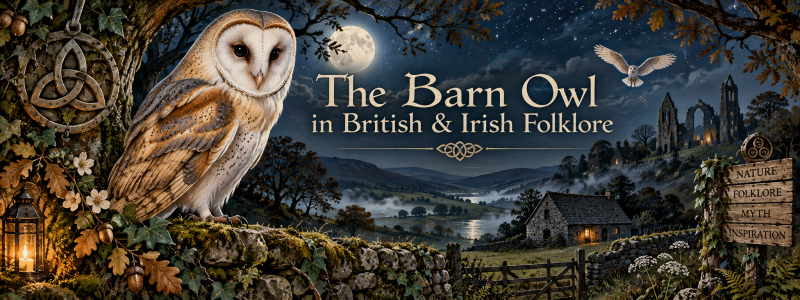
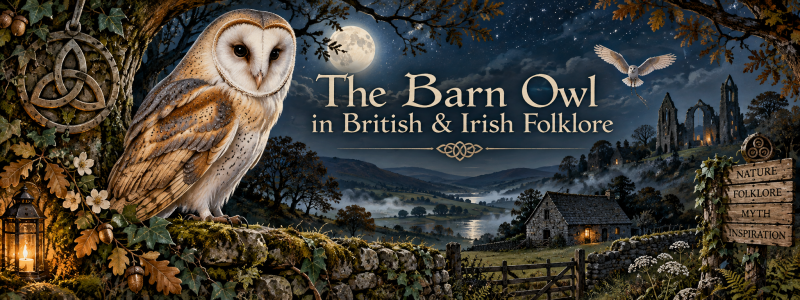
Ghostly pale, almost completely silent in flight and most often encountered in the half-light of dusk or darkness of night, the barn owl has all the qualities needed to inspire folklore. For generations, owls have occupied an uneasy place in British and Irish tradition, associated at different times with death, warning, mystery and the supernatural.
Yet there was never one universal belief about the barn owl. Traditions varied enormously between places and periods, and folklore concerning owls in general has sometimes later been attached specifically to the barn owl. Separating those traditions is important if we want to understand what historical sources actually tell us.
The barn owl's extraordinary natural behaviour undoubtedly contributed to its reputation. It can appear almost white in moonlight, fly with remarkably little sound and produce calls very different from the familiar hooting popularly associated with owls. Encountered unexpectedly around an old barn, churchyard, field or country lane at night, it is easy to understand how such a bird could become part of supernatural storytelling.
This page explores the barn owl within British and Irish folklore, looking at old beliefs and omens, the traditions surrounding owls in Celtic-language literature, and the meanings attached to this remarkable bird today — while distinguishing historical folklore from much later modern interpretation
Barn Owls, Death and Omens
Across Britain and Ireland, owls have often carried an uneasy reputation. Their nocturnal habits, strange voices and ability to appear suddenly from the darkness made them natural candidates for stories involving warning, death and the supernatural. In some regional traditions, hearing or seeing an owl close to a house could be interpreted as an omen of illness, misfortune or death.
We need to be careful, however, when describing these beliefs specifically as barn owl folklore. Historical collections frequently record traditions simply concerning “the owl”, without identifying the species involved. Later writers sometimes transferred general owl beliefs to the barn owl because its pale plumage and eerie nocturnal behaviour seemed particularly appropriate.
The barn owl's own calls probably helped strengthen this reputation. Unlike the familiar hoot associated with some other owls, barn owls can produce harsh screeches and hissing sounds. Heard unexpectedly at night — particularly before electric lighting transformed the countryside — such cries could easily have seemed disturbing or inexplicable.
These traditions do not mean that people everywhere feared barn owls. Folklore is rarely that consistent. Beliefs varied between communities, and the same animal might be regarded as ominous in one tradition while attracting little supernatural significance in another. What survives is a patchwork of local beliefs rather than a single British or Irish interpretation of the bird.
Owls in Welsh Tradition — Blodeuwedd
One of the best-known owls in medieval Welsh literature appears in the story of Blodeuwedd, preserved in the Fourth Branch of the Mabinogi. Blodeuwedd is created from flowers by the magicians Math and Gwydion to become the wife of Lleu Llaw Gyffes. Her story, however, takes a darker turn when she and her lover Gronw Pebr plot Lleu's death.
After Lleu survives the attempt and eventually returns, Gwydion punishes Blodeuwedd by transforming her into an owl. He declares that she will no longer show her face in daylight and that other birds will be hostile towards her. The episode provides one of the clearest literary connections between an owl and themes of transformation, isolation and night within medieval Welsh tradition.
Importantly, the medieval text does not identify Blodeuwedd specifically as a barn owl. Modern artwork and retellings frequently portray her as one, but presenting this as an ancient tradition would go beyond the surviving evidence. The story concerns an owl, while the choice to represent that owl as a barn owl belongs largely to later interpretation.
Blodeuwedd has acquired many additional meanings in modern Paganism and contemporary spirituality, where she may be interpreted through ideas such as independence, transformation or feminine power. These interpretations can form meaningful modern traditions, but they should be distinguished from what the medieval Welsh story itself actually says.
Owls in Irish Tradition
Owls also appear within Irish-language tradition, although we should be cautious about trying to construct a single ancient Irish belief about them. References are scattered across literature, language, natural history and later folklore rather than forming one clear mythology devoted to the owl.
An interesting example occurs in the Irish name for the barn owl, scréachóg reilige, commonly understood as “screecher of the graveyard” or “graveyard screecher”. The name evokes two characteristics that helped give the bird its eerie reputation: its harsh cry and its association with old buildings, ruins and places around churches where suitable nesting sites could sometimes be found.
Such names are fascinating evidence of how people perceived an animal, but they should not automatically be treated as proof of an ancient religious belief. An association between an owl, graveyards and death may develop naturally from where the bird was encountered, when it was active and the unsettling sounds it made after dark.
Later Irish folklore contains wider traditions concerning owls, omens and nocturnal birds, but these vary considerably by locality. As elsewhere in Britain and Ireland, it is safer to speak of many owl traditions rather than claiming that the barn owl possessed one fixed supernatural meaning throughout Irish history.
Why the Barn Owl Became a Bird of Mystery
Long before folklore gave the owl supernatural associations, the barn owl already possessed an extraordinary collection of natural characteristics. It hunts mainly at night and around dusk, moving across fields with remarkably quiet flight while searching for small mammals hidden in the vegetation below.
Its pale, heart-shaped face makes the bird particularly striking. In poor light, the white underside of a barn owl can seem almost luminous, while its broad wings allow it to appear suddenly and disappear again with very little sound. An unexpected encounter on a dark country lane or beside an old barn can still be startling today.
Its voice adds another dimension. The barn owl does not give the familiar repeated hoot associated with species such as the tawny owl. Instead, it produces screeches, hisses and other harsh calls that can sound remarkably strange when heard without knowing their source.
Folklore often grows from attempts to understand unusual experiences within the natural world. The barn owl needed little embellishment: a pale nocturnal bird flying silently through darkness and producing eerie cries already possessed many of the qualities from which supernatural stories could develop.
Barn Owl Symbolism and Modern Paganism
In modern Paganism and contemporary nature-based spirituality, the barn owl is often associated with intuition, hidden knowledge, transformation and the ability to perceive what others cannot. Its silent flight and nocturnal life make it a natural symbol for journeys into darkness, mystery and the unseen.
The barn owl's pale appearance has also encouraged modern associations with boundaries and liminal places — the imagined threshold between daylight and darkness, the familiar and the unknown, and sometimes between the living world and the Otherworld. These ideas fit particularly well with the atmosphere surrounding the bird, but they should not automatically be described as ancient Celtic beliefs.
Historical Welsh tradition provides us with the transformation of Blodeuwedd into an owl, while British and Irish folklore preserves various beliefs concerning owls, omens and death. Neither gives us evidence for a single ancient system in which the barn owl universally represented wisdom, intuition or passage between worlds.
Modern interpretations are nevertheless part of the barn owl's continuing folklore. Traditions do not simply stop developing. The important distinction is between beliefs documented in historical sources and meanings created or adopted by people today. Both can be explored without presenting one as the other.
Perhaps that is particularly appropriate for the barn owl. It remains a bird of boundaries: hunting across fields as daylight fades, occupying old buildings and ruins, and appearing briefly from darkness before vanishing again. Even without supernatural explanation, there is something profoundly mysterious about encountering one.
Frequently Asked Questions About Barn Owl Folklore
What does a barn owl symbolise in folklore?
There is no single historical meaning for the barn owl. British and Irish traditions concerning owls include associations with omens, death, night and the supernatural. Modern interpretations often associate barn owls with intuition, wisdom and transformation, but these should not automatically be presented as ancient Celtic beliefs.
Is the barn owl associated with death?
Owls have been regarded as omens of death or misfortune in some British and Irish folk traditions. However, many historical accounts refer simply to an “owl” without identifying the species. The barn owl's pale appearance, nocturnal behaviour and unusual screeching calls have helped strengthen its later association with ghostly and supernatural themes.
Was Blodeuwedd turned into a barn owl?
In the medieval Welsh Mabinogi, Gwydion transforms Blodeuwedd into an owl as punishment for her role in the attempted killing of Lleu Llaw Gyffes. The surviving medieval story identifies her as an owl, but does not specify a barn owl. Her depiction as a barn owl is largely a later artistic interpretation.
What is the Irish name for the barn owl?
One Irish name for the barn owl is scréachóg reilige, often translated as “graveyard screecher”. The name reflects the bird's distinctive cry and its historical association with old buildings, ruins and church environments.
Are barn owls sacred in Celtic mythology?
There is not good evidence for claiming that barn owls were universally sacred to ancient Celtic peoples. Owls certainly appear in Celtic-language traditions, most famously in the Welsh story of Blodeuwedd, but claims that the barn owl had one fixed sacred meaning usually go beyond what the surviving historical evidence can demonstrate.
From Folklore to Art
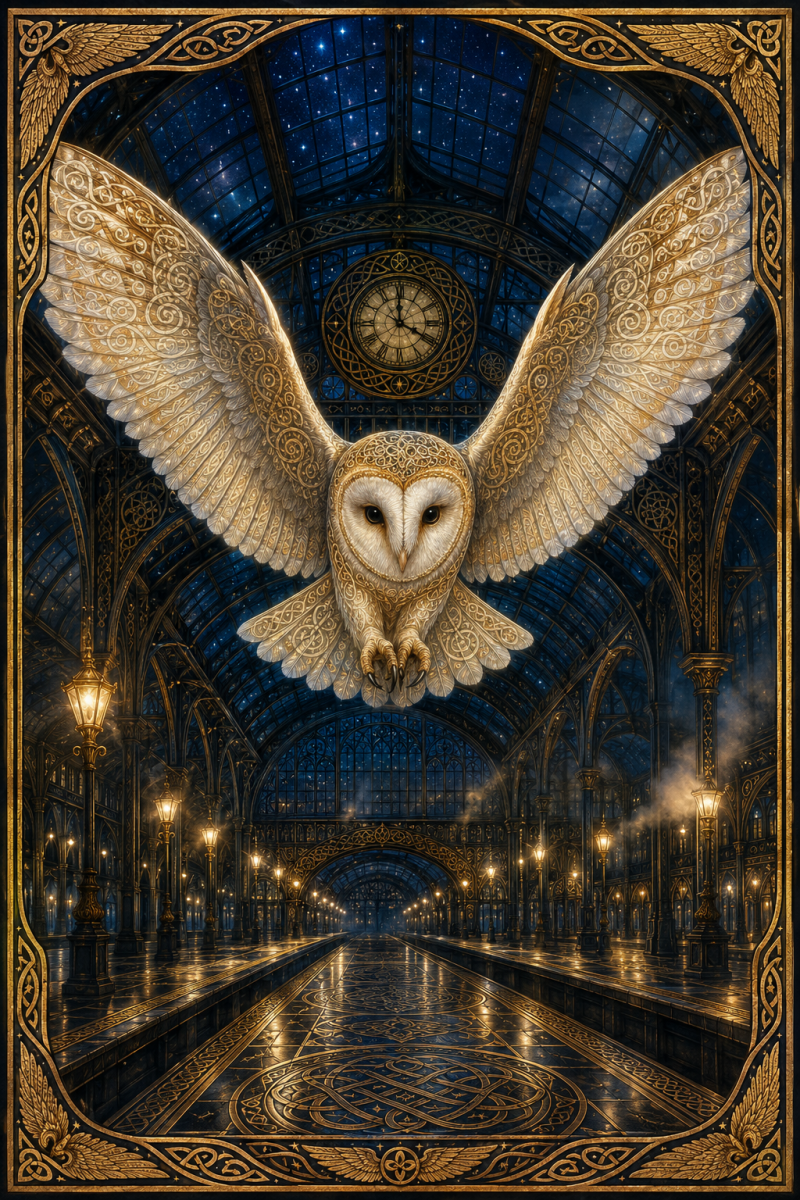
Silent in flight and pale against the darkness, the barn owl has long seemed like a creature moving between worlds. Its combination of beauty, mystery and nocturnal behaviour makes it a particularly powerful subject for folklore-inspired art.
In my Pixie Page Crafts artwork, the barn owl inhabits the kind of landscape suggested by the old stories — moonlit woodland, ancient stone, misty fields and forgotten paths. The imagery draws inspiration from British and Irish folklore without attempting to portray modern symbolism as historical fact.
For me, much of the barn owl's magic comes from the real animal itself. A pale shape passing silently across a dark field can feel almost supernatural even when we understand exactly what we are seeing. Folklore gives that moment another layer, connecting the living bird with generations of stories, fears and imagination.
My barn owl artwork celebrates that meeting point between nature, folklore and the mysterious landscape — the place where much of Pixie Page Crafts begins
View more of the Pixie Page Craft Celtic Art Collections
Continue Exploring the Folklore
The barn owl is only one of the remarkable animals woven into the folklore and storytelling traditions of Britain and Ireland. Explore the Hare, Raven, Fox, Stag, Swan, Wolf, The Badger and Wild Boar, each revealing a different relationship between people, animals, landscape and the supernatural.
You can discover the complete collection through Animals in Celtic & British Folklore, or journey further into stories of transformation, mysterious beings and places beyond the ordinary world in The Celtic Otherworld.
If you would like to explore these traditions beyond the website, visit the Pixie Page Crafts Folklore Bookshelf, where I've gathered recommended reading on British and Irish folklore, mythology, animals, sacred landscapes and the supernatural.
Sources & Further Reading
The Mabinogion — translated by Sioned Davies
An accessible modern translation of the medieval Welsh tales, including the Fourth Branch of the Mabinogi and the story of Blodeuwedd.
A Dictionary of English Folklore — Jacqueline Simpson & Steve Roud
A major reference work for English folk beliefs, customs, omens and traditions, useful for placing historical beliefs concerning owls within their wider folkloric context.
The Penguin Guide to the Superstitions of Britain and Ireland — Steve Roud
A valuable evidence-based guide to recorded superstitions and their histories, particularly useful for avoiding unsupported claims about supposedly ancient beliefs.
The Folklore of Birds — Edward A. Armstrong
A broad historical study of traditions and beliefs associated with birds. Leave this one unlinked for the moment — I don't want to give you a questionable link just for the sake of having one.
The Schools’ Collection — National Folklore Collection, UCD (Dúchas.ie)
A remarkable collection of folklore gathered by Irish schoolchildren during the 1930s, now available to search online.
Folklore varies greatly by place and period. Where historical sources refer simply to “the owl”, I have avoided assuming that the tradition originally referred specifically to the barn owl. Modern Pagan and spiritual interpretations are identified separately from documented historical folklore.