Sacred Waters, Wells & Rivers
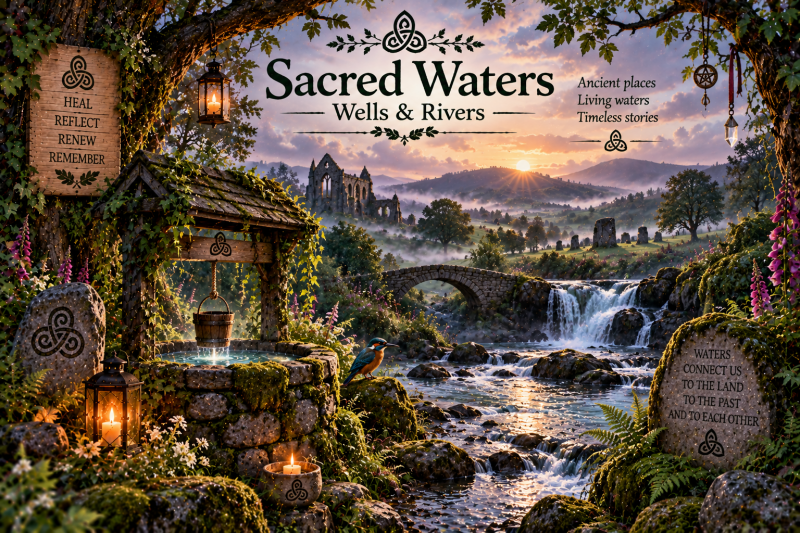
Where Water Meets the Otherworld
Across Britain and Ireland, water has shaped both the landscape and the stories told about it. Rivers carve valleys through hills, springs emerge unexpectedly from rock, wells gather beneath ancient trees and streams disappear into dark woodland before emerging again miles away. Long before modern plumbing made water something that simply arrived from a tap, a reliable spring or well could determine where people lived.
Water was essential for drinking, farming, animals, cooking and washing, but its importance went far beyond everyday survival. Springs, wells, rivers, lakes and pools became associated with healing, offerings, pilgrimage, supernatural beings and ancient deities. Archaeology has revealed objects deliberately deposited in watery places, while folklore preserves countless stories of magical wells, mysterious rivers and spirits inhabiting the water.
Some of these traditions are ancient. Others belong to medieval Christianity or much later folklore. Many have become intertwined so thoroughly that separating one period from another is difficult.
What remains constant is the water itself.
It continues flowing through the same landscape.
Why Was Water Sacred?
It is not difficult to understand why ancient communities might have regarded water as extraordinary. A spring appears to emerge directly from the earth. A river continuously moves yet never seems to empty. Rain falls from the sky and transforms dry ground into fertile land.
Without understanding underground aquifers or the modern science of the water cycle, a powerful spring could seem mysterious. Where was all that water coming from?
Some springs also contained minerals that changed their colour, smell or taste. Others remained remarkably constant through drought or winter. Certain waters may genuinely have helped particular skin complaints or other conditions, strengthening reputations for healing.
A place where clean water emerged endlessly from beneath the earth could easily become more than a practical resource.
It could become sacred.
Springs — Water Born from the Earth
A natural spring is one of the most atmospheric features of the British and Irish landscape.
Water emerges quietly between stones, beneath tree roots or from a hillside and begins its journey downhill. A tiny trickle may eventually join a stream, which joins a river, which finally reaches the sea.
To earlier communities, a spring could appear almost like the earth itself producing water.
This made springs natural places for stories.
Some became associated with saints. Others acquired traditions involving healing, fertility or supernatural beings. Certain springs became destinations for pilgrimage, while others remained small local places known primarily to nearby communities.
The beginning of a river can be surprisingly humble.
Sometimes an entire waterway begins with little more than water appearing beneath a stone.
Holy Wells
Thousands of wells and springs across Britain and Ireland have been described as holy wells.
Many are associated with Christian saints. Some developed chapels or shrines nearby, while others remained simple stone-lined pools or springs beside country lanes.
People visited them for many reasons.
Some sought healing.
Some prayed.
Some left offerings.
Others simply collected water.
In certain places, annual visits took place on a saint's feast day or another important date.
It is sometimes claimed that every Christian holy well was originally a Pagan sacred site. This is possible in individual cases, but it cannot automatically be assumed. Some wells may preserve traditions older than Christianity, while others developed their sacred reputation during the Christian period.
The landscape contains layers.
A spring can gather new stories without losing the old ones.
Healing Waters
Healing is one of the most persistent themes surrounding sacred water.
Individual wells became famous for particular conditions. One might be visited for eye problems, another for skin complaints, infertility or general health.
Some waters contained minerals that may genuinely have affected the body. Others probably gained their reputations through tradition, faith and stories of successful cures.
For people living before modern medicine, visiting a healing spring offered something important even when the water itself could not cure disease.
It offered hope.
A journey could be made.
A ritual performed.
A prayer spoken.
Something could be done.
Coins, Pins and Offerings
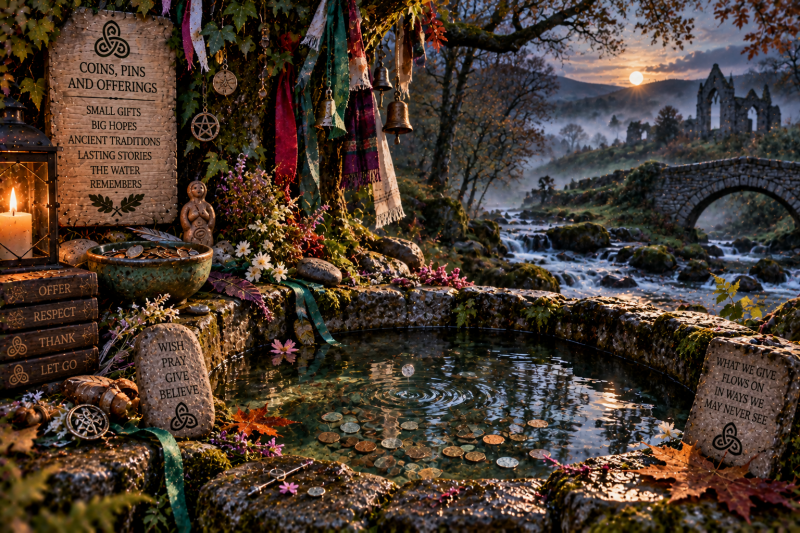
People have deposited objects into water for thousands of years.
Archaeologists have discovered weapons, jewellery, coins and other valuable objects in rivers, lakes, bogs and springs. In some cases, the deliberate nature of these deposits suggests ritual activity rather than accidental loss.
Later traditions continued the practice of leaving small objects at wells and springs.
Coins became particularly familiar.
The modern habit of throwing a coin into water and making a wish may seem playful, but it belongs to a much larger human pattern.
We give something to the water.
Then we ask for something in return.
The Wishing Well
The wishing well is now such a familiar idea that its strangeness is easy to overlook.
You stand beside water.
Drop something valuable into it.
Make a private request.
And walk away.
Similar ideas appear in many different cultures and periods, although they should not all be treated as one continuous ancient tradition.
The custom reflects a deeper relationship between giving and receiving.
Water provides life freely.
An offering acknowledges that gift.
Even a modern coin tossed into a fountain carries a faint echo of that much older idea.
Rag Trees and Clootie Wells
Some sacred wells are surrounded by trees covered with strips of cloth, ribbons and other objects.
These places are sometimes known as clootie wells, from a Scots word referring to cloth.
Traditionally, a piece of cloth might be dipped in the water and associated with a prayer or request for healing. In some traditions, as the cloth decayed, the illness was believed to disappear with it.
The sight can be extraordinary.
Hundreds of pieces of fabric move among the branches while water flows beneath them.
Modern visitors, however, sometimes leave synthetic ribbons, plastic objects or materials that do not biodegrade. These can damage trees and pollute the site.
If visiting such a place, respecting the landscape is more important than leaving evidence that you were there.
Wells and Ancient Trees
Water and trees frequently appear together in sacred landscapes.
A spring may emerge beneath the roots of an old tree. Wells can sit beneath hawthorn, ash or other species, creating places where two powerful forms of folklore meet.
The tree reaches upward.
The roots descend into the earth.
The water rises from below.
It is easy to see why such places inspired stories.
In later folklore, trees beside wells could become part of healing customs, offering traditions or stories involving saints and supernatural beings.
A sacred place was rarely just one thing.
Stone, tree and water could all contribute to its meaning.
Rivers — Roads Through the Landscape
Before modern roads, rivers were among the great routes through the landscape.
They provided water, fish, fertile soil and transport. Settlements developed beside them. Boundaries followed them. Bridges and fords became strategically important.
But rivers also created natural divisions.
Standing on one bank, the opposite side is physically separated from you.
To cross, you need a bridge, boat or shallow ford.
That made rivers powerful symbolic boundaries.
In folklore, crossing water could sometimes mean moving from safety into danger, from one territory into another or even from the ordinary world towards something supernatural.
A river is both a road and a barrier.
Rivers as Goddesses
Several rivers in Britain and Ireland carry names associated with ancient female divine figures or mythological traditions.
The River Boyne in Ireland is connected with Boann, an important figure in Irish mythology. Medieval stories explain the river's creation through her encounter with a supernatural well.
The River Shannon is similarly associated with the figure Sionann.
These stories do more than explain geography.
They transform the landscape into mythology.
The river is no longer simply water passing through the land.
It has a name.
A personality.
A story.
Boann and the River Boyne
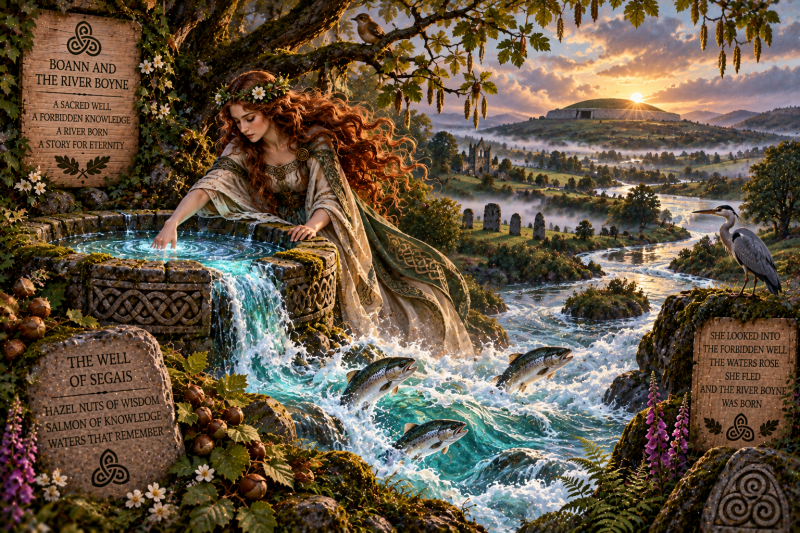
One famous Irish story concerns Boann and the Well of Segais.
The supernatural well was surrounded by hazel trees whose nuts contained wisdom. In different versions of the story, Boann approaches or challenges the forbidden well.
The water rises violently.
It pursues her across the landscape and eventually flows towards the sea.
Through this event, the River Boyne is created.
Like many mythological stories, there are different versions and interpretations.
But the imagery is extraordinary.
Hidden knowledge lies inside a well.
A boundary is crossed.
Water escapes.
And an entire river is born.
The Well of Wisdom
The Well of Segais belongs to one of the most beautiful groups of images in Irish mythology.
Hazel trees grow around the sacred water.
Their nuts fall into the pool.
Salmon eat the hazelnuts and acquire their wisdom.
This imagery is connected with the famous Salmon of Knowledge, another story in which wisdom moves from the natural world into human hands.
Hazel.
Water.
Salmon.
Knowledge.
Each element exists in the real Irish landscape, yet mythology transforms their relationship into something supernatural.
The story suggests that wisdom does not simply belong to humans.
It already exists within nature.
Lakes and the Hidden World
Lakes have their own atmosphere.
Unlike rivers, they can appear completely still.
The surface reflects the sky while hiding everything beneath it.
This made lakes natural places for supernatural stories.
Legends tell of drowned settlements, magical islands, monsters and entrances to other worlds.
Fog can make an island disappear completely.
Reflections can make sky and water almost indistinguishable.
A person standing beside a deep lake cannot easily see what lies beneath the surface.
Folklore grows beautifully in places where human vision fails.
Offerings Beneath the Water
Archaeological discoveries show that prehistoric and later communities sometimes placed valuable objects into watery locations.
Weapons are particularly striking.
A sword represents enormous labour and valuable material. Deliberately placing one into a river or lake means giving up something important.
We cannot always know why this happened.
An offering to a deity?
A funeral custom?
A marker of status?
A ritual connected with warfare?
Different deposits may have had entirely different meanings.
What matters is that water was sometimes chosen as the place where valuable objects left the human world.
Once beneath the surface, they were difficult or impossible to retrieve.
The gift became permanent.
Bog Bodies and Sacred Wetlands
Wetlands occupy another strange boundary between land and water.
Bogs can preserve organic material for extraordinary lengths of time because of their unusual chemical conditions.
Across northern Europe, human remains known as bog bodies have been discovered with skin, hair and clothing sometimes remarkably preserved.
Some individuals appear to have died violently, leading to theories involving punishment, murder, sacrifice or ritual killing.
The evidence differs between individual cases, and sweeping explanations should be avoided.
But bogs clearly held unusual significance within ancient landscapes.
They were neither solid land nor open water.
Once again, the boundary becomes important.
Fords — Crossing the Water
Before bridges became common, rivers were often crossed at fords.
A ford could become one of the most important places in an entire landscape.
Roads converged there.
Travellers met there.
Animals crossed there.
Control of a ford could have strategic importance.
Unsurprisingly, fords also appear frequently within mythology and folklore.
Battles could occur beside them.
Heroes could meet there.
Journeys changed direction there.
The ford is another liminal place — neither fully one bank nor the other.
You enter the water in one world and emerge on the opposite side.
Bridges and Folklore
Bridges eventually transformed river crossings.
But bridges acquired folklore of their own.
Stories across Europe tell of supernatural builders, strange bargains, ghosts and creatures living beneath bridges.
Why?
A bridge is a remarkable structure.
It carries people across something that would otherwise block their path.
It joins two separated pieces of land.
Symbolically, it does exactly what so many supernatural stories imagine.
It connects worlds.
An old stone bridge in mist can therefore become much more than architecture.
It becomes a threshold.
Waterfalls — The Voice of the River
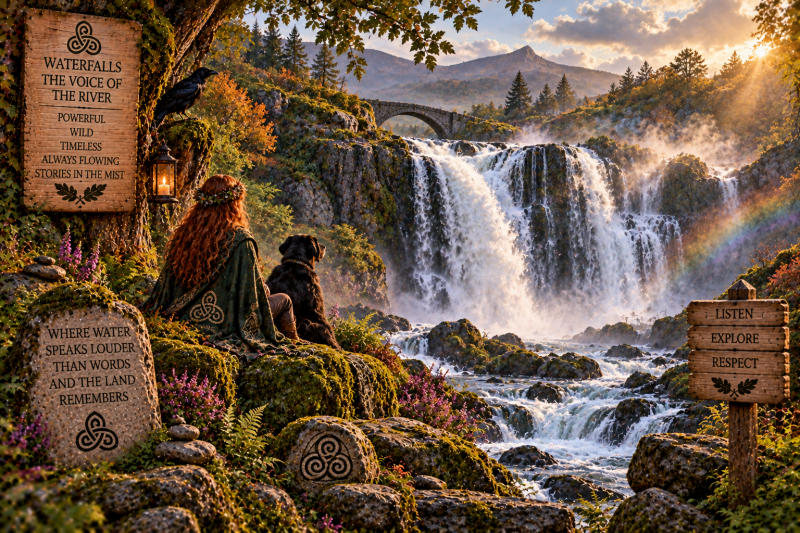
Waterfalls have an entirely different character from wells and quiet pools.
They are loud.
Powerful.
Constantly moving.
The sound can be heard before the water itself becomes visible.
Mist hangs in the air around them.
Rainbows sometimes form in sunlight.
Deep pools develop beneath them.
Across different traditions, waterfalls acquired stories involving spirits, supernatural beings and dangerous places.
The attraction is understandable.
A waterfall is one of the places where water reveals its strength.
The gentle stream becomes something capable of shaping stone.
The Lady of the Lake
One of the most famous supernatural water figures in British literature is the Lady of the Lake from Arthurian tradition.
Different medieval texts present different figures and stories beneath this familiar modern title.
The Lady of the Lake becomes associated particularly with Excalibur, the legendary sword of King Arthur.
The image is unforgettable.
A hand rises from mysterious water holding a sword.
Later, the weapon returns to the lake.
Once again, water acts as a boundary.
The sword comes from somewhere beyond the ordinary human world.
And eventually it must be returned.
Water Spirits
British and Irish folklore contains many supernatural beings associated with rivers, lakes, wells and other watery places.
Some are helpful.
Others are dangerous.
Stories tell of beautiful figures beside water, shape-shifting creatures, mysterious horses and spirits capable of drawing people beneath the surface.
Scottish folklore includes the kelpie, commonly associated with water and often appearing in horse-like form.
Other regions developed their own water beings.
Such stories probably served many purposes.
They entertained.
They explained mysterious events.
And perhaps most practically, they warned people to respect dangerous water.
The Kelpie — Beauty and Danger
The kelpie is one of Scotland's most famous supernatural creatures.
It is commonly described as a shape-shifting water spirit, often appearing as a horse near rivers or lochs.
In many stories, the creature tempts someone to climb onto its back.
Once they do, escape becomes impossible.
The kelpie carries its victim into the water.
Behind the supernatural story lies an important reality.
Rivers and lakes are dangerous.
Currents can be invisible.
Banks collapse.
Cold water shocks the body.
Children wandering near deep water needed memorable warnings.
“Do not go near the river” is advice.
“There is a creature in the river that will drag you beneath the water” is a story you remember.
The Sacred Spring and Christianity
When Christianity spread across Britain and Ireland, sacred landscapes did not simply disappear.
Many springs and wells became associated with saints.
Chapels were built near some.
Pilgrimages developed.
Older customs may have continued in altered forms, although the history of each site must be considered individually.
This created a fascinating landscape where Christian and possibly pre-Christian traditions could overlap.
A person might visit a well because of a saint.
Another might come because their grandparents said the water healed.
Another simply because the place felt special.
The water did not need to choose between traditions.
It continued flowing.
Pilgrimage to the Water
Visiting a sacred well often required a journey.
That journey itself could become part of the experience.
A person might walk several miles.
Follow an old path.
Approach the spring.
Say prayers.
Drink or collect water.
Walk around the site according to local custom.
Leave an offering.
Then return home.
The act of travelling gives the destination importance.
A tap provides water instantly.
A sacred spring asks you to go to it.
Perhaps that effort is part of what makes the place memorable.
Water and Divination
Water has also been used in traditions of divination and scrying.
A still surface reflects light, faces and the sky.
In dim conditions, reflections become ambiguous.
A candle beside a bowl of water can create constantly changing shapes.
People interpreted these patterns in different ways.
Mirrors later served similar purposes.
Again, water's physical properties contribute directly to its folklore.
Water reflects the world.
But never perfectly.
Movement distorts the image.
Depth hides what lies beneath.
It shows us something familiar and makes it strange.
Water and the Moon
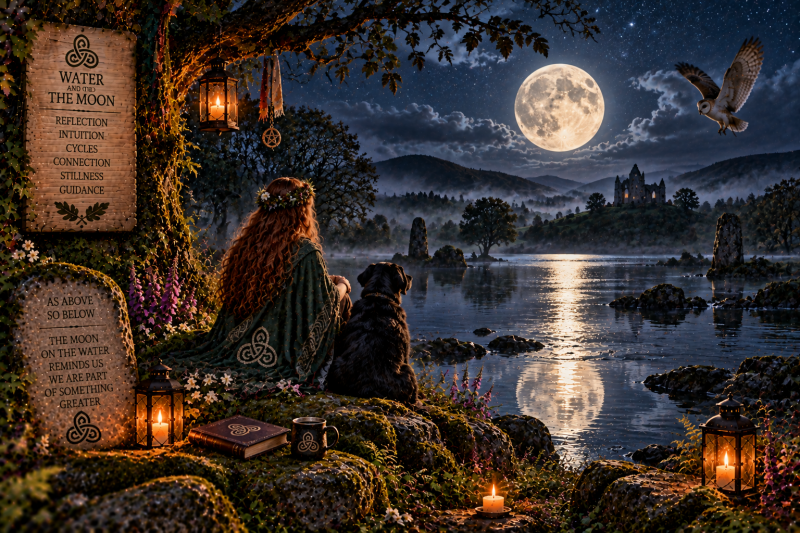
Moonlight reflected upon water is one of the most powerful images in modern Pagan art and spirituality.
The connection is not difficult to understand.
A full moon creates a bright path across a dark lake.
Ripples break the reflection into thousands of moving pieces.
The moon appears simultaneously above and below.
Sky and water seem connected.
Modern Pagan practices sometimes use bowls of water, moonlight or natural springs within rituals.
These practices vary enormously and should not automatically be projected backwards onto ancient communities.
But the attraction is timeless.
People thousands of years ago looked into moonlit water too.
Rivers Remember
There is something unusual about standing beside an old river.
The water in front of you is constantly changing.
Yet the river itself can be thousands or millions of years old.
People have lived beside it.
Crossed it.
Fished from it.
Built bridges over it.
Thrown offerings into it.
Fought beside it.
Written songs about it.
And disappeared.
The river remains.
This gives water a powerful connection with memory.
It changes every second while somehow remaining the same.
Sacred Water in Modern Paganism
Water remains important within many modern Pagan traditions.
People may visit springs, wells, rivers or the sea for reflection, seasonal observance or spiritual practice. Water can symbolise healing, emotion, intuition, purification and change.
Some leave offerings.
However, modern visitors have an important responsibility.
Coins can contaminate small pools.
Plastic ribbons remain for decades.
Candles can damage stone.
Crystals and objects that seem natural may introduce substances that do not belong in the water.
The most respectful offering may be one that leaves nothing behind.
A moment of silence costs the landscape nothing.
Protecting Sacred Waters
Many historic wells and springs are fragile.
Some have already been damaged by pollution, development or careless visitors.
If we genuinely consider a place sacred, protecting it should matter more than performing a ritual there.
Do not leave plastic.
Do not introduce oils, wax, salt or chemicals.
Do not remove stone or archaeological material.
Do not damage trees.
Do not assume that because other visitors have tied objects to branches it is environmentally safe to do the same.
Respect does not require leaving a mark.
Sometimes respect means ensuring nobody can tell you were ever there.
How to Experience Sacred Water
Find a local spring, river, stream or historic well.
You do not need to travel to a famous sacred site.
Walk beside the water slowly.
Listen before you look.
Notice how many different sounds the water makes as it moves around stones.
Look for plants growing along the banks.
Watch insects above the surface.
Look for kingfishers, dippers, wagtails or dragonflies.
Place your hand in the water if it is safe and permitted.
Think about where that water came from.
Rain fell somewhere.
It entered the soil.
Moved underground.
Emerged as a spring.
Joined a stream.
Became a river.
Eventually it may reach the sea.
The journey never truly ends.
The Water Beneath the Hill
Imagine walking through woodland early in the morning.
The path descends between old trees.
Fern and moss cover the stones.
You hear water before you see it.
At the bottom of the hill, a spring emerges beneath the roots of an ancient tree.
Someone built a small stone basin around it generations ago.
The stones are worn smooth.
Water spills over their edges and disappears beneath the leaves before joining a stream further down the valley.
Perhaps people once came here seeking healing.
Perhaps a saint's name became attached to the spring.
Perhaps stories were told about fairies living nearby.
Perhaps someone left an offering here centuries before any of those stories were written down.
You cannot know everything that happened.
But you can kneel beside the same water.
Listen to the same sound.
Watch the same sunlight moving across the surface.
Then the water flows away.
Past stones.
Under bridges.
Through villages.
Across fields.
Towards the sea.
This is the mystery of sacred water.
It never stays.
And yet it is always there.
Connecting the hill to the river.
The living to the past.
The ordinary world to the world of stories.
Sacred waters remind us that the landscape is never truly still. Every spring, well and river is part of a journey that began long before us and will continue long after we are gone.