Folklore of Britain & Ireland
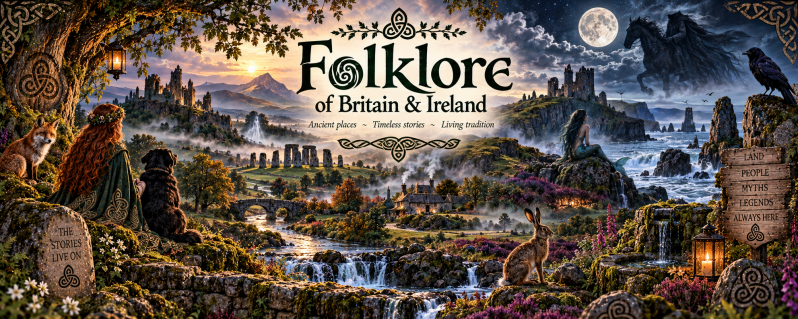
A Landscape Filled With Stories
Across Britain and Ireland, almost every part of the landscape has gathered stories.
Old roads have ghosts. Ancient hills conceal sleeping kings. Wells possess healing powers. Fairies inhabit lonely mounds. Black dogs appear on deserted lanes. Mermaids wait beside rocky coasts. Ravens carry warnings, hares become witches and mysterious lights lead travellers away from familiar paths.
Some stories are ancient. Others are surprisingly recent. Many have been told and retold so often that their beginnings are impossible to identify.
Together they form the extraordinary folklore of England, Scotland, Wales and Ireland — thousands of years of belief, imagination, fear, humour and attempts to understand the mysterious world beyond the firelight.
Folklore is not simply a collection of fairy tales.
It is the memory of a landscape.
What Is Folklore?
Folklore includes the stories, customs, beliefs, sayings, songs and traditions passed between people.
Unlike a novel written by one author, a folk story may belong to an entire community.
One person tells it.
Someone else remembers it slightly differently.
Another adds something.
The story travels to another village.
Generations pass.
Eventually dozens of versions may exist.
This is why searching for the single “original” version of an old legend can be impossible.
Folklore lives because it changes.
Before Stories Were Written Down
For most of human history, stories were spoken rather than written.
Imagine an isolated farmhouse several centuries ago.
Outside there are no streetlights. No cars pass along the road. Beyond the windows lies almost complete darkness.
Inside, people gather around a fire.
Someone begins telling a story.
Perhaps they heard it from their grandmother.
Perhaps she heard it from hers.
Nobody knows where it began.
The listeners remember the parts that frighten them, amuse them or make them wonder.
Later they tell the story to somebody else.
That is how folklore survives.
The Landscape Remembers
One of the most distinctive features of British and Irish folklore is how closely stories are attached to particular places.
A hill is not simply a hill.
It may contain fairies.
A standing stone may once have been a giant.
A lake may hide a drowned village.
A ruined castle may have a ghost.
A strange rock might have been thrown by the Devil.
A spring may cure illness.
The landscape becomes a map of stories.
Once you know those stories, it becomes difficult to see the landscape in quite the same way again.
Ancient Stones and Forgotten People
Britain and Ireland contain thousands of prehistoric monuments.
Stone circles.
Standing stones.
Burial chambers.
Passage tombs.
Hillforts.
Ancient earthworks.
For later generations, the people who built many of these monuments were already unimaginably distant.
Without archaeology, there was no obvious explanation for who constructed them.
So folklore provided answers.
Giants built them.
Fairies lived beneath them.
Witches moved them.
The Devil threw them.
Kings were buried inside them.
These stories may not tell us why prehistoric people actually constructed the monuments.
But they tell us how later communities understood the mysterious remains surrounding them.
Giants in the Landscape
Giants appear everywhere in British and Irish folklore.
They throw stones across valleys.
Create hills.
Build causeways.
Leave enormous footprints in rock.
Fight one another across mountains.
Many unusual geological formations acquired giant legends.
Northern Ireland's famous Giant's Causeway, for example, became associated with the Irish hero Fionn mac Cumhaill, known in English as Finn McCool.
Geology tells us how these landscapes formed.
Folklore tells us what people imagined when they looked at them.
The two stories can exist together.
Fairies — Beautiful, Dangerous and Strange
Modern popular culture often portrays fairies as tiny winged creatures.
Traditional folklore is much stranger.
Across Britain and Ireland, supernatural beings were known by countless regional names: the Aos Sí in Irish tradition, the Tylwyth Teg in Wales, brownies in Scotland and northern England, pixies in the southwest and many others.
Some could help humans.
Others played tricks.
Some were dangerous.
They might steal food, mislead travellers, punish disrespect or interfere with livestock.
People sometimes avoided speaking about them directly.
Names such as the Fair Folk or the Good People could be safer.
Traditional fairies were not always creatures you wanted to meet.
Fairy Mounds
Ancient burial mounds became particularly associated with fairy folklore.
To later communities, these mysterious earthworks appeared like entrances into another world.
Stories warned against disturbing them.
Music might be heard beneath the earth.
Strange lights could appear nearby.
A person entering a fairy mound might believe they had stayed for only a few hours, only to discover that years had passed outside.
Such stories transformed archaeology into supernatural geography.
The ancient mound became a doorway.
Fairy Rings
A circle of mushrooms appearing suddenly in a field can look almost deliberately arranged.
Today we understand the biological processes that create many fungal rings.
Earlier communities created other explanations.
They became fairy rings.
Fairies had danced there during the night.
Entering the circle might be dangerous.
A person could become trapped, enchanted or drawn into supernatural celebrations.
The explanation may not be scientific.
But stand beside a perfect ring of mushrooms on a misty morning and it is easy to understand why people invented it.
Changelings
Among the darker fairy traditions are stories of changelings.
A fairy or supernatural being was sometimes believed to steal a human child and leave something else in its place.
These stories are disturbing today and could historically have serious consequences for vulnerable people.
Illness, disability or unusual behaviour that communities could not understand might sometimes be interpreted through supernatural belief.
Changeling folklore therefore reminds us that folklore was not always harmless entertainment.
Beliefs could influence how real people were treated.
The magical world could have very real consequences.
The Wild Hunt
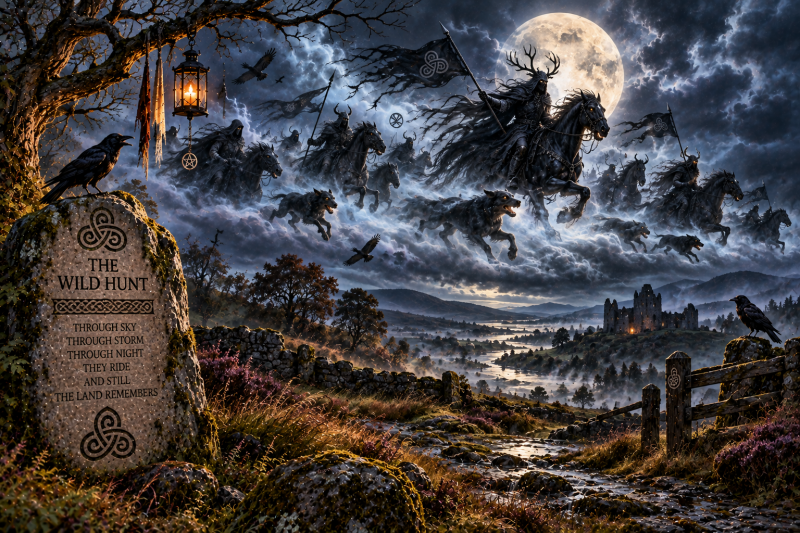
On stormy nights, people across parts of northern Europe told stories of supernatural riders racing through the sky.
This mysterious procession became known as the Wild Hunt.
Its leader differed between regions and periods.
Sometimes the riders were spirits.
Sometimes they were the dead.
Sometimes seeing the Hunt was considered an omen.
Imagine hearing a winter storm without modern buildings or traffic to drown out the sound.
Wind screams through trees.
Branches crash.
Dogs bark.
Birds cry out in darkness.
Something seems to be moving across the sky.
Folklore gives that sound a name.
The Hunt is passing.
Black Dogs on Lonely Roads
Few creatures in British folklore are as unsettling as the supernatural black dog.
Stories of enormous dark dogs appear in different regions, particularly in England.
They haunt roads, churchyards, bridges and isolated places.
East Anglia has the famous Black Shuck.
Other regions developed their own names and traditions.
Sometimes the dog is dangerous.
Sometimes it predicts death.
In other stories, strangely, it acts almost like a guardian and accompanies travellers along lonely roads.
Anyone who has walked a country lane alone at night can understand the power of the story.
In darkness, every shape becomes uncertain.
Ghosts of the Old Roads
Britain and Ireland possess an enormous tradition of ghost stories.
Phantom coaches travel forgotten roads.
Soldiers return to old battlefields.
Women in white appear beside rivers.
Children are heard inside abandoned buildings.
Footsteps cross empty rooms.
Whether or not someone believes in ghosts, these stories reveal something important.
Places accumulate memory.
An old inn may have welcomed travellers for centuries.
A castle may have witnessed violence.
A road may have been walked by thousands of people who are now forgotten.
Ghost stories give those absent people a way of returning.
The Headless Horseman
The image of the headless rider appears in several traditions.
Irish folklore includes the terrifying Dullahan, a supernatural figure commonly described as a headless horseman.
In later tellings, the Dullahan rides through the night carrying its own head.
Encounters with it can be associated with death.
The legend contains several of folklore's most powerful ingredients.
A lonely road.
A horse approaching in darkness.
A faceless rider.
And the knowledge that something terrible may follow.
Sometimes folklore works because the image needs almost no explanation.
The Banshee
One of Ireland's most famous supernatural beings is the bean sí, commonly anglicised as banshee.
The name is related to the idea of a “woman of the fairy mound.”
In folklore, the banshee became especially associated with lamentation and the foretelling of death.
She might be heard crying or keening before a death within a family.
Descriptions vary.
Sometimes she appears young and beautiful.
Elsewhere she is old and frightening.
The banshee is not simply a monster.
Her defining act is mourning.
She belongs to the boundary between grief, death and the supernatural.
Witches and Shape-Shifting
Witches occupy an enormous place in later British and Irish folklore.
They were accused of causing illness, damaging crops, harming livestock or controlling weather.
Stories also gave witches supernatural abilities.
One of the most persistent was shape-shifting.
A witch might become a hare.
A cat.
A bird.
Or another animal.
This helps explain why certain animals accumulated unusually strong supernatural associations.
A hare running across a moonlit field might not simply be a hare.
Someone watching from the farmhouse window might wonder what else it could be.
The Hare — Animal of Mystery
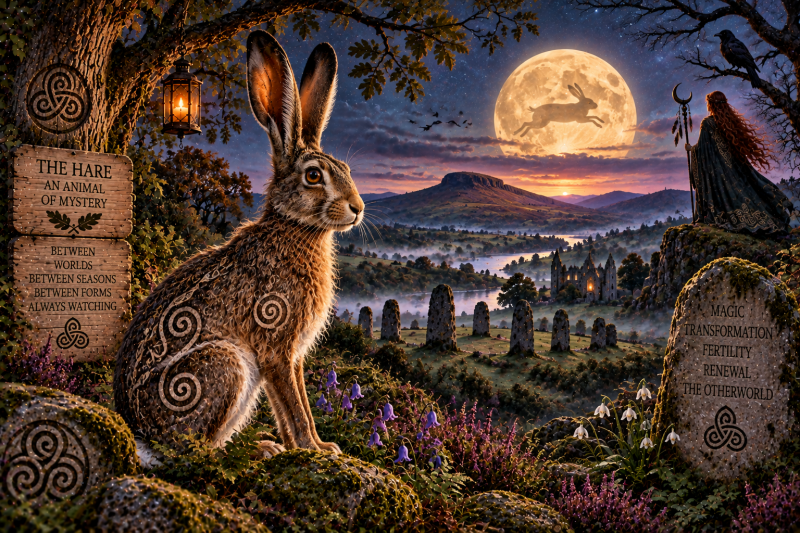
The hare is one of the most magical animals in British and Irish folklore.
Its speed, solitary behaviour and strange appearance helped surround it with stories.
Hares became associated with witches, transformation, fertility and the supernatural.
Stories sometimes describe a hunter injuring a hare only to later discover a local woman suffering from an identical wound.
The implication is clear.
The hare and the woman were the same being.
Such stories appear in numerous variations.
The ordinary animal becomes a doorway into something mysterious.
Ravens and Crows
Few birds carry more folklore than ravens and crows.
Their intelligence, dark feathers and habit of feeding on carrion made them natural symbols of death, battle and prophecy.
Irish mythology connects crow or raven imagery with the complex supernatural figure of the Morrígan.
In Welsh and British traditions, ravens also became associated with legendary figures and important places.
Yet the real birds are just as remarkable.
Ravens can solve problems, recognise individuals and communicate through a wide variety of sounds.
Sometimes the animal behind the folklore is more extraordinary than the legend.
Owls in the Darkness
Owls live in a world humans rarely see.
They move almost silently.
They hunt in darkness.
Their eyes reflect light.
Their calls travel through woodland at night.
Unsurprisingly, different cultures surrounded owls with meanings involving wisdom, death, mystery and prophecy.
Welsh mythology gives us perhaps one of the most beautiful transformations through the story of Blodeuwedd, the woman created from flowers who is eventually transformed into an owl.
The owl exists between two worlds.
The familiar countryside of daylight and the hidden landscape of night.
Selkies — People of the Sea
Around Scotland, Ireland and other northern coastal regions, stories developed about selkies.
These supernatural beings live as seals in the sea but can remove their skins and take human form on land.
Many selkie stories are deeply melancholy.
A human steals or hides a selkie's sealskin, preventing them from returning to the sea.
The selkie may remain for years, sometimes marrying and raising children.
But eventually the hidden skin is discovered.
The call of the sea becomes irresistible.
The selkie returns to the water.
These stories speak about freedom, belonging and the impossibility of possessing someone who belongs somewhere else.
Mermaids and the Dangerous Sea
Coastal communities developed countless stories of mermaids and other supernatural sea beings.
Some mermaids were beautiful.
Some were dangerous.
Their appearance could predict storms, shipwreck or death.
The sea naturally produced such folklore.
For fishing communities, it provided food and livelihoods while also taking lives without warning.
A calm sea could become violent within hours.
Someone sailing beyond the horizon simply disappeared from sight.
The ocean was both provider and destroyer.
Mermaid stories belong perfectly to that uncertain boundary.
Kelpies and Water Horses
Scottish folklore tells of supernatural water beings commonly known as kelpies.
They are frequently described as shape-shifting creatures appearing as horses beside rivers or lochs.
A traveller or child might be tempted to climb onto the animal.
Once mounted, escape becomes impossible.
The creature plunges into the water.
The supernatural warning contains practical wisdom.
Water can be dangerous even when it looks calm.
A frightening story may keep children away from a dangerous river far more effectively than an ordinary warning.
Sacred Wells and Healing Springs
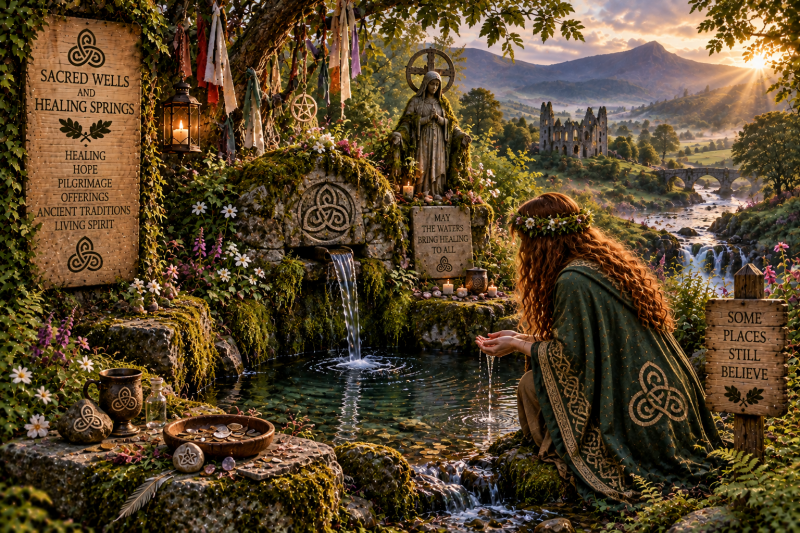
Across Britain and Ireland are thousands of wells and springs surrounded by traditions of healing and holiness.
Some are associated with saints.
Some may preserve older traditions.
People travelled to drink the water, wash affected parts of the body, pray or leave offerings.
Trees beside wells sometimes became covered with cloth or ribbons.
Coins were dropped into water.
Pins and other small objects were offered.
The custom varies from place to place.
But the idea remains remarkably consistent.
Water comes from somewhere hidden beneath the earth.
And perhaps it carries something with it.
Rivers of Myth
Rivers do more than cross the landscape.
They create it.
Irish mythology gives stories to great rivers such as the Boyne and Shannon, connecting them with supernatural women, sacred wells and forbidden knowledge.
The River Boyne is associated with Boann, whose encounter with the Well of Segais leads to the river's creation in medieval Irish tradition.
Such stories transform geography into biography.
The river has a beginning.
A character.
A memory.
It becomes part of the mythological world.
Trees With Stories
Trees are among the most important features of British and Irish folklore.
Oak represents strength and longevity.
Hazel became connected with wisdom.
Rowan gained a reputation for protection.
Hawthorn became deeply associated with fairies.
Elder accumulated complicated traditions involving protection, danger and supernatural presence.
Individual trees could also become landmarks.
A tree beside a road might stand for centuries.
Generations met beneath it.
Animals sheltered beneath it.
Stories accumulated around it.
Eventually the tree became more than a plant.
It became part of local memory.
The Hawthorn and the Fair Folk
Few trees are more strongly associated with fairy folklore than hawthorn.
A lone hawthorn growing in a field could attract particular caution in Ireland.
Stories warned against cutting or damaging certain trees believed to belong to the fairies.
Roads and buildings have occasionally become surrounded by modern stories concerning supposedly protected fairy trees.
Whether every story has ancient origins is another question.
But the persistence of the belief is remarkable.
A small thorn tree can become more powerful in local imagination than concrete and machinery.
Rowan — The Protective Tree
Rowan became widely associated with protection in later British and Irish folk tradition.
Its bright red berries made it visually distinctive, while crosses and charms made from rowan appear in folk practices.
The tree could be planted near houses or associated with protection against harmful supernatural influences.
Its appearance also contributes to its reputation.
In autumn, brilliant berries glow against dark foliage.
In upland landscapes, rowan can grow in exposed places where few other trees thrive.
It seems resilient.
A fitting tree to stand between a home and whatever might be outside.
The Elder Tree
Elder occupies a complicated place in folklore.
Its flowers and berries were useful, yet the tree could also be treated cautiously.
Different regions developed stories about spirits inhabiting elder trees or consequences for cutting them without permission.
Some traditions involved asking the tree before taking wood.
Such beliefs reveal a relationship with nature very different from seeing plants simply as resources.
The tree possesses agency.
You do not merely take.
You ask.
Hidden Treasure
Stories of buried treasure occur throughout Britain and Ireland.
Gold lies beneath hills.
Ancient kings were buried with riches.
Treasure waits beneath standing stones.
Sometimes supernatural guardians protect it.
Other stories say treasure can only be discovered on a particular night or under unusual circumstances.
Such legends probably grew for many reasons.
Real archaeological discoveries occasionally revealed valuable objects.
Old ruins suggested lost wealth.
And, naturally, people enjoy imagining fortune lying just beneath familiar ground.
The field you pass every day might contain a king's treasure.
You simply haven't found it yet.
Churchyards After Dark
Churchyards accumulated an extraordinary amount of folklore.
They were places of burial, memory and religion, but also physical spaces filled with old stones, yew trees and shadows.
At night they became ideal settings for stories.
Ghosts walked there.
Black dogs guarded graves.
Strange lights appeared.
Supernatural creatures waited near gates.
Yet churchyards also offered protection in some traditions because they were consecrated ground.
This contradiction is typical of folklore.
The same place can be frightening and safe at once.
Crossroads — Places Between Places
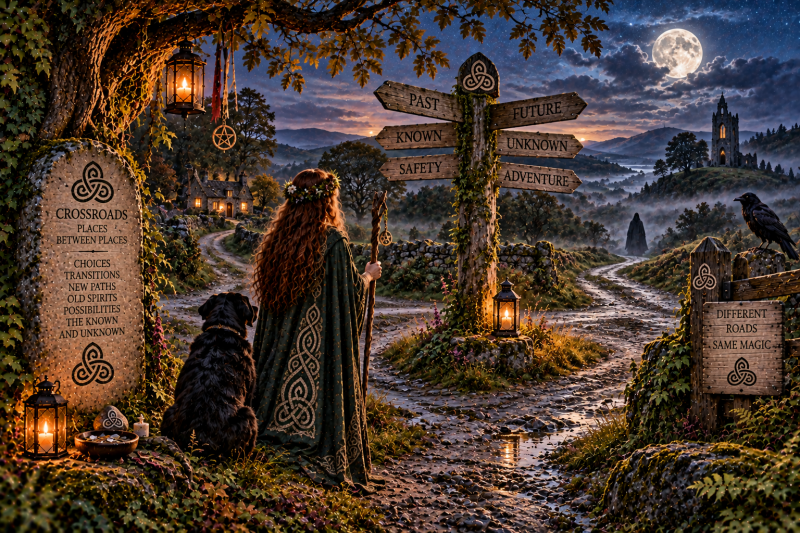
Crossroads have attracted supernatural beliefs across many cultures.
A crossroads does not truly belong to one road.
It is the place where several possibilities meet.
That makes it a natural liminal space — somewhere between destinations.
Folklore associated crossroads with ghosts, witches, spirits, burial customs and magical encounters.
The symbolism is powerful.
At a crossroads you must make a decision.
One direction takes you home.
Another leads somewhere unknown.
Stories begin where certainty ends.
The Devil in British Folklore
The Devil appears with surprising frequency in British landscape folklore.
He throws stones.
Builds bridges.
Creates hills.
Leaves marks in rocks.
Attempts impossible tasks.
Often he is tricked by ordinary people.
Many geographical features called the Devil's Dyke, Devil's Bridge, Devil's Punch Bowl or similar names acquired explanatory legends.
These stories are generally much later than the prehistoric landscapes they describe.
They show how Christian imagery became incorporated into older traditions of explaining strange places through supernatural stories.
The landscape continuously receives new characters.
Sleeping Kings Beneath the Hills
One of the most enduring folklore motifs is the sleeping hero.
A legendary king or army does not truly die.
Instead, they sleep beneath a hill, cave or ancient place.
One day, when the country needs them most, they will return.
King Arthur became the most famous British example.
Similar motifs surround other legendary figures.
The story transforms death into waiting.
The hero is not gone.
He is simply beneath the landscape.
The hill becomes a container for hope.
King Arthur in the Landscape
Arthurian legend is attached to an extraordinary number of locations.
Caves.
Lakes.
Castles.
Battlefields.
Stone circles.
Hills.
Different regions claim connections with Arthur, Merlin, Guinevere and the Knights of the Round Table.
Many of these associations developed long after the supposed historical period of Arthur.
That does not make them unimportant.
Folklore is not archaeology.
Its purpose is different.
Arthur became so powerful in British imagination that communities placed him directly into their own landscapes.
Local Folklore — The Stories Almost Lost
Some of the most valuable folklore is not famous.
It belongs to individual villages.
A haunted bridge.
A fairy field.
A strange stone.
A house where footsteps were heard.
A pool children were warned to avoid.
A tree nobody wanted to cut down.
These stories are especially vulnerable to disappearing.
If the final person who remembers a story dies without telling it, an entire piece of local history can vanish.
This makes collecting local folklore incredibly important.
Not because every story is literally true.
But because somebody once thought it worth remembering.
Did People Really Believe These Stories?
Sometimes.
That is the most accurate answer.
Some supernatural traditions were clearly treated seriously.
Others were entertainment.
Some people believed strongly while their neighbours were sceptical.
Others may have claimed not to believe while still refusing to walk past a particular place after dark.
Human belief has always been complicated.
Even today, someone may say they do not believe in ghosts and then feel uncomfortable alone inside a supposedly haunted building.
Folklore lives in that fascinating space between belief and imagination.
Folklore and Fear
Many folk stories contain warnings.
Do not wander beside deep water.
Do not enter dangerous woodland.
Do not travel alone at night.
Do not mistreat strangers.
Do not disturb ancient places.
Do not harm certain trees.
Do not ignore the weather.
Supernatural stories made these warnings memorable.
A dangerous pool becomes more frightening when a kelpie lives there.
A treacherous bog becomes unforgettable when spirits wander across it.
Folklore helped transform practical knowledge into stories people remembered.
Folklore and Nature
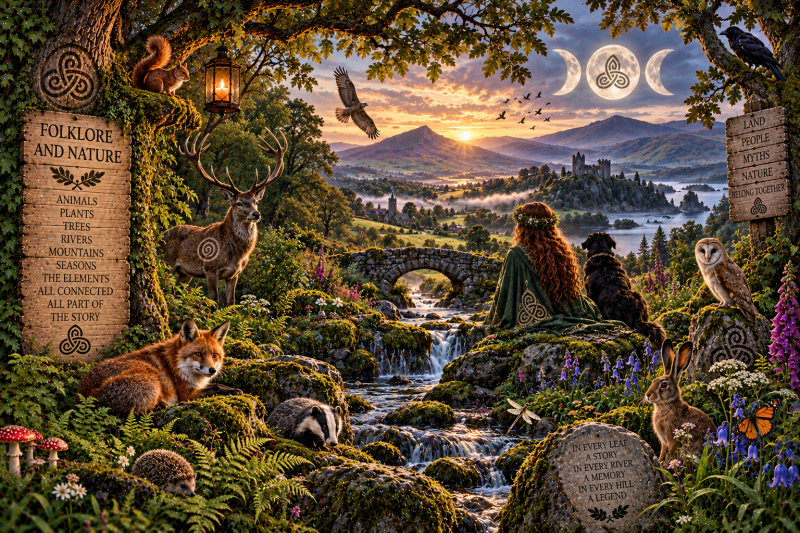
Animals, plants and weather appear constantly within folklore because earlier communities lived much closer to seasonal change.
A bad winter mattered.
A failed harvest mattered.
The arrival of migrating birds mattered.
The behaviour of livestock mattered.
People watched nature closely.
When something unusual happened, stories helped explain it.
Why does the owl call at night?
Why does mist appear over the river?
Why do mushrooms grow in circles?
Why does the moon sometimes turn red?
Science gives us extraordinary answers.
Folklore gives us the answers people created before those explanations existed.
Both tell us something valuable about being human.
Christianity and Older Traditions
British and Irish folklore cannot be divided neatly into “Pagan” and “Christian.”
The traditions have interacted for centuries.
Saints became associated with wells.
Ancient monuments gained Christian legends.
Fairies existed alongside beliefs about angels and demons.
Seasonal customs became attached to Christian feast days.
Older traditions were adapted, forgotten, revived and reinvented.
Trying to label every custom as exclusively one religion often oversimplifies the history.
Folklore behaves more like a river.
Different streams enter it.
Eventually it becomes difficult to tell where one ends and another begins.
Folklore in the Modern World
We may have satellites, smartphones and electric lights, but folklore has not disappeared.
New ghost stories emerge.
Urban legends spread online.
Old traditions are rediscovered.
People continue visiting sacred wells, ancient stones and supposedly haunted places.
Fairy folklore appears in books, films, games and art.
The method of storytelling has changed.
The desire for stories has not.
A tale once told beside a farmhouse fire may now travel around the world in seconds.
Folklore is still evolving.
How to Discover the Folklore Around You
Begin close to home.
Look at an old map.
Find unusual place names.
Search for ancient wells, standing stones, ruined chapels, old bridges, caves and earthworks.
Talk to older residents.
Read local history books.
Visit museums and archives.
Then walk through the landscape.
A story becomes different when you stand where it supposedly happened.
The fairy mound is no longer a paragraph in a book.
It is beneath your feet.
The haunted road disappears into darkness ahead of you.
The sacred spring is still flowing.
Suddenly folklore becomes geography.
Somewhere Between History and Imagination
Imagine walking home along an old country lane at dusk.
An owl calls from the trees.
Beyond the hedge stands an ancient mound.
A stream passes beneath a stone bridge.
Hawthorn branches lean over the road.
Mist gathers in the valley.
You know the scientific explanations.
You know why mist forms.
You know what an owl is.
You know the mound was built by human hands.
And yet the landscape still feels different after dark.
Perhaps that is where folklore truly lives.
Not entirely in belief.
Not entirely in fiction.
But somewhere between history, landscape, memory and imagination.
For thousands of years, people across Britain and Ireland have looked at the same hills, rivers, forests and night skies and filled them with stories.
Many storytellers are forgotten.
Many stories have disappeared.
But some remain.
They survive in place names.
In old books.
In family memories.
In warnings.
In songs.
In ruined buildings.
And in the stories we still tell when darkness falls.
The folklore of Britain and Ireland is not simply a collection of tales from the past. It is a living map of how generations of people experienced the landscape around them — and how the landscape, in return, entered their imagination.