Black Dogs in British Folklore
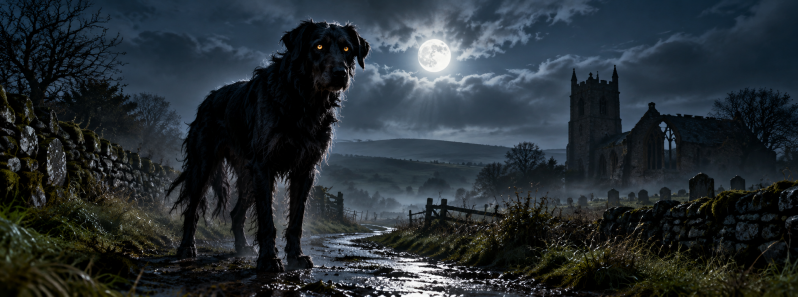
On lonely roads, beside old churchyards and across windswept stretches of countryside, British folklore tells of mysterious black dogs appearing after darkness falls. Sometimes enormous, sometimes silent and occasionally described with glowing or fiery eyes, these supernatural hounds belong to one of Britain's most enduring traditions of strange encounters.
The best known is Black Shuck, the legendary black dog associated particularly with East Anglia, but he is far from alone. Across different regions, stories tell of spectral hounds appearing on roads, moors, coastlines and ancient tracks — sometimes as omens of death or misfortune, but occasionally as mysterious guardians accompanying travellers through dangerous places.
There was never one single British black-dog legend. Names, appearances and meanings changed from place to place. Some traditions became associated with the Wild Hunt, while others remained intensely local, attached to one road, church, bridge or stretch of countryside.
Together they form a wonderfully eerie part of British folklore: the unsettling possibility that when a traveller hears paws on the road behind them, the animal following them may not be an ordinary dog at all.
Black Shuck — The Demon Dog of East Anglia
Of all Britain's spectral black dogs, Black Shuck is probably the most famous. For centuries, stories of an enormous dark hound have been told across Norfolk, Suffolk and the wider East Anglian landscape, where it is said to haunt lonely roads, coastlines, churchyards and isolated stretches of countryside.
The name Shuck is often linked with an old word meaning a shaggy or rough-haired dog. Descriptions vary considerably, but Black Shuck is commonly portrayed as unnaturally large, covered in black fur and possessing one or two blazing eyes. In some stories he appears suddenly beside a traveller before disappearing just as mysteriously.
Black Shuck's meaning is equally uncertain. Some traditions treat an encounter as an omen of death or disaster, while others describe a less hostile creature — a spectral companion that follows solitary travellers along dangerous roads before quietly vanishing.
This variation is important. There was never a single official story of Black Shuck. Like many creatures of folklore, the legend changed as it travelled between villages and generations, with particular roads, churches and landscapes acquiring their own versions of the mysterious black dog.
The Black Dog of Bungay — 1577
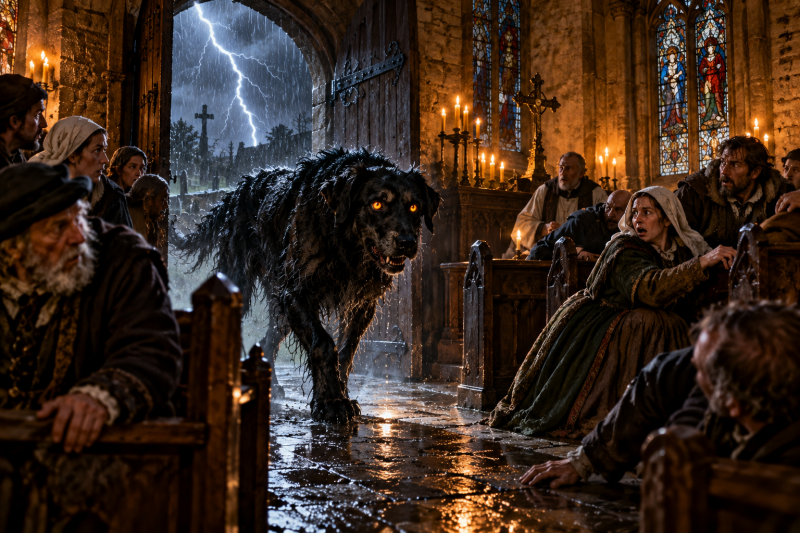
One of the most famous historical stories later associated with Black Shuck occurred during a violent thunderstorm in Suffolk on 4 August 1577. According to a contemporary pamphlet written by Abraham Fleming, something terrifying appeared inside the church at Bungay while people were gathered there.
Fleming described a “black dog” appearing among the congregation during the storm. The animal was said to run through the church with extraordinary violence, and two people were reported to have died during the event. The same account connected another frightening incident with the church at Blythburgh, where the storm also caused destruction and deaths.
The story has become one of the foundations of the modern Black Shuck legend. However, there is an important distinction: Fleming's pamphlet did not call the creature “Black Shuck.” That identification belongs to the later development of East Anglian folklore.
Fleming was also writing in a deeply religious age. His account presented the terrible storm and its events as a warning of divine judgement rather than as a modern investigation of a supernatural animal. Over the centuries, however, the image that endured was unforgettable — a mysterious black dog appearing inside a church while a violent storm raged outside.
Black Dogs Across Britain
Black Shuck may be the most famous example, but stories of mysterious black dogs occur across many parts of Britain. Their names and behaviour vary from region to region, yet the same haunting image repeatedly appears: an unnaturally large dark hound encountered in an isolated place after nightfall.
In parts of northern England, traditions tell of the Barghest, a monstrous black dog associated with lonely roads and the approach of death. Yorkshire folklore in particular contains stories of frightening spectral dogs whose appearance could be regarded as a warning or omen.
In Lancashire and surrounding areas appears the Skriker, another supernatural black dog whose strange cries were said to announce misfortune. Elsewhere, local names and legends became attached to particular lanes, bridges, churchyards and stretches of moorland.
Southwestern England developed traditions of spectral hunting packs including the Yeth Hounds and Wish Hounds, while stories of mysterious hounds elsewhere became entangled with traditions of the Wild Hunt.
These legends were never completely uniform. A black dog might be terrifying in one village yet strangely protective in another. What connects them is not one single creature, but a recurring piece of British folklore — the supernatural hound encountered at the edge of the familiar world.
Churchyards, Crossroads and Lonely Roads
Supernatural black dogs were often encountered in places that already carried an atmosphere of uncertainty — churchyards, crossroads, bridges, old tracks, moorland paths and lonely roads. In folklore, these were more than convenient settings for frightening stories. Many were places of transition: locations where one territory, road or state of being met another.
Churchyards created an especially powerful association. Dogs had long been connected in European mythology and folklore with death, burial and the guarding of boundaries, making the appearance of a mysterious hound beside graves particularly unsettling. Some black-dog traditions therefore resemble guardians as much as monsters.
Crossroads carried their own supernatural reputation. A traveller arriving at a crossroads after dark stood between several possible directions, often beyond the safety of a village or home. Folklore repeatedly transformed such uncertain places into locations where the ordinary and supernatural worlds might briefly overlap.
The same was true of old roads and tracks. Before modern lighting, walking alone through the countryside at night meant entering a landscape largely hidden from view. A real dog glimpsed briefly in moonlight, the sound of an unseen animal or a dark shape moving beside a hedge could easily become something far stranger in the telling.
Perhaps that is why Britain's spectral dogs so often wait at the boundary — between settlements and wilderness, safety and danger, daylight and darkness, and sometimes between the worlds of the living and the dead.
Omens of Death or Supernatural Guardians?
Many accounts describe the appearance of a spectral black dog as an omen of death, illness or approaching misfortune. A traveller who encountered one might fear that something terrible was about to happen, particularly if the animal suddenly vanished or behaved in a way no ordinary dog could.
Yet Britain's black dogs were not always hostile. In some traditions, the mysterious animal behaved more like a guardian or protector. Stories tell of black dogs accompanying lone travellers along dangerous roads, remaining beside them until they reached safety and then disappearing into the darkness.
This makes the folklore considerably more interesting than a simple tale of demonic hounds. The same basic figure could represent death in one community and protection in another. Even within a single tradition, the meaning of an encounter might depend upon how the traveller behaved.
Dogs themselves may help explain this ambiguity. For thousands of years they have lived beside humans as hunters, companions and guardians. A supernatural dog could therefore occupy two roles at once — something powerful enough to inspire fear, yet familiar enough to offer protection.
Perhaps the most unsettling black-dog stories are those in which the creature does nothing threatening at all. It simply appears beside the road, watches the traveller pass and then is no longer there.
The Wild Hunt and the Hounds of the Night
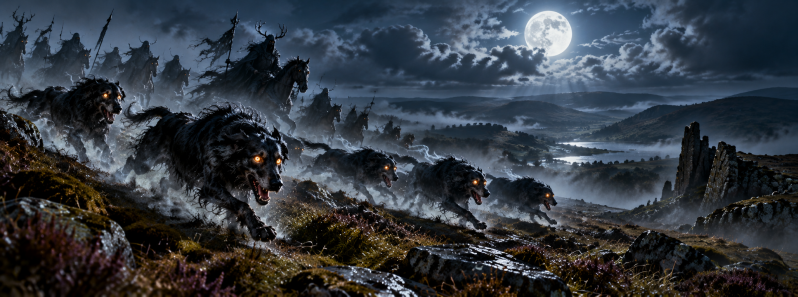
Not every supernatural hound in British folklore travelled alone. Some traditions described whole packs of ghostly dogs racing through the night, their cries heard overhead or across the countryside.
The Gabriel Hounds were said in parts of northern England to be mysterious hounds heard passing through the sky. Their cries could be interpreted as an omen of death or misfortune. The name became attached to eerie nocturnal sounds that seemed to come from somewhere high above the listener.
Other traditions spoke of the Yeth Hounds and Wish Hounds, supernatural hunting dogs particularly associated with southwestern England. Such packs became closely connected in later folklore with stories of spectral huntsmen and the terrifying procession known as the Wild Hunt.
Real wildlife may sometimes have contributed to these stories. Migrating birds calling invisibly overhead at night can produce surprisingly strange sounds, while foxes, owls and distant dogs can seem very different when heard across a dark landscape. Yet natural explanations alone cannot account for the rich mythology that developed around them.
In folklore, the sound became something much more powerful: the hounds were running, the hunters were following, and sensible travellers knew to stay out of their path.
Why Did People See Black Dogs?
Stories of spectral black dogs probably developed from many different experiences rather than from one simple cause. Britain was once filled with unlit roads, isolated farms, churchyards, forests and open moorland, where travelling after dark could be genuinely dangerous.
An ordinary dog encountered unexpectedly at night could appear enormous when little more than its outline was visible. Moonlight reflected from an animal's eyes might create an eerie glow, while mist, rain and distance could distort its size and shape. Foxes and other animals heard but not clearly seen may also have contributed to particular encounters.
Yet these explanations only tell part of the story. Once a place acquired a reputation for a supernatural hound, every strange sound or fleeting shape could become another chapter in the legend. Stories were repeated, altered and attached to particular roads and landmarks until the black dog became part of the landscape itself.
That is one of the fascinating things about folklore. A frightening encounter lasts only moments, but the story it creates can survive for centuries.
Black Dogs in Folklore Today
Britain's spectral hounds remain remarkably popular. Black Shuck appears in books, artwork, ghost stories, local history and modern popular culture, while regional black-dog legends continue to be retold in the places where they originated.
Their survival may owe something to the simplicity of the legend. It requires no castle, ancient treasure or elaborate monster — only a dark road, a solitary traveller and the sound of paws somewhere behind them.
And unlike many legendary creatures, the black dog is based upon something completely familiar. Everyone knows what a dog looks like. The folklore begins when that familiar animal is encountered somewhere it should not be, behaves in a way it should not behave — and then disappears.
Sources & Further Reading
Abraham Fleming — A Straunge and Terrible Wunder, 1577
The contemporary printed account describing the violent storm and the mysterious black dog at Bungay, as well as events at Blythburgh. This is particularly important because it lets us separate the original sixteenth-century account from later Black Shuck folklore.
Read A Straunge and Terrible Wunder — Project Gutenberg
The Churches Conservation Trust — St Mary's Church, Bungay
Useful historical background on the church associated with the famous 1577 black-dog story.
St Mary's Church, Bungay — Churches Conservation Trust
The Folklore Society
Founded in 1878, the Folklore Society is an important organisation for the study of traditional folklore, customs, beliefs and narratives.
A note on the tradition: Stories of supernatural black dogs vary considerably across Britain. Black Shuck, the Barghest, Skriker, Yeth Hounds and other spectral dogs belong to different regional traditions, and later retellings have sometimes combined stories that were originally distinct.
Explore More Folklore
Britain's spectral black dogs belong to a much wider world of supernatural folklore. Discover The Wild Hunt and its ghostly riders and hounds, explore The Celtic Otherworld and beliefs surrounding the boundary between worlds, or visit Folklore of Britain & Ireland to discover more strange creatures, legends and traditions from across these islands.
The Wild Hunt →
The Celtic Otherworld →
Folklore of Britain & Ireland →