Kelpies & Water Horses in British & Irish Folklore
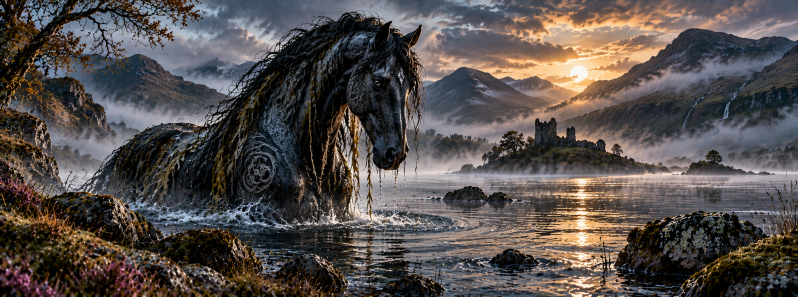
Beneath the dark surface of rivers and lochs, folklore tells of creatures that could take the shape of magnificent horses. They might appear quietly beside the water, seemingly tame enough to approach — but those who climbed onto their backs could discover too late that they had encountered something supernatural.
In Scotland, the kelpie became the best-known of these mysterious water horses, a shape-shifting being associated particularly with rivers and streams. Other traditions tell of even more dangerous creatures inhabiting lochs and the sea, including the formidable Each-Uisge of Gaelic folklore.
Stories of supernatural horses and water beings appear in different forms across Scotland, Ireland and other parts of the British Isles. Their traditions are not identical, although modern retellings sometimes combine them under the single name “kelpie”.
Behind the frightening stories lies something very real: water could be beautiful, unpredictable and deadly. Rivers changed with rain, lochs concealed their depths and apparently peaceful pools could hide powerful currents. Folklore gave those dangers a face — and sometimes that face belonged to a horse waiting beside the water.
What Is a Kelpie?
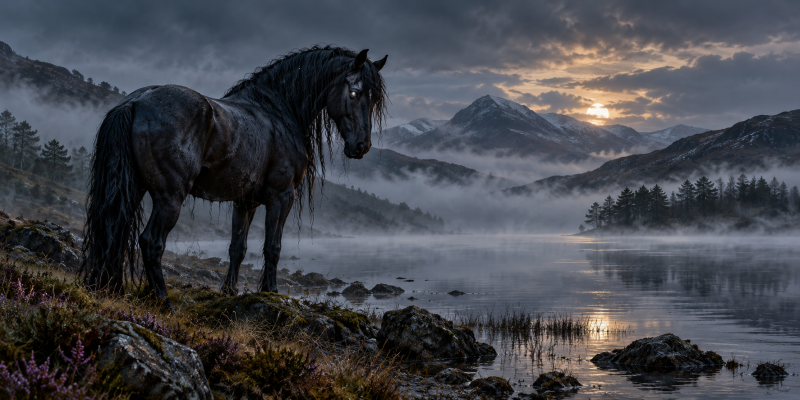
In Scottish folklore, the kelpie is a supernatural water spirit most strongly associated with rivers, streams and lochs. It was often said to take the form of a magnificent horse standing alone beside the water, seemingly tame enough for an unsuspecting traveller or child to approach.
But the beautiful animal concealed something far more dangerous.
Stories tell of people climbing onto the kelpie’s back only to discover that they could no longer free themselves. The creature would race towards the water, carrying its helpless rider beneath the surface. In some versions of the tale, several children could become trapped upon the same horse as its back mysteriously lengthened to accommodate them all.
The kelpie was not always restricted to the shape of a horse. Folklore also describes these beings appearing in human form, sometimes as a handsome stranger whose appearance concealed clues to his supernatural nature. Water dripping from his hair, weeds tangled among it, or an unnaturally damp appearance could betray the creature’s connection to the river or loch.
Like many beings of British and Irish folklore, the kelpie existed somewhere between story, warning and the supernatural. Tales of dangerous water horses gave people a memorable reason to be wary of deep pools, fast-flowing rivers and lonely stretches of water — places that could be beautiful, but deadly.
The Each-Uisge — The Water Horse of the Highlands
Among the water spirits of Scottish folklore, few were considered as dangerous as the each-uisge — a name from Scottish Gaelic usually translated as “water horse.”
Although the each-uisge is sometimes described simply as another kind of kelpie, traditional accounts often distinguish between them. Kelpies were particularly associated with rivers and flowing water, while the each-uisge was more closely connected with lochs and the sea, especially the remote waters of the Scottish Highlands.
Like the kelpie, the each-uisge could appear as a beautiful horse and tempt a traveller to climb onto its back. Once mounted, however, the rider might find themselves unable to escape as the creature plunged into the water.
The each-uisge could also take human form. Stories sometimes describe a handsome stranger appearing near the water, with some small detail revealing his true nature — most famously water weeds or other traces of the loch tangled in his hair.
In folklore, the each-uisge developed an especially fearsome reputation. Some traditions portrayed it not merely as a spirit that drowned its victims, but as a creature capable of devouring them, making it considerably darker than many accounts of the kelpie.
These stories transformed isolated Highland lochs into places where the familiar landscape could suddenly become supernatural. A beautiful horse beside still water might not be lost at all — and the stranger encountered beside the loch might belong to the water rather than the human world.
Kelpie or Each-Uisge — What’s the Difference?
The names kelpie and each-uisge are sometimes used almost interchangeably today, but Scottish folklore traditionally gives the two water horses somewhat different characteristics.
The kelpie is most strongly associated with rivers, streams and other flowing waters. It commonly appears as a horse that tempts people onto its back before carrying them into the water.
The each-uisge, whose Gaelic name means “water horse,” is more often associated with lochs and the sea. Stories of the each-uisge can also be considerably darker, describing a creature that not only drowned those unfortunate enough to mount it but could devour its victims.
Both beings could appear in horse or human form, and both belong to a much wider tradition of supernatural creatures associated with dangerous waters.
Folklore was passed down through generations rather than organised into a single fixed mythology, so descriptions naturally vary between regions and storytellers. The distinction between kelpie and each-uisge should therefore be seen as a useful guide rather than an absolute rule.
Together, however, they reveal something important about Scottish folklore: water was never merely part of the landscape. It could be mysterious, unpredictable and alive with stories.
Water Horses Beyond Scotland
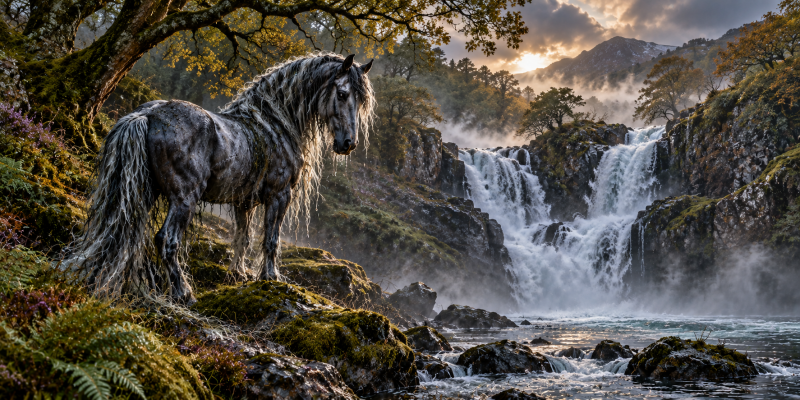
Scotland is famous for its kelpies and each-uisge, but stories of supernatural horses associated with water appear elsewhere in the folklore of Britain and Ireland. Their names and characteristics vary, yet many share the same unsettling idea: something apparently familiar waiting beside water may not be what it seems.
In Irish folklore, supernatural horses appear in stories connected with lakes, rivers and the Otherworld. Irish tradition contains many tales in which horses cross the boundary between the human and supernatural realms, while mysterious beings emerge from or disappear beneath the water.
Wales has its own remarkable water-horse tradition. The ceffyl dŵr, literally “water horse,” was said to haunt lonely pools, rivers and waterfalls. Like its Scottish relatives, it could appear as an ordinary horse before revealing its supernatural nature. Some stories describe the creature carrying a rider through the air before disappearing or throwing them to the ground.
On the Isle of Man, folklore tells of the glashtyn, a supernatural being associated with water that could appear as either a horse or a man. Tales warned that its attractive human appearance could conceal something dangerous, particularly when encountered near rivers or the sea.
These traditions are not necessarily different names for exactly the same creature. Instead, they belong to a wider family of stories in which horses, water and the supernatural world become intertwined.
From Highland lochs to Welsh rivers and the shores of Ireland and the Isle of Man, water-horse folklore reflects an old understanding of the landscape: beautiful places could also be dangerous places, and the boundary between the ordinary world and the supernatural was sometimes thought to lie just beneath the surface.
Why Were Water Horses So Feared?
For communities living among rivers, lochs, lakes and rugged coastlines, water was both essential and dangerous. A calm surface could conceal deep water, sudden currents, steep banks or treacherous ground beneath the surface.
Stories of kelpies and other water horses may have given these dangers a memorable supernatural form.
A child warned that a river contained a creature capable of dragging them beneath the water had a powerful reason to stay away. Travellers approaching an unfamiliar loch or river after dark might likewise remember stories of supernatural horses waiting along its banks.
But water-horse folklore was more than a simple collection of cautionary tales.
Across British and Irish tradition, water frequently marks a boundary. Wells, rivers, lakes and springs could be associated with healing, offerings, spirits and entrances to another world. Something emerging from the water therefore belonged to a place that was familiar but also mysterious.
The horse carried powerful associations of its own. For centuries it represented strength, speed, travel and status, yet an uncontrolled horse could also be dangerous. Combining the horse with the unpredictable nature of water created a particularly powerful supernatural creature.
Perhaps this is why the water horse survived so strongly in folklore. It transformed a real danger of the landscape into something people could imagine, describe and remember.
The message hidden within many of the stories remains remarkably simple:
Respect the water — because you may not know what lies beneath it.
Can a Kelpie Be Tamed?
Although kelpies were feared as dangerous water spirits, Scottish folklore also contains stories in which humans managed to capture or control them.
One recurring element is the kelpie’s bridle. In some tales, gaining possession of the creature’s bridle gave a person power over the supernatural horse. Once controlled, the kelpie could possess extraordinary strength and might be forced to perform work that no ordinary horse could manage.
Stories sometimes describe captured kelpies being made to haul enormous stones or carry impossibly heavy loads. Their supernatural strength made them valuable servants — at least while they remained under human control.
But controlling a kelpie was rarely presented as entirely safe.
The creature still belonged to the supernatural world, and stories about binding such beings often carry a warning. Human beings might temporarily command the forces of the wild, but those forces could remain dangerous, resentful and unpredictable.
This theme appears repeatedly throughout folklore: a supernatural creature can sometimes be tricked, captured or bound, yet its power never truly becomes ordinary.
The kelpie therefore represented more than the danger of deep water. It could also embody the ancient idea that nature might be harnessed for a time, but never completely mastered.
The Kelpie of Loch Garve
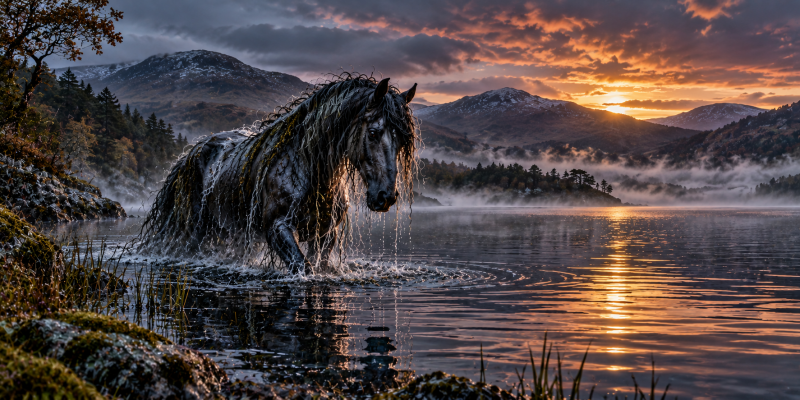
One traditional Scottish tale associated with Loch Garve in the Highlands tells of a kelpie that lived within the dark waters of the loch.
Unlike many kelpie stories, which focus upon travellers being lured to the water, the tale of Loch Garve introduces another side to the creature. According to versions of the story, the kelpie had a mate beneath the loch who suffered terribly from the cold.
The kelpie approached a local builder and sought his help in creating a place where she could find warmth.
The builder was carried across the water and eventually constructed a great fireplace or chimney for the kelpie's underwater home. In return for his work, the supernatural creature rewarded him, and the builder returned safely to the human world.
The story is unusual because the kelpie is not simply portrayed as a monster. It remains powerful and otherworldly, but it is capable of making an agreement with a human and honouring it.
Like many traditional tales, the details differ depending upon the version being told. Yet the story preserves something important about folklore. Supernatural beings were not always divided neatly into good and evil. They could be dangerous in one story, helpful in another, and sometimes surprisingly human in their desires.
Even the feared water horse, it seems, might care about the comfort of those it loved.
Kelpies in Modern Scottish Folklore & Culture
The kelpie may belong to centuries-old Scottish folklore, but the water horse has never completely disappeared from the landscape or imagination of Scotland.
Today, kelpies appear in books, artwork, storytelling and popular culture, where they are often portrayed as mysterious shape-shifters connected with Scotland's lochs and rivers. Modern interpretations sometimes soften the darker elements of the traditional stories, transforming the kelpie from a feared water spirit into a symbol of the wildness, mystery and power of the Scottish landscape.
Perhaps the most spectacular modern representation is The Kelpies near Falkirk in Scotland. Created by sculptor Andy Scott, the enormous pair of horse heads rise beside the Forth & Clyde Canal and have become one of Scotland's most recognisable modern landmarks.
The sculptures draw upon both the supernatural kelpies of Scottish folklore and the powerful working horses that played an important role in Scotland's industrial past.
Their scale seems particularly appropriate. The old stories described beings possessing extraordinary strength and belonging to the waters themselves; today, two enormous horses once again stand beside the water.
The meaning has changed, but the image of the Scottish water horse continues to endure.
Water Horses and the Celtic Otherworld
Water holds a special place within the folklore and mythology of Britain and Ireland. Rivers, wells, springs, lakes and the sea were sometimes imagined as places where the boundaries between the ordinary world and the supernatural became uncertain.
This makes the water horse particularly fascinating. Creatures such as the kelpie, each-uisge and ceffyl dŵr appear at precisely this boundary — emerging from water, changing their form and sometimes carrying human beings away from the familiar world.
These traditions connect naturally with wider stories of [the Celtic Otherworld], where mysterious landscapes exist beyond or alongside the human world. In Irish and Welsh tradition especially, journeys across water can lead towards supernatural realms, enchanted islands and places where ordinary rules no longer apply.
Water itself also possessed powerful associations within traditional belief. [Sacred waters, wells and rivers] could be connected with healing, offerings, spirits and ancient customs that survived across generations.
The water horse therefore belongs to a much larger landscape of belief. Whether encountered beside a Highland loch, a Welsh river or an isolated pool, it represents that uncertain moment when the familiar world meets something older, stranger and beyond human control.
The Water Horse Still Waits
The landscape has changed since stories of kelpies and water horses were told beside fires and passed between generations, but the places that inspired them remain.
Scottish lochs still disappear beneath mist. Welsh rivers still tumble through wooded valleys. Across Ireland and the Isle of Man, lakes, rivers and coastlines continue to carry stories that are far older than anyone living beside them today.
Perhaps that is why the water horse remains such a powerful figure in folklore.
It brings together two things that human beings have depended upon for centuries — horses and water — and transforms them into something mysterious and unpredictable. The familiar becomes supernatural, and an ordinary journey beside a river or loch becomes a story worth remembering.
Whether the kelpie was imagined as a warning against dangerous water, a supernatural inhabitant of the landscape, or simply a tale told on a dark night, its message has survived remarkably well.
When the mist settles over the water and something moves along the distant shore, the old stories become surprisingly easy to understand.
Sources & Further Reading
- Historic Environment Scotland — Supernatural Creatures in Scottish Folklore — useful for kelpies, their shape-shifting traditions and Scottish oral accounts. Historic Environment Scotland — Supernatural Creatures in Scottish Folklore
- National Trust for Scotland — A Place for Natural Heritage Folklore — discusses kelpie traditions and their possible role as warnings about dangerous water. National Trust for Scotland — Natural Heritage Folklore
- National Trust for Scotland — Robert Burns glossary fragment — a particularly nice historical source: Burns described kelpies as mischievous spirits haunting fords in a glossary dating from 1787. National Trust for Scotland — Robert Burns Kelpie Reference
- Culture Vannin — Folklore Sites around the Isle of Man — includes Manx glashtyn traditions, including a horse-like being said to drag people into a river. Culture Vannin — Manx Folklore Sites
- National Library of Wales — Cymru Fu — background on an important 19th-century collection of Welsh fables, folklore and traditions. National Library of Wales — Cymru Fu
Explore More Folklore
The stories of kelpies and water horses belong to a much wider world of British and Irish folklore, where rivers can mark the boundaries between worlds, mysterious beings inhabit the landscape and animals often possess meanings far beyond the ordinary.
Continue exploring [The Celtic Otherworld], discover the traditions surrounding [Sacred Waters, Wells & Rivers], or journey into [Fairies, Spirits & the Fae] to uncover more of the supernatural beings found throughout British and Irish folklore.
You can also return to [Folklore of Britain & Ireland] to explore more legends, traditions, mysterious creatures and ancient beliefs from across these islands.