The Banshee in Irish Folklore — The Cry of the Bean Sí
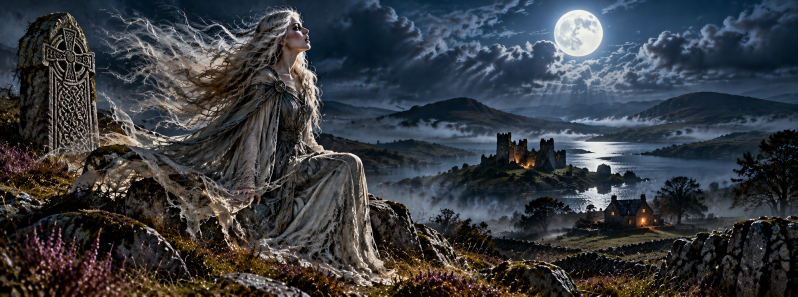
In the folklore of Ireland, few supernatural figures are as haunting as the Banshee. Her mournful cry was said to be heard in the darkness when death was approaching a family — a sound of grief arriving before the news itself.
The name comes from the Irish bean sí, meaning “woman of the fairy mound” or “woman of the sídhe”. Yet the Banshee of traditional folklore is rather more complicated than the screaming ghost often portrayed in modern horror stories.
She might appear as a beautiful young woman, a sorrowful figure with long flowing hair, or an aged woman dressed in dark or pale clothing. Sometimes she was not seen at all. Instead, her presence was known only through an eerie wailing or keening heard outside a house or across the countryside.
Most importantly, the Banshee did not usually cause the death she foretold. She announced it and mourned it. Her cry connected the supernatural world with one of the most human experiences of all — grief.
What Is a Banshee?
The Banshee is a supernatural female figure from Irish folklore whose appearance or cry traditionally foretells a death. Unlike the murderous spirit sometimes depicted in modern films and fiction, the traditional Banshee generally does not kill anyone. She is a messenger and mourner — her lament announces that death is near.
Her Irish name, bean sí (often written bean sídhe in older forms), literally connects her with the sídhe, the ancient mounds and supernatural beings of Irish tradition. These places were associated with the Otherworld and with the beings commonly called fairies in English.
Banshee traditions became particularly associated with certain Irish families. In some accounts, a family's Banshee mourned its dead generation after generation, appearing or crying shortly before a member of that family died.
This makes her an unusual supernatural figure. She could be terrifying to hear, but she was not necessarily an enemy. Her defining act was one of warning and mourning rather than attack.
The Cry of the Banshee — Keening Before Death
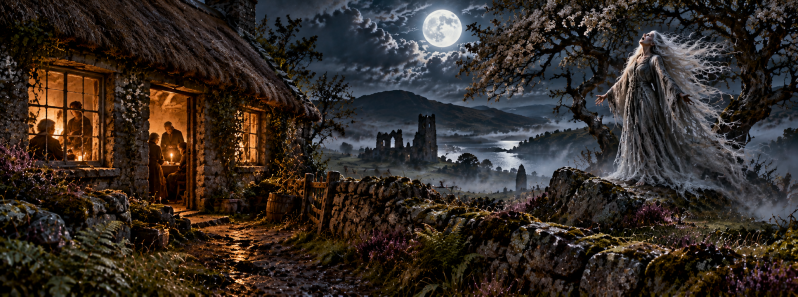
The most famous sign of the Banshee was not her appearance but her voice. Her supernatural lament was said to be heard before the death of a family member, sometimes while the person was far from home and before news of the death could possibly have arrived.
This cry is often connected with the Irish tradition of keening — a ritual lament for the dead traditionally performed at wakes and funerals. Keening could involve crying, chanting and vocal expressions of grief, creating a powerful public expression of mourning.
In Banshee folklore, however, the order was reversed. The lament came before the death was known. A strange wailing heard outside a house, beside a road or somewhere across the countryside might therefore be interpreted as the Banshee mourning someone who was about to die.
Descriptions of the sound vary. Some accounts describe sorrowful weeping, others a piercing cry or prolonged wail. What mattered was its meaning: those who recognised the sound understood that news of a death might soon follow.
This connection between supernatural folklore and the very real human tradition of mourning helps explain why the Banshee became such a powerful figure in Irish storytelling. She was frightening not simply because she belonged to the Otherworld, but because she gave grief a voice before grief had arrived.
What Does a Banshee Look Like?
Irish folklore gives the Banshee no single fixed appearance. Descriptions vary considerably between stories and regions, which is one reason modern images of her can be misleading.
In some accounts she appears as a beautiful young woman with long flowing hair, while in others she is an elderly woman, small and frail, with a face marked by centuries of sorrow. She may wear white, grey or dark clothing, and some traditions describe a cloak or long dress moving around her as she mourns.
Her hair became an especially memorable feature. Stories sometimes describe the Banshee combing her long hair, an image that contributed to Irish folk beliefs surrounding mysteriously found combs. Picking up an abandoned comb could be considered unwise if it belonged to a supernatural woman.
Yet many people in Banshee stories never claimed to see her at all. The cry alone was enough. Somewhere beyond the house, perhaps beside a road, river or lonely field, came a sound that those listening believed could mean only one thing.
This uncertainty is part of the Banshee's power. She could be young or old, beautiful or frightening, visible or unseen. It was the mourning that identified her.
The Banshee and Irish Families
One of the most distinctive features of Banshee folklore is her association with particular Irish families. Rather than wandering randomly in search of victims, the Bean Sí was sometimes understood as a supernatural mourner attached to a family across generations.
Traditional accounts frequently associate Banshees with old Gaelic families, particularly surnames beginning with Ó or Mac. Later folklore sometimes named families such as the O'Neills, O'Briens, O'Connors, O'Gradys and Kavanaghs, although traditions varied considerably from place to place.
When a member of the family was approaching death, its Banshee might begin to keen. In some stories the cry could be heard near the ancestral home even when the dying person was many miles away. The lament therefore acted almost like a supernatural announcement that news of a death was coming.
Some traditions even spoke of several Banshees mourning together when a particularly important person died. The greater the number of supernatural mourners, the greater the status of the person whose death they foretold.
Seen this way, the Banshee was not simply a frightening apparition. She belonged to the family's story — a mysterious mourner who remembered its dead from one generation to the next.
The Banshee, the Sídhe and the Otherworld
The name Bean Sí places the Banshee within the mysterious world of the sídhe — the supernatural beings and ancient mounds that occupy such an important place in Irish tradition. The word sí is connected with the otherworldly mounds believed to be inhabited by beings existing alongside, but separate from, the human world.
This connection helps explain why the Banshee should not simply be described as a ghost. Although some later stories blur the distinction between spirits of the dead and fairy beings, the older tradition places her within a much broader landscape of Irish supernatural belief.
Ancient burial mounds, hills, lakes and lonely places could all become associated with the Otherworld. The beings connected with these places were not necessarily good or evil. They belonged to a realm with its own rules, capable of interacting with human lives in ways that could be beautiful, dangerous or deeply unsettling.
The Banshee occupies a particularly unusual position within that world. She does not normally lure people away or attack them. Instead, she crosses the boundary for a moment to deliver something humans cannot avoid — the knowledge that death is approaching.
Her lament then fades, leaving the living to wait for the news.
The Banshee by Rivers and Lonely Places
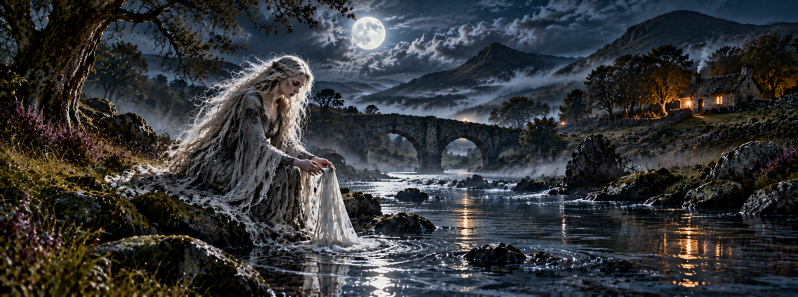
Banshee stories often place her away from busy human spaces. She might be heard beside a river, lake, lonely road, field or ancient landscape, particularly during the hours of darkness when familiar surroundings became difficult to recognise.
Water has a particularly strong connection with supernatural women throughout Irish and wider Celtic folklore. In some traditions, a mysterious woman could be encountered washing clothing associated with someone who was soon to die. Such stories overlap with traditions of supernatural washerwomen found elsewhere in Ireland, Scotland and Brittany, although these figures should not automatically be treated as identical to the Banshee.
The landscape itself was important. A cry carried across a valley or over water could seem to come from nowhere. Wind, birds and animals heard at night could produce unfamiliar sounds, but once a community knew the tradition of the Bean Sí, an unexplained lament might acquire a much more frightening meaning.
As with so much folklore, landscape and story strengthened one another. A particular riverbank, ruined house or lonely road might become associated with an encounter, and the next generation would pass the place already knowing what had supposedly been heard there before.
Was the Banshee Evil?
Despite her frightening reputation, the traditional Banshee was not necessarily an evil figure. Modern horror often portrays her as a screaming spirit that attacks or kills, but this is very different from the role she usually plays in Irish folklore.
The Banshee's cry foretold death, but she generally did not cause it. She mourned someone whose death was approaching or announced a death that had already occurred beyond the knowledge of those who heard her.
This distinction changes the character of the legend considerably. The Banshee becomes less a monster and more a supernatural witness to human mortality — frightening because of what her appearance means rather than because she intends harm.
In some traditions her connection with a particular family makes this relationship even more personal. She returns generation after generation, mourning people whose ancestors she was also believed to have mourned.
Perhaps that is why the Banshee remains such a powerful figure. She does not bring death. She brings the warning that death is already on its way.
The Banshee in Folklore Today
The Banshee has travelled far beyond Ireland. She appears throughout modern fantasy, horror, films, games and popular culture, where the traditional Bean Sí has often been transformed into a terrifying screaming ghost.
Yet the older folklore is subtler and, in many ways, more haunting. There is no need for an attack or dramatic apparition. A family lies asleep. Somewhere outside, a strange lament begins in the darkness.
By morning, perhaps nothing has happened.
Then the news arrives.
Sources & Further Reading
Dúchas — The Schools’ Collection
The National Folklore Collection of Ireland preserves thousands of accounts collected from schoolchildren and their families during the 1930s, including traditional beliefs and stories concerning the Banshee.
Explore the Schools’ Collection — Dúchas.ie
Dúchas — National Folklore Collection
An excellent resource for exploring original Irish folklore material, including regional traditions and accounts of supernatural beings.
Dúchas.ie — National Folklore Collection of Ireland
University College Dublin — National Folklore Collection
Background on Ireland's National Folklore Collection, one of the world's major collections of oral tradition and ethnological material.
National Folklore Collection — UCD
The Folklore Society
A useful wider resource for the academic study of folklore, traditional beliefs, customs and supernatural narratives.
A note on the tradition: Banshee folklore varies considerably according to place, family and period. Later literature and popular culture have also changed the image of the Banshee, particularly the idea that she is an attacking or murderous spirit. This page uses Banshee and the Irish Bean Sí while distinguishing traditional accounts from later interpretations.
Explore More Folklore
The Banshee belongs to a much wider world of Irish supernatural tradition. Explore Fairies, Spirits & the Fae to discover the beings associated with the sídhe, journey into The Celtic Otherworld and its mysterious realms beyond the human world, or visit Folklore of Britain & Ireland for more legends, spirits and traditional beliefs from across these islands.
Make these three phrases clickable:
Fairies, Spirits & the Fae →
The Celtic Otherworld →
Folklore of Britain & Ireland →