The Wild Hunt in British & European Folklore
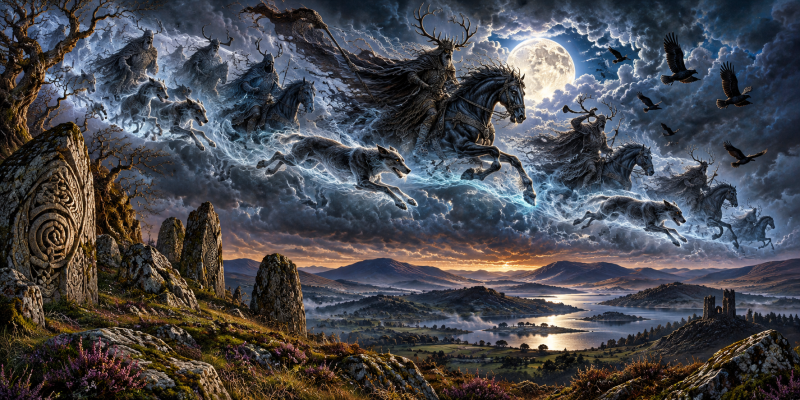
Across the storm-darkened skies of European folklore rides one of its most haunting legends — the Wild Hunt. A supernatural procession of spectral riders, ghostly hounds and restless spirits, the Hunt was said to thunder through the night sky or race across lonely landscapes during storms and the darkest months of the year.
Stories of the Wild Hunt vary greatly from place to place. In some traditions it is led by a god, legendary king or ancient hero; in others by a mysterious huntsman or figure of the dead. To encounter the Hunt could be an omen of danger, upheaval or death, while those who heard its horns and hounds were often warned to remain indoors and avoid its path.
From Woden and Herne the Hunter to Welsh tales of Arawn and the Cŵn Annwn, the idea of a supernatural hunt connects mythology, landscape and centuries of storytelling across Britain and northern Europe.
What Was the Wild Hunt?
The Wild Hunt was not a single story with one fixed cast of characters. Instead, it was a widespread family of legends describing a supernatural hunt or procession travelling through the night. Tales appeared across Britain, Scandinavia, Germany and other parts of northern and western Europe, with each region giving the Hunt its own leader, hunters and meaning.
Those who witnessed it might hear the bay of hounds, the pounding of hooves, the blast of horns or wild cries carried upon the wind. Sometimes the riders themselves were visible; elsewhere, the terrifying sounds of the Hunt were said to pass overhead while little could be seen.
The identity of the hunters changed from one tradition to another. Gods, kings, legendary heroes, restless spirits and the dead could all ride at the head of the procession. What remained remarkably persistent was the image of a mysterious company moving through the darkness — belonging neither entirely to the human world nor comfortably to the world beyond it.
In later folklore, encountering the Wild Hunt could be interpreted as an omen. War, death, violent weather or some other misfortune might follow its appearance. The safest response was often simple: do not interfere with the Hunt, and do not follow it.
Woden and the Wild Hunt
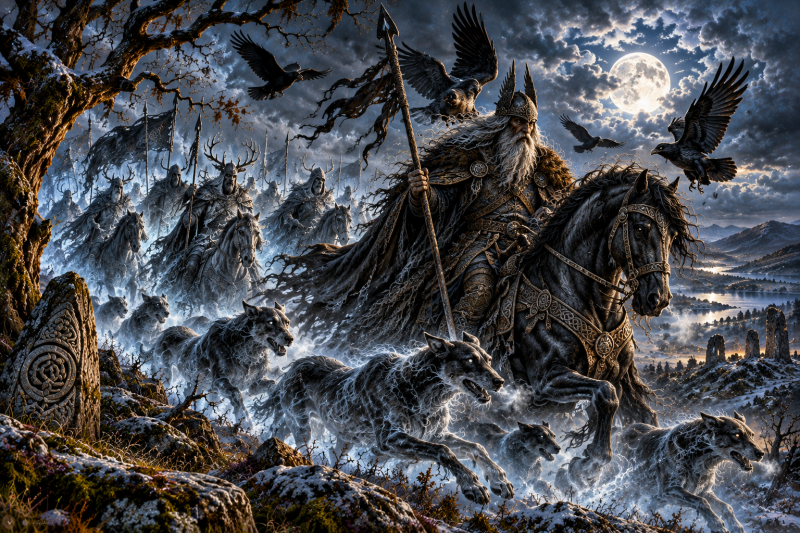
One of the figures most famously associated with the Wild Hunt is Woden, the Anglo-Saxon form of the Germanic god better known in Norse tradition as Odin. Across Germanic-speaking Europe, traditions developed in which a supernatural rider or company swept through the winter sky, and later folklore often connected this mysterious procession with Woden or Odin.
Woden was associated with many things — including war, wisdom, death, magic and ecstatic inspiration. These qualities made him a natural figure to become entangled with stories of ghostly riders and the restless dead. In some traditions, the Hunt was imagined as a company of spirits travelling behind its supernatural leader through storms and darkness.
Winter was particularly important to these stories. Long nights, fierce winds and strange sounds overhead could transform the familiar landscape into something unsettling. The roaring of a winter storm might become the approach of spectral horses; distant cries might become hunting hounds; racing clouds could suggest riders passing across the moon.
Over centuries, older mythology, Christian belief and local storytelling became intertwined. As a result, the leader of the Wild Hunt could change dramatically from one region to another. Woden remained one of its most powerful associations, but he was never its only huntsman.
Herne the Hunter and the Wild Hunt
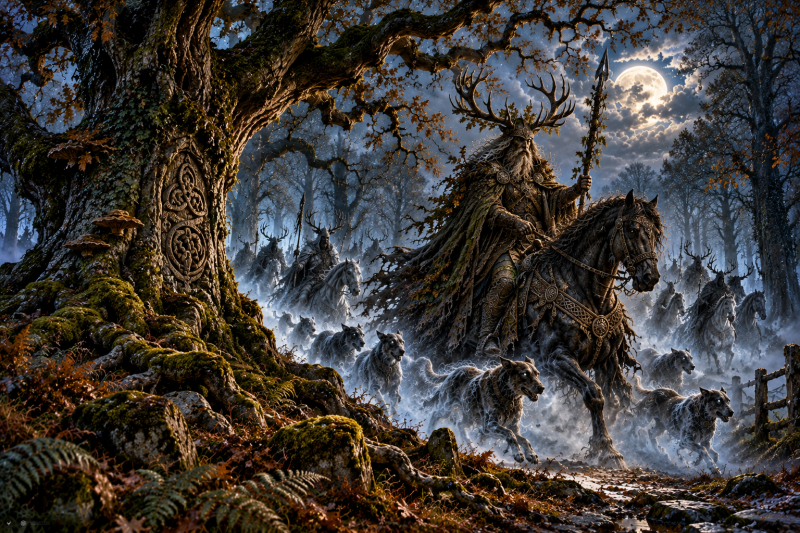
In English folklore, one of the figures most often compared with the leader of the Wild Hunt is Herne the Hunter, the mysterious horned huntsman associated with Windsor Forest and Windsor Great Park.
Herne appears in written literature at least as early as William Shakespeare's The Merry Wives of Windsor, where he is described as a spirit who walks around an oak tree at midnight, wearing great horns upon his head. Later folklore expanded his legend, transforming Herne into an increasingly supernatural figure connected with the forest, hunting and the night.
Over time, Herne became associated with imagery remarkably similar to the Wild Hunt: a spectral huntsman, horses, hounds and a terrifying nocturnal procession. Modern retellings have strengthened this connection further, although Herne was not originally simply an English version of Woden, and the traditions should not be treated as identical.
His legend nevertheless captures something central to Wild Hunt folklore — the idea that familiar countryside could become strange after darkness fell. Forest tracks, ancient trees and lonely paths became places where the boundary between everyday life and the supernatural seemed dangerously thin.
Arawn, the Cŵn Annwn and the Welsh Otherworld
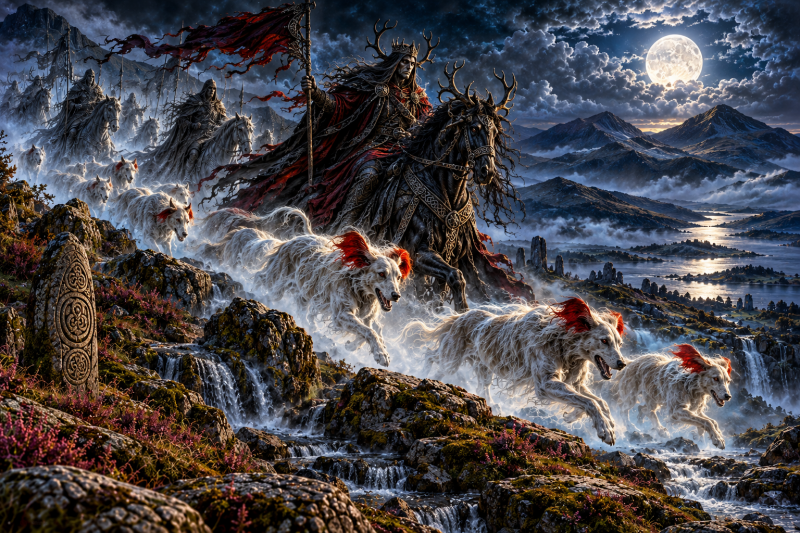
Welsh tradition contains one of Britain's most striking supernatural hunts: the Cŵn Annwn, the otherworldly hounds associated with Annwn, the Welsh Otherworld. They are often described in later folklore as spectral hunting dogs whose cries could be heard travelling through the night.
In medieval Welsh literature, Arawn is a ruler of Annwn and a hunter. In the First Branch of the Mabinogi, Prince Pwyll encounters Arawn's hunting party after driving his own hounds away from a stag already brought down by Arawn's strange dogs. The encounter begins Pwyll's extraordinary journey into the affairs of the Otherworld.
Later Welsh folklore developed traditions surrounding the Cŵn Annwn as supernatural hounds moving across the landscape. Their appearance is famously otherworldly: white hounds with red ears, colours that carry supernatural significance in medieval Welsh and Irish storytelling.
Their cries were sometimes regarded as an omen of death, and a curious feature of the tradition held that the hounds could sound loudest when they were far away and grow quieter as they approached. The effect must have made their imagined passage through a dark Welsh landscape particularly unsettling.
The Cŵn Annwn are frequently discussed alongside the wider European tradition of the Wild Hunt. The traditions are not identical, but they share powerful imagery: a supernatural hunt, otherworldly hounds, mysterious riders and the dangerous crossing of boundaries between worlds.
When Did the Wild Hunt Ride?
The Wild Hunt was particularly associated with the darkest and wildest part of the year. Across northern European traditions, supernatural processions were often imagined during winter, when long nights, violent storms and howling winds transformed the landscape.
Midwinter and the period around Christmas and the Twelve Nights became especially rich in stories of wandering spirits and supernatural riders. In some regional traditions, people were warned against travelling at certain times or interfering with a mysterious procession passing through the night.
It is easy to understand why such stories flourished. Before electric lighting, a winter storm over an isolated farm, forest or moor could be profoundly unsettling. Wind screamed through trees and chimneys, animals cried somewhere beyond the darkness, and racing clouds crossed the moon. Folklore gave those sounds a shape: the hunters were abroad.
This seasonal connection also helped the Wild Hunt survive long after the older beliefs surrounding it had changed. The story became part of a much wider European tradition in which winter was a time when the boundary between the ordinary world and the supernatural seemed unusually close.
What Happened If You Encountered the Wild Hunt?
To encounter the Wild Hunt was rarely considered fortunate. In many versions of the legend, the safest thing a traveller could do was keep out of its path. The supernatural hunters belonged to another world, and attracting their attention could have dangerous consequences.
Folklore differed from region to region. Some stories warned that a person who saw the Hunt might be swept up and carried away, forced to join its furious journey through the night. Others treated its appearance as an omen of death, warfare, disaster or sudden change.
There were also tales in which people foolish enough to mock or challenge the hunters received a gruesome reward. A huntsman might throw down part of his supernatural quarry, leaving the unfortunate witness with something horrifying to carry home. Such stories reinforced a familiar rule of traditional folklore: when the Otherworld passes close by, respect it and keep your distance.
Yet the Wild Hunt was not always simply evil. Its riders could be frightening without being demonic. They belonged to a realm outside ordinary human life — unpredictable, powerful and governed by rules of their own. That ambiguity is one reason the legend has remained so compelling.
Storms, Landscape and the Sounds of the Wild Hunt
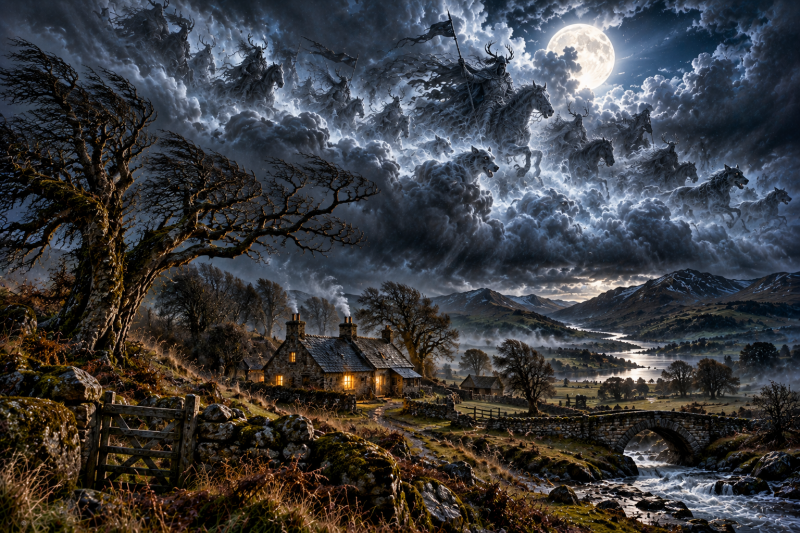
Many Wild Hunt traditions are closely connected with wild weather and lonely landscapes. Mountains, forests, moors and open countryside could turn ordinary sounds into something extraordinary, particularly during winter storms.
Wind rushing through trees, valleys and rocky ground can produce strange whistles, roars and distant cries. The calls of animals and birds heard at night may be difficult to identify, while thunder or the sound of hooves travelling across hard ground can carry surprisingly far. To people living without modern lighting or weather forecasting, such sounds could make the darkness feel inhabited by unseen travellers.
This does not mean that the Wild Hunt was simply invented to explain bad weather. Folklore is rarely that straightforward. Older mythology, beliefs about the dead, local legends and generations of storytelling all contributed to the tradition. But the landscape provided the perfect stage upon which those beliefs could come alive.
A storm moving across a mountain ridge could become a company of riders. The distant cry of hounds could become the dogs of the Otherworld. Clouds racing across a winter moon might reveal, for just a moment, the Hunt passing overhead.
The Wild Hunt in Modern Folklore
The Wild Hunt never entirely disappeared. Instead, it moved from oral tradition and local legend into literature, fantasy, art, music and modern Pagan and folklore-inspired culture.
Modern portrayals often combine elements that originally belonged to different traditions. Woden or Odin, Herne the Hunter, Arawn, spectral riders and supernatural hounds may all appear beneath the broad idea of the Wild Hunt. This has created a powerful modern mythology, although the older regional traditions were considerably more varied.
Perhaps the legend survives because its central image remains so effective. A storm gathers after dark. Dogs can be heard somewhere in the distance. Clouds race across the moon and, for a moment, the night seems filled with movement.
Centuries after the stories were first told, it is still easy to imagine the warning:
Stay inside tonight. The Hunt is riding.
Sources & Further Reading
The Mabinogion — translated by Jeffrey Gantz, Penguin Classics
Welsh medieval tales containing some of the most important surviving literature concerning Annwn and the Welsh Otherworld.
The Mabinogion — Penguin Classics
Claude Lecouteux — Phantom Armies of the Night: The Wild Hunt and the Ghostly Processions of the Undead
A detailed study of the Wild Hunt, phantom armies, supernatural processions and traditions surrounding the dead. Inner Traditions
Phantom Armies of the Night — Inner Traditions
William Shakespeare — The Merry Wives of Windsor
One of our most useful historical references for Herne the Hunter. The play explicitly describes an old tale of Herne walking Windsor Forest at midnight with horns upon his head. Folger Shakespeare Library
Read The Merry Wives of Windsor — Folger Shakespeare Library
H. R. Ellis Davidson — Gods and Myths of Northern Europe
Useful background reading on the gods, myths and pre-Christian beliefs of Scandinavian and Germanic peoples, including the wider mythological world of Odin/Woden. Penguin Books
Gods and Myths of Northern Europe — Penguin
A note on the tradition: The Wild Hunt is a collection of related traditions rather than a single fixed legend. Its leaders, supernatural beings and meanings vary considerably according to place and period. Modern retellings sometimes combine traditions that were historically distinct.
Explore More Folklore
The Wild Hunt belongs to a much wider world of supernatural belief across Britain and Ireland. Explore The Celtic Otherworld and the mysterious realm of Annwn, discover the traditions surrounding Fairies, Spirits & the Fae, or explore Shape-Shifting, Magic & Ancient Beliefs. You can also return to Folklore of Britain & Ireland to discover more legends, supernatural beings and traditions connected with the landscapes of these islands.