The Wheel of the Year
Eight Festivals Through the Changing Seasons
The first snowdrops push through cold soil.
Spring returns to the hedgerows.
Bonfires burn as summer approaches.
Fields turn golden beneath the August sun.
Leaves begin falling.
Then darkness returns, winter settles across the landscape and the cycle begins again.
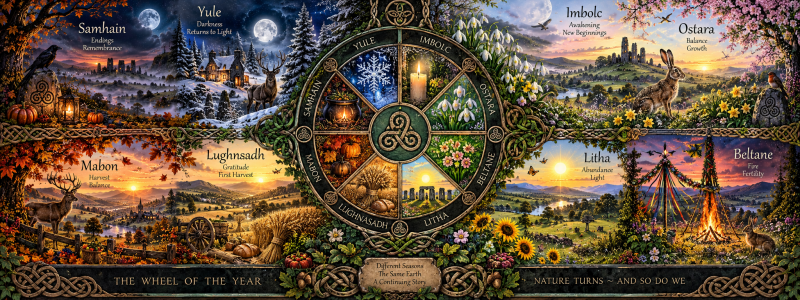
The Wheel of the Year is a modern Pagan calendar built around eight seasonal festivals that mark these changing moments.
They are commonly known as:
Samhain • Yule • Imbolc • Ostara • Beltane • Litha • Lughnasadh • Mabon
Together they create a journey through darkness and light, growth and harvest, life and death, endings and beginnings.
But the history behind the Wheel is more complicated — and considerably more interesting — than it sometimes appears online.
Some of its festivals have genuinely ancient roots.
Others draw upon later European traditions.
And the eight-spoked Wheel as we know it today is largely a modern Pagan creation.
Rather than diminishing its meaning, understanding that history reveals how ancient traditions, folklore and modern spirituality have come together to create something new.
What Is the Wheel of the Year?
Imagine the year as a great circle.
At four points are major astronomical events:
Winter Solstice
Spring Equinox
Summer Solstice
Autumn Equinox
Between them sit four traditional seasonal festivals strongly associated with Irish and Gaelic tradition:
Imbolc
Beltane
Lughnasadh
Samhain
Together these eight celebrations form what modern Pagans commonly call the Wheel of the Year.
Each festival represents another turn of the seasonal cycle.
Winter gives way to spring.
Spring becomes summer.
Summer ripens into harvest.
Harvest fades into winter.
And then everything begins again.
Is the Wheel of the Year Ancient?
This is one of the most important questions surrounding the Wheel.
The answer is:
Not in its modern eight-festival form.
There is no evidence that ancient Celtic communities gathered around a diagram divided into eight equal festivals called the Wheel of the Year.
The modern system developed primarily during the twentieth-century revival of Pagan religion, particularly through Wicca and related traditions.
But many of the ingredients are much older.
Samhain, Imbolc, Beltane and Lughnasadh have roots in Irish and Gaelic seasonal traditions.
Solstice celebrations have existed in various cultures for thousands of years.
Seasonal customs surrounding harvest, fire, greenery and the return of spring are also extremely old.
The modern Wheel brings these different traditions together.
Think of it not as an unchanged ancient calendar —
but as a modern path built partly from very old stones.
❄️ Yule — The Winter Solstice
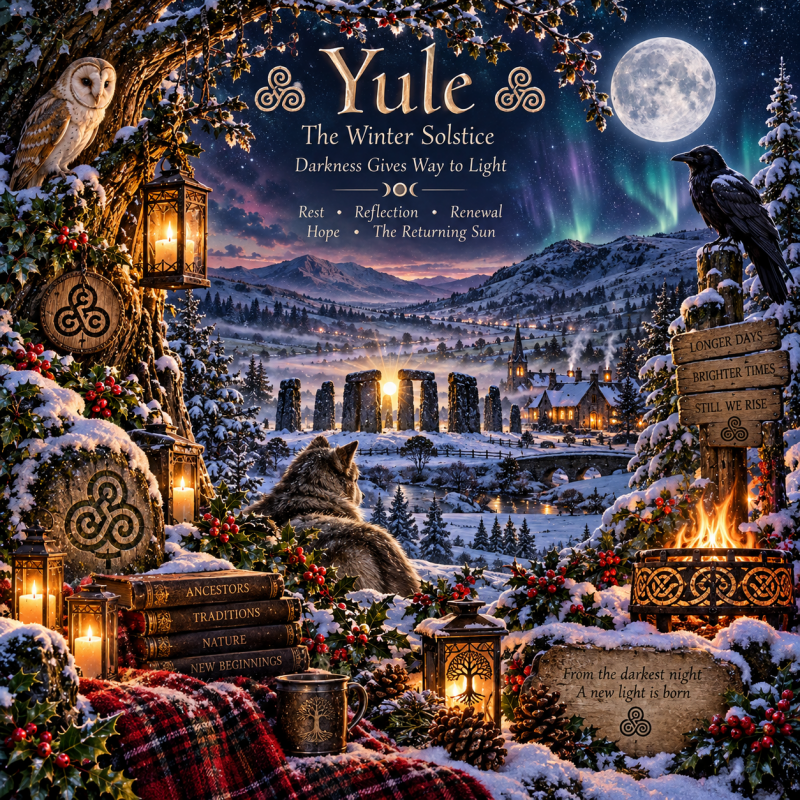
Around 21 December
The Winter Solstice marks the darkest point of the year in the Northern Hemisphere.
It is the shortest day and longest night.
After the solstice, daylight slowly begins returning.
For communities living without electric lighting, that change would have been impossible to ignore.
Midwinter traditions across northern Europe developed around fire, feasting, evergreen plants and community.
The word Yule has Germanic rather than Celtic origins, but it has become an important part of the modern Pagan Wheel.
Evergreens are especially appropriate symbols.
While much of the landscape appears dormant, holly, ivy and other evergreen plants remain green.
They became natural images of endurance during winter.
Modern Pagan celebrations often focus upon the return of light, renewal, hope and the continuation of life through darkness.
🌱 Imbolc — The First Stirring of Spring
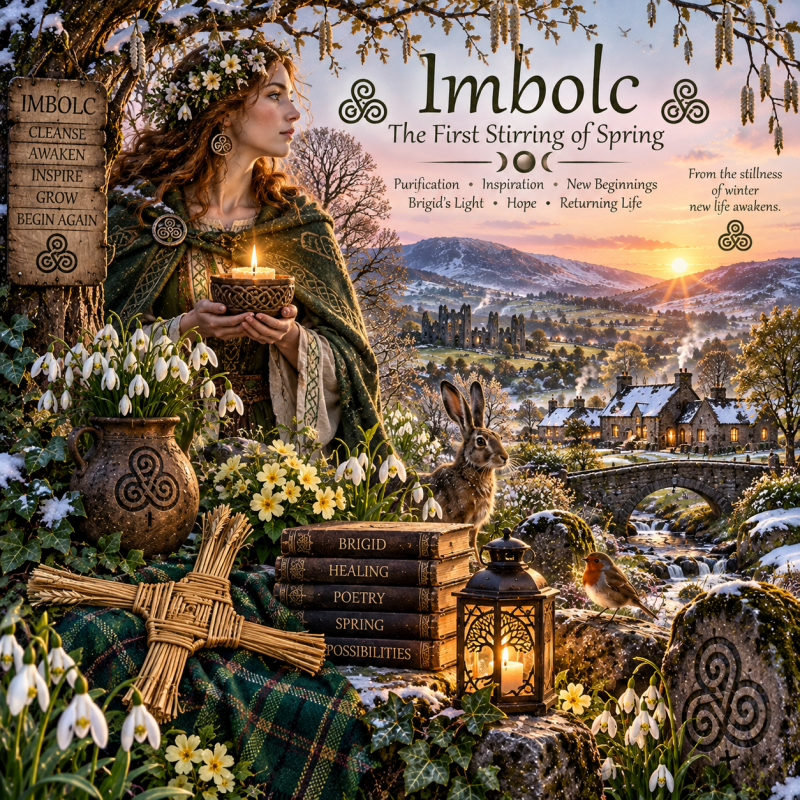
Around 1 February
Winter still holds the landscape.
But something has begun to change.
Days are noticeably longer.
Early flowers emerge.
Birdsong slowly increases.
Traditionally associated with the beginning of spring in Ireland, Imbolc has particularly strong connections with Brigid.
Brigid appears in Irish tradition both as an important pre-Christian figure and later as the Christian Saint Brigid, with complicated relationships between the traditions surrounding them.
Later customs included Brigid's crosses and visits associated with the saint's feast day.
For modern Pagans, Imbolc often represents purification, inspiration, new beginnings and the first signs of returning life.
It is not yet spring in all its abundance.
It is something quieter.
A promise beneath the soil.
🌸 Ostara — The Spring Equinox
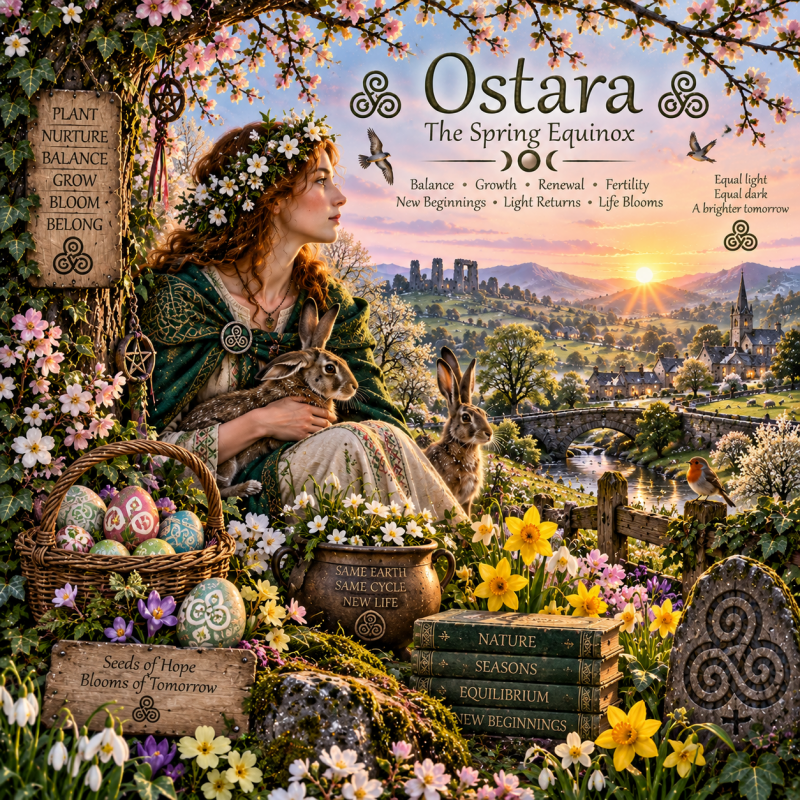
Around 20 March
At the Spring Equinox, daylight and darkness reach approximate balance.
The landscape is awakening rapidly.
Trees begin opening their buds.
Wildflowers appear.
Birds build nests.
Animals become increasingly active.
Within the modern Pagan Wheel, this festival is commonly called Ostara.
Claims surrounding its ancient history need some caution.
The name is generally connected with Ēostre, a goddess mentioned by the eighth-century English monk Bede, rather than an ancient Celtic festival.
Modern Ostara celebrations often emphasise balance, fertility, growth and renewal.
Eggs, flowers, seeds and young animals have become popular symbols.
Whatever its modern spiritual interpretation, the Spring Equinox marks something very real.
Winter has loosened its grip.
The growing season has begun.
🔥 Beltane — Fire and the Coming of Summer
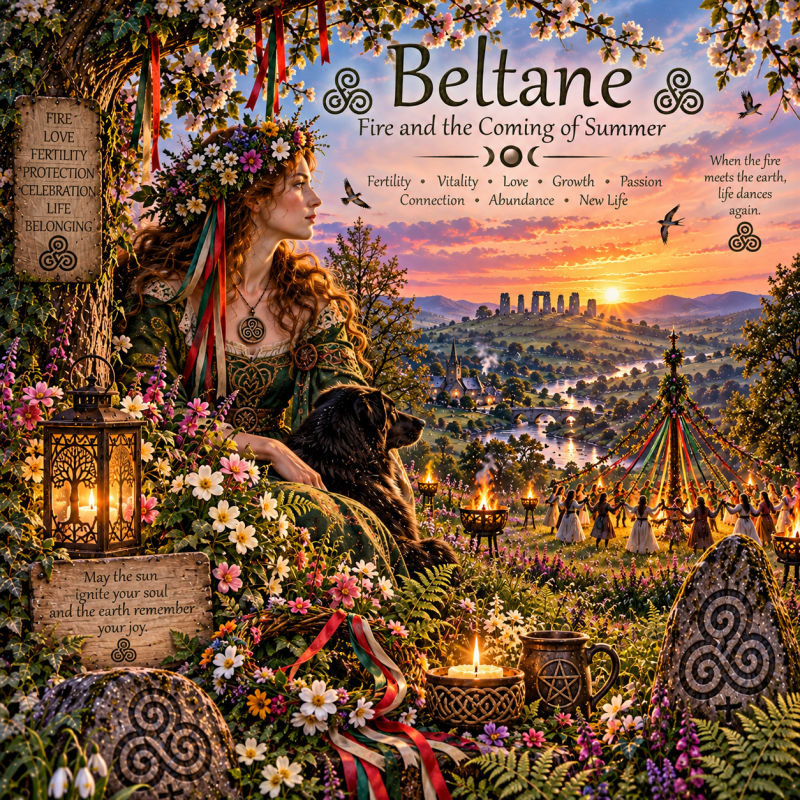
Around 1 May
Few seasonal festivals possess imagery as powerful as Beltane.
In Irish tradition, Beltane marked the beginning of the summer half of the year.
Fire played an important role in later recorded customs.
Cattle could be driven between fires as part of protective traditions before being moved towards summer grazing.
May itself accumulated an enormous collection of customs throughout Britain and Ireland.
Flowers.
Greenery.
May bushes.
Bonfires.
Gatherings.
Modern Pagan Beltane celebrations often focus upon fertility, vitality, love, fire and the abundance of the approaching summer.
The landscape is no longer merely awakening.
It is overflowing with life.
☀️ Litha — The Summer Solstice
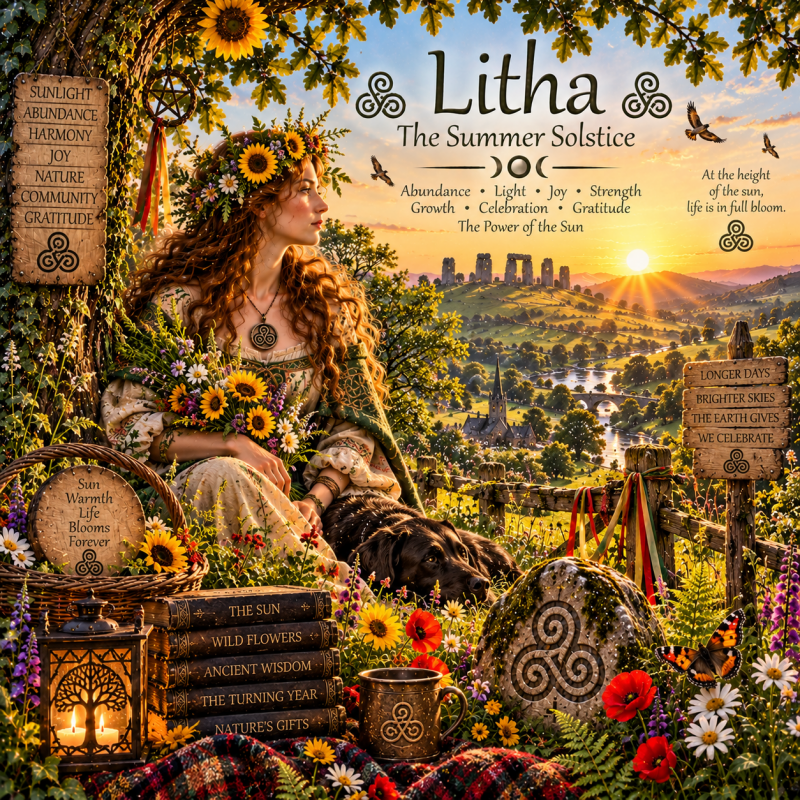
Around 21 June
Eventually the sun reaches its highest point.
The Summer Solstice gives us the longest day and shortest night of the year.
Within modern Paganism this celebration is frequently called Litha.
As with Ostara, the modern festival combines older seasonal traditions with newer Pagan interpretation.
Across Britain and Europe, midsummer accumulated customs involving fires, plants, gatherings and celebration.
Today thousands of people continue gathering at ancient monuments such as Stonehenge to watch the solstice sunrise.
Modern Pagan celebrations often focus upon light, abundance, strength and the extraordinary energy of midsummer.
But the solstice also contains a quiet reminder.
The sun has reached its peak.
From this moment onward, the days slowly begin becoming shorter again.
Even at the height of summer, winter has begun its distant return.
🌾 Lughnasadh — The Beginning of Harvest
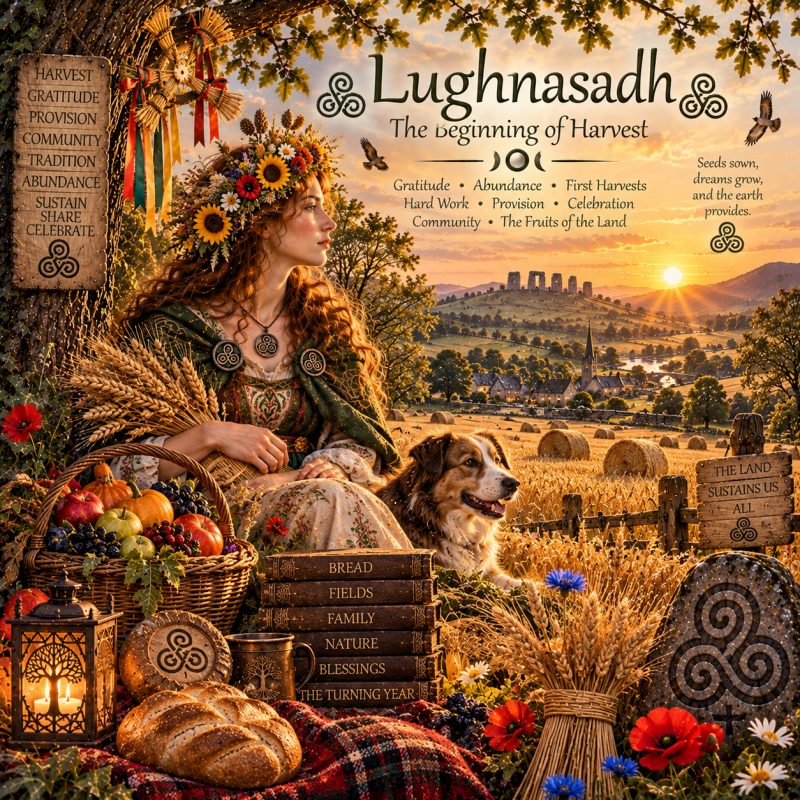
Around 1 August
By August the landscape has changed again.
Fields turn gold.
Fruit begins ripening.
The first major harvests arrive.
Lughnasadh is an old Irish seasonal festival associated with the god Lugh and with gatherings, games and the beginning of harvest time.
Medieval Irish sources contain traditions surrounding assemblies held at this period.
Later customs included fairs, gatherings and journeys to hills or other prominent places.
Modern Pagan celebrations frequently emphasise grain, bread, gratitude and the first harvest.
The season contains both abundance and uncertainty.
The crops may be ready.
But they still have to be gathered.
For farming communities, a successful harvest could mean survival through winter.
That gives harvest celebrations a meaning far deeper than decoration.
🍂 Mabon — The Autumn Equinox
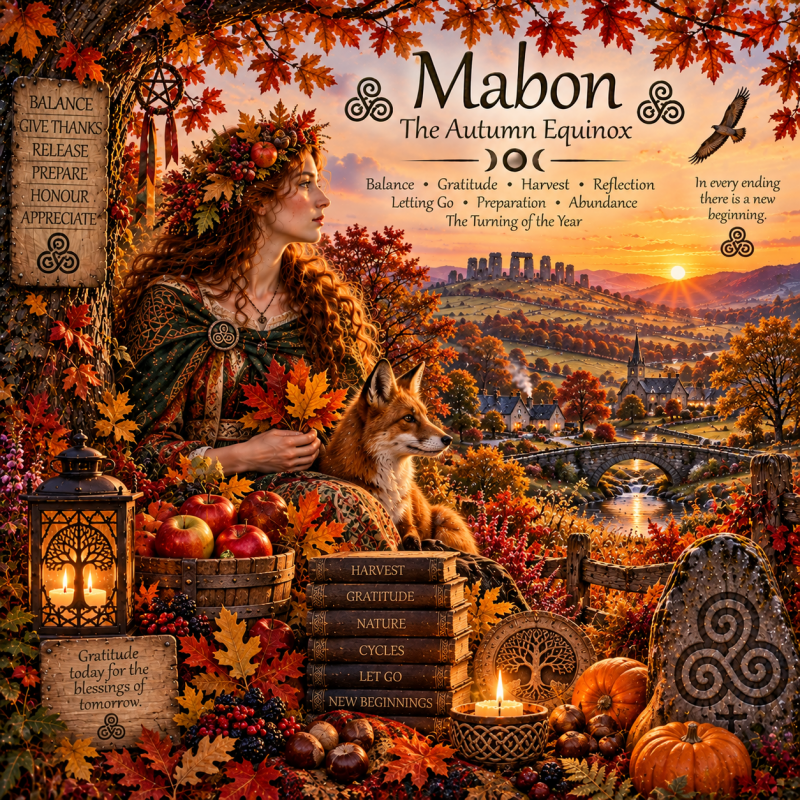
Around 22 September
Day and night return once again to approximate balance.
But this time the year is moving towards darkness.
Leaves begin changing colour.
Fruit hangs heavy on branches.
Nuts fall.
The air cools.
Modern Pagans commonly call the Autumn Equinox Mabon.
The name is relatively modern in this particular festival context and should not be mistaken for the documented name of an ancient Celtic equinox celebration.
It was inspired by Mabon ap Modron, a figure from Welsh mythology.
Modern celebrations often focus upon harvest, gratitude, balance and preparation for winter.
Nature appears extraordinarily generous at this time.
But the falling leaves carry another message.
Everything changes.
🎃 Samhain — The Beginning of Winter
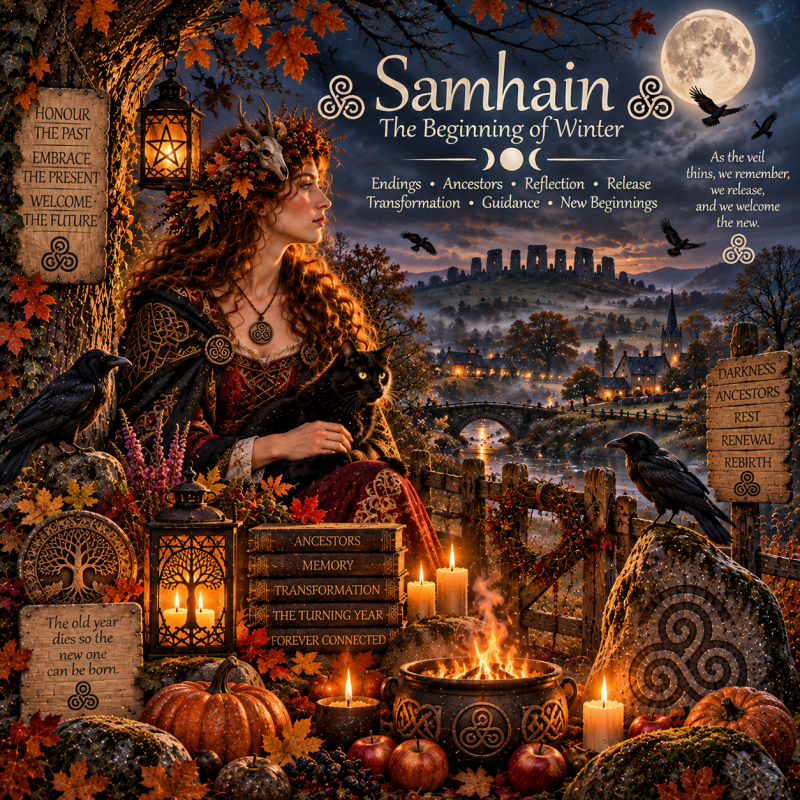
Around 31 October–1 November
The harvest is ending.
Leaves fall from the trees.
Nights lengthen rapidly.
Cold returns.
In Irish tradition, Samhain marked the beginning of the winter half of the year and appears prominently within medieval literature.
Stories associated the period with supernatural events and unusual encounters.
Later customs surrounding Halloween and All Hallows added further layers involving the dead, disguise, divination, fires and supernatural belief.
Today Samhain has become one of the most important celebrations for many modern Pagans.
It is often associated with ancestors, remembrance, death, endings and the mysterious boundary between worlds.
The familiar modern phrase claiming that “the veil between the worlds is thinnest” at Samhain is much newer than is sometimes suggested.
Yet the association between this season and supernatural activity genuinely has deep roots.
Perhaps that is unsurprising.
The landscape itself appears to be dying.
Leaves disappear.
Plants collapse.
Darkness arrives earlier each evening.
Winter waits at the door.
The Four Fire Festivals
The four Gaelic seasonal festivals —
Imbolc, Beltane, Lughnasadh and Samhain
— are sometimes collectively described today as the cross-quarter festivals or fire festivals.
Fire is particularly prominent in traditions surrounding some of them, although we should be cautious about assuming identical rituals were performed everywhere.
Together they roughly mark major transitions in the traditional pastoral and agricultural year.
Spring begins.
Summer arrives.
Harvest starts.
Winter returns.
They remind us that earlier calendars were not simply numbers printed on paper.
They were experienced through the landscape.
The Solstices and Equinoxes
The other four points on the modern Wheel are astronomical.
The solstices mark the extremes of daylight.
The equinoxes occur when day and night are approximately equal.
These events happen whether humans celebrate them or not.
That is part of their appeal.
No calendar needs to tell the sun when to rise.
The earth simply continues its journey.
The Wheel therefore connects modern spiritual celebration with something much larger:
the movement of our planet around the sun.
The Wheel and the Farming Year
For earlier rural communities, seasons were not aesthetic.
They determined survival.
Spring meant planting and new livestock.
Summer meant growth.
Late summer and autumn meant harvest.
Winter meant surviving on what had been stored.
Weather could decide whether a family experienced abundance or hunger.
The festivals surrounding the seasonal year therefore make more sense when we remember how closely human survival once depended upon the landscape.
Even today, those rhythms remain visible.
Look at a hedgerow each month and it changes.
Flowers appear and vanish.
Birds arrive and leave.
Fruit ripens.
Leaves fall.
Frost returns.
The Wheel is happening outside whether we celebrate it or not.
Animals Around the Wheel
Wildlife follows its own seasonal calendar.
Hares become conspicuous during spring.
Bees emerge among the flowers.
Swallows return.
Stags roar during the autumn rut.
Salmon move through rivers.
Owls hunt across dark winter fields.
Many of the animals explored elsewhere at Pixie Page Crafts therefore belong naturally within the Wheel of the Year.
Their lives remind us that seasonal change affects every creature sharing the landscape.
Humans are simply one part of that cycle.
Trees Around the Wheel
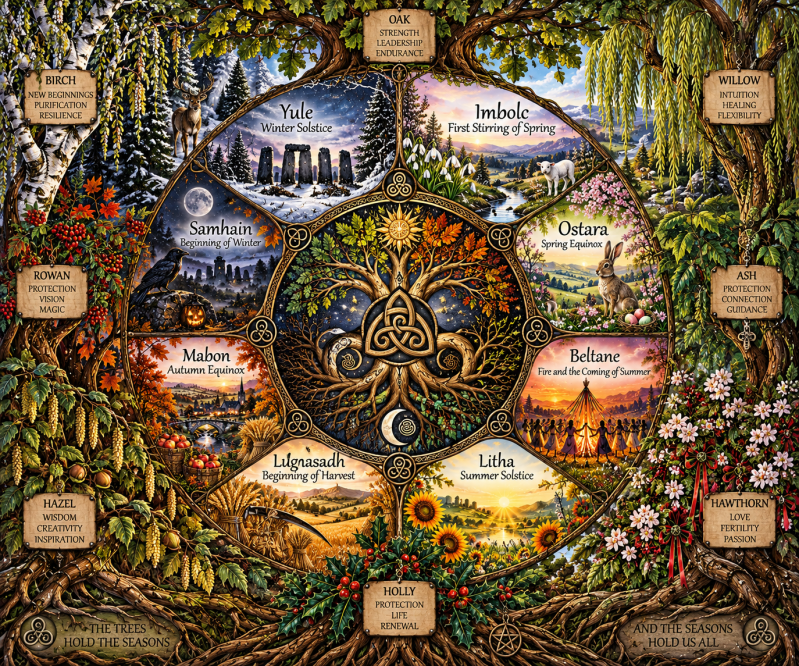
Trees may provide the clearest record of the changing year.
Winter branches stand bare against the sky.
Spring buds open.
Summer creates dense green canopies.
Autumn transforms woodland into gold, red and brown.
Then the leaves fall.
The tree appears dormant.
But beneath the bark, life remains.
This cycle naturally inspired ideas surrounding death, renewal and rebirth.
An ancient tree may repeat that transformation hundreds of times during its lifetime.
The Wheel Is a Circle
Perhaps the most important idea behind the Wheel of the Year is that it has no true ending.
Samhain leads towards Yule.
Yule moves towards Imbolc.
Imbolc becomes Ostara.
Ostara becomes Beltane.
Beltane becomes Litha.
Litha becomes Lughnasadh.
Lughnasadh becomes Mabon.
Mabon returns us to Samhain.
And then it begins again.
But perhaps begin is the wrong word.
A circle has no beginning.
Every ending is already moving towards something new.
The Wheel of the Year Today
Modern Pagans celebrate the Wheel in many different ways.
Some perform rituals.
Some light candles or fires.
Others decorate their homes according to the season.
Some cook seasonal food, walk in nature, visit meaningful landscapes or simply observe what is changing outside.
There is no single universal way to celebrate.
And you do not need to practise Paganism to find meaning in the seasonal cycle.
The Wheel can simply encourage us to notice the world around us.
When did you first hear a bee this spring?
When did the swallows arrive?
When did the first leaf turn yellow?
When did you first notice darkness arriving earlier?
These small observations reconnect us with rhythms that modern life makes surprisingly easy to ignore.
An Ancient Rhythm in a Modern World
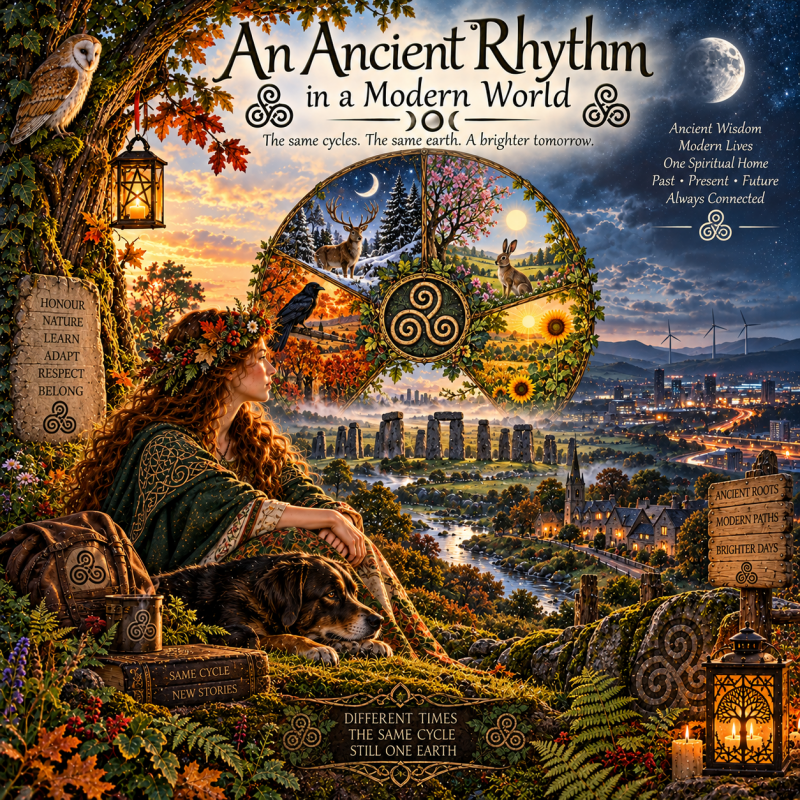
We live very differently from the people who first celebrated many of these seasonal moments.
Electric lights push back darkness.
Supermarkets provide strawberries in winter.
Central heating makes February more comfortable.
Weather forecasts tell us when storms are approaching.
Yet outside our windows, the ancient cycle continues.
The sun rises and sets.
Seeds germinate.
Birds migrate.
Trees flower.
Fruit ripens.
Leaves fall.
Winter returns.
And then, quietly, the first snowdrop appears.
Perhaps that is why the Wheel of the Year continues to resonate.
It reminds us that however modern our lives become, we still live upon a turning Earth beneath the same sun, moon and stars that our ancestors watched thousands of years ago.
The names may change.
The traditions may evolve.
The stories may be retold.
But the seasons continue turning.
And somewhere in the landscape, the next chapter of the year has already begun. 🌿