Imbolc — The First Stirring of Spring
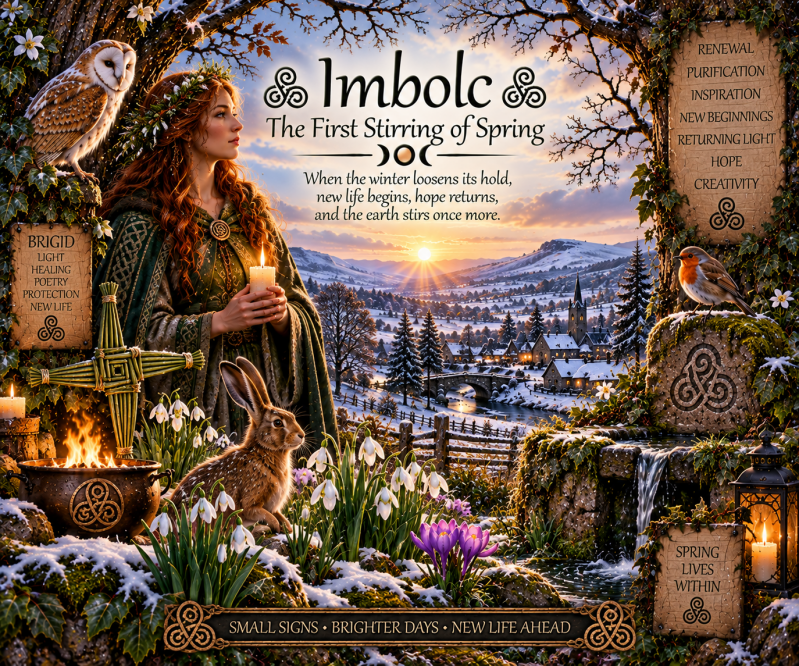
When Life Begins to Wake Beneath the Winter Earth
The landscape may still look like winter.
Frost lies across the fields. Bare branches move in the cold wind. The hills may disappear beneath rain, mist or snow.
But something has changed.
The evenings remain light for a little longer.
Birdsong begins to strengthen.
Tiny green shoots appear beneath fallen leaves.
Snowdrops push through cold soil.
And in the farming year, the season of new life approaches.
Imbolc is traditionally associated with the beginning of spring in Ireland and is celebrated around 1 February.
Within the modern Pagan Wheel of the Year, it stands between the Winter Solstice and Spring Equinox.
It is not the spectacular flowering of spring.
It is something much quieter.
The first stirring.
The moment when life hidden beneath the winter landscape begins to return.
What Is Imbolc?
Imbolc is one of the four major traditional Irish seasonal festivals, alongside:
Beltane
Lughnasadh
Samhain
Its name appears in medieval Irish sources, although scholars continue to discuss its precise original meaning and etymology.
The festival was associated with the beginning of spring and later became closely intertwined with the feast of Saint Brigid, celebrated on 1 February.
For modern Pagans, Imbolc commonly represents:
Renewal
Purification
Inspiration
New beginnings
Returning light
Hope
Creativity
But as with so much folklore, the story of Imbolc has developed across many centuries.
Ancient seasonal observance, medieval Irish tradition, Christianity, folk custom and modern Pagan spirituality have all contributed different layers.
Understanding those layers does not diminish the festival.
It makes it far more interesting.
The Beginning of Spring?
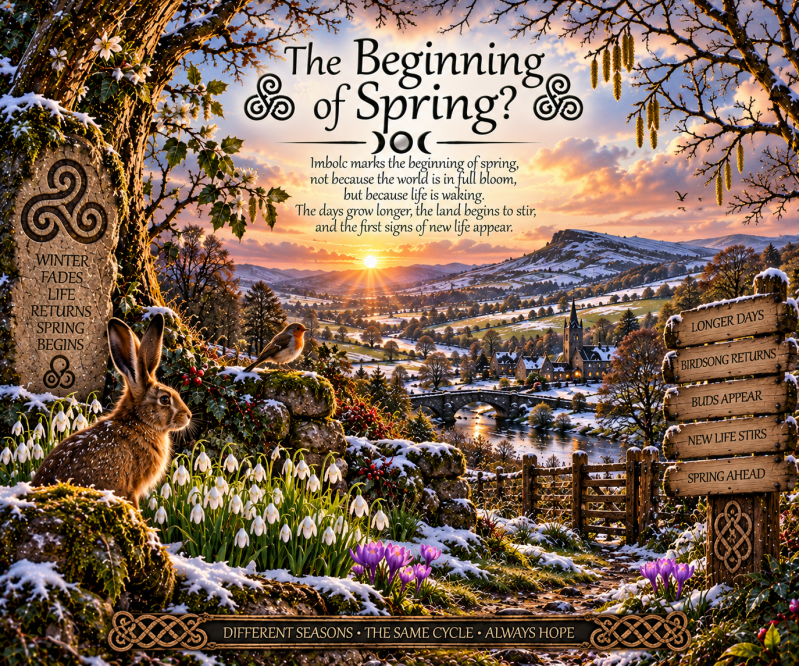
For many people today, February hardly feels like spring.
It can be freezing.
Snow may still fall.
Trees remain bare.
Storms sweep across the countryside.
So why would Imbolc mark the beginning of spring?
Our modern understanding of the seasons is only one way of dividing the year.
In traditional Gaelic seasonal reckoning, the year was organised differently from the modern meteorological calendar.
Imbolc marked the beginning of the spring season.
Beltane marked summer.
Lughnasadh marked autumn.
Samhain marked winter.
The important point was not necessarily warm weather.
It was change.
By early February, daylight has noticeably increased since the Winter Solstice.
Animals and plants begin responding.
The land is still cold —
but winter is no longer standing still.
Brigid — One Name Across Many Centuries
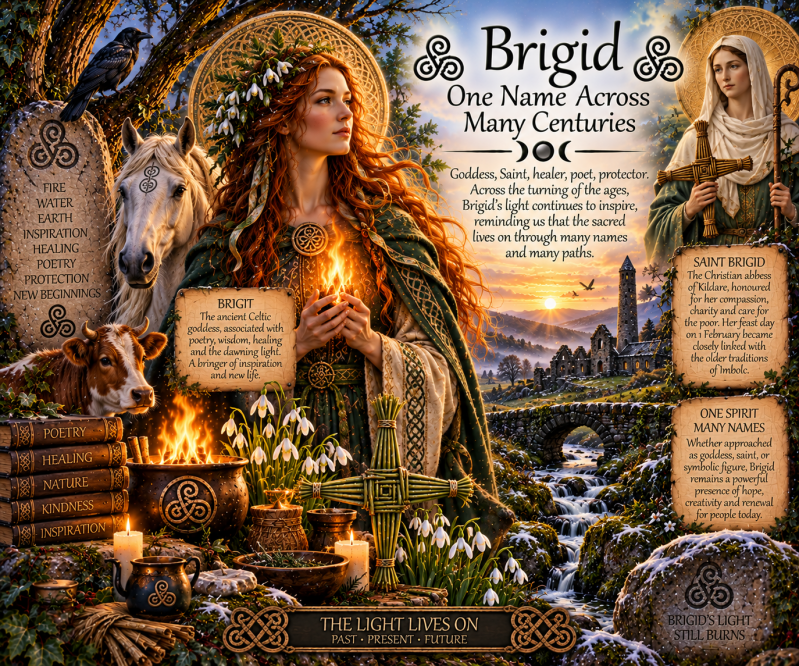
It is almost impossible to explore Imbolc without encountering Brigid.
Brigid is one of the most fascinating figures in Irish tradition because several historical and religious worlds meet around her name.
A goddess named Brigit appears in medieval Irish literature.
The Cath Maige Tuired describes her as a daughter of the Dagda and connects her with poetry and skilled knowledge.
Then there is Saint Brigid of Kildare, one of Ireland's most important saints, traditionally associated with the fifth and sixth centuries.
Over time, traditions surrounding the saint became deeply connected with the beginning of February.
The relationship between the pre-Christian goddess and Christian saint is complicated.
It is tempting to say simply that the goddess became the saint.
History does not allow us to be quite that certain.
But the similarities and overlapping traditions have fascinated scholars, folklorists and modern Pagans for generations.
Today Brigid may be approached as a saint, a goddess, a figure of folklore or a source of spiritual inspiration depending upon the tradition of the person celebrating.
Brigid and the Sacred Flame
Fire has become one of the strongest symbols associated with Brigid.
She is widely connected in modern tradition with inspiration, poetry, creativity, healing and the hearth.
Kildare also developed a famous tradition involving a sacred flame associated with Saint Brigid and her religious community.
The historical details changed over the centuries, but the image of Brigid's flame became extraordinarily powerful.
It fits Imbolc beautifully.
At Yule, the returning sun is barely beginning its journey.
By Imbolc, that return can be felt.
The days are visibly longer.
A flame therefore becomes a symbol not only of physical warmth —
but of ideas beginning, creativity returning and hope becoming visible again.
Brigid's Cross
One of the best-known traditions associated with Saint Brigid's Day is the making of Brigid's crosses.
They are traditionally woven from rushes or similar plant material.
The familiar design usually consists of a central woven square with four arms extending outward.
Traditionally, crosses were made around the eve of Saint Brigid's Day and placed within the home.
They became associated with protection and blessing, particularly for the household and livestock.
Different regions developed different designs and customs.
Today the Brigid's cross remains one of the most recognisable symbols associated with both Saint Brigid and modern celebrations of Imbolc.
It is also a wonderful example of how something simple gathered from the landscape can become filled with meaning.
Rushes.
Hands.
A few careful folds.
And a tradition carried through generations.
Brat Bríde — Brigid's Cloth
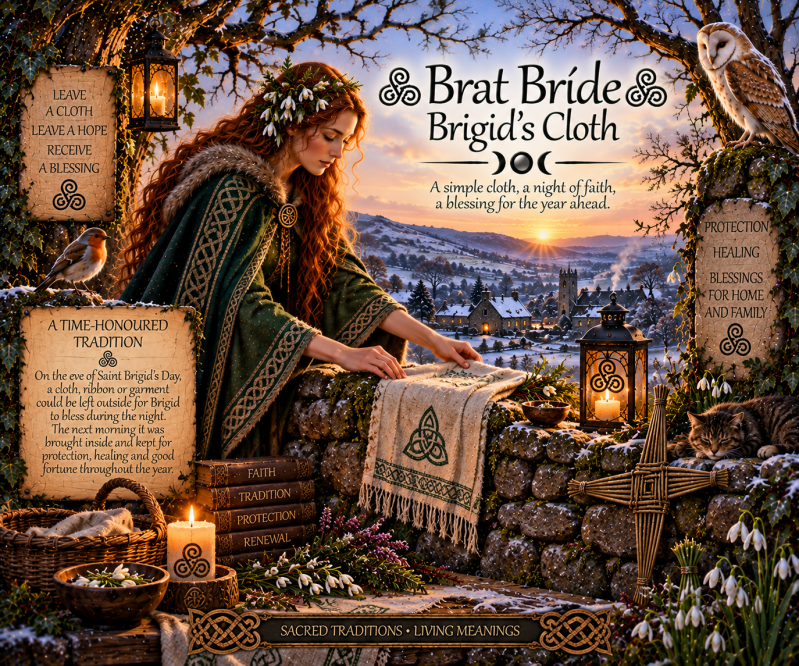
Another fascinating Irish folk custom involved the Brat Bríde, or Brigid's cloth.
A piece of cloth, ribbon or garment could be left outside on the eve of Saint Brigid's Day.
According to tradition, Brigid would pass during the night and bless it.
The cloth could then be kept and used for protection or healing.
Variations of the custom existed in different places.
From a folklore perspective, it is particularly beautiful.
The household goes to sleep.
A simple piece of fabric waits outside in the darkness.
Morning arrives.
And the object is no longer considered ordinary.
It has encountered the sacred.
Brigid Comes to the House
Some traditions imagined Brigid travelling across the landscape on the eve of her feast.
Households might symbolically welcome her.
Food could be left.
A bed might be prepared in some traditions.
Signs of her supposed visit could be looked for the following morning.
This idea belongs to a much wider family of folklore in which supernatural or sacred visitors travel during important nights of the year.
At Samhain, the dead might return.
At Christmas, supernatural visitors appear in numerous European traditions.
And around Brigid's Day, Brigid herself could be imagined walking through the winter night.
The landscape was not empty.
Something was travelling through it.
Snowdrops — The Flowers of Returning Light
Few flowers capture the feeling of Imbolc better than the snowdrop.
They appear when much of the countryside still looks dormant.
Their white flowers may emerge through frost, fallen leaves and even snow.
They have therefore become popular modern symbols of hope, purity, resilience and returning life.
It is worth remembering that not every modern plant association attached to Imbolc represents an ancient Celtic belief.
But snowdrops hardly need ancient mythology to make them meaningful.
Their symbolism comes from what they actually do.
They flower when winter is still here.
A snowdrop does not wait for perfect conditions.
It simply appears.
The First Lambs
Imbolc is frequently associated with lambing and sheep's milk.
This connection is often used when explaining the festival's name, although the exact etymology of Imbolc remains debated and should not be reduced to one certain translation.
What is clear is that livestock were enormously important to earlier rural communities.
The arrival of new lambs represented more than a picturesque sign of spring.
It represented the continuation of the flock.
Milk.
Food.
Livelihood.
Survival.
Today we may look at lambs in a field and think simply:
spring is coming.
For an earlier farming household, the meaning was considerably deeper.
New life meant the future of the farm.
Milk and the Returning Season
Milk has consequently become an important symbol in modern Imbolc celebrations.
It represents nourishment and the return of agricultural abundance after winter scarcity.
Modern celebrations sometimes include milk, butter, cream or dairy foods.
Again, we should be cautious about presenting every modern custom as an unchanged ancient ritual.
But the symbolism makes sense.
Winter is the season of stored resources.
Spring begins the return of fresh growth and new production.
The land is starting to provide again.
Sacred Wells and Holy Wells
Ireland contains an extraordinary number of holy wells, many associated with saints and local traditions.
Some are connected specifically with Saint Brigid.
People visited wells for prayer, healing or pilgrimage.
Offerings might be left.
Specific routes could be walked.
Water might be collected.
Trees near wells sometimes accumulated ribbons, cloths and other offerings.
Modern Pagan interpretations frequently connect sacred wells with older pre-Christian traditions.
In some cases ancient significance is possible or likely, but proving uninterrupted continuity can be difficult.
What we can say with certainty is that wells became powerful places in Irish folk religion.
Water emerges mysteriously from the earth.
It gives life.
It heals thirst.
It allows crops, animals and humans to survive.
It is easy to understand why springs and wells became sacred.
Water and Fire
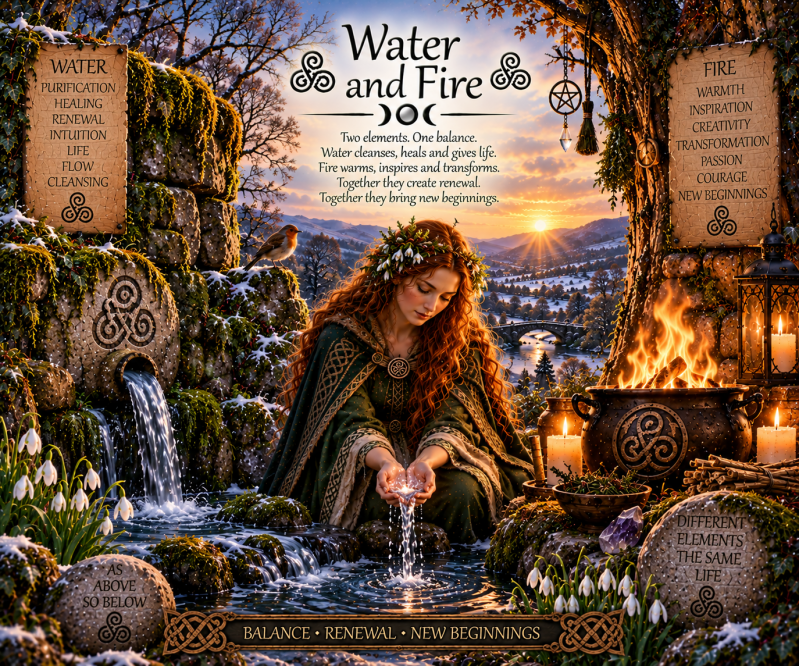
Imbolc contains an interesting symbolic pairing.
Fire and water.
Fire represents warmth, inspiration and returning sunlight.
Water represents healing, purification and life.
One rises.
The other flows.
Both transform.
Modern Pagan celebrations often bring these two elements together.
A candle may be lit.
Water may be placed on an altar.
A spring or stream may be visited.
Whether or not ancient communities would have interpreted these elements in precisely the same way, they remain powerful symbols of the season.
Snow melts.
Streams rise.
Sunlight strengthens.
The frozen world begins moving again.
Purification and Spring Cleaning
Imbolc is often associated today with purification.
This may sound highly spiritual.
But it can also be wonderfully practical.
Open the windows.
Clear clutter.
Sweep the floor.
Clean forgotten corners.
Repair something broken.
Prepare the garden.
Throw away what is no longer useful.
The instinct to clean and reorganise as winter begins to end appears in many cultures.
After months spent largely indoors, the return of light reveals everything that accumulated through winter.
Modern Pagan practice often turns this ordinary seasonal impulse into ritual.
Cleaning the home becomes symbolic of making room for what comes next.
Seeds Beneath the Earth
February can look lifeless.
But beneath the soil, enormous changes are preparing to happen.
Seeds remain hidden.
Bulbs send out roots.
Buds develop.
Soil organisms become more active as temperatures change.
The landscape contains potential that cannot yet be seen.
That makes seeds a powerful modern symbol for Imbolc.
Not everything needs to happen immediately.
An idea can be a seed.
A plan can be a seed.
A new habit can be a seed.
Imbolc does not demand that everything suddenly burst into flower.
It simply asks:
What would you like to begin?
Birds Know Spring Is Coming
One of the easiest ways to experience Imbolc is to listen.
Birdsong begins changing as daylight increases.
Territorial and courtship behaviour becomes more noticeable among some species.
Robins, blackbirds, great tits and other familiar birds become increasingly vocal as the season moves forward.
They do not need a calendar to tell them spring is approaching.
Their behaviour responds to environmental cues including changing daylight.
That creates a beautiful connection between ancient seasonal observation and modern science.
People centuries ago noticed the birds changing.
We notice them too.
Today we simply understand more about why it happens.
Hazel Catkins and the Changing Hedgerow
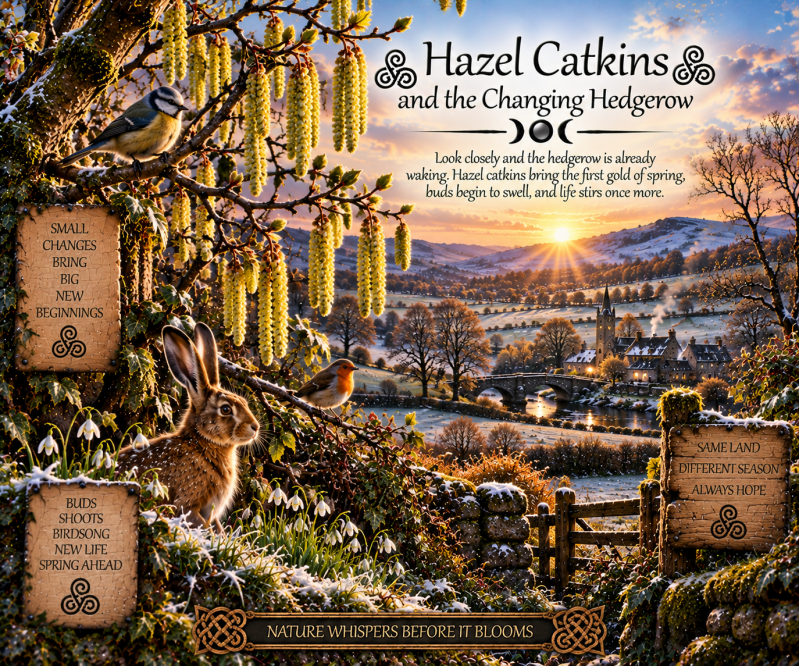
Snowdrops are not the only sign.
Hazel trees produce their long hanging catkins during late winter and early spring.
Tiny buds begin swelling.
Early plants emerge along sheltered banks.
The countryside still looks brown and grey from a distance.
Look closely and it is already changing.
Imbolc is a festival for looking closely.
Spring at this stage is rarely spectacular.
It hides in details.
A bud.
A shoot.
A bird singing earlier than last week.
A patch of daylight lingering after five o'clock.
The world whispers before it shouts.
The Cailleach and the End of Winter
Scottish and Irish folklore contains traditions surrounding the mysterious Cailleach, a powerful female figure often associated with landscape and winter.
Stories vary enormously by region.
In later folklore she may appear as an old woman connected with storms, mountains, winter weather and the shaping of the landscape.
Modern Pagan storytelling sometimes places the Cailleach and Brigid into a neat seasonal opposition — winter yielding to spring.
Traditional folklore is much more complicated than a single universal story.
But the contrast is wonderfully evocative.
The old winter landscape remains.
Yet somewhere beyond it, spring is approaching.
Weather Divination
The beginning of February accumulated traditions concerning the prediction of weather.
People naturally wanted to know:
How much longer will winter last?
Agricultural communities had good reason to care.
Folklore throughout Europe developed countless methods of predicting the remaining winter from animals, sunshine, clouds and seasonal conditions.
Some modern discussions connect these traditions with the later North American celebration of Groundhog Day, which falls on 2 February.
The details changed enormously as customs travelled.
But the question remained the same.
Will winter continue —
or is spring finally coming?
Imbolc and the Hearth
The hearth was once the centre of the home.
It provided heat.
It cooked food.
It illuminated darkness.
Families gathered around it.
During late winter, when cold weather could still be severe, keeping the household fire alive mattered enormously.
Brigid's later associations with hearth and flame therefore fit naturally into the season.
Modern celebrations may use candles instead.
A small flame becomes a reminder that warmth is returning.
Outside, winter remains.
Inside, the light is growing.
Creativity and Inspiration
Brigid's connection with poetry has made creativity an important theme within modern Imbolc practice.
This is especially fitting for artists, writers, musicians and craftspeople.
Winter can feel like a period of stillness.
Imbolc becomes the point at which ideas begin moving again.
Sketch.
Write.
Paint.
Stitch.
Build.
Photograph.
Plant.
Make something simply because you want to see what it becomes.
Creativity follows the same pattern as spring.
It often begins invisibly.
An idea appears.
Then another.
Eventually something exists that did not exist before.
Imbolc in Modern Paganism
Modern Pagans celebrate Imbolc in many different ways.
Some honour Brigid.
Some focus upon the returning sun.
Others celebrate nature without working with any deity.
Common modern practices include lighting candles, making Brigid's crosses, visiting wells or springs, cleaning the home, preparing seeds, writing intentions, baking, walking in nature or creating seasonal altars.
There is no single universal Imbolc ritual.
Modern Paganism contains many traditions and individual approaches.
For some people the festival is deeply religious.
For others it is simply a meaningful way to reconnect with seasonal chan
Ancient Tradition and Modern Meaning
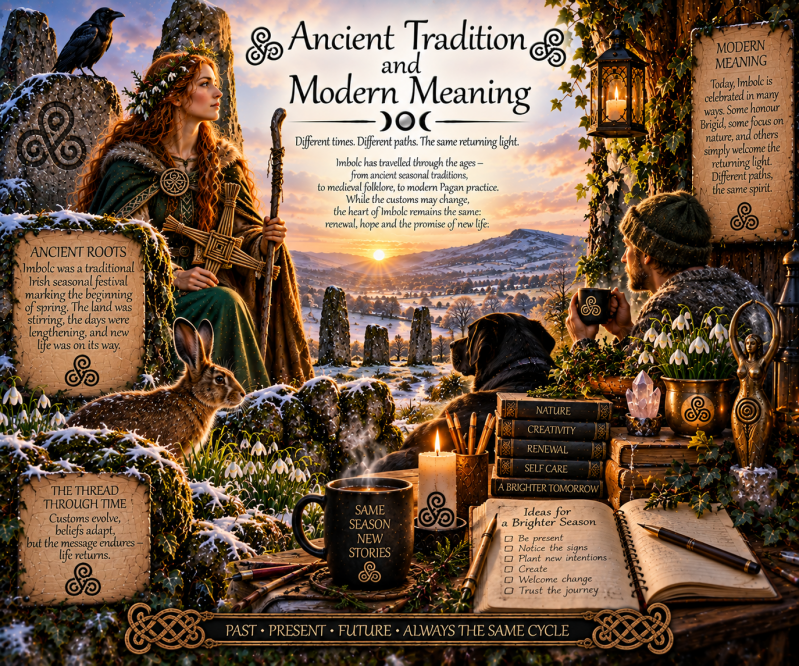
As with the rest of the Wheel of the Year, it is important to distinguish between different historical layers.
We have evidence for Imbolc as an Irish seasonal festival.
We have medieval literary references.
We have extensive traditions surrounding Saint Brigid.
We have folk customs recorded much later.
And we have modern Pagan interpretations.
They are connected —
but they are not identical.
A beautiful modern Imbolc ritual does not need to be described as a secret ceremony performed unchanged for thousands of years.
Modern traditions can possess meaning precisely because people are still creating them.
Folklore has never stopped evolving.
How to Notice Imbolc
Go outside around the beginning of February.
Do not search for dramatic spring scenery.
Look for the smallest changes.
Find the first snowdrop.
Look for hazel catkins.
Listen to the birds.
Watch buds on the trees.
Notice where water runs after winter rain.
Look at the evening sky.
Then repeat the same walk a week later.
And again a week after that.
You will begin seeing something extraordinary.
The landscape is transforming in front of you.
Slowly enough that we normally fail to notice.
The First Stirring
Imbolc does not arrive with the abundance of Beltane.
There are no summer flowers covering the hedgerows.
No golden harvest fields.
No blazing autumn woodland.
The landscape remains quiet.
Perhaps that is why the festival carries such a powerful message.
Change does not always begin dramatically.
Sometimes it starts underground.
A root extends.
A bulb opens.
A bird begins singing.
A lamb is born.
A candle is lit.
An idea appears.
The days lengthen.
And suddenly we realise winter is losing its hold.
Beneath the Frost
Stand in a field on a cold February morning and it may appear that nothing is happening.
Frost covers the grass.
Mist hangs over the hills.
Bare branches reach into a pale sky.
But beneath your feet, the next season has already begun.
Roots are growing.
Bulbs are preparing to flower.
Seeds wait for warmth.
Birds are responding to the lengthening days.
The sun climbs a little higher.
Spring does not suddenly arrive one morning.
It gathers quietly.
Day by day.
Bud by bud.
Song by song.
Until eventually the whole landscape changes.
That is the spirit of Imbolc.
Not spring in full bloom.
Not winter completely gone.
But the beautiful moment between them.
The first stirring of life beneath the sleeping earth. 🌱