Lughnasadh — The Beginning of Harvest
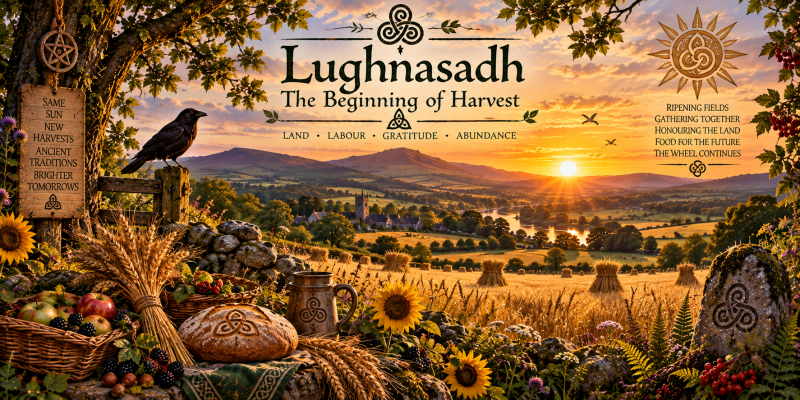
When the Fields Turn Gold
By the beginning of August, the countryside has changed again. The brilliant fresh greens of spring have deepened and faded beneath weeks of summer sun. Grasses have grown tall, berries are beginning to colour in the hedgerows and fields of grain have turned from green to shades of gold.
The year has reached a moment of abundance, but it is no longer the carefree abundance of early summer. Crops that have spent months growing must now be gathered. Fruit must ripen. Grain must be cut. Food must be stored. The first hints of autumn are beginning to appear.
Around 1 August, the traditional Gaelic festival of Lughnasadh marks the beginning of the harvest season. It is one of the four major seasonal festivals found in early Irish tradition, alongside Samhain, Imbolc and Beltane.
Within the modern Pagan Wheel of the Year, Lughnasadh is often celebrated as a festival of harvest, grain, bread, abundance, gratitude, skill and community. But its history reaches far beyond modern Paganism, into medieval Irish literature, ancient gathering places and traditions surrounding one of Ireland's most important mythological figures — Lugh.
What Is Lughnasadh?
Lughnasadh, traditionally pronounced roughly LOO-nuh-suh, is an old Gaelic festival associated with the beginning of August and the opening of the harvest season. In modern Irish, the month of August is called Lúnasa, preserving the festival's name within the calendar itself.
Unlike some festivals within the modern Wheel of the Year, Lughnasadh has strong historical roots in Irish tradition. Medieval texts describe gatherings, games, trading and other activities connected with this time of year.
It was not simply a private religious ceremony. Lughnasadh could involve entire communities coming together. People travelled, competed, traded, formed agreements and participated in celebrations.
The festival belonged both to the land and to the people who depended upon it.
Lugh — The Many-Skilled God
The name Lughnasadh is connected with Lugh, one of the great figures of Irish mythology. Lugh is portrayed as exceptionally talented and capable, associated with kingship, skill, craftsmanship, warfare and mastery of many arts.
One famous story describes Lugh arriving at Tara, the legendary seat of the High Kings of Ireland. The gatekeeper asks what skill he possesses. Lugh offers one after another — warrior, smith, poet, musician, craftsman and more — only to be told that someone inside already possesses each skill.
Eventually Lugh asks whether Tara has anyone who possesses all of those skills together.
It does not.
And so he is admitted.
This idea of Lugh as the master of many arts became one of his defining characteristics.
Tailtiu — The Woman Behind the Festival
Although Lughnasadh bears Lugh's name, an important figure in the festival's mythology is Tailtiu.
According to medieval Irish tradition, Tailtiu was Lugh's foster mother. Stories describe her clearing land so that it could be used for agriculture, an exhausting task that ultimately caused her death.
Lugh is said to have established funeral games and gatherings in her honour.
These traditions became associated with Tailteann, in modern County Meath, where assemblies known as the Óenach Tailten were held.
The story connects several themes that lie at the heart of Lughnasadh: land, labour, sacrifice, agriculture, community and remembrance.
Before there can be a harvest, someone must prepare the ground.
The Great Gatherings
Lughnasadh was strongly associated with gatherings and assemblies.
People could travel considerable distances to attend. There might be athletic contests, horse racing, trading, music, storytelling and legal or political business.
These gatherings remind us that seasonal festivals were not isolated from everyday life. Religion, agriculture, entertainment, trade and community could all exist together.
A festival offered an opportunity to meet people who lived beyond your immediate settlement. News could be exchanged. Goods could be traded. Relationships could begin.
The harvest season therefore gathered more than crops.
It gathered people.
Games in Honour of the Dead
The tradition of funeral games associated with Tailtiu places competition at the heart of Lughnasadh mythology.
Athletic contests held in memory of an important person may seem unusual today, but similar traditions appear in several ancient cultures. Physical achievement could honour the dead while strengthening relationships among the living.
Running, wrestling, racing and tests of skill transformed remembrance into action.
For a festival associated with Lugh, the master of many skills, competition seems especially appropriate.
Lughnasadh celebrates not only what the land can produce but also what human beings can accomplish.
The First Harvest
Today we often think of harvest as one single event.
Traditionally, it was a season.
Different crops ripened at different times. Grain might be ready while fruit still needed weeks. Nuts would come later. Apples would continue ripening towards autumn. Livestock farming followed its own seasonal rhythms.
Lughnasadh marked the beginning of this process.
The first grain harvest was particularly important.
After months of waiting and watching the weather, people could finally begin gathering the food upon which the coming months depended.
A successful harvest meant survival.
A failed one could mean hunger.
Grain — The Gold of the Fields
Few sights capture Lughnasadh more beautifully than a field of ripe grain moving in the late-summer wind.
Wheat, barley, oats and rye have supported communities for thousands of years. Grain can be dried and stored, allowing the energy of summer to feed people long after the growing season has ended.
This ability made grain extraordinarily valuable.
The golden field therefore represents more than beauty.
It represents stored sunlight.
Months of rain, soil, labour and sunshine have been transformed into food.
At Lughnasadh, the green landscape begins turning gold.
The First Loaf
Bread has become one of the most familiar symbols of Lughnasadh within modern Paganism.
The symbolism is powerful.
Seed is placed into the earth. A plant grows. Grain forms. The crop is harvested. The grain is ground into flour. Water is added. Dough is kneaded. Fire transforms it into bread.
A simple loaf contains an entire relationship between humanity and the landscape.
Modern Lughnasadh celebrations sometimes include baking bread as a way of recognising this journey.
The loaf becomes the field brought into the home.
Lughnasadh and Lammas
Lughnasadh is sometimes called Lammas, but the two names have different histories.
Lammas is an English Christian festival traditionally observed on 1 August. Its name comes from the Old English idea of loaf-mass, when bread made from the new grain could be brought to church and blessed.
Because Lammas and Lughnasadh occur at approximately the same time and both became associated with harvest, modern Pagan traditions often bring their symbolism together.
Historically, however, they are not simply two names for one identical ancient festival.
One belongs primarily to Gaelic tradition.
The other developed within Anglo-Saxon and Christian England.
Their meeting within the modern Wheel is another example of traditions becoming intertwined.
Harvest and Hard Work
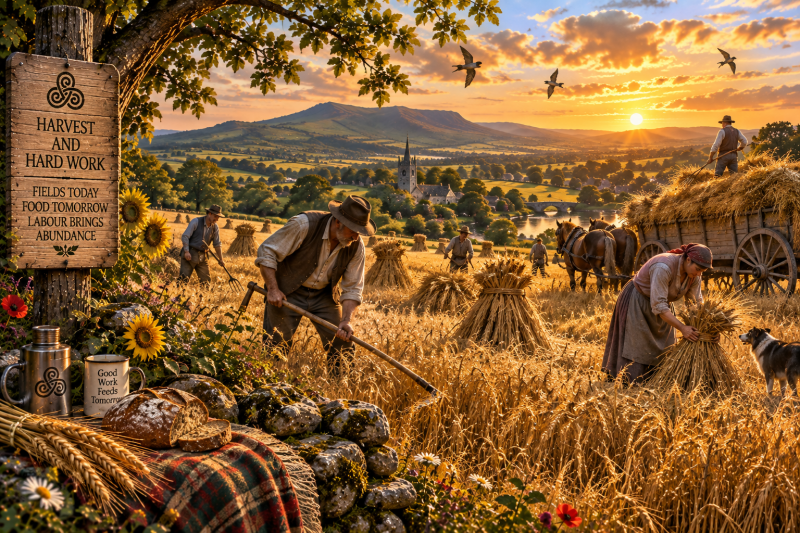
Modern images of harvest can be wonderfully romantic — golden fields, baskets of apples, warm sunsets and freshly baked bread.
Historically, harvest was also extremely hard work.
Crops had to be gathered quickly when conditions were right. Rain at the wrong time could ruin grain. Entire communities might work long days while daylight and weather allowed.
Before modern agricultural machinery, much of this work depended upon human and animal labour.
Lughnasadh therefore contains an important theme that can easily be forgotten:
abundance requires effort.
The beautiful golden field is also the result of months of work.
The Weather Matters
Few times of year demonstrate humanity's dependence upon weather as clearly as harvest.
Too much rain could damage crops.
Too little rain earlier in the growing season could reduce yields.
Storms could flatten grain.
Warm, dry conditions could allow harvesting to proceed quickly.
Before modern forecasting, people watched the sky carefully and developed countless weather sayings and traditions.
The harvest could not simply be scheduled.
Nature decided when the moment was right.
Bilberries and the Hills
Lughnasadh traditions were not limited to grain fields.
In Ireland, gatherings around the beginning of August could involve travelling to hills, mountains and other elevated places. People gathered berries, particularly bilberries, while socialising and celebrating.
These hilltop traditions sometimes continued long after their original meanings had changed.
The connection is wonderfully appropriate.
At Lughnasadh, people leave their homes and climb into the landscape.
They gather food.
They meet neighbours.
They look across the countryside.
The festival becomes part pilgrimage, part picnic and part community gathering.
Climbing the Hills
Mountains and hills occupy an important place within Lughnasadh tradition.
Some gatherings took place on high ground, and later Christian pilgrimages became associated with particular mountains around this period.
The best-known example today is Croagh Patrick in County Mayo, where pilgrims traditionally climb the mountain around the last Sunday of July.
The Christian pilgrimage has its own history and meaning, but its timing sits within a much older seasonal landscape of late-summer gatherings.
Standing on high ground at the beginning of August also offers something simple and timeless.
You can see the harvest spreading below.
Berries in the Hedgerows
The hedgerow begins changing around Lughnasadh.
Blackberries may be forming, though many will not fully ripen until later. Elderberries begin developing. Rowan trees carry clusters of berries. Hawthorn fruits slowly turn towards red.
Summer flowers remain, but fruit is beginning to replace blossom.
This is one of the great transitions of the natural year.
In spring, plants attract pollinators with flowers.
By late summer, successful pollination has become fruit and seed.
The landscape is preparing the next generation.
Rowan — Red Berries and Old Folklore
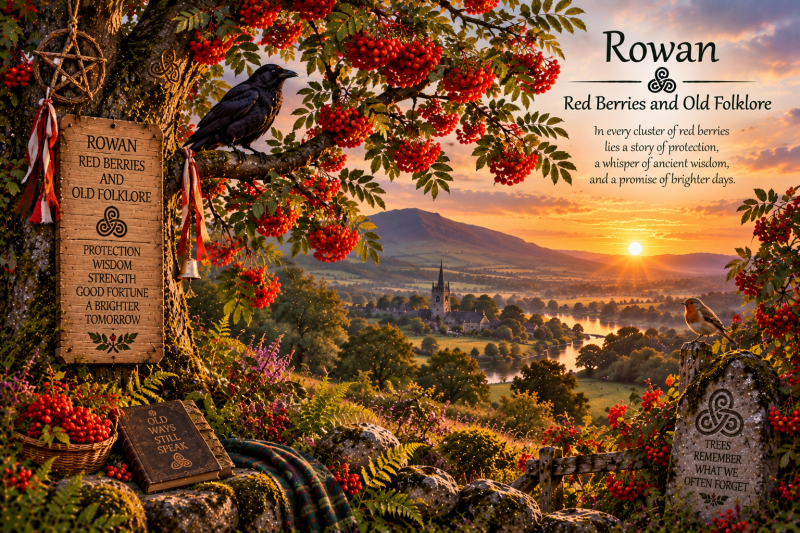
The rowan is one of the trees most richly surrounded by folklore in Britain and Ireland.
Its bright berries and distinctive leaves made it easy to recognise, while traditions associated it with protection against harmful supernatural influences.
Rowan crosses, branches and berries appear within later folk customs.
By late summer, clusters of berries can add brilliant colour to the landscape.
Within a Lughnasadh setting, rowan represents another form of harvest.
Not the cultivated harvest of the field, but the wild harvest of woodland and hedgerow.
Apples and the Harvest to Come
Apples are often associated with autumn, but by Lughnasadh many trees already carry clearly developing fruit.
The apples are not necessarily ready.
That is precisely what makes them appropriate.
Lughnasadh is the beginning of harvest, not its conclusion.
Some food is ready.
Some is still ripening.
Other crops remain weeks away.
The apple tree reminds us that nature does not follow one harvest day.
The season unfolds gradually.
The Harvest Moon?
The phrase Harvest Moon is sometimes loosely associated with Lughnasadh, but astronomically the Harvest Moon is the full moon occurring closest to the Autumn Equinox.
That usually places it later than Lughnasadh.
Still, the moon has always mattered to people working outdoors. Before electric lighting, a bright moon could extend useful light into the evening.
This is another example of why separating beautiful symbolism from historical or astronomical fact can make these traditions more interesting rather than less.
Lughnasadh does not need every harvest symbol to belong specifically to it.
Its own story is already rich enough.
The Scythe and the Sickle
Harvest tools became powerful symbols because they physically transformed the landscape.
A field that stood tall in the morning could be cut by evening.
The sickle and later the scythe became familiar images of harvest, labour and the passage of time.
Their curved blades also acquired wider symbolic meanings in art and folklore.
Harvest is an act of ending.
The living stalk is cut.
But that ending provides food and preserves seed for another year.
Lughnasadh therefore contains both life and death.
Growth and cutting.
Beginning and ending.
Sacrifice and the Harvest
The word sacrifice is sometimes used dramatically when discussing ancient seasonal festivals, and claims about historical ritual should always be treated carefully.
But there is a simpler form of sacrifice built directly into agriculture.
To eat the grain, the plant must be cut.
To save seed, some of the harvest must not be eaten.
To grow food, time and labour must be given.
The landscape teaches that gaining one thing often requires giving something else.
Modern Pagan interpretations of Lughnasadh sometimes use harvest as a metaphor for this principle.
What are we willing to give in order for something else to grow?
The Corn Dolly
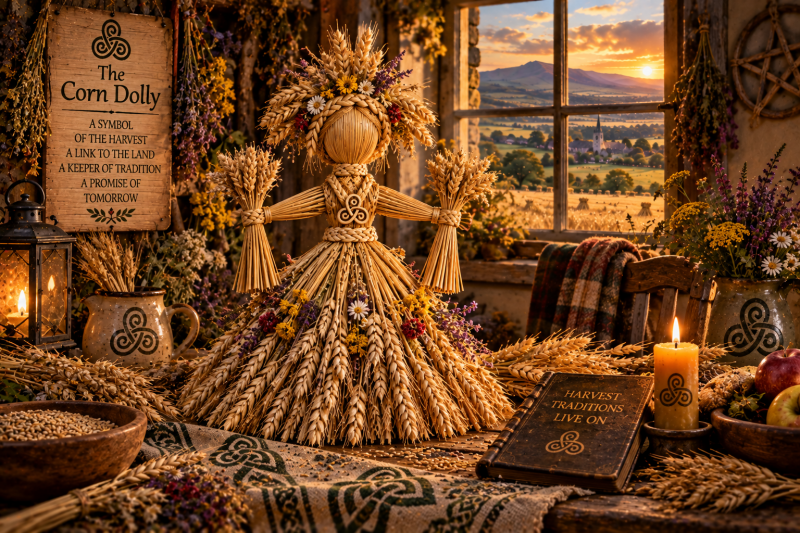
Figures woven from straw or grain stalks became part of harvest customs in Britain and elsewhere.
Today these are commonly called corn dollies, using the older British meaning of “corn” as cereal grain rather than specifically maize.
Different regions developed remarkably varied designs.
Later folklore and modern interpretation sometimes described these figures as homes for a spirit of the crop, although the histories of individual customs are complex and should not all be treated as remnants of one universal ancient religion.
Whatever their origins, corn dollies beautifully demonstrate the creativity of rural tradition.
The harvest was not only eaten.
It was turned into art.
Markets, Fairs and Community
Harvest created goods that could be traded.
Grain, livestock, fruit, crafts and other products moved through markets and fairs, making late summer an important economic period as well as an agricultural one.
This fits naturally with the great gatherings associated with Lughnasadh.
A festival brought together people who had something to sell, something to buy, news to share or skills to demonstrate.
Modern farmers' markets still carry a little of this atmosphere.
Tables covered with bread, vegetables, preserves, honey and fruit are modern expressions of something very old.
The land produces abundance, and people gather to exchange it.
Lugh and the Celebration of Skill
Because Lugh is characterised by his many abilities, modern Lughnasadh celebrations often include the idea of recognising skills and craftsmanship.
This can extend far beyond traditional crafts.
Painting.
Woodworking.
Cooking.
Music.
Gardening.
Writing.
Sewing.
Photography.
Storytelling.
Anything learned through patience and practice can fit the spirit of Lughnasadh.
A skill is its own kind of harvest.
You practise for months or years.
Eventually, something grows from that effort.
Gratitude for the Harvest
Modern Lughnasadh celebrations often focus upon gratitude.
At the beginning of harvest, people can pause to recognise what the year has produced so far.
Some harvests are literal.
Vegetables from a garden.
Fruit from trees.
Flowers grown from seed.
Others are personal.
A project completed.
A new skill learned.
A friendship strengthened.
An idea finally brought into the world.
Lughnasadh asks a simple question:
What has grown because you gave it time?
The First Signs of Autumn
Lughnasadh belongs to summer, but autumn is beginning to appear around its edges.
Evenings arrive a little earlier than they did at Litha. Some leaves begin looking tired. Grasses dry. Seeds form. Berries colour.
The change is subtle.
There may still be hot days ahead.
Butterflies still move through gardens.
Swallows remain in the sky.
But the direction of the year is unmistakable.
At Litha, the light began decreasing.
At Lughnasadh, the landscape begins showing the consequences.
Lughnasadh in Modern Paganism
Today Lughnasadh is celebrated in many different ways.
Some people bake bread or prepare meals using seasonal produce. Others visit hills, gather berries, attend festivals, make corn dollies or decorate their homes with grain, sunflowers and late-summer flowers.
Some celebrate through ritual.
Others simply take a long walk through the countryside and notice the changing fields.
For artists and craftspeople, Lughnasadh can also become a celebration of making things.
The festival associated with the many-skilled Lugh is an appropriate moment to appreciate what human hands can create.
Ancient Tradition and Modern Meaning
Lughnasadh is particularly fascinating because ancient literature, later folklore and modern Pagan practice all overlap around it.
There really were important gatherings.
Lugh really does occupy a major place within Irish mythology.
Tailtiu and the funeral games appear within medieval tradition.
Later communities developed their own harvest customs, while modern Pagans have added new practices and interpretations.
We do not need to pretend that every modern Lughnasadh custom is thousands of years old.
The genuine history is more interesting.
A festival survived because people kept finding new reasons to gather around the same turning point in the year.
How to Experience Lughnasadh
Go outside at the beginning of August and look at the countryside differently.
Find a field of ripening grain and watch it move in the wind. Look for rowan berries. Notice the first dark blackberries forming in the hedges. Find an apple tree and see how much fruit it carries.
Listen to the insects in the long grass.
Notice how the evening arrives earlier than it did at Litha.
If you can, climb a hill.
Look across the fields below.
Much of what you see has spent the entire year reaching this moment.
The Beginning of Harvest
Imagine standing beside a field late on an August evening.
The sun hangs low over the hills, turning the grain almost copper.
A warm breeze moves across the field in waves.
Beyond the hedge, rowan berries glow red among green leaves. Blackberries are beginning to darken. Swallows cross the sky above you.
Somewhere nearby, bread is cooling after leaving an oven.
The year feels abundant.
But the light is changing.
The shadows are longer now.
Summer has not ended, yet autumn can be felt somewhere beyond the horizon.
Soon the grain will disappear from the fields.
Apples will ripen.
Blackberries will fill the hedgerows.
Leaves will begin to turn.
Then Mabon will bring the balance of the Autumn Equinox, and Samhain will eventually open the door into winter.
But for now there is work to do.
The fields are ready.
The first crops are being gathered.
Months of growth have finally become something that can sustain life.
This is Lughnasadh — when the green world begins turning gold, when skill and labour meet abundance, and when the first harvest reminds us that everything we gather began with something we once planted. 🌾