Ostara — The Spring Equinox
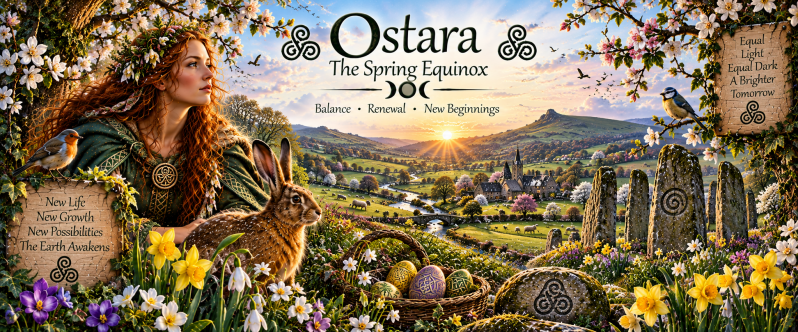
When Light and Darkness Stand Together
Morning arrives differently now.
Birdsong fills the hedgerows. Buds are opening on the trees. Bees venture out on warmer days, and the countryside is slowly filling with flowers.
Winter has not entirely disappeared.
A cold morning can still cover the grass with frost, and March winds can race across the hills.
But the balance has changed.
Around 20 March, the Northern Hemisphere reaches the Spring Equinox — the astronomical moment when the sun crosses the celestial equator and day and night are approximately equal in length.
Within the modern Pagan Wheel of the Year, this seasonal turning point is commonly celebrated as Ostara.
It has become a festival of:
Balance
Renewal
Growth
Fertility
New beginnings
Hope
Returning wildlife
The awakening earth
But Ostara has an unusual history.
Unlike festivals such as Samhain, Imbolc, Beltane and Lughnasadh, we cannot simply trace Ostara back to an ancient Celtic festival of the same name.
Its story leads instead through an Anglo-Saxon goddess mentioned by a medieval monk, later scholarship, European spring customs and the development of modern Paganism.
And somewhere along that journey appear two of spring's most familiar symbols:
the hare and the egg.
What Is the Spring Equinox?
The Spring Equinox is an astronomical event.
Earth travels around the sun while tilted on its axis.
During winter in the Northern Hemisphere, our part of Earth is tilted away from the sun.
As Earth continues along its orbit, the balance gradually changes.
At the Spring Equinox, neither hemisphere is tilted predominantly towards or away from the sun.
Day and night become roughly equal.
Then the balance tips.
From this point until the Summer Solstice, daylight in the Northern Hemisphere continues increasing.
The sun rises earlier.
It sets later.
Temperatures generally begin climbing.
Plants respond.
Animals respond.
And the landscape transforms.
The equinox therefore marks something very real.
Light has overtaken darkness.
Is Ostara an Ancient Celtic Festival?
No.
This is one of the most important things to understand about Ostara.
There is no good historical evidence for an ancient Celtic festival called Ostara celebrated at the Spring Equinox.
The four seasonal festivals most strongly documented within early Irish tradition are:
Imbolc
Beltane
Lughnasadh
Samhain
The equinoxes and solstices certainly occur in nature, and prehistoric people were capable of observing astronomical events with extraordinary accuracy.
But that does not mean every prehistoric or Celtic community celebrated the modern eight festivals of the Wheel of the Year.
The Wheel in its familiar form is largely a modern Pagan system.
Ostara is one part of that modern tradition.
That does not make it meaningless.
It simply means its history is different.
Ēostre — The Mysterious Goddess of Spring
Almost every discussion of Ostara eventually reaches a mysterious figure called Ēostre.
And almost everything we know about her begins with one man.
The Anglo-Saxon monk Bede, writing in the eighth century, described the old English calendar in his work The Reckoning of Time.
Bede mentions a month called Eosturmonath, which roughly corresponded with part of April.
He states that the month had once been named after a goddess called Eostre, whose festivals had been celebrated during it.
And that is essentially the surviving early written evidence.
We have no detailed mythology about her.
No surviving ancient stories describing her adventures.
No list of sacred animals.
No instructions for her rituals.
No ancient account saying she carried eggs or travelled with rabbits.
This makes Ēostre fascinating —
and mysterious.
From Ēostre to Ostara
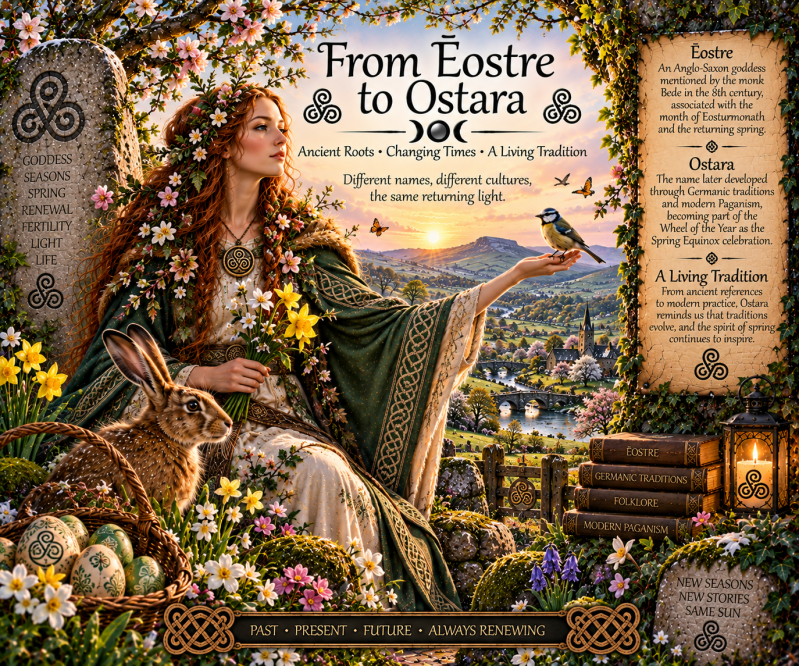
Many centuries after Bede, the German scholar Jacob Grimm explored related Germanic traditions.
He proposed a reconstructed Germanic goddess whom he called Ostara.
The name became increasingly influential in later discussions of Germanic religion and springtime tradition.
Eventually modern Pagan movements adopted Ostara as the name for the Spring Equinox celebration within the Wheel of the Year.
So the modern festival name has historical inspiration.
But we should not imagine a perfectly documented ancient festival called Ostara surviving unchanged for thousands of years.
The reality is far more complicated.
And perhaps more interesting.
An eighth-century reference survived.
A nineteenth-century scholar examined it.
Twentieth-century Pagan traditions developed it further.
And today thousands of people celebrate Ostara.
Tradition continues to evolve.
Spring Has Arrived
Imbolc whispers.
Ostara speaks much louder.
At Imbolc we looked for snowdrops beneath bare trees and listened for the earliest changes in birdsong.
By the Spring Equinox the transformation is much easier to see.
Daffodils brighten roadsides.
Blackthorn may cover hedges with white blossom.
Willow buds open.
Primroses appear.
Frogs return to ponds.
Bees emerge during warmer weather.
Birds build nests.
The countryside suddenly feels busy.
Winter was a season of survival.
Spring becomes a season of activity.
The Hare — The Great Animal of Spring
Few animals seem more suited to Ostara than the hare.
Across the British countryside, hares become particularly noticeable during spring.
Their famous behaviour of chasing, leaping and apparently “boxing” in open fields helped create the familiar expression:
mad as a March hare.
For generations, this extraordinary behaviour fascinated people.
Hares also accumulated a remarkable body of folklore across Britain and Ireland.
They became associated with:
mystery
witchcraft
transformation
the moon
the wild landscape
fertility
Stories sometimes claimed witches could take hare form.
Other tales warned against harming unusual hares.
The animal seemed to exist somewhere between ordinary wildlife and folklore.
Was the Hare Sacred to Ēostre?
This claim appears constantly online.
You may read that:
“Ēostre's sacred animal was the hare.”
Or:
“The Easter Bunny comes directly from Ēostre's sacred hare.”
The evidence is far weaker than those statements suggest.
Bede does not tell us that Ēostre had a sacred hare.
There is no surviving early Anglo-Saxon myth describing a hare companion belonging to her.
The relationship between hares, Easter customs and modern Ostara symbolism developed through a much more complicated mixture of folklore and later tradition.
The hare remains a wonderful symbol of spring.
We simply do not need to invent ancient evidence to appreciate it.
Rabbits, Hares and the Easter Bunny
The modern Easter Bunny has its own fascinating history.
European traditions developed around an Easter hare that brought or judged the giving of eggs.
German-speaking immigrants carried versions of these customs to North America, where the Easter hare gradually became the familiar Easter Bunny.
Rabbits and hares are also obvious symbols of fertility because of their reproductive behaviour.
Over time, spring, eggs, hares, rabbits and Easter became increasingly intertwined.
Modern Paganism later incorporated many of these familiar spring symbols into Ostara celebrations.
The result is a wonderful example of traditions crossing boundaries.
Folklore rarely travels in a straight line.
The Egg — A World Waiting to Begin
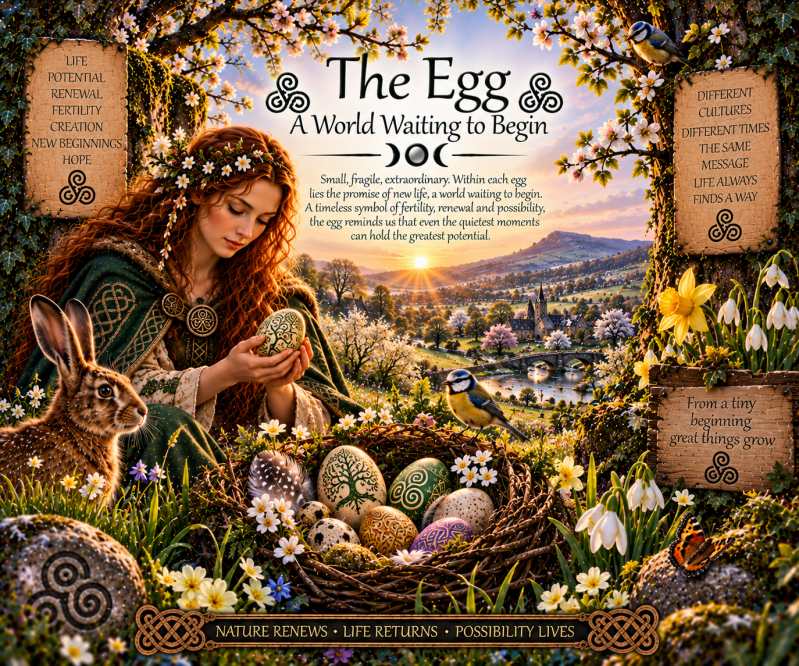
An egg is one of nature's simplest symbols of potential.
From the outside it appears still.
Inside, life may be developing.
That made eggs natural symbols of:
birth
fertility
renewal
creation
new life
Eggs have appeared in springtime and religious traditions across many cultures and historical periods.
Within Christianity, decorated eggs became particularly associated with Easter and the Resurrection.
In modern Pagan celebrations of Ostara, eggs frequently represent fertility and the returning life of spring.
Again, we should avoid the simplistic claim that every modern Easter egg is merely the survival of one specific ancient Pagan ritual.
Traditions overlap and change.
But the symbolism of the egg requires very little explanation.
Life is waiting inside.
Decorating Eggs
Decorated eggs have a long and varied history.
Different cultures developed their own techniques, colours, patterns and meanings.
Today decorating eggs can also make a beautiful Ostara activity.
Leaves and flowers can inspire patterns.
Natural dyes can produce earthy colours.
Spirals, trees, suns, moons and geometric patterns can transform an ordinary shell into a tiny piece of seasonal artwork.
For artists and craftspeople, the egg becomes something else as well:
a blank surface waiting to be transformed.
Flowers of the Spring Equinox
By late March, the British countryside can contain an extraordinary variety of flowers.
Depending upon location and weather, you may encounter:
Daffodils
Primroses
Violets
Lesser celandine
Wood anemones
Blackthorn blossom
Early bluebells
Dandelions
Each appears according to its own rhythm.
Modern Ostara symbolism often uses spring flowers to represent renewal and awakening.
But flowers are more than symbols.
They are food.
Early insects depend upon nectar and pollen.
That means the spring landscape is not merely becoming prettier.
An entire ecological network is switching back into activity.
Bees Return
On a warm spring day, listen beside flowering plants.
You may hear one of the most important sounds of the season.
Buzzing.
Queen bumblebees emerge from hibernation and begin searching for food and suitable nesting places.
Other pollinating insects become increasingly active.
Early flowers are therefore enormously important.
Willow.
Dandelion.
Dead-nettle.
Fruit blossom.
Primrose.
Different plants support different species.
The return of bees reminds us that the Wheel of the Year is not only a human idea.
The changing season affects millions of lives around us.
Birds and the Spring Dawn
By Ostara, birdsong can dominate the morning.
Robins.
Blackbirds.
Wrens.
Great tits.
Blue tits.
Song thrushes.
Many species are establishing territories, attracting mates and preparing to breed.
Nesting activity increases.
Material is gathered.
Pairs form.
Eggs will soon appear.
For earlier communities without clocks or calendars on every wall, these changes in the natural world were obvious seasonal signals.
The birds announced spring long before any printed calendar did.
Frogs, Toads and the Returning Waters
Spring also transforms ponds.
Frogs return to breeding sites.
Spawn appears.
Toads begin moving towards traditional ponds, sometimes crossing roads to reach them.
Water that looked almost empty during winter suddenly becomes filled with activity.
This is one of spring's most dramatic transformations.
Life was not necessarily absent.
Much of it was simply waiting.
Ostara reminds us to look not only at woodland and fields —
but at the water.
Seeds and New Beginnings
Seeds have become another popular symbol of modern Ostara.
It is easy to understand why.
A seed contains possibility.
It may look tiny and insignificant.
Give it soil, moisture, warmth and time —
and it can become something completely different.
Planting seeds around the Spring Equinox can therefore be both practical and symbolic.
What do you want to grow?
Flowers?
Herbs?
Vegetables?
A new project?
A new skill?
An idea?
Nature does not separate physical growth from the passage of time.
Everything begins somewhere.