Mabon — The Autumn Equinox
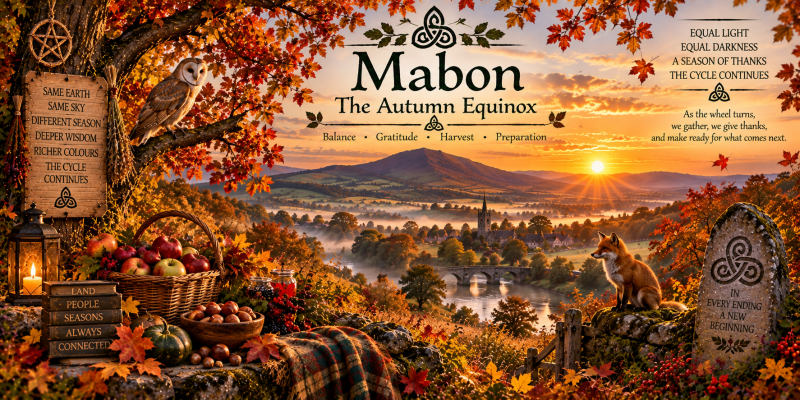
When Light and Darkness Meet Again
The countryside is changing quickly now. The brilliant greens of summer are fading into gold, amber and rust. Apples hang heavily from branches, blackberries darken along the hedgerows and fallen leaves begin collecting beneath the trees. Mornings arrive cooler, mist gathers over rivers and fields, and sunset comes noticeably earlier each evening.
Around 22–23 September, the Northern Hemisphere reaches the Autumn Equinox. Day and night are approximately equal before the balance tips towards darkness and the nights become longer than the days.
Within the modern Pagan Wheel of the Year, the Autumn Equinox is commonly called Mabon. It has become a celebration of harvest, balance, gratitude, abundance and preparation for the darker half of the year.
Yet Mabon has an unusual history. Unlike Samhain or Lughnasadh, there is no evidence of an ancient Celtic festival at the Autumn Equinox called Mabon. The name was adopted for the modern Pagan festival much more recently.
The astronomical event, however, is ancient.
For thousands of years, human beings have watched the same autumn sun move lower across the sky and felt the same unmistakable message in the landscape.
Winter is coming.
What Is the Autumn Equinox?
The Autumn Equinox is an astronomical event caused by the Earth's orbit around the sun and the tilt of its axis. At the equinox, neither hemisphere is tilted predominantly towards or away from the sun.
Day and night are therefore roughly equal in length, although they are not perfectly equal everywhere because of the way sunrise and sunset are measured and because Earth's atmosphere bends sunlight.
After the Autumn Equinox, the Northern Hemisphere continues tilting progressively away from the sun. Days shorten rapidly, nights lengthen and the sun follows a lower path through the sky.
At Ostara, the Spring Equinox, the balance tipped towards light.
At Mabon, it tips towards darkness.
The two festivals face one another across the Wheel.
Is Mabon an Ancient Celtic Festival?
This is one of the most important historical points about Mabon.
Mabon is not the surviving name of an ancient Celtic Autumn Equinox festival.
The word comes from Mabon ap Modron, a figure from Welsh mythology whose name means something close to “Mabon, son of Modron.” Mabon appears most famously within the medieval Welsh tale Culhwch and Olwen.
However, there is no historical evidence that ancient Welsh or Celtic communities celebrated the Autumn Equinox with a festival named after him.
The use of Mabon as the modern Pagan name for the Autumn Equinox developed during the twentieth century.
This makes Mabon one of the newer names on the Wheel of the Year.
But new traditions can still carry meaningful ideas.
The autumn landscape itself is considerably older than any festival name.
Mabon ap Modron — The Son of the Mother
The mythological Mabon ap Modron is a fascinating figure in Welsh tradition.
His name connects him with his mother, Modron, whose name itself means “mother.” Scholars have long noted similarities between Mabon and the Gaulish deity Maponos, whose name is related to ideas of youth or a divine son.
In Culhwch and Olwen, Mabon is taken from his mother when he is only three nights old. Later, the heroes must discover where he is being held.
To find him, they seek the knowledge of increasingly ancient animals.
The story becomes a journey backwards through memory itself.
Eventually Mabon is found and freed.
It is a remarkable myth, but its relationship with the modern Autumn Equinox festival is a later creation rather than an ancient seasonal connection.
The Second Harvest
Within modern Paganism, Mabon is often described as the second harvest, following Lughnasadh and preceding Samhain.
This is a useful way of imagining the progression of the agricultural year.
At Lughnasadh, the first grain harvest begins.
By the Autumn Equinox, orchards and hedgerows are producing enormous quantities of food. Apples, pears, berries, nuts and many cultivated crops are ready or approaching readiness.
Later, Samhain traditionally marked another major turning point when livestock and the final agricultural preparations for winter became increasingly important.
Harvest is therefore not one moment.
It is a long seasonal process.
Mabon stands beautifully in the middle of it.
The Orchard at Equinox
Few places capture the feeling of Mabon better than an old orchard.
Branches bend beneath apples.
Some fruit remains green while others have turned deep red or gold. Fallen apples lie among damp grass. Wasps investigate damaged fruit and birds arrive to feed.
The orchard contains both abundance and decay.
Perfect fruit hangs beside fruit already returning to the earth.
This is one of autumn's great lessons.
Nothing in nature is wasted.
The fallen apple feeds insects, fungi and microorganisms. Its seeds may travel. Nutrients return to the soil.
What looks like an ending becomes part of another beginning.
Apples — Fruit of Autumn
Apples have accumulated an extraordinary body of mythology and folklore across Britain, Ireland and Europe.
They appear in stories of magical islands, supernatural abundance, healing, love and immortality.
In Welsh tradition, the island of Avalon became associated through its name and later literature with apples. Medieval and later Arthurian traditions transformed Avalon into one of Britain's most enduring legendary places.
Apples were also simply valuable food.
They could be eaten fresh, cooked, stored and turned into cider.
At Mabon, the apple therefore sits perfectly between mythology and everyday life.
It is both a symbol and something you can pick from a tree.
Blackberries in the Hedgerows
By September, British and Irish hedgerows can be heavy with blackberries.
The transformation is remarkable.
The tiny flowers of early summer became green fruit, then red and finally deep purple-black berries.
For generations, blackberry picking has been one of the simplest forms of wild harvesting.
Families gather them for pies, crumbles, jam and preserves.
Blackberries also accumulated folklore. Later traditions sometimes warned against gathering them after certain autumn dates, often connecting spoiled late berries with the Devil or other supernatural explanations.
Behind the folklore lies a practical truth.
As autumn advances, fruit becomes older, damaged and less appealing.
Folklore often wraps observation inside a memorable story.
Hazel Nuts — Food from the Woodland
September also brings another important wild harvest.
Hazelnuts.
Hazel has deep roots in Irish and British folklore. In medieval Irish literature, hazelnuts appear within stories involving wisdom and supernatural knowledge.
One famous tradition tells of hazelnuts falling into a sacred pool where they are eaten by salmon, connecting the nut with the legendary Salmon of Knowledge.
But hazel was also enormously practical.
Its flexible wood could be used for fencing, baskets and countless other purposes, while the nuts provided valuable food.
At Mabon, hazel represents something central to the season.
The wild landscape is producing its own harvest.
Rowan, Hawthorn and Elder
The hedgerows become increasingly colourful around the Autumn Equinox.
Rowan trees may carry brilliant clusters of red berries. Hawthorn produces haws. Elderberries hang in dark bunches from branches.
These plants supported wildlife and also entered human food, medicine and folklore.
Rowan became particularly associated with protection. Hawthorn accumulated enormous fairy lore. Elder became surrounded by beliefs concerning supernatural beings, protection and the consequences of mistreating the tree.
Autumn reveals another side of these familiar plants.
In spring we notice their flowers.
At Mabon we see what those flowers became.
The Great Harvest of Seeds
Fruit attracts our attention because it is colourful and edible.
But an even larger harvest is happening almost everywhere.
Seeds.
Thistles produce drifting seeds. Sycamore keys spin towards the ground. Acorns fall beneath oak trees. Ash produces clusters of winged seeds. Beech trees form mast.
The entire landscape is preparing for another generation.
Some seeds will be eaten.
Some will rot.
Some will travel enormous distances.
A tiny number will eventually become mature plants.
Autumn can look like a season of decline, but it is also a season filled with beginnings waiting for the right moment.
Acorns and the Oak

By the Autumn Equinox, oak trees begin dropping acorns.
The tiny acorn seems almost absurd when compared with the enormous tree it can eventually become.
Oak trees have accumulated centuries of symbolism involving strength, endurance and longevity.
At Mabon, however, the oak tells another story.
Even the strongest tree begins as something small.
A mature oak may produce thousands upon thousands of acorns during its lifetime.
Most will never become trees.
But some will.
The future woodland falls quietly to the ground every autumn.
Animals Preparing for the Dark Half
Humans are not the only creatures responding to the changing season.
Squirrels gather and cache food. Birds feed heavily upon berries. Small mammals take advantage of nuts and seeds. Many insects reach the end of their adult lives, while others prepare to overwinter in different stages.
Migratory birds begin extraordinary journeys.
Swallows that filled summer skies eventually disappear southwards.
Geese and other winter visitors begin appearing.
The landscape becomes a place of arrivals and departures.
Mabon reminds us that the Wheel of the Year is not merely a human calendar.
Wildlife follows it too.
The Changing Birds
One of the most noticeable changes of autumn happens above us.
The screaming swifts of summer have already disappeared from many places. Swallows and house martins gather before migration. Other species begin moving through Britain from northern regions.
Soon winter thrushes such as redwings and fieldfares will become familiar sights.
For people in earlier centuries, bird movements were powerful signs of seasonal change.
The sky itself became a calendar.
When certain birds disappeared and others returned, everyone knew the year had moved on.
Autumn Mist
Mabon belongs to mist.
Cooler nights allow moisture to condense over rivers, valleys and fields.
Early morning landscapes can disappear beneath white layers, leaving only treetops, church towers and distant hills visible above them.
Mist has always encouraged imagination.
A familiar path becomes unfamiliar.
Distances become difficult to judge.
Trees appear and disappear.
Sounds travel strangely.
It is easy to understand why mist became associated with supernatural stories.
The landscape itself seems to move between worlds.
Balance at the Equinox
Balance is one of the central themes of modern Mabon celebrations.
At the equinox, day and night stand close to equality.
But the balance does not last.
The Wheel immediately continues.
Darkness begins winning more time each day.
This makes the equinox an interesting symbol.
Balance in nature is rarely permanent.
It is a moment of transition.
Modern Pagans sometimes use Mabon to think about balance in their own lives — between work and rest, activity and reflection, giving and receiving.
Nature offers an important reminder.
Balance does not mean standing still.
The Return of Darkness
After the Autumn Equinox, darkness becomes increasingly noticeable.
Sunset arrives earlier.
Morning comes later.
Evenings that seemed endless at Litha now disappear rapidly.
For modern people surrounded by electric lighting, the change can be inconvenient.
For earlier communities, it transformed daily life.
Less daylight meant less time for outdoor work.
More fuel was needed.
Homes became the centre of evening activity.
The year was moving indoors.
The dark half of the year was returning.
Fire Returns to the Home
At Litha, fire belonged outdoors beneath the longest day.
By Mabon, fire begins returning to the hearth.
Cool evenings make warmth welcome again.
Historically, the household fire was essential for heating, cooking and light.
The seasonal movement from outdoor summer life towards the hearth is one of autumn's oldest rhythms.
Modern Mabon celebrations often include candles, lanterns and fires.
Their warm light reflects something our ancestors understood very well.
When the sun gives us less light, we create our own.
The Harvest Table
One of the most beautiful modern symbols of Mabon is the harvest table.
Apples.
Pears.
Bread.
Nuts.
Berries.
Pumpkins and squashes.
Grain.
Seasonal vegetables.
These foods represent months of growth compressed into a single meal.
A harvest table can therefore become a simple act of gratitude.
You do not need an elaborate ritual.
Prepare food that grew during the year.
Share it.
And remember how many things were required to bring it to the table.
Soil.
Rain.
Sunlight.
Pollinators.
Farmers.
Transport.
Time.
Every meal contains a landscape.
Gratitude Without Forgetting Hardship
Harvest festivals naturally encourage gratitude, but historically harvest was also a time of uncertainty.
A poor crop could have serious consequences.
Storms could destroy grain.
Disease could damage plants.
Fruit harvests varied.
Food had to last through winter.
Celebrating abundance therefore existed beside awareness of scarcity.
That gives Mabon a deeper meaning.
Gratitude is strongest when we understand that abundance cannot always be guaranteed.
The harvest matters because nothing in nature promises that next year will be identical.
Preserving the Harvest
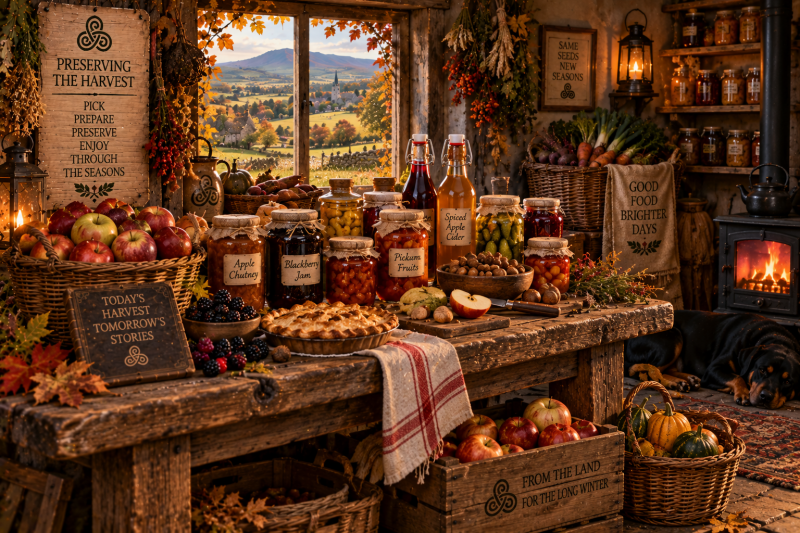
Gathering food is only half of harvest.
The other half is keeping it.
Before refrigeration, communities developed numerous ways of preserving seasonal abundance.
Fruit could be dried.
Grain could be stored.
Vegetables could be pickled.
Meat could be salted or smoked.
Apples could be kept in suitable conditions.
Berries could become preserves.
These techniques allowed summer and autumn food to survive into winter.
A jar of jam is therefore something remarkable.
It is summer preserved behind glass.
The Autumn Sun
The sun at Mabon feels different from the sun at Litha.
It sits lower in the sky.
Its light travels through more atmosphere, creating the rich golden tones associated with autumn mornings and evenings.
Long shadows stretch across fields.
Leaves glow when sunlight passes through them.
The landscape can become extraordinarily beautiful precisely because the light is weakening.
This creates one of Mabon’s central paradoxes.
The days are becoming darker.
Yet autumn produces some of the most beautiful light of the entire year.
Colours of Mabon
Modern Mabon imagery often uses gold, red, brown, orange and deep green.
These colours reflect genuine changes in the landscape.
As chlorophyll breaks down within deciduous leaves, other pigments become visible.
Different tree species respond differently, creating the patchwork colours of autumn woodland.
The process is not simply the tree “dying.”
It is carefully withdrawing valuable resources before winter.
The tree is preparing.
Autumn colour is part of survival.
Preparing for Winter
This may be the most important theme of Mabon.
Preparation.
Animals gather food.
Trees withdraw resources from their leaves.
Plants produce seeds.
Humans gather and preserve crops.
Everything is responding to what comes next.
Winter is still some distance away.
There may be warm days ahead.
But nature does not wait until winter arrives before preparing for it.
That makes Mabon a useful moment to ask:
What needs to be prepared while there is still time?
Mabon in Modern Paganism
Modern Pagans celebrate Mabon in many different ways.
Some create harvest altars using apples, leaves, grain, acorns and berries. Others prepare seasonal meals, visit orchards, walk through woodland, collect fallen leaves or watch sunset on the equinox.
Some celebrations involve formal ritual.
Others simply involve noticing autumn.
Both can carry meaning.
A walk through an orchard can teach as much about the season as any ceremony.
Ancient Tradition and Modern Meaning
The Autumn Equinox is ancient.
The name Mabon, as used for the modern Pagan festival, is not.
That distinction is worth preserving.
Welsh mythology gives us the fascinating figure of Mabon ap Modron. European and British cultures developed countless harvest customs. Modern Paganism brought these ideas together around the astronomical Autumn Equinox.
Tradition continues to evolve.
There is no need to invent an ancient festival where evidence does not support one.
The real story is richer.
Human beings have always watched the seasons.
The names change.
The stories change.
The harvest remains.
How to Experience Mabon
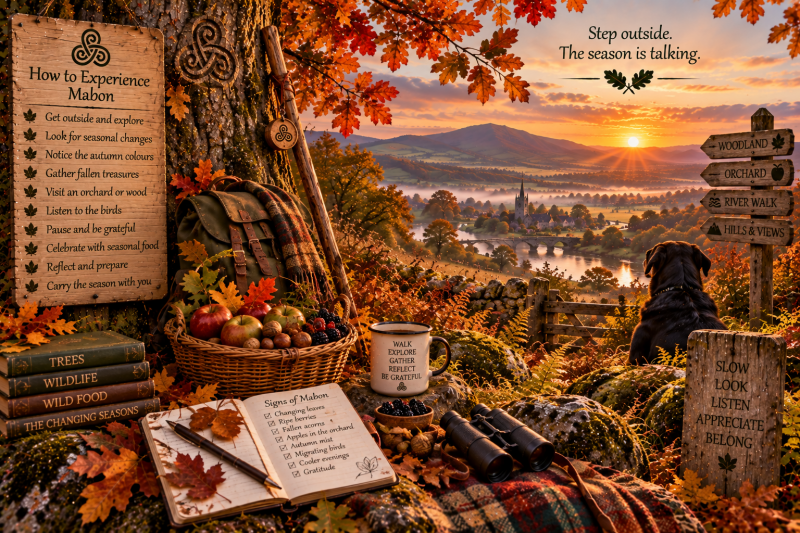
Go outside around the Autumn Equinox and choose somewhere with trees, hedgerows or orchards.
Look for fruit.
Notice which berries have ripened.
Pick up an acorn.
Look at the first leaves beginning to change colour.
Listen for birds.
Walk beside a river early enough to see mist over the water.
Then notice the light.
Remember how late the sun remained in the sky at Litha.
Now watch it disappear.
The difference is enormous.
The Wheel has moved.
When the Balance Tips Towards Darkness
Imagine standing at the edge of an orchard late on an September evening.
Apples hang among leaves beginning to yellow. Beyond the hedge, blackberries darken beneath arching brambles. Acorns lie beneath an old oak.
A robin sings somewhere nearby.
Mist is beginning to gather above the river in the valley.
The setting sun turns everything gold.
For a moment, the world seems perfectly balanced.
Light and darkness.
Summer and winter.
Growth and rest.
Abundance and decline.
Then the sun slips below the hills.
The temperature falls.
Shadows disappear into one another.
Tomorrow night will be slightly longer.
Soon the leaves will fall.
Soon Samhain will arrive.
Soon winter will open its door.
But tonight the orchard is full.
The harvest is gathered.
The earth has given what it can.
This is Mabon — the Autumn Equinox, when light and darkness meet once more, the land offers its abundance, and the Wheel quietly turns towards the dark half of the year. 🍂