Beltane — Fire and the Coming of Summer
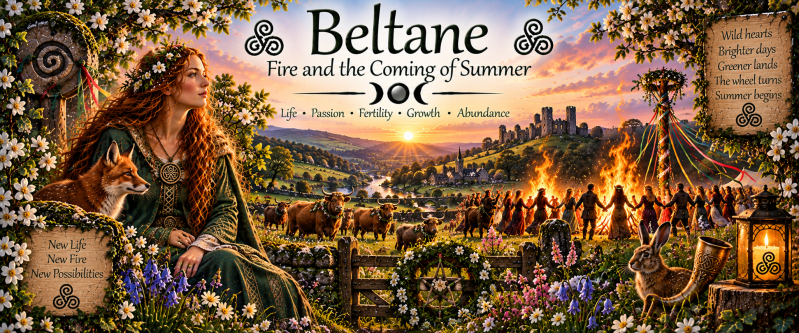
When the Green World Bursts Into Life
The quiet awakening of spring is over. The hedgerows are thick with new leaves, hawthorn blossom spills across the countryside, bluebells cover woodland floors, insects move between flowers and birdsong fills the early morning. The days are longer, the evenings are lighter and everywhere life seems to be growing at once.
Around 1 May, the traditional Gaelic festival of Beltane marks the beginning of the summer season. It is one of the four great seasonal festivals found in Irish tradition, alongside Samhain, Imbolc and Lughnasadh. Beltane stood at the opposite side of the year from Samhain. Where Samhain opened the door into winter, Beltane welcomed the beginning of summer.
Over the centuries Beltane became associated with fire, livestock, protection, greenery, flowers, gatherings and the fertility of the land. Within the modern Pagan Wheel of the Year, it has also become a celebration of life, passion, growth, love, abundance and creativity.
Behind the modern celebrations lies a much older story — a story of cattle and bonfires, May mornings and flowering hawthorn, protecting what mattered and watching the landscape turn green again.
What Is Beltane?
Beltane is an old Gaelic seasonal festival traditionally associated with 1 May and the beginning of summer. Its Irish name is Bealtaine, which is also the modern Irish name for the month of May.
References to Beltane appear in medieval Irish literature, while later folklore records a remarkable variety of May customs in Ireland and Scotland. For communities whose lives depended upon livestock and agriculture, this point in the year was enormously important. Winter was over, grass was growing strongly again and animals could be moved towards summer grazing.
Beltane was therefore much more than a picturesque celebration of flowers. It marked a genuine turning point in rural life.
The Beginning of Summer?
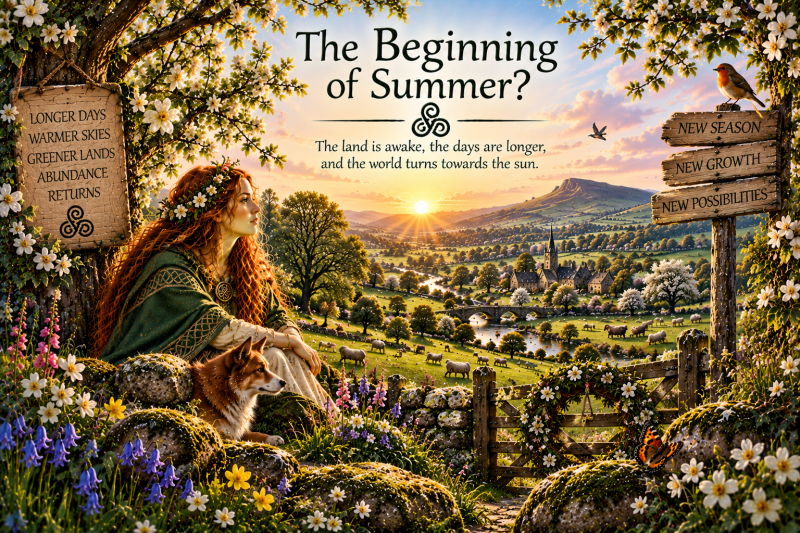
To modern eyes, calling 1 May the beginning of summer may seem strange. Today many of us think of June, July and August as summer, but traditional Gaelic seasonal divisions were different.
The year could be understood as having a light half and a dark half. Beltane opened the summer half of the year, while Samhain opened the winter half.
At Imbolc, the first signs of spring had begun appearing. By Beltane, the transformation was unmistakable. Leaves covered the trees, pastures were growing, flowers filled the landscape and animals were raising their young.
The land had returned to abundance. Summer had arrived.
The Fires of Beltane
Fire is perhaps the most famous symbol of Beltane. Historical and folkloric accounts describe bonfires being lit as part of May celebrations. In some traditions, household fires were extinguished before being relit, while fire and smoke could be associated with purification, blessing and protection.
One particular custom became especially famous: cattle being driven between fires.
The purpose was protective. Smoke and flame were believed to help safeguard the animals before they were taken towards their summer grazing grounds. To farming communities, livestock represented wealth, food and survival. Protecting them was therefore an extremely serious matter.
Imagine an early May evening centuries ago. Smoke rises into the twilight while two fires burn. Cattle slowly move between them as people gather nearby. Ahead lie months of summer grazing, but also the dangers of disease, injury, bad weather and all the uncertainties of livestock farming.
Passing the herd between Beltane fires offered protection against an unpredictable world.
Fire as Protection
Modern Pagan celebrations often associate Beltane fire with passion, creativity and fertility, but traditional Beltane fire carried another important meaning: protection.
Fire warmed the home, cooked food, transformed materials and illuminated darkness. It could also destroy. These qualities made fire a powerful force within folklore.
At Beltane, fire stood at the boundary between one season and another. People, animals and communities crossed that seasonal boundary hoping to enter summer safely.
Beltane and the Hill of Uisneach
One of the places strongly associated with Beltane today is the Hill of Uisneach in County Westmeath, Ireland. Uisneach occupies an important place within Irish mythology and tradition and was regarded as a significant central location.
Medieval literature connects the area with gatherings and fires, while modern Beltane celebrations have returned to Uisneach. The landscape therefore carries many different layers of meaning — ancient monument, mythological place, gathering site and modern place of celebration.
The same hill continues to gather new stories.
May Morning
Beltane did not belong only to fire. May morning developed its own extraordinary collection of customs and beliefs.
People might rise early, gather flowers and greenery or collect water before sunrise. Dew itself acquired special significance in folklore. In some traditions, washing the face in May morning dew was believed to preserve beauty or bring good fortune.
These customs reveal something important about seasonal folklore. People did not merely observe the changing landscape. They interacted with it. They gathered plants, touched the water, walked through the countryside and brought pieces of the season back into their homes.
Hawthorn — The May Tree
Few trees are more closely associated with May in Britain and Ireland than the hawthorn. Its white blossom traditionally appears around this period, giving the tree another familiar name: the May tree.
A flowering hawthorn can transform an entire hedgerow. Branches become covered with clouds of white blossom, bees gather among the flowers and the countryside fills with new colour.
Hawthorn also accumulated an enormous body of folklore involving fairies, protection, boundaries, luck and the supernatural. It could be considered both beautiful and strangely dangerous.
Hawthorn and the Fair Folk
In Irish folklore, certain hawthorn trees became associated with the Aos Sí, the supernatural beings commonly translated into English as fairies.
A lone hawthorn standing in a field could acquire particular significance. Stories warned people against cutting or damaging trees believed to belong to the Fair Folk. Not every hawthorn was regarded in this way, but the connection between hawthorn and fairy belief became extremely strong.
This makes the tree particularly appropriate for Beltane. It stands at the meeting point between the natural landscape and the supernatural imagination.
Bringing May Into the Home
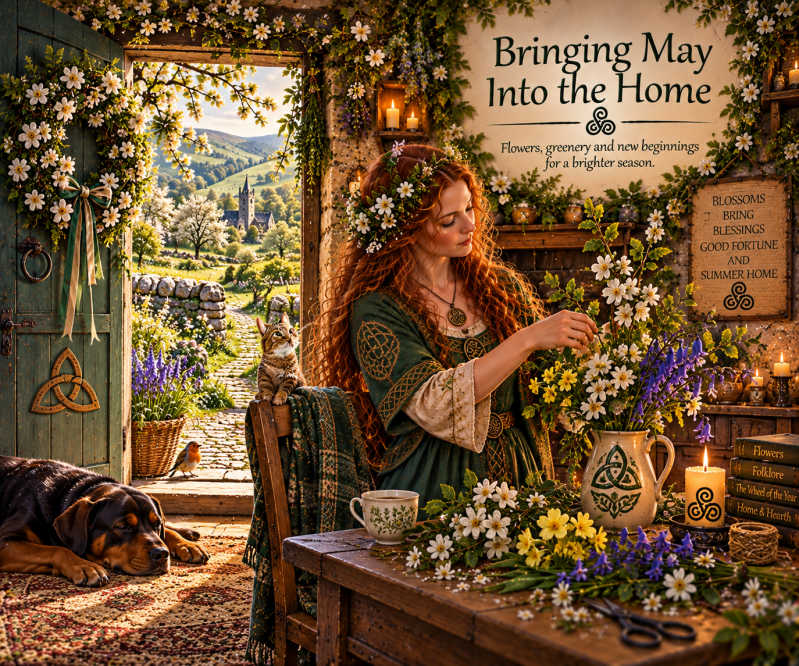
Flowers and greenery played an important role in later May traditions. Branches and blossoms could be placed around homes, doors and other important places.
After months of winter scarcity, the countryside suddenly offered colour again. White hawthorn, yellow flowers, green leaves and blue woodland floors transformed the landscape within a matter of weeks.
Bringing flowers home symbolically brought the new season across the threshold.
It was a way of bringing summer itself into the home.
The May Bush
In parts of Ireland, the May Bush became another seasonal tradition. A branch or bush could be decorated with flowers, ribbons, coloured objects and other ornaments.
Different places developed different versions of the custom, which reminds us that folk traditions rarely followed one universal set of rules.
The May Bush transformed something taken from the landscape into a focus for celebration. It also reminds us that folklore was not simply something people believed. It was something they created and participated in.
Maypoles and May Day
The Maypole is one of the most recognisable symbols of May celebrations. Tall poles decorated with greenery, flowers and later colourful ribbons became the centre of dancing and festivities in many European traditions.
Maypole customs are particularly associated with English and European May Day traditions rather than being specifically ancient Celtic Beltane rituals. This distinction is important because modern Beltane celebrations often combine customs from several different historical traditions.
Today Maypoles, Gaelic Beltane fires, flowers, dancing and modern Pagan symbolism may all appear within the same celebration. Rather than being one unchanged ancient ceremony, Beltane as celebrated today contains many different layers.
The Queen of the May
British May Day traditions also developed figures such as the May Queen. Usually represented by a girl or young woman crowned with flowers, the May Queen became a personification of the beauty and abundance of the season.
Modern Pagan traditions sometimes reinterpret the May Queen through wider ideas surrounding fertility, nature or divine feminine symbolism. Historically, however, May Queen customs varied considerably between places and periods.
At the heart of the tradition lies a wonderfully simple idea: when the landscape crowns itself with flowers, people do the same.
Bluebells — When the Woodland Turns Blue
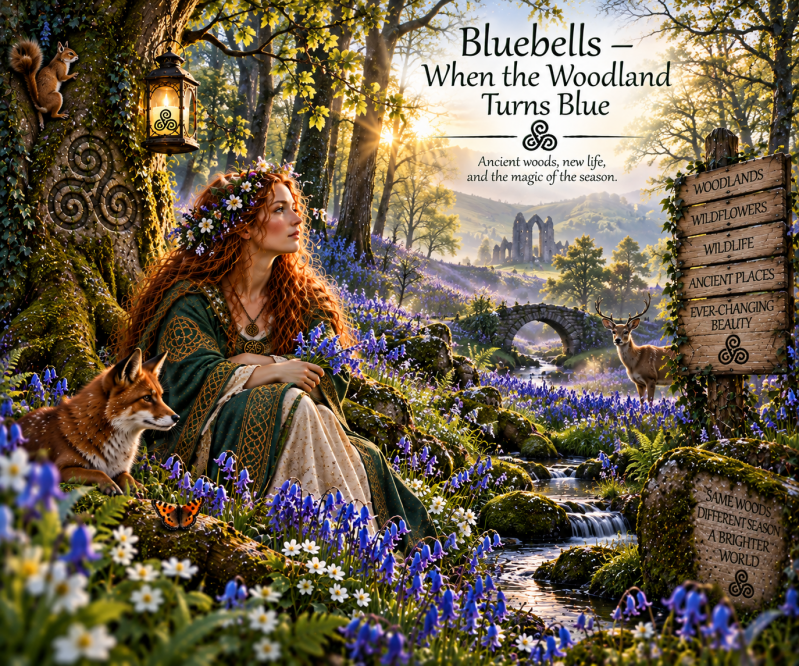
Around Beltane, many British woodlands undergo one of their most spectacular transformations. Bluebells appear, sometimes covering ancient woodland floors with vast carpets of blue and violet beneath the newly opening leaves.
Bluebells gathered folklore of their own. Fairies became associated with bluebell woods, and stories sometimes imagined the ringing of the flowers as a supernatural sound.
As with much fairy folklore, beauty and danger existed side by side. A bluebell wood could be enchanting, but enchantment was not always considered safe.
Flowers, Bees and Abundance
By May, pollinating insects have access to an increasingly rich landscape. Hawthorn, dandelions, bluebells, fruit blossom, wild garlic, cow parsley, buttercups and countless other plants provide food.
Bees move rapidly between flowers and butterflies become increasingly noticeable. The ecological relationships of summer are assembling around us. Flowers feed insects, insects pollinate plants, birds feed upon insects and plants begin producing fruit and seeds.
Beltane's association with abundance therefore reflects something very real.
The landscape is becoming productive again.
The Green World
There is a particular moment each spring when the countryside seems to change almost overnight. Trees that stood bare only weeks earlier suddenly carry leaves. Hedgerows become dense, grass grows rapidly, paths narrow beneath vegetation and woodland shade returns.
This is the green explosion of May.
Winter reduces the landscape to bark, stone, mud and sky. Beltane covers it again. Green becomes the dominant colour and the world suddenly feels overwhelmingly alive.
For people living close to the land, this transformation must always have been extraordinary.
Beltane and Fertility
Fertility is one of the themes most strongly associated with modern Beltane, and it is easy to understand why.
The landscape is full of reproduction and growth. Birds nest, animals raise their young, flowers are pollinated, seeds develop and plants grow rapidly. The agricultural year moves towards production.
Modern Paganism often extends this symbolism into human love, sexuality and relationships. For some practitioners, Beltane has become one of the most romantic festivals of the Wheel.
But fertility does not have to mean only reproduction. A fertile field produces crops. A fertile woodland produces new trees. A fertile imagination produces ideas.
Beltane celebrates the power to create and grow.
Love and Handfasting
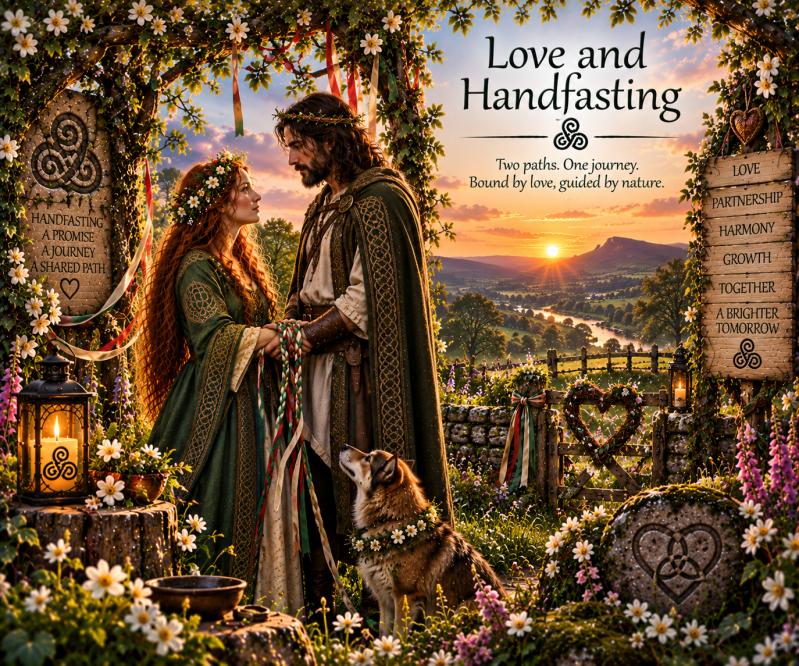
Beltane has become particularly associated within modern Paganism with love, partnership and handfasting ceremonies.
Handfasting is now widely used as a term for Pagan or nature-based wedding and commitment ceremonies. Couples may have their hands symbolically bound together with cords or ribbons to represent their relationship.
The history of handfasting is more complicated than the popular claim that all ancient Celtic couples were married in this way for “a year and a day.” Historical Scottish use of the word handfasting concerned agreements and marriage arrangements, while many features of modern Pagan handfasting ceremonies are much more recent.
Even so, Beltane's atmosphere of growth, abundance and summer makes it a natural time for celebrating relationships.
The Fairy World at Beltane
Like Samhain, Beltane developed strong associations with the supernatural.
Both festivals stood at important seasonal boundaries. Samhain marked the movement into winter, while Beltane marked the movement into summer.
In folklore, boundaries can be dangerous places.
The boundary between one day and another.
Between land and water.
Between civilisation and wilderness.
Between one season and the next.
Such moments and places were often imagined as times when encounters with supernatural beings became more likely.
Fairy traditions surrounding May therefore fit naturally into Beltane folklore.
Beltane and Samhain — Two Sides of the Year
Beltane and Samhain face one another across the Wheel.
At Samhain, vegetation dies back, darkness increases and winter begins. At Beltane, vegetation surges forward, daylight dominates and summer begins.
One festival moves towards darkness.
The other moves towards light.
Yet both became associated with fire, protection and supernatural belief.
Together they form two great gateways within the traditional Gaelic year.
Samhain opens the winter door. Beltane opens the summer door.
The Sun and the Growing Light
By Beltane, the change in daylight since Yule is extraordinary.
The Winter Solstice brought the shortest days of the year. Imbolc revealed the first obvious return of light. At Ostara, light and darkness reached approximate balance.
Now daylight dominates.
Sunrise arrives early and sunset comes late. Plants receive long hours of light and the countryside responds with rapid growth.
The Wheel has moved decisively towards summer.
The sun has become one of the great forces shaping the landscape.
Beltane in Modern Paganism
Modern Beltane celebrations vary enormously. Some people attend large festivals with bonfires, music and dancing, while others celebrate privately at home or outdoors.
People may light candles or fires, decorate with flowers, make garlands, walk through woodland, create May Bushes, dance around Maypoles, hold handfastings or simply spend time observing the changing countryside.
For some, Beltane is deeply spiritual. For others, it is a celebration of nature, community and creativity.
There is no single universal Beltane ceremony.
Like the landscape itself, the tradition continues to grow and change.
Ancient Tradition and Modern Meaning

Beltane has genuine historical roots, but that does not mean everything associated with modern Beltane was practised by ancient Celtic communities.
The traditional Gaelic festival, later Irish and Scottish folklore, British May Day customs, European spring traditions and modern Pagan practices have all contributed to what Beltane has become.
Keeping these histories separate where possible does not make the festival less magical.
Quite the opposite.
It allows us to see how traditions survive.
They are remembered, forgotten, adapted, borrowed and created again.
The old fire still burns, but every generation adds something to its light.
How to Experience Beltane
The simplest way to understand Beltane is to go outside around the beginning of May.
Walk beside an old hedgerow and look for hawthorn blossom. Visit woodland filled with bluebells. Listen for bees among the flowers. Notice how late the evening remains light. Watch birds feeding their young and look at how quickly the grass and leaves are growing.
Return to the same place you visited at Imbolc or Ostara.
The transformation can be astonishing.
The landscape that whispered in February is now almost shouting.
Summer is coming.
Fire and the Coming of Summer
Imagine standing on a hillside as evening approaches at the beginning of May.
Below you, hawthorn blossom runs like white ribbons through the hedgerows. Bluebells cover the woodland floor. Lambs call from distant fields and swallows move through the evening sky.
Behind you a fire crackles.
Smoke rises through the warm air.
Beyond it, the sun slowly disappears behind green hills.
Winter seems impossibly distant.
Yet only a few turns of the Wheel ago, these same trees were bare and these fields were frozen.
Now everything is alive.
Perhaps that is the real magic of Beltane.
Not something hidden beyond the landscape.
The landscape itself is the magic.
Every leaf, flower, nest, insect and newborn animal tells the same story.
Life has returned in abundance.
The light half of the year has opened.
The fires are burning.
And summer is waiting just beyond the hill. 🔥🌿