Litha — The Summer Solstice
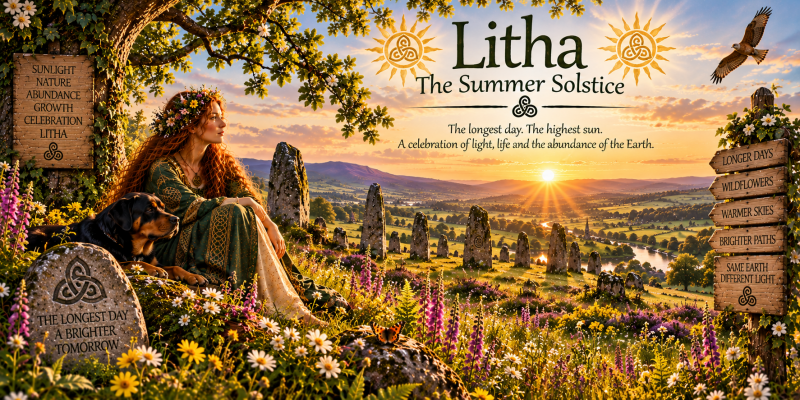
The Longest Day and the Height of the Sun
The countryside has reached its fullest expression of summer. Trees stand heavy with leaves, hedgerows overflow with flowers, insects move through warm meadows and birds are busy raising their young. Even late in the evening, light remains in the western sky.
Around 20–21 June, the Northern Hemisphere reaches the Summer Solstice, the longest day and shortest night of the year. Within the modern Pagan Wheel of the Year, this turning point is commonly celebrated as Litha.
Litha is associated with sunlight, abundance, fire, growth, strength, nature and celebration. Yet hidden within the longest day is a quieter meaning. The sun has reached its highest point. From now onward, however slowly at first, daylight begins to decrease.
At the very height of summer, the Wheel has already begun turning towards winter.
What Is the Summer Solstice?
The Summer Solstice is an astronomical event caused by the tilt of the Earth as it travels around the sun. At this point in the year, the Northern Hemisphere is tilted most strongly towards the sun.
The sun follows its highest and longest path across our sky, giving us more hours of daylight than on any other day of the year. The exact date varies slightly but usually falls on 20 or 21 June.
After the solstice, the days gradually begin becoming shorter. At first the change is almost impossible to notice. Summer still has months to run and much of the warmest weather may still lie ahead.
Astronomically, however, something important has changed.
The light has reached its peak.
Is Litha an Ancient Celtic Festival?
The answer is more complicated than is sometimes suggested.
The Summer Solstice itself is ancient, and humans have observed the changing position of the sun for thousands of years. Prehistoric monuments provide remarkable evidence that particular communities paid close attention to important solar events.
However, there is no strong evidence that ancient Celtic peoples across Britain and Ireland celebrated a universal festival called Litha at the Summer Solstice.
The name Litha comes from Old English month names recorded by the eighth-century scholar Bede. He referred to periods around June and July using forms of the word Liða. The modern Pagan use of Litha as the name of the Summer Solstice festival developed much later.
The familiar eight-festival Wheel of the Year combines traditions from different cultures and periods. Litha therefore has historical inspiration, but the modern celebration should not be mistaken for one unchanged ancient Celtic festival.
Midsummer
Long before the modern Pagan name Litha became popular, the period surrounding the Summer Solstice was widely known as Midsummer.
Midsummer traditions developed across many parts of Europe. Fires were lit, communities gathered, plants were collected and the brief summer night accumulated an enormous amount of folklore.
In Christian Europe, many of these customs became associated with the Feast of St John the Baptist on 24 June. Older seasonal customs, local folklore and Christian traditions became intertwined.
This is something we see repeatedly throughout the Wheel of the Year. Traditions rarely disappear completely. They change names, acquire new meanings and become part of new celebrations.
Stonehenge and the Rising Sun
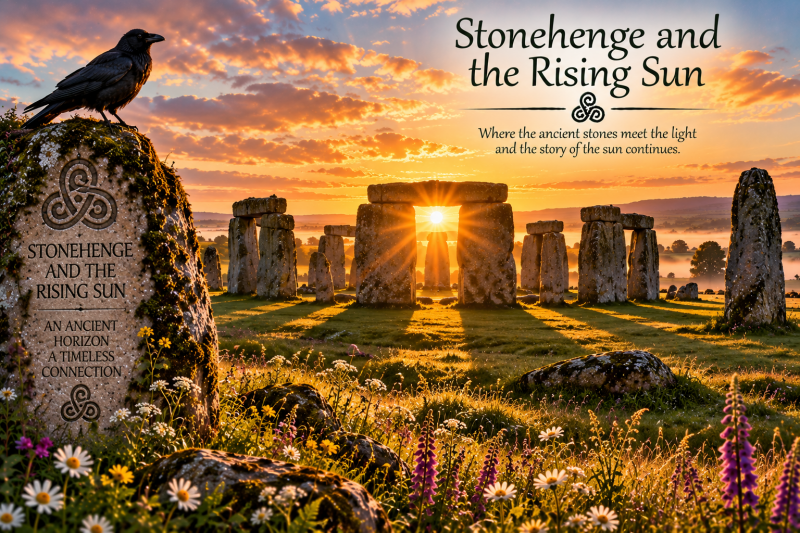
Few places are more strongly associated today with the Summer Solstice than Stonehenge.
The prehistoric monument in Wiltshire was constructed and altered over many centuries. Its architecture has important relationships with the positions of the sun at the solstices.
Around the Summer Solstice, the rising sun aligns with the monument's axis in a way that continues to attract thousands of people.
We cannot know exactly what every person who used Stonehenge thousands of years ago believed. Nor should we simply call it a Celtic temple. Much of Stonehenge is considerably older than the cultures usually described as Celtic.
But its alignment demonstrates something extraordinary.
People were watching the sun thousands of years ago.
They noticed its journey.
And they built that knowledge into stone.
The Sun at Its Greatest Strength
By the Summer Solstice, sunlight dominates the day. Dawn arrives incredibly early and darkness does not return until late in the evening.
For agricultural communities, sunlight was not merely beautiful. It powered the growing season.
Crops depended upon it. Pastures grew beneath it. Fruit developed. Trees produced leaves. Wild plants flowered and insects emerged in enormous numbers.
Modern Pagan celebrations often represent the sun with gold, candles, sunflowers, solar symbols and fire.
These symbols may be spiritual, but they also reflect something completely real.
Almost everything happening in the summer landscape ultimately depends upon energy from the sun.
Fire at Midsummer
Fire appears repeatedly in European Midsummer traditions.
Bonfires could be lit on hills or in community spaces, sometimes accompanied by dancing, feasting and celebration. In different regions, fires acquired traditions involving protection, purification, fertility or good fortune.
People sometimes jumped over fires or drove animals near smoke as part of seasonal customs.
As always, traditions varied enormously by place and period. There was no single Midsummer ceremony practised everywhere.
But the symbolism is striking.
At the time when the great fire in the sky reaches its highest point, people create smaller fires upon the earth.
The Shortest Night
The Summer Solstice brings the shortest night of the year.
In northern parts of Britain, true darkness can seem almost reluctant to arrive. Twilight lingers long after sunset, and dawn begins surprisingly soon.
This brief night became a natural setting for folklore.
Midsummer nights were imagined as unusual times when magic might be stronger, plants might possess special properties and encounters with supernatural beings could become possible.
A summer night already feels different from a winter one. The air is warm, vegetation surrounds the paths and darkness never seems complete.
It is easy to understand why imagination filled those few hours with magic.
Midsummer and the Fairies
Fairies have become strongly associated with Midsummer in literature and folklore.
Perhaps the most famous example comes from Shakespeare's A Midsummer Night's Dream, with its woodland full of fairies, lovers, confusion and enchantment.
But supernatural traditions surrounding summer nights extend beyond Shakespeare.
Across European folklore, particular nights of the year could be considered especially significant. The boundaries between ordinary and supernatural worlds were sometimes imagined as thinner at these moments.
Midsummer therefore joins Beltane and Samhain as one of those seasonal periods when the landscape itself seems capable of becoming something more mysterious.
Flowers at Midsummer
By June, the countryside can contain an extraordinary abundance of wildflowers.
Oxeye daisies brighten meadows. Foxgloves rise beside woodland paths. Honeysuckle climbs through hedgerows. Dog roses flower along lanes. Clover feeds bees, while grasses ripple through fields.
Different plants acquired different folklore and medicinal uses.
Collecting particular herbs around Midsummer became part of traditions in several European countries. Some were believed to possess greater power when gathered at this special point in the year.
Whether understood through folklore or botany, the reason plants attracted attention is obvious.
This is the season when the plant world is at its most spectacular.
St John's Wort — The Midsummer Plant
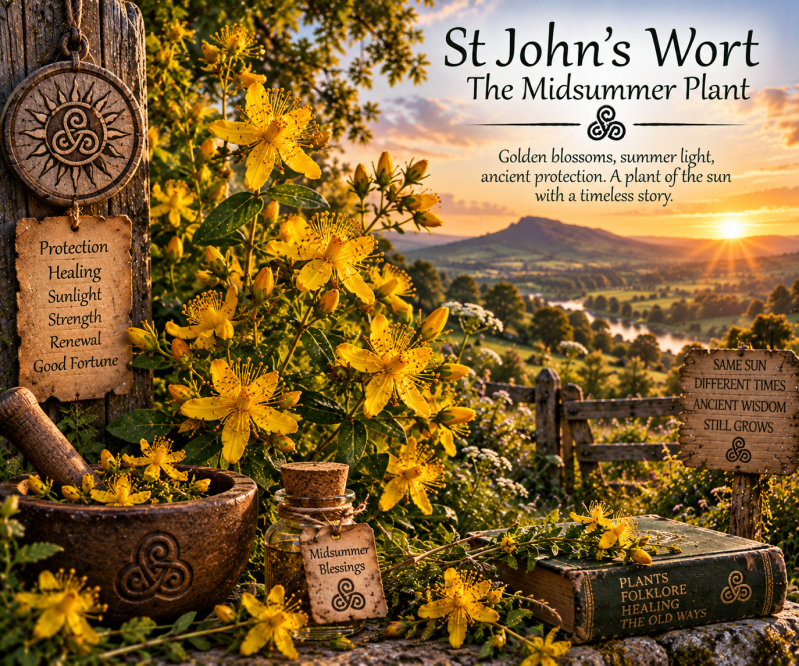
One plant became especially connected with Midsummer: St John's wort.
Its yellow flowers appear around the period associated with St John's Day, giving the plant its familiar English name.
Across European folk tradition, St John's wort acquired associations with protection and the warding away of harmful influences.
Its golden flowers also fit the solar character of the season beautifully.
Modern Pagans sometimes incorporate the plant into Litha symbolism, connecting its yellow flowers with the strength of the sun.
Here again we see several historical layers meeting: plant lore, Christian naming, folk belief and modern Pagan interpretation.
Oak — The Tree of High Summer
The oak has become one of the trees most strongly associated with Litha in modern Paganism.
By midsummer, an oak stands in its full green strength. Its canopy is dense, its branches filled with leaves and the tree becomes an entire habitat for insects, birds, lichens and countless other forms of life.
Oak trees also possessed enormous cultural importance across Britain and Ireland. They appear in place names, folklore, historical accounts and later interpretations of Druidic tradition.
Modern Pagan symbolism often connects the oak with strength, endurance, protection and the power of the growing year.
Standing beneath a great oak at midsummer, it is not difficult to understand why.
The Oak King and Holly King
Modern Pagan folklore often tells the story of the Oak King and Holly King, two symbolic figures representing the light and dark halves of the year.
In a popular version of the story, the Oak King grows in strength from midwinter until the Summer Solstice. At Litha, he reaches the height of his power but is defeated by the Holly King, whose strength then increases as the days shorten towards winter.
At Yule, the pattern reverses.
It is a wonderfully effective seasonal myth, but it should not be presented as a clearly documented ancient Celtic belief. The familiar version belongs largely to more recent folklore interpretation and modern Pagan tradition.
Its symbolism, however, captures the paradox of the Summer Solstice perfectly.
At the moment light becomes strongest, darkness begins its return.
Bees, Butterflies and the Summer Meadow
A summer meadow around Litha can feel like an entire world in motion.
Bumblebees move between clover and wildflowers. Butterflies travel through the grasses. Hoverflies hang almost motionless in the air before suddenly darting away.
Beetles, moths and countless smaller insects occupy plants that might look empty from a distance.
These insects support much of the wider ecosystem. They pollinate plants and provide food for birds, bats and other animals.
Litha therefore celebrates abundance on a scale far beyond what humans normally notice.
Beneath the flowers, among the grasses and above the hedgerows, millions of small lives are participating in summer.
Birds of the Long Days
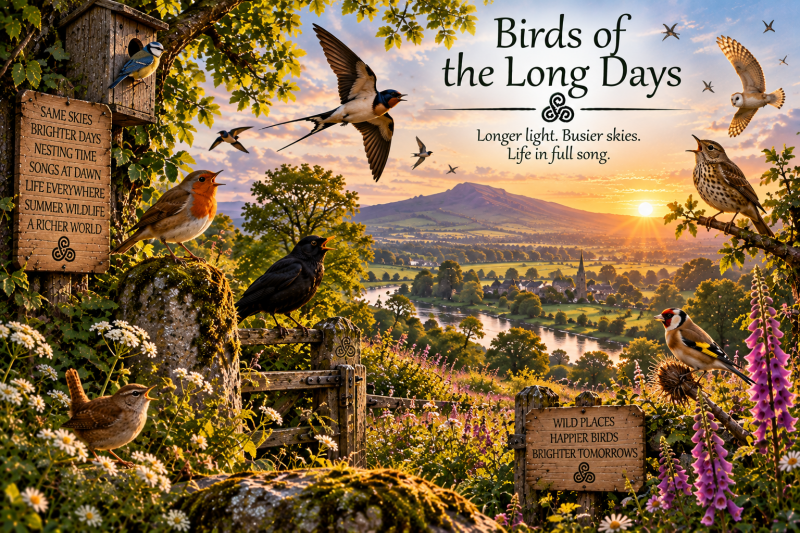
The long daylight hours make midsummer an incredibly busy time for birds.
Many species are feeding chicks. Adults repeatedly travel between nests and feeding grounds, gathering insects, seeds and other food.
Swallows and house martins sweep through the air. Swifts scream above towns and villages. Blackbirds search lawns and hedgerows. Owls wait until the very late evening before darkness finally arrives.
The dawn chorus may begin while many people are still asleep.
At Litha, the day belongs to the birds almost as much as it belongs to us.
Water in the Summer Landscape
Although Litha is strongly associated with fire and sunlight, water remains equally important.
Streams flow beneath green canopies. Rivers reflect the long evening light. Ponds fill with insects and amphibians, while lakes become surrounded by thick summer vegetation.
In folklore, springs and wells could be places of healing, pilgrimage and offering.
The contrast between fire and water also creates powerful modern symbolism. The sun provides warmth and energy, while water allows the landscape to survive beneath it.
Too little sun and plants struggle.
Too little water and they fail.
Summer abundance depends upon both.
The Magic of Midsummer Dew
Just as May morning dew acquired special properties in folklore, Midsummer dew became surrounded by traditions of its own.
In different parts of Europe, dew gathered around Midsummer could be associated with beauty, health, fertility or good fortune.
People might walk barefoot through wet grass or collect dew from plants.
To modern eyes this may seem like simple superstition, but imagine experiencing an early summer morning centuries ago.
The sun rises through mist.
Every blade of grass carries water.
Spider webs shine.
The entire landscape sparkles.
It is not difficult to understand why dew seemed magical.
Gathering Herbs
Midsummer was traditionally regarded in various parts of Europe as an important time for gathering particular herbs and plants.
Some were used medicinally. Others became protective charms or were incorporated into seasonal celebrations.
The exact plants and customs varied greatly by region.
Modern Pagan celebrations sometimes continue this idea by gathering flowers or herbs for wreaths, altars and decorations.
However, wild plants should always be gathered responsibly. Some are protected, some are poisonous and many provide essential food or habitat for wildlife.
Sometimes the best way to honour a plant is simply to leave it growing.
The Sun and the Moon
The Summer Solstice is usually described as a solar festival, but the moon remains part of the midsummer landscape.
Because darkness arrives so late, seeing the moon in a still-bright summer sky can create a beautiful meeting of opposites.
Sun and moon.
Day and night.
Fire and water.
Growth and decline.
Modern Pagan traditions often use these contrasts to explore the idea that nature is made from cycles rather than permanent states.
Nothing remains at its highest point forever.
The Wheel always moves.
The First Turning Towards Darkness
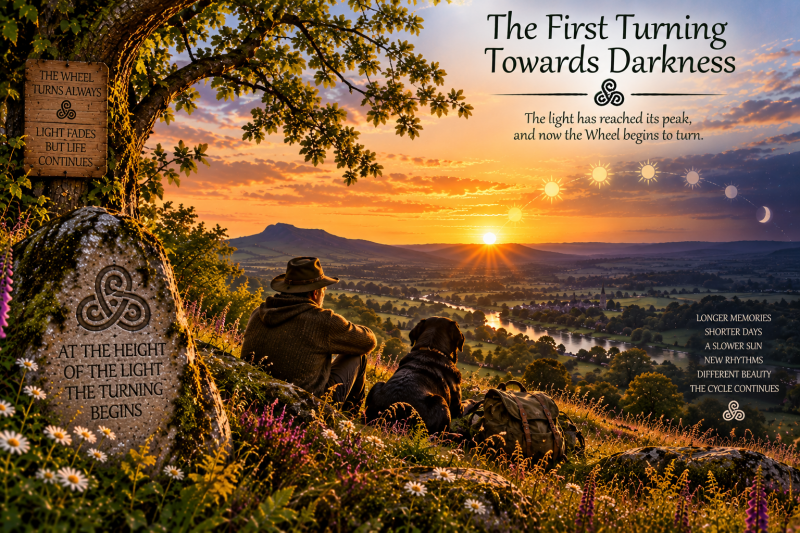
This is perhaps the most important idea within Litha.
The longest day sounds like the ultimate celebration of sunlight.
And it is.
But it is also the moment when the light stops increasing.
Tomorrow will be fractionally shorter.
Then the next day shorter again.
For weeks, the difference will barely be noticeable. Summer will continue growing warmer and the countryside will remain green.
But the direction has changed.
This gives Litha a deeper meaning than simply celebrating sunshine.
It teaches that every peak contains the beginning of change.
Abundance and Gratitude
At midsummer, nature appears generous.
Gardens grow quickly. Wildflowers fill the countryside. Trees carry developing fruit. Fields move towards harvest.
Modern Litha celebrations often use this abundance as an opportunity for gratitude.
Not necessarily gratitude to any particular deity, but simple recognition of what exists around us.
Food.
Water.
Sunlight.
Wildlife.
Trees.
Friends.
Family.
Home.
Creativity.
A beautiful landscape.
The things that feel ordinary are often the things upon which everything else depends.
Litha in Modern Paganism
Modern Pagans celebrate Litha in many different ways. Some attend gatherings or formal rituals, while others observe the solstice privately.
People may watch the sunrise, light a fire or candle, create flower crowns, decorate with oak leaves and summer flowers, visit stone circles, spend time beside water, gather with friends or simply remain outdoors until the sun disappears.
Some celebrations focus strongly upon deities or spiritual practice. Others are centred almost entirely upon nature.
There is no single correct way to celebrate Litha.
The one thing every celebration shares is the same astronomical moment.
The longest day has arrived.
Ancient Tradition and Modern Meaning
As with Ostara and much of the modern Wheel of the Year, it helps to separate historical evidence from later interpretation.
The Summer Solstice is an ancient astronomical event that humans have observed for thousands of years. Prehistoric monuments demonstrate knowledge of the sun's movement. European Midsummer traditions have deep historical roots.
The modern Pagan festival called Litha brings these strands together with newer symbolism and practices.
That does not make the modern festival false.
It makes it another chapter in a very long human relationship with the seasons.
Our ancestors watched the sun.
We watch the same sun today.
The stories around it change.
The light does not.
How to Experience Litha
One of the simplest ways to experience Litha is to spend as much of the day outdoors as possible.
Wake early enough to see sunrise if you can. Listen to the dawn chorus. Walk through a meadow. Watch bees visiting flowers. Sit beneath an old tree. Follow a stream or river.
Then go outside again late in the evening.
Notice how long the light remains.
Watch the sun approach the horizon.
Listen as daytime birds become quiet and bats begin appearing.
Feel the temperature change.
And remember that people have watched this same seasonal transition for thousands of years.
The Longest Evening
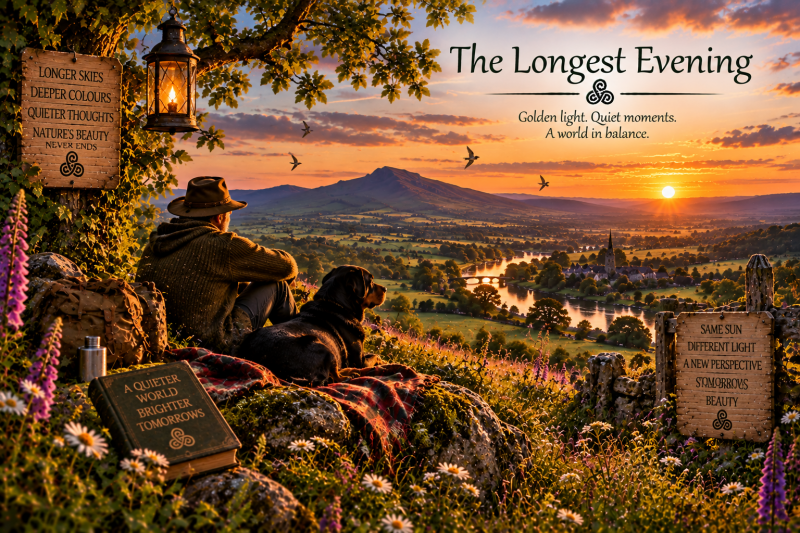
Imagine sitting on a hillside on the evening of the Summer Solstice.
The grass is warm beneath you. Wildflowers move gently in the breeze. Bees have begun disappearing for the night while swallows still cross the sky.
Below, a river reflects the golden light.
An oak tree stands dark against the horizon.
Somewhere in the distance, smoke rises from a fire.
The sun sinks slowly.
But darkness seems unwilling to arrive.
Eventually the final light disappears behind the hills.
The longest day is over.
Nothing looks different.
Summer remains.
Yet the Wheel has turned.
Tomorrow contains slightly more darkness.
Months from now, the trees will lose their leaves. Frost will return. Yule will bring the longest night.
But not yet.
For now, the fields are green, the flowers are open and the sun has reached the height of its journey.
This is Litha — the great pause at the summit of the light, when summer stands in all its glory and the Wheel quietly begins to turn again. ☀️🌿