Yule
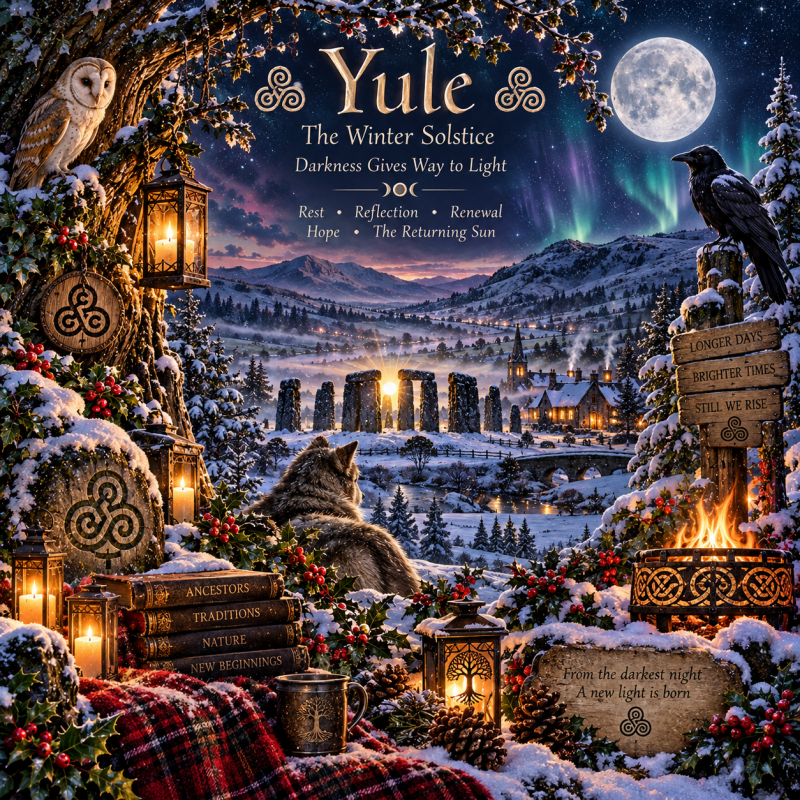
Darkness Gives Way to Light
The countryside is quiet.
Bare trees stand against the winter sky. Frost covers the fields. Darkness arrives before the evening has truly begun, and the sun seems to barely climb above the horizon before disappearing again.
Then something changes.
The Winter Solstice arrives — the shortest day and longest night of the year in the Northern Hemisphere.
From this point onward, almost imperceptibly at first, the days begin to lengthen.
Light is returning.
Within the modern Wheel of the Year, this midwinter turning point is celebrated as Yule, a festival associated with fire, evergreen plants, feasting, reflection, renewal and the return of the sun.
Its history reaches through many different traditions.
Some are ancient.
Some are medieval.
Some became part of Christmas.
Others have been revived or reimagined by modern Paganism.
Together they tell one of humanity's oldest seasonal stories:
even the longest night eventually ends.
What Is Yule?
Today, Yule is commonly used by Pagans for celebrations surrounding the Winter Solstice, usually falling around 21 December in the Northern Hemisphere.
The exact astronomical moment varies slightly from year to year.
At the solstice, Earth's tilt means the Northern Hemisphere experiences its shortest period of daylight and longest night.
Afterwards, daylight gradually begins increasing again.
For modern people surrounded by electric lighting, this change can be easy to overlook.
For earlier communities it was impossible to ignore.
Winter darkness affected work, travel, farming and everyday life.
The return of longer days therefore represented something very real.
The sun was coming back.
Is Yule Celtic?
This is where the history becomes particularly interesting.
Yule is not originally a Celtic festival.
The word comes from Germanic and Norse traditions, with related forms appearing in Old Norse and Old English.
Midwinter celebrations known as Jól formed an important part of the seasonal calendar in parts of northern Europe.
Over centuries, elements of older midwinter customs became intertwined with Christian Christmas traditions.
Modern Paganism later incorporated Yule into the eight-festival Wheel of the Year.
So although Yule frequently appears today beside Celtic festivals such as Samhain, Imbolc, Beltane and Lughnasadh, its historical origins are different.
That mixture is part of what makes the modern Wheel fascinating.
It brings together traditions from different places and periods around the shared experience of seasonal change.
The Winter Solstice
The Winter Solstice is not simply a festival date invented by humans.
It is an astronomical event.
Earth travels around the sun while tilted on its axis.
During winter in the Northern Hemisphere, our part of the planet is tilted away from the sun.
At the Winter Solstice, the sun follows its lowest and shortest path across our sky.
Then the pattern reverses.
Sunrise slowly begins arriving earlier and sunset gradually later.
The change is tiny at first.
But it continues.
Day after day.
Week after week.
Eventually winter gives way to spring.
That certainty makes the solstice a powerful symbol.
Darkness reaches its greatest extent — and then begins to retreat.
Midwinter Before Modern Calendars
Long before clocks, printed calendars and weather forecasts, people watched the natural world.
The position of sunrise changed.
Shadows lengthened.
Days shortened.
Certain stars appeared at particular times.
Animals changed their behaviour.
Plants disappeared and returned.
People who depended directly upon farming and livestock had good reason to understand seasonal patterns.
Archaeological monuments also demonstrate that some prehistoric communities paid extraordinary attention to the movement of the sun.
One of the most remarkable examples lies in Ireland.
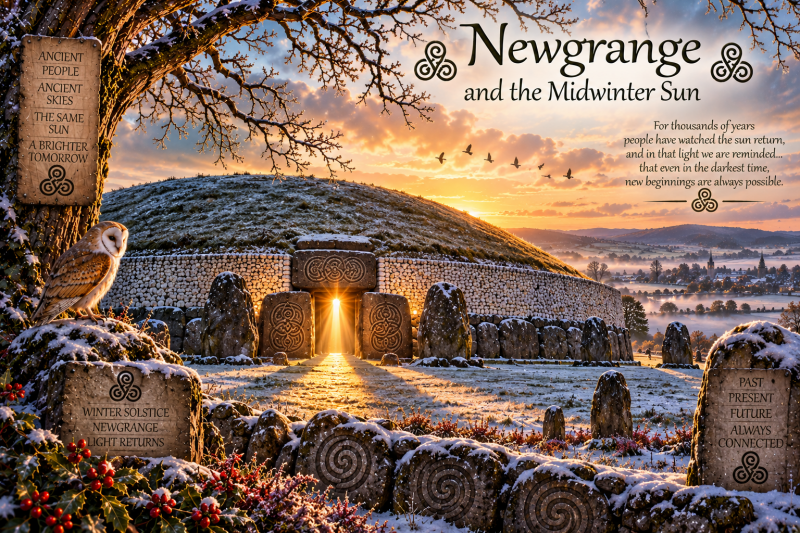
Newgrange and the Midwinter Sun
Stonehenge and the Solstice
Britain provides another famous example.
Stonehenge is aligned with important positions of the sun around the solstices.
Much attention today focuses upon the Summer Solstice sunrise, but the monument also has a significant relationship with the Winter Solstice sunset.
Archaeological evidence from the surrounding landscape suggests midwinter may have been an important period for gathering and feasting.
Again, we should resist pretending we know exactly what prehistoric people believed.
Stonehenge existed long before written Celtic culture in Britain.
But its relationship with the sun reminds us that seasonal astronomy was important thousands of years before the modern Wheel of the Year existed.
Fire in the Darkness
It is difficult to imagine midwinter celebration without fire.
A hearth provided warmth.
It cooked food.
It illuminated darkness.
It protected a household from bitter weather.
Fire therefore possessed practical importance long before it acquired spiritual symbolism.
During the darkest part of the year, a flame naturally represents light, warmth, survival and hope.
Modern Yule celebrations frequently include candles, lanterns or fires.
A single candle lit on the longest night can carry a simple message:
the darkness is temporary.
The Yule Log
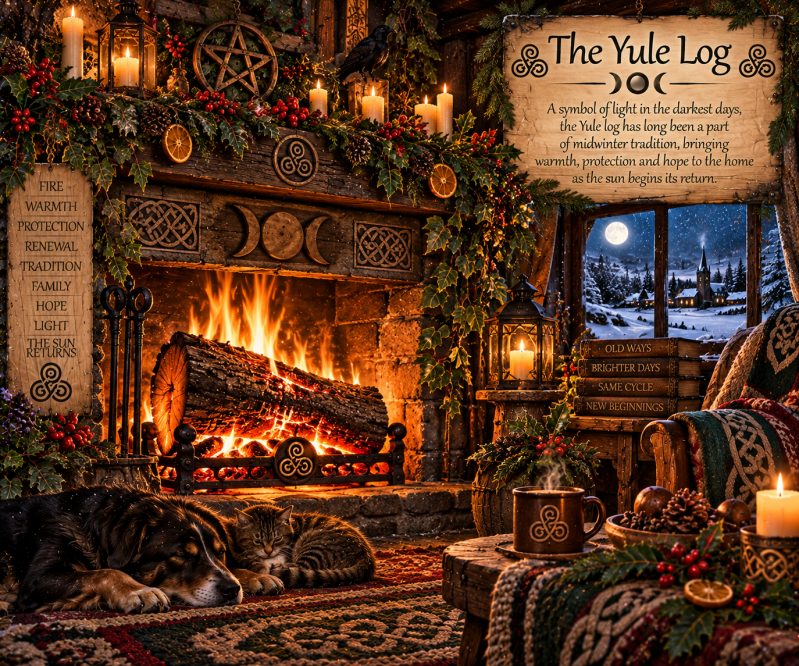
One of the most famous midwinter traditions is the Yule log.
Historical versions of the custom varied by region and period.
A large piece of wood might be brought into the home and burned during Christmas or midwinter celebrations.
Different areas developed their own customs concerning how the log was selected, decorated, lit or preserved.
Later folklore sometimes suggested keeping part of the previous year's log to help light the next one.
Today the tradition survives in several forms.
Some modern Pagans burn an actual Yule log.
Others decorate a log with greenery and candles.
And, of course, the name survives in the familiar chocolate Yule log cake.
A tradition that once centred upon the winter hearth has travelled all the way to the dessert table.
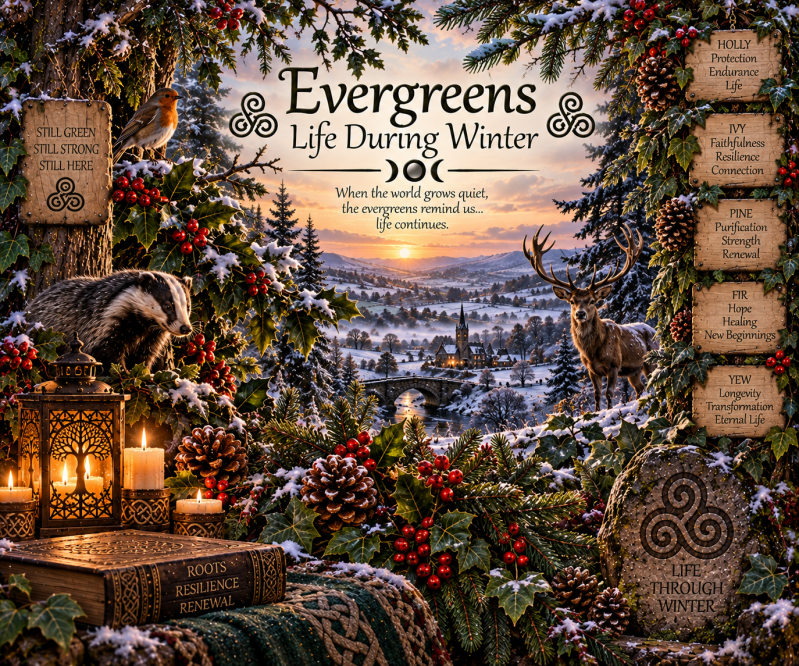
Evergreens — Life During Winter
Walk through woodland in December and most plants appear dormant.
Leaves have vanished.
Flowers are scarce.
Fields look empty.
Yet some plants remain green.
Holly. Ivy. Pine. Fir. Yew.
Evergreen plants naturally stand out during winter.
For generations they have been brought indoors as seasonal decoration.
Their ability to remain green while much of the surrounding landscape appears lifeless made them powerful symbols of endurance, continuity and life through winter.
Modern Pagan Yule celebrations frequently make extensive use of evergreen branches and wreaths.
But evergreen decoration also became deeply woven into Christmas tradition.
Once again, different layers of history overlap.
Holly — Green Leaves and Winter Berries
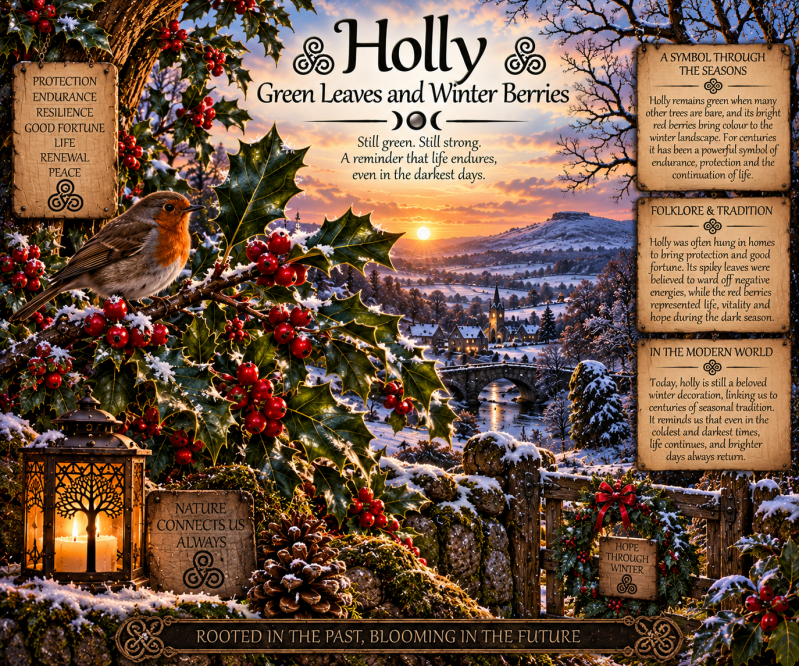
Few plants look more suited to midwinter than holly.
Its glossy evergreen leaves remain vivid when deciduous trees stand bare, while its bright berries provide striking winter colour.
Holly accumulated many traditions and superstitions across Britain and Ireland.
It became an important Christmas decoration and was sometimes associated with protection.
Modern Pagan symbolism often interprets holly as representing endurance, protection and continuing life during the dark season.
Whatever interpretation we choose, the reason holly attracted attention is easy to understand.
In the depths of winter, it is still alive and green.
Ivy — Holding On Through Winter
Ivy is another plant strongly associated with winter decoration.
It climbs walls and trees, remaining green throughout the cold months.
Together, holly and ivy became deeply embedded in British seasonal tradition.
Their meanings changed through time.
Christian symbolism was added.
Older folk customs survived.
Modern Pagan interpretations added another layer.
This is typical of folklore.
Traditions rarely remain frozen in one historical period.
They grow like ivy themselves —
new meanings climbing over older ones.
The Yew — Life Beside Death
The yew has an especially powerful presence in the British landscape.
Ancient yews can live for extraordinary lengths of time and are famously associated with churchyards.
Their evergreen foliage combined with remarkable longevity has encouraged associations with death, endurance, regeneration and immortality.
Some yews may have been growing for centuries before the churches beside them were constructed.
Standing beneath an enormous old yew in winter can therefore create an extraordinary sense of continuity.
Generations disappear.
The tree remains.
Feasting at Midwinter
Winter celebrations were not only about symbolism.
They were also about food.
Late autumn and early winter were important periods in the agricultural year.
Livestock that could not easily be supported through winter might be slaughtered.
Stored grain, preserved foods and seasonal drink could contribute to communal feasting.
A feast provided more than calories.
It brought people together during the darkest part of the year.
That remains true today.
Whether we call the celebration Yule, Christmas, Midwinter or simply dinner with family and friends, sharing food during winter remains one of our strongest seasonal traditions.
The Wild Hunt
Winter folklore across parts of northern Europe developed stories of mysterious supernatural processions sometimes collectively described as the Wild Hunt.
Details vary greatly between countries and historical periods.
A supernatural leader might ride through the night accompanied by ghostly hunters, warriors, horses or hounds.
Storms and strange noises in the winter sky could become associated with the Hunt.
Modern fantasy has transformed the idea considerably, but the older traditions were often unsettling.
Encountering the supernatural procession could bring danger or misfortune.
The Wild Hunt demonstrates how winter created perfect conditions for folklore.
Darkness.
Wind.
Bare trees.
Long nights.
And sounds travelling through landscapes where very little could be seen.
Animals of Midwinter
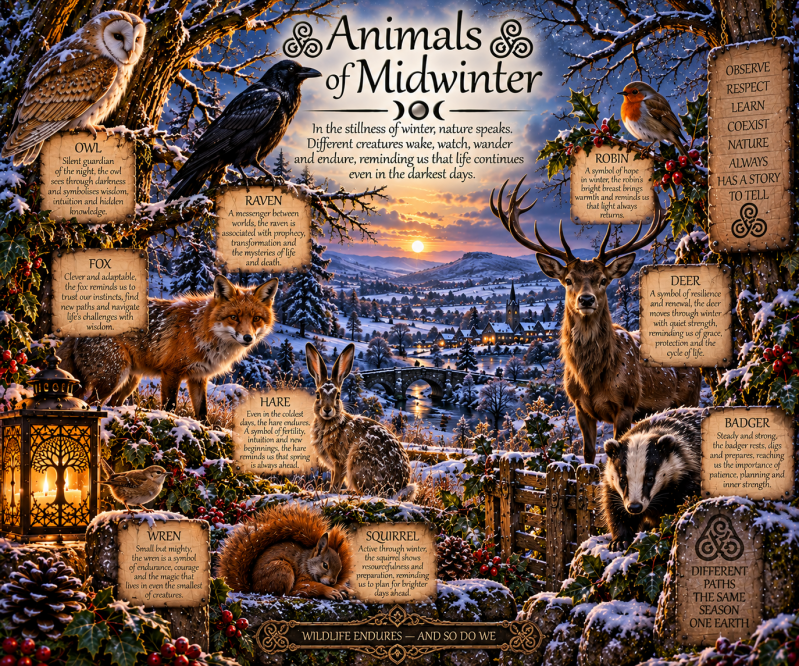
Wildlife does not disappear during Yule.
It simply changes its behaviour.
Robins become particularly visible around gardens.
Ravens and crows cross winter skies.
Owls begin hunting while humans are still awake because darkness arrives so early.
Deer move through bare woodland.
Foxes appear in frosty fields.
These animals have accumulated their own enormous collections of folklore.
The winter landscape makes encounters with them especially atmospheric.
A raven sitting in a leafless tree beneath a grey December sky looks very different from the same bird on a bright summer morning.
The animal has not changed.
The season changes the story we see around it.
The Holly King and Oak King
Modern Pagan folklore sometimes describes the seasonal year through the story of the Holly King and Oak King.
In popular versions, the two figures represent opposing halves of the year.
One rules while daylight decreases.
The other rules while daylight increases.
They battle at the solstices and exchange dominance.
It is a wonderful piece of seasonal mythology.
However, it should not be presented as a clearly documented ancient Celtic belief.
The familiar modern story owes much to relatively recent folklore interpretation and modern Pagan tradition.
That does not prevent it from being meaningful.
It simply belongs to a newer chapter of the story.
The Return of the Sun
One of the most beautiful ideas surrounding Yule is also the simplest.
The sun returns.
Of course, scientifically the sun has not gone anywhere.
Earth's axial tilt creates our changing seasons.
But from the perspective of someone standing in a northern winter landscape, the experience feels very different.
Daylight has been disappearing for months.
Then it stops.
The decline reverses.
At first the difference is barely noticeable.
Eventually evening light lingers longer.
Birdsong changes.
Snowdrops appear.
Spring approaches.
Yule therefore celebrates not the arrival of summer, but the first almost invisible movement towards it.
Yule and Christmas
Yule and Christmas have become deeply intertwined.
This can make separating individual traditions extremely difficult.
Christmas developed within Christian Europe while absorbing, adapting and existing alongside many regional winter customs.
Evergreen decoration, fires, feasting, gift giving, seasonal plants and community gatherings accumulated meanings from many different periods.
Some modern claims attempt to describe almost every Christmas tradition as directly stolen from Paganism.
History is rarely that simple.
Traditions influence one another.
Customs disappear and return.
Religious meanings change.
Local practices become national ones.
Commercial culture adds another layer.
Rather than searching for one single origin, it can be more interesting to follow how a custom travelled.
Yule in Modern Paganism
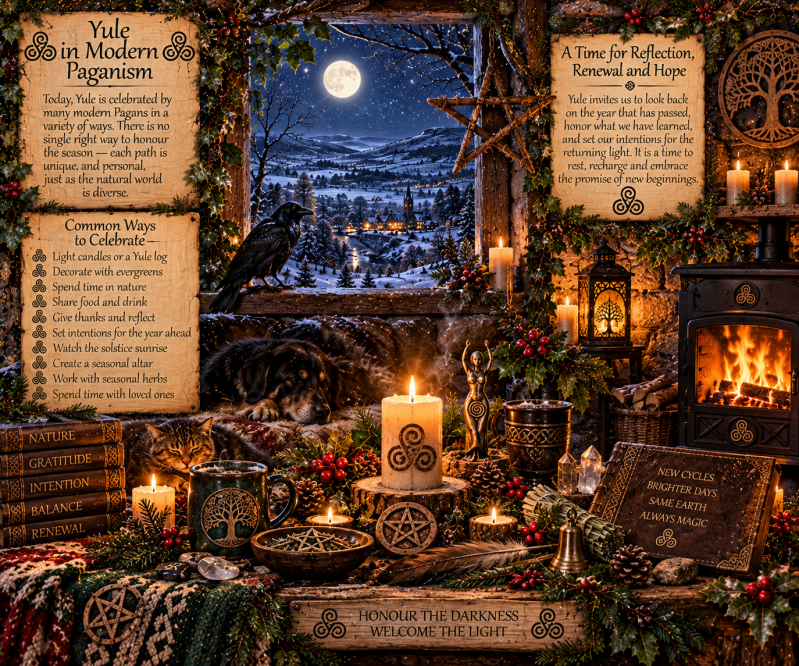
Today Yule is celebrated across a wide variety of Pagan traditions.
There is no single required ritual.
Some people watch the solstice sunrise.
Some light candles.
Others decorate an altar with evergreen plants, pinecones, holly or ivy.
A Yule log may be burned.
Seasonal food may be shared.
Some people spend time outdoors.
Others use the occasion for meditation, gratitude or reflection.
For many practitioners the central theme is the return of light.
Yule becomes a moment to recognise what has passed and consider what might come next.
Celebrating Yule Through Nature
You do not need elaborate rituals to observe the Winter Solstice.
Go outside.
Notice where the sun rises.
Walk through winter woodland.
Look for holly berries.
Listen for ravens.
Watch the evening arrive.
Find the first stars.
Notice how early the moon becomes visible.
Then return several weeks later.
The difference may surprise you.
Daylight has already begun reclaiming the landscape.
Sometimes the simplest way to understand an old seasonal celebration is to experience the season itself.
A Time for Rest
Modern culture often treats constant activity as something admirable.
Nature does not.
Winter slows everything.
Trees become dormant.
Some animals hibernate.
Plants retreat underground.
Growth becomes almost invisible.
Yule can therefore represent something modern life sometimes forgets:
rest is part of the cycle too.
Not every season needs to be productive.
Not every field needs to flower.
Not every tree needs to carry leaves.
Sometimes preparing for what comes next means becoming still.
Looking Back
The end of the calendar year naturally encourages reflection.
What changed?
What disappeared?
What arrived unexpectedly?
What did we learn?
What should we carry forward?
Modern Yule practice often incorporates this kind of reflection.
It fits naturally with the season.
The landscape itself appears to pause.
The old year is nearly finished.
The new one waits beyond the darkness.
Looking Forward
Yet Yule is not simply about endings.
Beneath frozen ground, spring already exists in potential.
Buds have formed.
Seeds wait.
Bulbs remain hidden beneath the soil.
The returning sunlight has begun its slow work.
Nothing dramatic happens overnight.
That may be Yule's most useful lesson.
Change does not always announce itself.
Sometimes it begins with something almost impossible to notice —
another minute of daylight.
From Darkness Comes Light
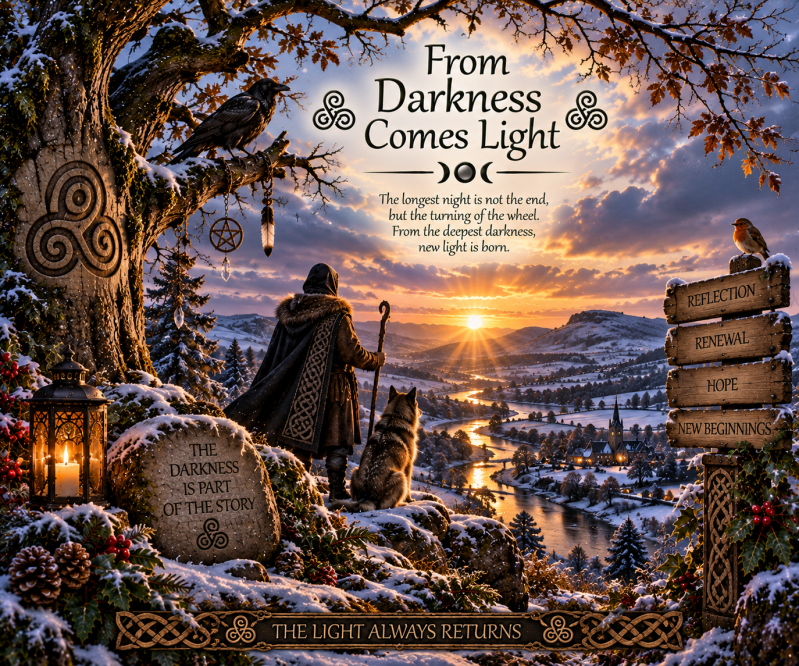
Imagine standing outside on the longest night.
The countryside is almost completely dark.
A few windows glow in distant houses.
Stars appear between clouds.
An owl calls somewhere beyond the trees.
The branches above you are bare.
Everything seems still.
Yet the Wheel has already turned.
Tomorrow contains slightly more light.
Then the next day.
Then the next.
Eventually snowdrops will appear.
Hawthorn will leaf.
Bees will return to flowers.
Hares will race through spring fields.
The darkness was never permanent.
Perhaps that is why humans have marked midwinter for thousands of years.
The Winter Solstice gives us something more powerful than a promise.
It gives us a certainty.
The light will return.
And somewhere beneath the frozen earth, the next season is already waiting. 🌿