The Birch in British, Irish & Celtic Folklore
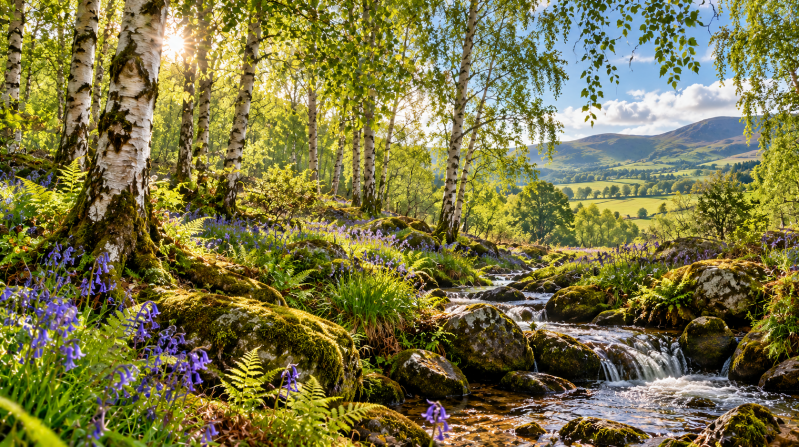
With its pale bark and delicate leaves, birch is one of the most recognisable trees of Britain and Ireland. It is also one of the first trees capable of colonising open or disturbed ground, helping woodland gradually return to places where trees have disappeared.
That natural ability to appear at the beginning of new woodland has made birch particularly suited to later associations with renewal, purification and new beginnings. Yet its folklore extends far beyond modern symbolism.
Birch appears in seasonal customs, traditional household objects and practical rural life. Its flexible twigs were used to make besoms and brooms, its bark and wood had numerous everyday uses, and birch became associated with particular spring and early-summer traditions.
In Irish tradition, birch is also connected with Beith, the first letter of the Ogham alphabet. Modern Celtic spirituality has developed an extensive symbolism around this connection, although the popular “Celtic Tree Calendar” should not simply be treated as an unchanged calendar used by the ancient Druids.
Birch therefore brings together language, landscape, seasonal custom, practical tradition and modern Pagan belief — making its real story considerably richer than the simple description “the Celtic tree of new beginnings”.
Beith — Birch in the Ogham Alphabet
Birch has an important place in the medieval Irish tradition of Ogham, an early writing system used primarily for inscriptions in the Irish language. The first letter of the Ogham alphabet is Beith, a word associated with birch.
Surviving Ogham inscriptions are found particularly in Ireland and western Britain, usually carved as groups of lines and notches along the edges of standing stones. Most surviving monumental inscriptions record personal names and family relationships rather than secret tree magic or divination.
Medieval Irish scholars later associated many Ogham letter names with trees and plants. These traditions are genuinely important sources for understanding how trees became connected with the alphabet, but they should not be confused with the elaborate modern system sometimes called the Celtic Tree Calendar.
In modern Druidry and Pagan spirituality, Beith has become strongly associated with beginnings, purification and renewal, partly because it stands first in the Ogham sequence and partly because birch is naturally capable of colonising open ground.
The distinction is important. Birch really does have a historical connection with Beith and Ogham, but many of the detailed spiritual meanings attached to individual Ogham trees today developed much later.
Why Birch Became a Tree of New Beginnings
Birch is frequently described today as a tree of renewal, rebirth and new beginnings. Although these meanings have been greatly developed within modern Pagan spirituality, there is something about the tree itself that makes the symbolism particularly appropriate.
Birch is a pioneer species. Its tiny, lightweight seeds can travel considerable distances on the wind, allowing young trees to establish themselves quickly on open or disturbed ground where woodland has been cleared, damaged or abandoned.
As birches grow, they help change the environment around them. Their leaves contribute organic material to the soil, while the developing woodland provides shelter in which other plants and trees can eventually become established.
A landscape that initially appears empty can therefore gradually become filled with young birches. Over time, other woodland species may follow.
This natural behaviour provides a powerful image of life returning after disturbance. The connection between birch and renewal does not require us to invent an ancient Celtic doctrine: it is something that can be observed directly in the landscape.
Combined with Beith's position at the beginning of the Ogham sequence, this ecological characteristic helped make birch particularly suitable for modern associations with fresh starts, cleansing and regeneration.
Birch, Beltane & Seasonal Customs
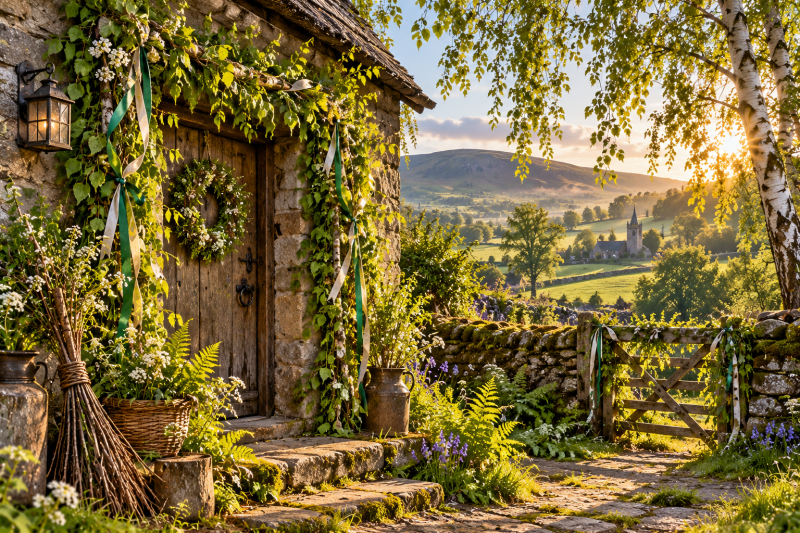
Birch also appears in spring and early-summer customs in parts of Britain and Ireland, where fresh branches and young greenery could be used to mark the changing season.
Trees, flowers and leafy branches played an important role in many May customs. Homes, doorways, animals and gathering places could be decorated with greenery, although the plants chosen varied according to region and local tradition.
Birch is sometimes specifically associated with Beltane in modern Pagan writing. There are genuine historical connections between May celebrations and the gathering of fresh greenery, but it is safer not to describe birch as the universal sacred Beltane tree of the ancient Celts.
Modern Pagan traditions have developed the association further, using birch to represent spring growth, purification, fertility and the beginning of a new cycle.
Here again, older seasonal customs and modern spirituality overlap. Fresh birch leaves emerging into the spring landscape provide a natural symbol for the return of growth after winter.
Birch Brooms, Besoms & Purification
One of the most familiar traditional uses of birch was the making of brooms or besoms. Bundles of flexible birch twigs could be tied around a handle to create a simple but effective tool for sweeping yards, hearths and floors.
This practical use may help explain why birch later became so strongly associated with cleansing and purification. A plant literally used to sweep away dirt provided an obvious symbolic image for removing unwanted influences and beginning again.
Besoms later acquired particularly strong associations with witches in British and European folklore. The familiar image of a witch flying upon a broom developed over centuries through stories, art and popular imagination, although it should not be assumed that every ordinary birch broom carried magical significance.
In modern Pagan and witchcraft traditions, the besom can be used symbolically to cleanse a ritual space. Often the action represents sweeping away unwanted influences rather than physically cleaning the floor.
Birch therefore demonstrates how an everyday household object can acquire additional layers of meaning. Practical sweeping, folk belief and modern ritual symbolism eventually became intertwined around the same bundle of twigs.
Birch in Scottish & Highland Tradition
Birch is a familiar tree across Scotland, particularly in the Highlands, where native birchwoods form an important part of the landscape. Downy birch and silver birch can survive in places where conditions are difficult for many larger woodland trees.
For generations, birch was also a useful practical resource. Its wood could provide fuel and material for small objects, while flexible twigs were used for brooms and other everyday purposes. Birch bark has been used in various ways across northern Europe, although particular customs differed considerably between regions.
In Gaelic-speaking communities, as elsewhere, trees formed part of a landscape understood not simply as wilderness but as a place of work, seasonal change, memory and tradition. Birch woodland provided shelter and resources while marking the gradual transition between open ground and established forest.
Modern accounts sometimes describe birch as possessing one fixed ancient Gaelic spiritual meaning. Surviving tradition is more complicated. Practical uses, place-names, seasonal customs and later folklore all contribute to the tree's cultural importance.
What remains particularly striking is the birch's ability to thrive in exposed landscapes. Against dark hillsides and moorland, its pale trunks create some of the most distinctive native woodland scenery in Scotland.
Birch, Protection & the Home
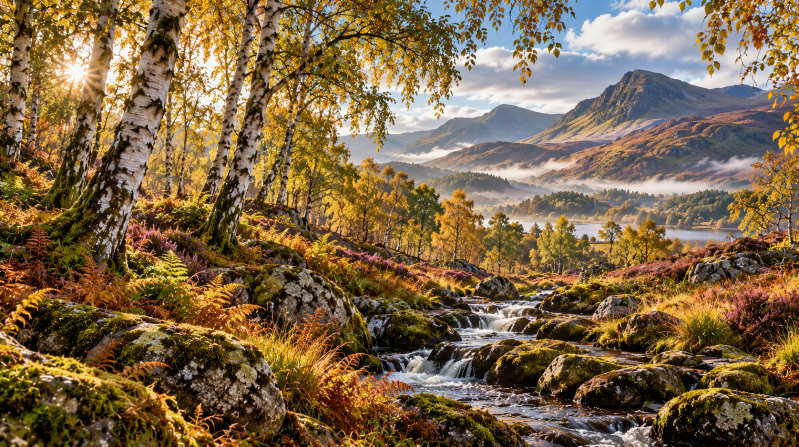
Birch also acquired associations with protection and the household. Fresh branches, birch twigs and brooms could appear in customs concerned with cleansing spaces or marking seasonal change.
Some later traditions treated birch as capable of driving away harmful influences or misfortune. These beliefs overlap naturally with its use in sweeping: the physical act of clearing a space could become a symbolic act of removing something unwanted.
Birch branches also appear among the many forms of greenery used in seasonal decoration. As with May customs more generally, practices differed between communities, and it would be misleading to describe one particular use as a universal ancient Celtic ritual.
In modern Pagan practice these older themes have developed into a strong association between birch and purification, protection and preparation for a new beginning.
The symbolism is remarkably consistent with the tree's everyday character: birch clears and recolonises open ground, its twigs formed the traditional broom, and its fresh spring foliage announces another season of growth.
Birch Symbolism & Modern Paganism
In modern Paganism and Celtic-inspired spirituality, birch has become strongly associated with renewal, purification, protection and new beginnings.
Several different traditions help explain these meanings. Birch is a pioneer tree capable of establishing itself on open and disturbed ground, while its twigs were traditionally used to make brooms and besoms. The first suggests regeneration; the second provides an obvious connection with cleansing.
Birch's association with Beith, the first letter of the Ogham alphabet, has added another layer to its modern symbolism. Contemporary practitioners may therefore use birch to represent the beginning of a journey, leaving the past behind or preparing for a new stage of life.
Birch is also incorporated into some modern Beltane and seasonal practices, particularly where fresh greenery represents returning growth and fertility.
These meanings should not be presented as one complete spiritual system inherited unchanged from the ancient Druids. Instead, modern birch symbolism combines genuine Ogham tradition, older folk customs, the natural behaviour of the tree and contemporary Pagan practice.
What Does the Birch Tree Symbolise?
Birch is now most commonly associated with new beginnings, renewal, purification and resilience.
Some of this symbolism reflects the tree's ecology. Birch readily colonises open ground and can be among the first trees to return after disturbance, making it a natural image of regeneration.
Traditional birch brooms and besoms contributed to associations with cleansing, while Beith's position at the beginning of the Ogham alphabet strengthened the modern connection with beginnings.
Seasonal customs involving fresh greenery and later Pagan traditions added further associations with spring, fertility and protection.
There was not one universal ancient “Celtic meaning of birch”. Its symbolism developed through a mixture of language, folklore, practical use, ecology and modern spiritual tradition.
Explore Related Folklore
Beltane — Fire and the Coming of Summer — Fire, Fertility & the Coming of Summer — explore the May festival, seasonal greenery, fire traditions and the beginning of summer.
The Rowan in British, Irish & Celtic Folklore — discover another distinctive tree strongly associated with protection in later British and Irish folk tradition
The Oak in British, Irish & Celtic Folklore — explore the mythology, history and symbolism surrounding one of the best-known trees of Britain and Ireland.
Sources & Further Reading
Woodland Trust — Silver Birch
Background on silver birch (Betula pendula), including identification, ecology, wildlife value, traditional uses and folklore.
Royal Botanic Gardens, Kew — Betula pendula
Botanical information on silver birch and its natural distribution.
Kew Science — Plants of the World Online
CELT — Corpus of Electronic Texts, University College Cork
A major collection of early and medieval Irish texts, useful for researching Ogham, early Irish language and historical tree traditions.
CELT — University College Cork
Dúchas — National Folklore Collection of Ireland
A searchable archive containing Irish folklore, seasonal customs, traditional plant lore and local beliefs.