The Oak in British, Irish & Celtic Folklore
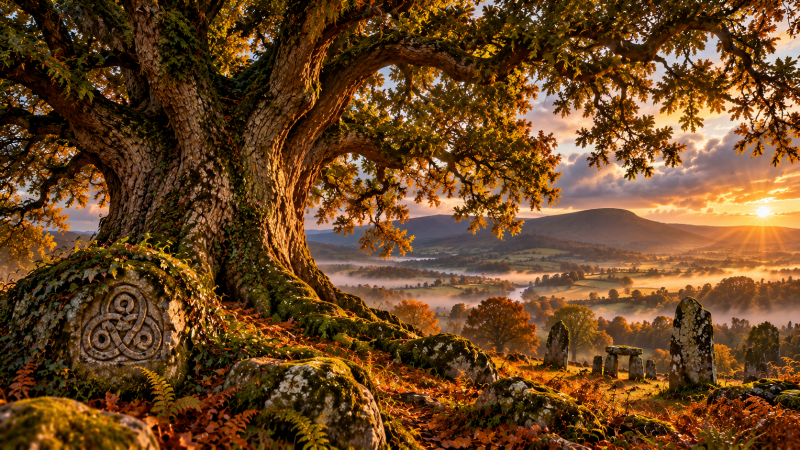
Few trees have occupied such an important place in the landscapes, history and imagination of Britain and Ireland as the oak. Capable of living for many centuries and developing enormous trunks and spreading crowns, ancient oaks became landmarks around which generations of human activity unfolded.
Oak also appears repeatedly in discussions of Celtic religion and the Druids. Classical writers described Druids gathering mistletoe from oak, while later traditions and modern interpretations have strengthened the connection between the tree, sacred groves and the religious practices of the ancient Celtic world.
Yet the oak's importance extended far beyond religion. Its timber built houses and ships, its bark was used in tanning, its acorns fed animals, and veteran trees became meeting places, boundary markers and witnesses to local history.
Folklore eventually surrounded many individual oaks, connecting them with saints, kings, fairies, storms, protection and remarkable events. Some traditions are ancient; others developed much later.
The story of the oak is therefore not simply the story of a “sacred Celtic tree”. It is the story of a species woven deeply into religion, landscape, everyday life and centuries of British and Irish folklore.
The Oak, Druids & Ancient Celtic Religion
The connection between oak trees and the Druids is one of the most famous ideas associated with ancient Celtic religion. Unlike many popular claims about “Celtic tree meanings”, however, there is some ancient written evidence behind this association — although it needs to be interpreted carefully.
The Roman writer Pliny the Elder, writing in the first century AD, described a ceremony in which Druids in Gaul gathered mistletoe growing on an oak. According to his account, the plant was cut with a golden sickle and accompanied by ritual sacrifice. Pliny also stated that the Druids regarded nothing as more sacred than mistletoe and the tree on which it grew, provided that tree was an oak.
This is important evidence, but it does not prove that every oak was regarded as sacred throughout the entire Celtic world. Pliny was describing particular practices among Druids in Gaul, and Roman authors viewed Celtic religion from outside their culture.
Sacred groves are also mentioned in classical descriptions of Celtic peoples. Trees and wooded places clearly could possess religious importance, but much of the detailed system of “Celtic tree spirituality” presented in modern books was reconstructed or developed many centuries later.
The oak's immense size and longevity nevertheless made it a natural focus for human attention. A great oak could outlive generations of people, dominate a landscape and provide a gathering place beneath its enormous crown.
The historical picture is therefore more interesting than the simplified claim that “the Celts worshipped oak trees.” Oak certainly had religious significance in some ancient Celtic contexts, but its traditions varied across different peoples, places and periods.
Oak, Mistletoe & the Druids
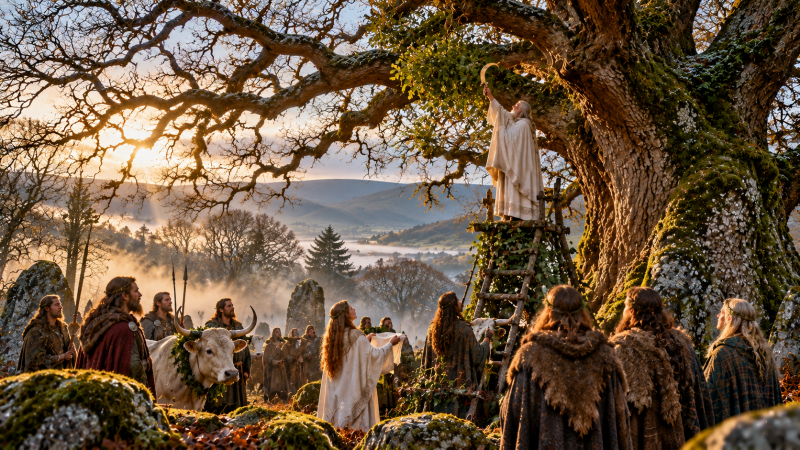
One of the most memorable descriptions of Druidic ritual concerns mistletoe growing upon an oak tree. The account comes from the Roman naturalist Pliny the Elder and has profoundly influenced later ideas about Druids and sacred trees.
Pliny described the mistletoe as being gathered on the sixth day of the moon. A Druid dressed in white climbed the tree and cut the plant with a golden sickle, while it was caught below rather than allowed to touch the ground. Two white bulls were then sacrificed as part of the ceremony.
An intriguing detail is that mistletoe is actually uncommon on oak. It grows much more readily on trees such as apple, lime, hawthorn and poplar. Mistletoe appearing on an oak would therefore have been an unusual sight, which may help explain why such a specimen could acquire special significance.
We should still be cautious. Pliny was a Roman author describing practices outside his own culture, and his account cannot tell us exactly how widespread the ceremony was or whether Druids elsewhere followed the same tradition.
Nevertheless, it provides rare written evidence connecting Druids, oak and ritual practice in antiquity. The later image of the Druid standing beneath a sacred oak is therefore not entirely a modern invention — even though centuries of romantic literature and modern Paganism have greatly expanded upon the surviving ancient evidence.
Does the Word “Druid” Mean Oak-Knower?
A popular explanation claims that the word Druid literally means “oak-knower” or “one who knows the oak”. The idea is attractive, particularly given the historical connection between Druids and oak, but the linguistic evidence is more complicated.
The ancient Celtic term reconstructed by linguists is usually given as dru-wid- or a related form. The second element is associated with knowledge or seeing, while the first has been connected both with words for oak and with a broader idea of strength or firmness.
This has produced interpretations such as “oak-knower”, “strong seer” or “one possessing great knowledge.” There is no simple English translation that can be treated as unquestionably correct.
The connection is nevertheless interesting because words related to oak and strength are closely linked in several Indo-European languages. Ancient oak trees themselves provided an obvious natural image of durability, age and permanence.
It is therefore reasonable to discuss a possible linguistic relationship between Druids and oak, but saying that Druid definitely means oak priest goes further than the surviving evidence allows.
Ancient Oaks, Meeting Trees & the British Landscape
Long before modern village halls and public buildings, a great tree could provide a natural gathering place. Its spreading crown created shelter, while its size and distinctive position made it an obvious landmark within the surrounding countryside.
Across Britain, individual oaks became associated with meetings, boundaries, local events and community memory. Some acquired names and stories that survived long after the events supposedly connected with them had passed from living memory.
One of Britain's most famous examples is the Major Oak in Sherwood Forest, Nottinghamshire. The enormous veteran tree became closely associated with the legend of Robin Hood, who was later said to have used it as a meeting place or shelter with his companions. There is no historical evidence that Robin Hood actually gathered beneath this particular tree, but the tradition demonstrates how an ancient tree can become absorbed into a much larger legend.
Other oaks served as boundary markers or meeting trees. Because they could survive for centuries, they provided relatively permanent features in landscapes where buildings, fences and generations of inhabitants continually changed.
Ancient oaks also became living records of land use. Pollarding, grazing, woodland management and centuries of human activity could leave visible marks upon their trunks and branches.
This ability to remain while the human landscape changed around them helped transform exceptional oaks into something more than trees. They became landmarks of memory — places where history, folklore and landscape met beneath the same branches.
The Royal Oak — Kings, Outlaws & Legendary Trees
Oak trees became attached not only to ancient religion but also to much later historical legends. Perhaps the most famous example is the story of King Charles II and the Royal Oak.
Following his defeat at the Battle of Worcester in 1651, Charles fled from Parliamentary forces. During his escape he reached Boscobel in Shropshire, where he later recalled hiding with Richard Penderel in the branches of a pollarded oak while soldiers searched the surrounding area.
The tree became known as the Royal Oak, and the story grew into one of the best-known episodes surrounding Charles II's escape. The original tree eventually deteriorated, while a later oak growing at the site became associated with its predecessor and continues the tradition.
After the Restoration of the monarchy in 1660, the Royal Oak became a powerful royalist symbol. The name appeared on inns, ships and other places across Britain, allowing the story of one particular tree to spread far beyond Shropshire.
Oak trees appear in many similar traditions. Outlaws shelter beneath them, kings meet beneath them, communities gather around them and important events become attached to them. Whether every story is historically accurate is almost beside the point from a folklore perspective: the tree becomes the physical place where people remember the story.
In this way, the oak's enormous lifespan allows folklore to accumulate around it. A human lifetime passes; the tree remains; another generation inherits both the oak and the tale associated with it.
Oak, Thunder & Lightning
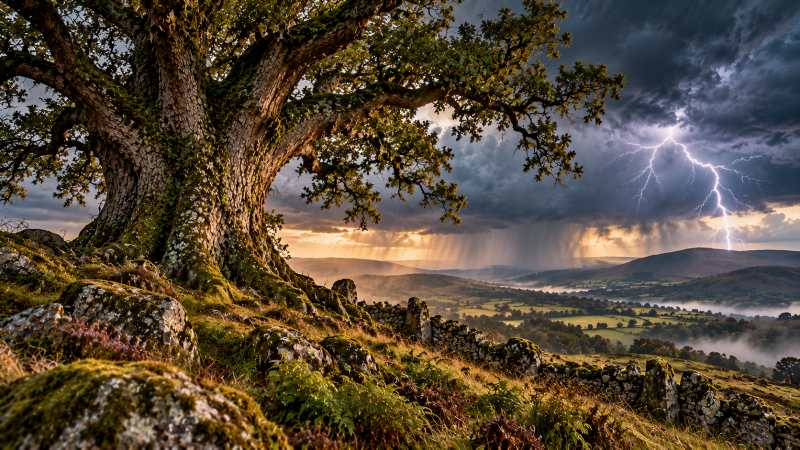
The oak's association with divine power was not limited to the Celtic world. Across several ancient European traditions, oak trees became connected with gods of thunder, storms and the sky.
In the classical world, the oak was particularly associated with Zeus in Greece and Jupiter in Rome. At the sanctuary of Dodona in north-western Greece, an ancient sacred oak played a central role in an oracle where the sounds of the tree and its surroundings were interpreted as divine messages.
Germanic tradition likewise connected oak with Thor, the thunder god. These parallels do not prove that every European culture inherited one identical ancient oak religion, but they demonstrate how readily the great tree became associated with strength, storms and supernatural power.
There may also be a natural reason why oak and lightning became linked in people's imaginations. Mature oaks can dominate open landscapes, rising above surrounding vegetation and therefore making dramatic targets during thunderstorms.
Later folklore sometimes regarded particular trees as having survived extraordinary storms or lightning strikes. A huge oak bearing a split trunk or blackened branch could itself become a visible reminder of the tremendous forces of nature.
Across these traditions, oak came to embody something that people could see for themselves: strength capable of enduring storms, generations and enormous spans of time.
Oak in Everyday Life — Timber, Ships & Acorns
For most people in Britain and Ireland, oak was not encountered primarily as a sacred tree. It was an immensely valuable working material, used for buildings, furniture, tools, fencing and countless objects of everyday life.
Oak timber is strong and durable, qualities that made it particularly important in traditional construction and shipbuilding. Huge quantities of oak were required for wooden ships, and the tree eventually became closely associated with British naval power. The phrase “Heart of Oak” reflected both the strength of the timber and the symbolic reputation the tree had acquired.
Oak bark was another valuable resource. Rich in tannins, it was widely used in the traditional leather-tanning industry. Woodlands could therefore be managed not simply for large timber trees but for the repeated production of useful bark and smaller wood.
Acorns also had economic value. Pigs could be turned into woodland to feed upon fallen acorns and other nuts, a practice known as pannage. In places such as the New Forest, forms of this ancient woodland practice survive today.
These everyday uses are important to the oak's folklore. A tree does not need to be regarded as supernatural to become culturally significant. Oak surrounded people in their houses, ships, tools, woodland economies and local landscapes, allowing practical importance and symbolic meaning to develop side by side.
Oak Symbolism & Modern Paganism
In modern Paganism and Celtic-inspired spirituality, the oak has become strongly associated with strength, endurance, wisdom, protection and connection with the natural world. These meanings are easy to understand when standing beneath a veteran oak whose life may already span several human generations.
Some modern associations also draw upon genuine historical material. Classical accounts connecting Druids with oak and mistletoe provide evidence that the tree possessed religious significance in at least some ancient Celtic contexts. Later traditions surrounding ancient oaks, meeting trees and historic landmarks added further layers of meaning.
Modern Druidry places particular importance upon trees and the natural landscape, with oak often occupying a prominent symbolic position. Contemporary practitioners may regard it as representing stability, knowledge, strength or spiritual wisdom.
Oak also appears in modern systems of Celtic tree symbolism and the so-called Celtic Tree Calendar. These systems can form meaningful parts of contemporary spiritual practice, but they should not automatically be presented as complete calendars or systems of tree meanings inherited unchanged from the ancient Druids.
The oak's modern symbolism therefore combines several different strands: ancient written evidence, centuries of British and Irish folklore, the remarkable biology of the tree and living Pagan traditions.
What Does the Oak Tree Symbolise?
Across British, Irish and wider European tradition, the oak has accumulated associations with strength, endurance, longevity, protection, authority and wisdom. Its enormous size and ability to survive for centuries made it a natural symbol of permanence.
Ancient sources provide evidence connecting oak with Druids and ritual in Gaul, while other European traditions associated the tree with powerful sky and thunder gods. Later British folklore attached individual oaks to kings, outlaws, meetings and important local events.
Modern Pagan and Celtic-inspired traditions have expanded these ideas, frequently describing oak as a tree of wisdom, courage, spiritual strength and connection with the sacred landscape.
There was never one universal historical “Celtic meaning of oak”. Instead, its symbolism developed through many different traditions — religious, practical, historical and folkloric — over a very long period of time.
Explore Related Folklore
The folklore of the oak reaches into many other parts of British, Irish and Celtic tradition. Its associations with Druids, sacred landscapes, ancient belief and the natural world connect it with wider traditions surrounding magical places, seasonal customs and other remarkable trees.
Shape-Shifting, Magic & Ancient Beliefs — explore traditions of magic, sacred plants and supernatural belief across Britain and Ireland.
The Celtic Otherworld — discover traditions surrounding the mysterious realms beyond the ordinary human world.
Sacred Trees & Ancient Landscapes — link this to your existing Sacred Trees page in Webador.
Trees & Plants in British, Irish & Celtic Folklore — link back to our new Trees & Plants hub.
Sources & Further Reading
Pliny the Elder — Natural History, Book XVI
The key classical source for the famous account of Druids gathering mistletoe from an oak, including the white-robed Druid, golden sickle and ritual involving white bulls.
Pliny — Natural History, Book XVI
Woodland Trust — English Oak
Useful information on the biology, longevity, wildlife value, history and traditional uses of the English oak (Quercus robur).
Royal Botanic Gardens, Kew — Quercus robur
Botanical reference material for the English or pedunculate oak.
Royal Botanic Gardens, Kew — Mistletoe
Useful background for the mistletoe material and the relationship between this unusual plant and its host trees.