Tír na nÓg — The Irish Land of Youth
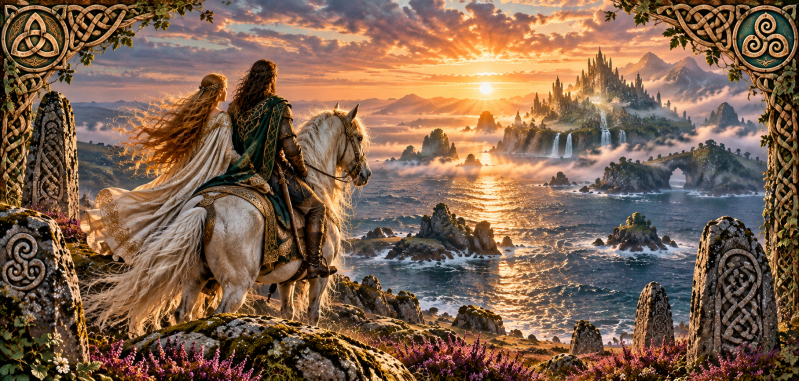
Beyond the Western Sea, Where Age and Time Have No Power
Beyond the western edge of Ireland, across an ocean that seemed to stretch towards another world, Irish tradition imagined extraordinary lands untouched by the ordinary rules of human existence. Among the most famous of these is Tír na nÓg — the Land of Youth, part of the much wider tradition of the Celtic Otherworld.
Tír na nÓg is remembered as a place where age has little or no power, where the landscape remains beautiful and abundant, and where the passage of time may be profoundly different from the mortal world. In later storytelling it became inseparably connected with Oisín, the great poet and warrior of the Fianna, and Niamh Chinn Óir — Niamh of the Golden Hair. Versions of their story survived within Irish oral tradition and were recorded by the National Folklore Collection of Ireland.
Their story begins with a journey. Niamh comes for Oisín and carries him away from Ireland on horseback, travelling westward across the sea towards Tír na nÓg. What seems to Oisín like a comparatively short absence ultimately separates him from the Ireland he once knew. When he eventually wishes to return, he is warned that he must not dismount from his horse or allow his feet to touch Irish soil. The famous episode can be found among the traditional Oisín in Tír na nÓg stories preserved by Dúchas.
But Tír na nÓg is more than the setting for a single romantic tale. It belongs to a much wider Irish tradition of supernatural lands, enchanted islands and journeys beyond the familiar world. These stories blur the boundaries between mythology, folklore and later storytelling, creating an imagined geography in which the sea itself can become a road into another realm.
For generations, stories of Tír na nÓg continued to be told and retold throughout Ireland. Accounts collected during the twentieth century demonstrate how the tradition remained part of Irish oral folklore long after versions of the story had appeared in literature. Explore another traditional account of Tír na nÓg preserved in the Schools' Collection →
What Does Tír na nÓg Mean?
The Irish name Tír na nÓg is usually translated as “Land of the Young” or “Land of Youth.” The word tír means land or country, while óg means young; na nÓg gives the sense of “of the young.” The name reflects one of the realm's defining characteristics — those who dwell there are beyond the ordinary ageing experienced in the human world.
Tír na nÓg is often described today simply as the “Celtic afterlife,” but that can be misleading. Irish tradition contains several supernatural lands and Otherworld realms, and they were not necessarily understood as different names for one single place. Mag Mell, for example, means approximately the “Plain of Delight,” while other stories describe extraordinary islands lying somewhere beyond the western sea.
Nor should Tír na nÓg automatically be treated as the equivalent of the Christian idea of Heaven. Stories about the Irish Otherworld contain journeys made by living people, supernatural inhabitants, feasting, music, beautiful landscapes and strange relationships with time. A mortal might enter such a realm and, at least in the stories, return again.
The westward location is particularly evocative. Standing on Ireland's Atlantic coast, the horizon marks the point where the familiar landscape disappears into an apparently limitless ocean. Irish storytelling repeatedly placed extraordinary islands and supernatural realms somewhere beyond that boundary, turning the western sea into one of folklore's great thresholds between the known and the unknown.
Oisín and Niamh — The Journey to Tír na nÓg
The best-known story associated with Tír na nÓg is the tale of Oisín and Niamh Chinn Óir, usually translated as Niamh of the Golden Hair. Oisín was a poet and warrior of the Fianna, the legendary band of warriors associated with his father, Fionn mac Cumhaill, whose adventures form an important part of the Fenian tradition of Irish storytelling.
According to the familiar tale, Niamh came from Tír na nÓg to Ireland in search of Oisín. Beautiful and otherworldly, she arrived riding a magnificent horse and invited him to accompany her to her homeland beyond the western sea. Oisín accepted, leaving Ireland and the Fianna behind as the pair travelled across the ocean towards a country unlike the mortal world.
Their journey itself marks the crossing of a boundary. The sea is no longer simply an obstacle separating one piece of land from another. In the story it becomes the space between worlds. When Oisín reaches Tír na nÓg, he enters a realm of youth, beauty and abundance where the ordinary effects of ageing appear to have been suspended.
Oisín remains there with Niamh, but eventually begins to long for Ireland and the people he left behind. What he does not understand is that time has not passed in the same way in the two worlds. The Ireland to which he wishes to return is no longer the Ireland he remembers.
Niamh allows him to make the journey home but gives him a crucial warning: he must remain upon the horse and must not allow his feet to touch the ground in Ireland. That warning prepares the story for its famous and tragic conclusion.
Traditional versions of the story were still being recorded from Irish storytellers many centuries later and can be explored through the National Folklore Collection.
Explore Oisín in Tír na nÓg in the National Folklore Collection →
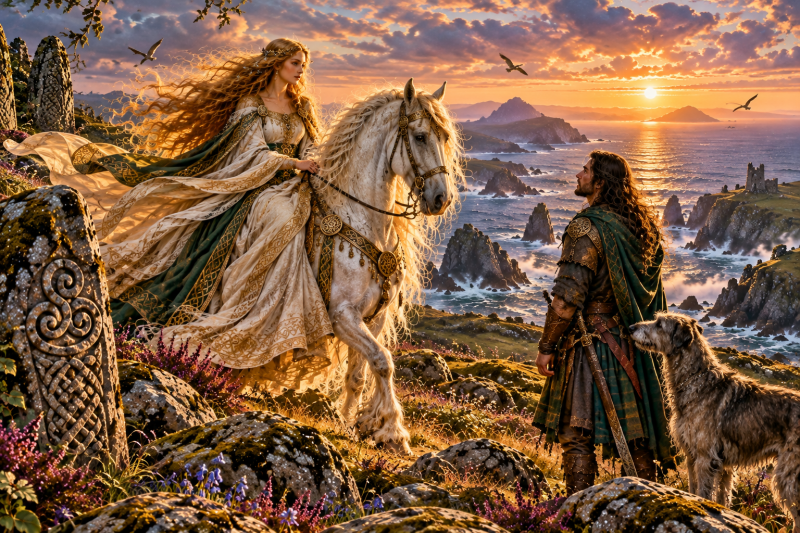
Oisín Returns to Ireland — When Centuries Have Passed
Although Oisín lives happily with Niamh in Tír na nÓg, memories of Ireland eventually draw him home. He longs to see the Fianna again and to revisit the landscapes and people he once knew. Niamh reluctantly agrees to his return and provides him with a horse for the journey, but her warning is absolute: whatever happens, Oisín must not allow his feet to touch the soil of Ireland.
When Oisín crosses the sea and reaches Ireland, he discovers a world he barely recognises. The companions he remembers are gone. The age of the Fianna has passed into memory and legend, and generations have lived and died during what had seemed to him a far shorter period in Tír na nÓg.
The contrast reveals one of the most fascinating ideas within Otherworld storytelling: time does not necessarily move at the same pace on both sides of the boundary. A visitor may experience days or years in an enchanted realm while decades or centuries pass in the human world. Similar distortions of time would later become a recurring feature of fairy traditions throughout Britain and Ireland.
In the familiar ending, Oisín encounters people struggling with a heavy stone. Leaning from his horse to help them, the saddle or girth gives way and he falls to the ground. The moment his body touches Irish soil, the protection of Tír na nÓg disappears. The centuries seemingly held at bay descend upon him, and the once-young warrior becomes an ancient man.
The episode transforms what begins as a journey to a paradise of eternal youth into something much more poignant. Oisín has returned home, but the home he wanted to return to no longer exists. Tír na nÓg therefore becomes not merely a magical country beyond the sea, but a story about time, memory, ageing and the impossibility of truly returning to the past.
Read a traditional version of Oisín's return in the National Folklore Collection →
Why Does Time Move Differently in Tír na nÓg?
One of the most memorable features of Tír na nÓg is its strange relationship with time. Oisín believes that he has been away from Ireland for a comparatively limited period, yet when he returns, generations have passed and the world of the Fianna has disappeared. The difference between the two realms is so great that returning to ordinary human time ultimately proves disastrous.
This idea fits into a much broader tradition surrounding the Irish Otherworld. Supernatural realms do not always obey the familiar rules of mortal life. Ageing may cease, extraordinary abundance may never diminish, and time itself can become uncertain. A person who crosses the boundary may therefore lose any reliable sense of how long they have been absent from the human world.
Similar ideas later appear repeatedly in fairy folklore. Stories collected throughout Ireland tell of people entering fairy dwellings, attending supernatural gatherings or encountering the Aos Sí, only to discover that time outside has passed differently from what they expected. Such tales helped create the enduring folklore motif that entering another realm could be wonderful, but returning from it could carry a terrible price.
Tír na nÓg should therefore not simply be imagined as a distant island that could be reached by travelling far enough west. In storytelling it exists beyond the normal boundaries of human experience. Crossing the sea represents more than a physical journey: Oisín has passed from a world governed by ageing and mortality into one where those rules no longer operate in the same way.
That is also why his return is so powerful. The moment Oisín touches Irish soil, ordinary time reasserts itself. The centuries he escaped in Tír na nÓg can no longer be avoided.
Was Tír na nÓg Really an Ancient Celtic Belief?
Tír na nÓg is frequently described online as though it were simply the ancient Celtic heaven or a single afterlife believed in by all Celtic peoples. The surviving evidence is considerably more complicated. There was no single unified “Celtic religion” stretching unchanged across Ireland, Britain and continental Europe, and the stories that survive were recorded in different places and periods.
Medieval Irish literature does, however, preserve a rich tradition of extraordinary realms beyond the ordinary human world. These include Mag Mell, the “Plain of Delight,” and mysterious islands encountered during supernatural sea voyages. Such places share characteristics later associated with Tír na nÓg: beauty, abundance, supernatural inhabitants and a different relationship with ageing and time.
The famous story of Oisín and Niamh in Tír na nÓg also needs some care. Oisín belongs to the much older body of storytelling surrounding Fionn mac Cumhaill and the Fianna, but the familiar Tír na nÓg narrative developed through later literary and oral tradition. We should therefore avoid claiming that the story exactly as we know it today was told by the ancient Celts.
That does not make the tradition any less valuable. Folklore rarely remains frozen in one historical moment. Stories are retold, reshaped and combined as they pass between generations. Tír na nÓg is a wonderful example of how older Irish ideas about supernatural realms continued to live within later storytelling.
Perhaps the safest way to understand it is not as a precisely mapped “Celtic heaven,” but as part of Ireland's much larger tradition of Otherworld journeys — stories in which human beings cross beyond the familiar landscape and encounter a realm where the ordinary rules of life no longer apply.
Explore Oisín and Tír na nÓg in Ireland's National Folklore Collection →
Other Lands Beyond the Western Sea
Tír na nÓg was not the only extraordinary land imagined beyond the boundaries of ordinary Ireland. Medieval Irish literature contains numerous accounts of beautiful islands, supernatural countries and mysterious realms reached by travelling across the sea. Together they form one of the richest traditions of Otherworld journeys in European storytelling.
One of these places is Mag Mell, usually translated as the “Plain of Delight.” It is portrayed as a realm free from many of the hardships of mortal existence — a place associated with beauty, abundance, happiness and supernatural inhabitants. Although Mag Mell and Tír na nÓg share similarities, it is better to regard them as related traditions rather than automatically assuming they were simply two names for exactly the same place.
Irish literature also developed remarkable voyage stories known as immrama — tales in which travellers sail across the ocean and encounter strange islands and supernatural wonders. Perhaps the most famous is the Voyage of St Brendan, where a Christian saint journeys through an Atlantic landscape filled with extraordinary islands and miraculous encounters. Although Christian in character, such voyage literature exists within a wider Irish fascination with what might lie beyond the familiar western horizon.
The sea therefore occupies a special position in these stories. It separates the everyday world from places where normal expectations about landscape, time and human existence can break down. Islands appear through mist, distant shores become gateways, and a journey west can become a journey beyond the boundaries of the known world.
Standing on Ireland's Atlantic coast, it is easy to understand why such imagery became so powerful. Beyond the final headlands lay an immense and largely unknowable ocean. In storytelling, that empty horizon offered somewhere for the impossible to exist.

The Sea as a Gateway to the Otherworld
In Irish storytelling, the sea often represents far more than a physical boundary. Beyond the western coastline lay an immense horizon whose distant reaches were unknown to most people. It provided a natural setting for stories about enchanted islands, supernatural kingdoms and journeys into places beyond ordinary human experience.
Travelling across water could therefore represent a crossing between worlds. In tales of Otherworld journeys, familiar landmarks disappear behind the traveller, mist obscures the horizon and strange islands emerge from the sea. The voyage itself becomes part of the transformation — the traveller has left the security of the known world without yet reaching whatever lies beyond it.
Water plays a similar role elsewhere in Irish and British folklore. Wells, rivers, lakes and springs are frequently associated with supernatural stories and sacred traditions. Rather than being merely features of the landscape, water could mark places of transition — boundaries where the familiar and mysterious seem unusually close.
This helps explain why the journey to Tír na nÓg is so important. Oisín does not simply ride from one country into another. He travels across the western sea and beyond the ordinary landscape of Ireland, entering a realm where ageing and time no longer behave as they do at home.
Even today, the image remains extraordinarily powerful: the last Irish headland disappearing behind you, an open Atlantic ahead, and somewhere beyond the horizon a land that belongs more to story than geography.
Tír na nÓg, Fairyland and the Aos Sí
Modern retellings sometimes describe Tír na nÓg simply as “the land of the fairies.” There are connections between Irish Otherworld traditions and later fairy folklore, but the traditions are richer and more complicated than that description suggests.
Irish tradition speaks of supernatural beings known as the Aos Sí, a name commonly associated with the people of the mounds. They became closely connected with ancient burial mounds, hills and other places in the Irish landscape where the boundary between the human and supernatural worlds was believed or imagined to be unusually close.
Later folklore contains countless stories of encounters with these beings. Music might be heard coming from beneath a hill, mysterious gatherings could appear at night, and humans who entered supernatural places sometimes discovered that the ordinary rules of time no longer applied. These themes strongly resemble the strange passage of time experienced by Oisín in the story of Tír na nÓg.
However, it is better not to treat Tír na nÓg, the Otherworld and fairyland as three perfectly interchangeable names for exactly the same place. Irish mythology and folklore developed over many centuries, and different stories describe supernatural realms, beings and landscapes in different ways.
What connects them is the recurring idea of a world existing close to the human world but beyond its normal boundaries. Sometimes the entrance lies across the western sea. Elsewhere it may be beneath an ancient mound, beyond a mysterious mist, beside water or hidden within the landscape itself.
That uncertainty is part of what makes Irish Otherworld folklore so compelling. The supernatural world is rarely given precise borders on a map. Instead, stories suggest that it may occasionally be encountered wherever the familiar landscape begins to feel strange.
Could Tír na nÓg Be Found on a Map?
Stories often place Tír na nÓg somewhere beyond the western sea, but that does not mean Irish storytellers were describing a geographical island that could simply be located on a modern map. Its position belongs to the imaginative landscape of folklore, where real coastlines, islands and oceans can form the boundaries of supernatural worlds.
For people living along Ireland's Atlantic coast, the western horizon must have provided a powerful setting for such stories. Beyond the cliffs and headlands stretched an enormous ocean whose distant reaches were unknown to most people. Islands appearing through mist or clouds gathering along the horizon could easily contribute to stories about mysterious lands lying beyond the visible world.
Irish tradition contains numerous legendary islands and supernatural places associated with the sea. Medieval voyage tales describe travellers encountering extraordinary islands filled with wonders, while later folklore continued to preserve stories of lands that appeared and disappeared beyond the coast.
One famous example is Hy-Brasil, a legendary island said in later tradition to lie somewhere west of Ireland. It even appeared on European maps for centuries despite never being reliably located. Hy-Brasil should not simply be identified with Tír na nÓg, but both demonstrate the extraordinary imaginative power that the Atlantic horizon acquired in Irish storytelling.
Tír na nÓg therefore occupies an intriguing space between landscape and imagination. Its stories begin in recognisable Ireland, cross the real Atlantic coast and then move into a realm where geography gives way to folklore. Perhaps that is why the legend remains so evocative: Tír na nÓg is always somewhere beyond the horizon — close enough to imagine, but impossible to reach by following an ordinary map.
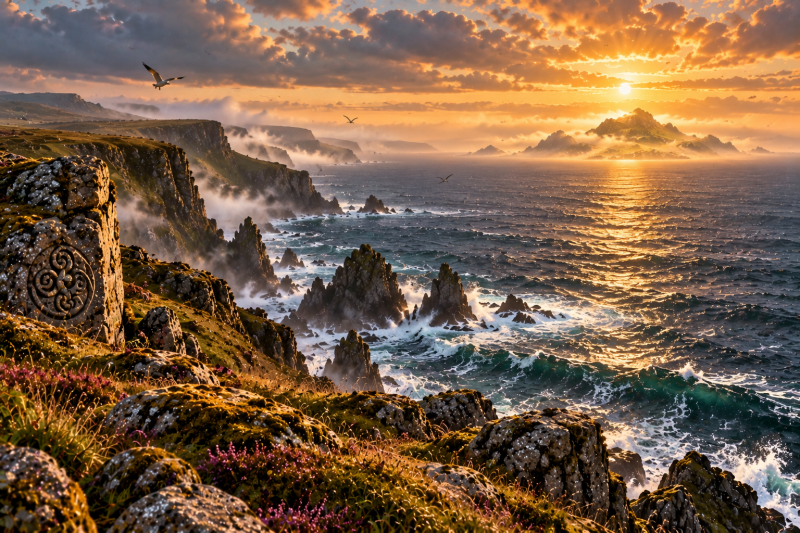
Tír na nÓg and the Landscape of Ireland
Although Tír na nÓg lies beyond the ordinary human world in storytelling, tales of the Otherworld were deeply connected with the real Irish landscape. Hills, ancient mounds, caves, lakes, wells and stretches of wild coastline could all become places where the boundary between the familiar and supernatural seemed unusually thin.
Ancient monuments were particularly powerful features of this landscape. Ireland's great prehistoric passage tombs and burial mounds were already thousands of years old when medieval Irish stories were being written down. Their original builders had long disappeared from memory, allowing later generations to surround these mysterious places with new stories and supernatural associations.
Places such as Brú na Bóinne, including the great passage tomb at Newgrange, became connected in medieval Irish tradition with figures of the Tuatha Dé Danann and the supernatural síd. In storytelling, the ancient landscape was therefore not simply a collection of ruins. Hills and mounds could become dwellings, entrances and places where another world seemed to exist alongside the human one.
This creates an interesting contrast with Tír na nÓg. Some Otherworld stories lead westward across the ocean, while others lead down into the landscape itself. The entrance might lie beyond the horizon, beneath an ancient hill, through a cave or beside mysterious water.
The geography changes from story to story, but the underlying idea remains remarkably powerful: the Otherworld is always just beyond the edge of ordinary experience.
Tír na nÓg in Irish Folklore Today
The story of Tír na nÓg did not disappear with the medieval manuscripts in which Ireland's Otherworld traditions were recorded. Stories of Oisín, Niamh and the Land of Youth continued within Irish storytelling, passing between generations and developing new details as they were retold.
During the great folklore-collecting projects of the twentieth century, versions of Oisín's journey were recorded from storytellers and schoolchildren across Ireland. These accounts are particularly valuable because they show that Tír na nÓg was not simply a subject preserved in old books. It remained part of a living tradition of stories remembered within families and local communities.
Today, Tír na nÓg remains one of the most recognisable names from Irish mythology and folklore. It appears in literature, music, artwork and modern interpretations of Celtic tradition. The details may change from one retelling to another, but the central image remains remarkably persistent: a beautiful land beyond the ordinary world where youth endures and time behaves differently.
Perhaps its survival is not difficult to understand. Beneath the supernatural elements lies an intensely human idea. Oisín is offered something people have dreamed about for centuries — escape from ageing and the passing of time. Yet eventually he discovers that eternal youth carries its own price. Everything he knew continues without him.
Explore traditional Tír na nÓg stories in the National Folklore Collection of Ireland →
Related Folklore
Tír na nÓg belongs to a much wider landscape of Irish and Celtic storytelling. If you would like to continue exploring the beliefs, places and traditions surrounding the Otherworld, these pages explore some of the closely connected themes found throughout Pixie Page Crafts.
The Celtic Otherworld
Explore supernatural realms, mysterious landscapes and traditions surrounding worlds beyond the everyday human experience.
The Celtic Otherworld
Fairies, Spirits & the Fae
Discover the Aos Sí, fairy traditions and the supernatural beings associated with ancient hills and wild landscapes.
Fairies, Spirits & the Fae
Sacred Waters, Wells & Rivers
Explore the folklore surrounding sacred water and the places where landscape, tradition and the supernatural meet.
Sacred Waters, Wells & Rivers
Sources & Further Reading
The traditions surrounding Tír na nÓg developed across centuries of Irish literature and oral storytelling. The resources below provide useful starting points for exploring the surviving folklore and the wider tradition of the Irish Otherworld.
Dúchas — National Folklore Collection of Ireland
The Schools' Collection preserves numerous accounts of Oisín, Niamh and Tír na nÓg recorded from Irish oral tradition during the twentieth century.
Explore Oisín in Tír na nÓg at Dúchas.ie →
CELT — Corpus of Electronic Texts, University College Cork
A major collection of Irish historical and literary texts useful for exploring Ireland's medieval storytelling traditions.
Explore CELT at University College Cork →
The National Library of Ireland
Collections and resources relating to Irish history, literature, manuscripts and cultural heritage.
Visit the National Library of Ireland →