Sacred Trees & Ancient Landscapes
Where the Land Holds the Stories
Across Britain and Ireland, the landscape is filled with places that seem to carry their own stories.
An ancient oak standing alone in a field. A twisted yew beside an old church. A spring emerging silently from beneath a hillside. A circle of weathered stones overlooking distant mountains.
These places have witnessed generations come and go.
Long before modern roads and towns transformed the countryside, people depended upon the natural world for food, shelter, fuel and survival. Trees, rivers, mountains and springs were not distant scenery — they were part of everyday life.
It is therefore unsurprising that the landscape became deeply woven into mythology, spirituality and folklore.
Over centuries, certain trees became associated with protection or supernatural beings. Wells acquired reputations for healing. Ancient monuments became homes of fairies and legendary figures. Mountains gathered stories of heroes, giants and mysterious events.
The landscape became more than somewhere people lived.
It became somewhere stories lived too.
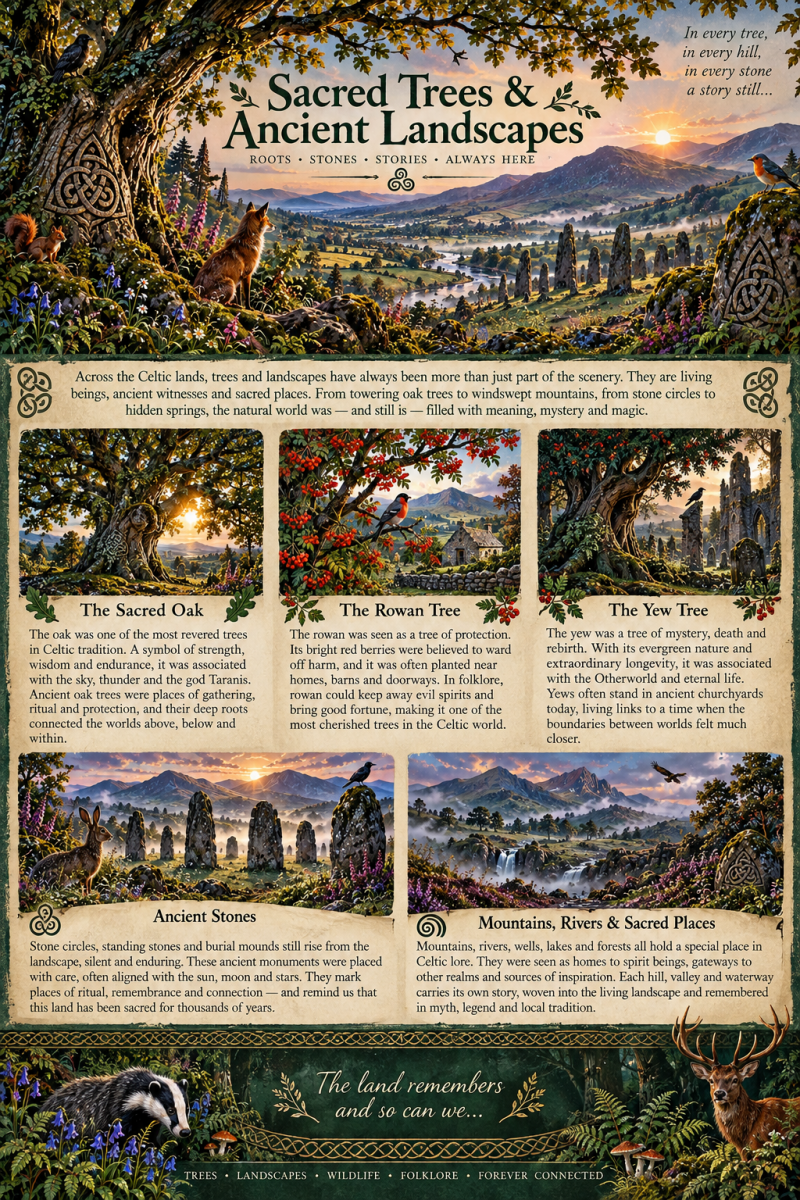
Sacred Trees and the Celtic World
Trees feature repeatedly in the mythology and later folklore of Ireland, Wales and Britain.
They provided timber, fuel, food and shelter, but some individual trees also became important landmarks.
Early Irish law even recognised different categories of trees and attached considerable value to certain species.
Medieval Irish literature contains references to significant trees, while later folklore preserved traditions surrounding particular trees and woodland places.
However, we should be careful with the popular modern idea that every species had one fixed “Celtic meaning.”
There was no universal ancient Celtic dictionary saying that one tree always represented strength while another always represented protection.
The reality is far more interesting.
Different trees accumulated different stories according to their appearance, usefulness, longevity, location and the traditions of individual communities.
The Oak — Strength, Age and the Ancient Woodland
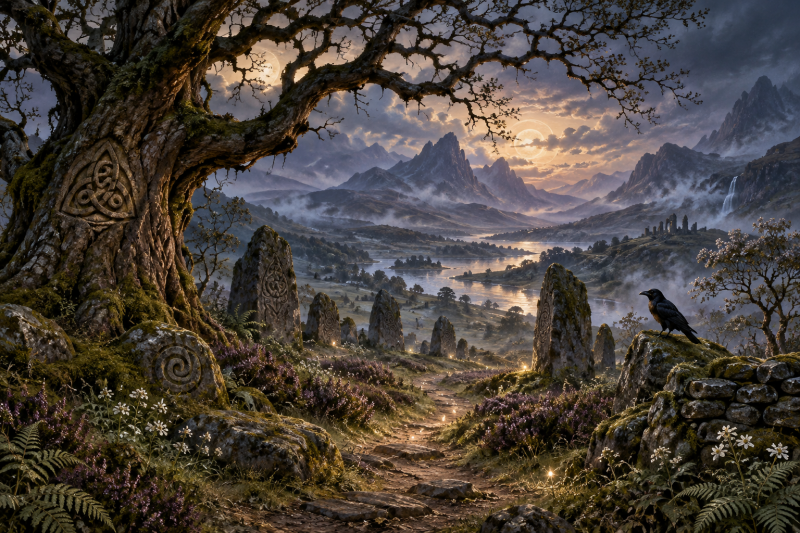
Few trees create a greater impression than a mature oak.
An old oak can survive for centuries, developing enormous twisting branches and a trunk wide enough to dwarf the people standing beneath it.
It provides habitat for an extraordinary variety of wildlife and produces valuable timber that has been used for buildings, ships, tools and countless other purposes.
The oak also appears in discussions of the Druids because classical writers connected the Druids of Gaul with ritual involving oak and mistletoe.
The Roman writer Pliny the Elder, writing during the first century AD, described a ritual in which Druids gathered mistletoe from an oak.
How representative this account was of Celtic religious practice more generally remains uncertain.
Nevertheless, the combination of enormous age, physical strength and practical importance made the oak an obvious tree around which stories could grow.
Even today, standing beneath a truly ancient oak can create a remarkable feeling of connection with the past.
A tree several centuries old has survived storms, wars, changing boundaries, generations of families and the transformation of the countryside surrounding it.
The tree becomes a living piece of history.
Rowan — The Bright Tree of Folklore
The rowan is another tree with particularly rich traditions in Britain and Ireland.
Its clusters of vivid red berries make it instantly recognisable, particularly as summer gives way to autumn.
Later Scottish and British folklore frequently associated rowan with protection against witchcraft, enchantment and harmful supernatural influences.
Rowan wood or berries might be incorporated into protective customs, and trees growing close to homes could acquire special significance.
Some traditions became so deeply rooted that people were reluctant to cut down particular rowan trees.
The rowan therefore makes a wonderful example of how an ordinary native tree could become surrounded by extraordinary beliefs.
To someone unfamiliar with the folklore, it is simply a beautiful tree covered in red berries.
To generations who knew the stories, it could represent protection at the boundary between the safety of home and the uncertainty beyond.
The Yew — A Tree Among the Dead
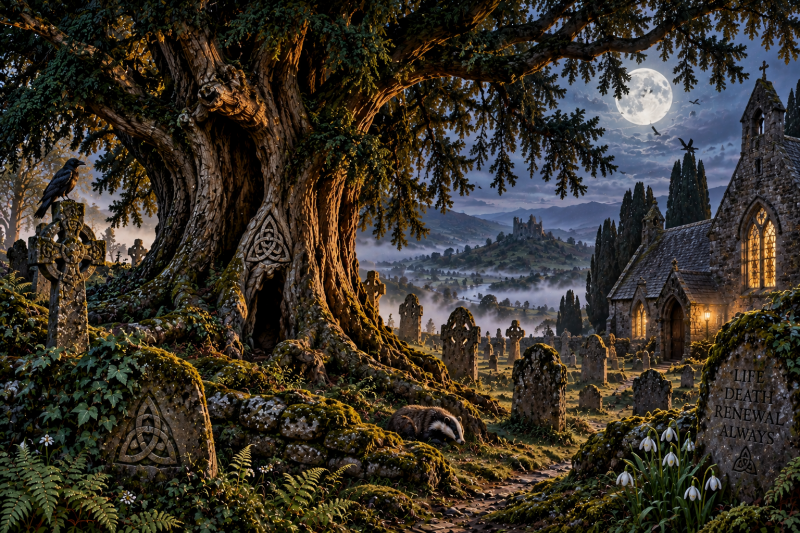
Few British trees possess an atmosphere quite like the yew.
Ancient yews can live for extraordinary lengths of time. Their trunks twist, hollow and sometimes appear almost to rebuild themselves as they age.
Today they are particularly associated with churchyards and burial grounds.
Some yews are believed to predate the churches standing beside them, although determining the precise age of extremely old yews can be difficult.
Their remarkable longevity naturally encourages associations with death, endurance and renewal.
A hollow ancient yew may appear almost dead in places while continuing to produce living growth.
That makes it easy to understand why later writers and modern spiritual traditions have found symbolism in them.
Whatever meanings earlier communities attached to individual yews, these trees remain among the most extraordinary living monuments in the British landscape.
Stand beneath one that may have been growing for many centuries and the human sense of time suddenly seems very small.
Hawthorn — The Tree at the Boundary
Few trees are more strongly connected with later fairy folklore than the hawthorn.
In spring its branches explode into masses of white blossom, transforming hedgerows and hillsides.
But solitary hawthorns could acquire very different reputations.
Particularly in Ireland, individual hawthorn trees sometimes became associated with fairies and supernatural places.
Stories warned against damaging certain trees, and some became known locally as fairy thorns.
Whether everyone literally believed that supernatural beings inhabited them is impossible to know.
What matters is that the traditions could be powerful enough to influence behaviour.
A farmer might leave an isolated tree untouched.
A path might bend around it.
People might hesitate before cutting its branches.
The tree became a boundary marker not simply in the physical landscape, but in the imagination.
Ancient Groves and Woodland
A forest is very different from a single tree.
Enter an old woodland and the outside world quickly disappears.
Branches close overhead.
Sound changes.
Paths twist between trees.
Sunlight reaches the ground in scattered patches.
It is easy to become disorientated.
Woodlands therefore make perfect settings for folklore.
Stories from across Europe place supernatural encounters, strange animals, witches, spirits and mysterious travellers among trees.
Woodland represents somewhere that humans can enter — but never completely control.
For earlier communities, forests also provided valuable resources while containing genuine dangers.
The result is a landscape that can simultaneously represent shelter, abundance, uncertainty and wilderness.
That tension has kept forests at the heart of storytelling for centuries.
Standing Stones and Ancient Monuments
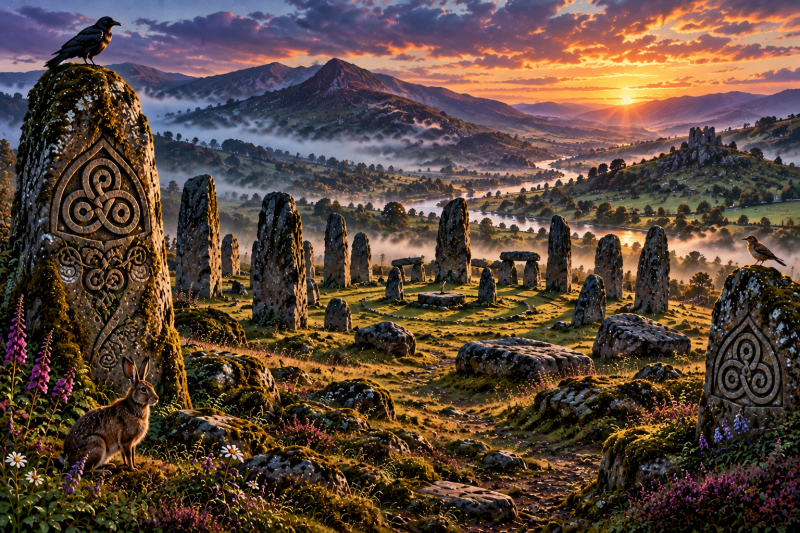
Not everything mysterious in the landscape was natural.
By the medieval period, Britain and Ireland were already covered with prehistoric monuments constructed thousands of years earlier.
Stone circles.
Standing stones.
Burial chambers.
Earthworks.
Ancient mounds.
Their original builders were long gone, and knowledge of exactly why many monuments had been constructed had disappeared.
But the monuments remained.
And where explanations disappear, stories often appear.
Later folklore attributed ancient structures to giants, fairies, legendary heroes and supernatural forces.
Some stones were said to move at particular times.
Others were associated with healing, fertility or strange events.
Ancient burial mounds became especially strongly connected with supernatural inhabitants in Irish tradition.
Archaeology can tell us something about the people who originally built these monuments.
Folklore tells us something equally fascinating:
what later generations imagined when they encountered them.
Mountains — Places Between Earth and Sky
Mountains naturally dominate the imagination.
They can be seen from enormous distances yet remain difficult to reach.
Their summits disappear into cloud.
Weather changes suddenly around them.
From their peaks, the familiar human landscape appears small and distant.
It is therefore unsurprising that mountains throughout Britain and Ireland accumulated stories.
Welsh mountains became associated with legendary figures and supernatural events.
Scottish peaks acquired tales of spirits, giants and strange creatures.
Irish mountains became connected with saints, mythology and local tradition.
Mountains occupy an interesting position in folklore.
They belong to the earth, yet their summits reach toward the sky.
They can therefore feel like natural boundaries between different worlds.
Rivers — Stories That Move Through the Land
Rivers connect landscapes.
A tiny stream emerging from a hillside can eventually become a powerful river flowing through valleys, villages and cities before reaching the sea.
People have always depended upon rivers for water, food, transport and fertile land.
But rivers can also be dangerous.
They flood.
They conceal deep pools.
Their currents carry objects away.
And their surfaces hide an underwater world that cannot easily be seen.
It is hardly surprising that rivers attracted mythology and folklore.
Stories associated them with supernatural beings, transformations, wisdom and boundaries.
Archaeological discoveries also show that people sometimes deliberately deposited valuable objects into rivers and other watery places during prehistoric and Iron Age periods.
Whether every such deposit represented a religious offering cannot always be known.
But clearly, water sometimes mattered enough for people to surrender objects of considerable value to it.
Sacred Springs and Holy Wells
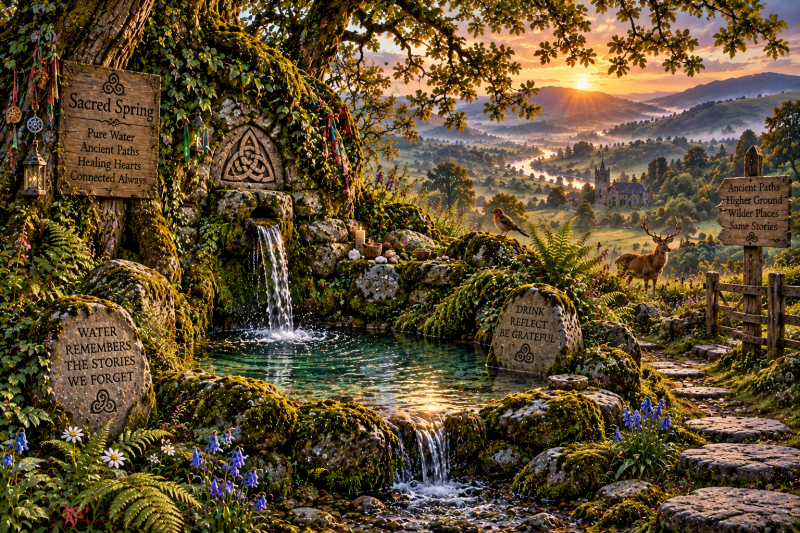
Across Britain and Ireland are countless springs and wells associated with local traditions.
Some became famous for supposed healing properties.
Visitors might drink the water, wash an affected part of the body or leave an offering.
Over time, many wells became associated with Christian saints.
But traditions surrounding water can be extremely old, and in some places different layers of belief appear to have accumulated over centuries.
Ribbons, pieces of cloth, coins and other objects have sometimes been left at wells.
These customs vary enormously from place to place and period to period.
It is therefore dangerous to label every holy well as a surviving ancient Celtic shrine.
Nevertheless, the continuing importance of springs demonstrates something fundamental.
Water emerging mysteriously from the earth naturally feels special.
Before modern plumbing, a clean and reliable spring could also be genuinely life-giving.
The practical and the spiritual could easily meet at the same place.
Caves and Hidden Places
Caves form natural entrances into the earth.
Step inside and daylight rapidly disappears.
Sound changes.
Temperature drops.
The familiar landscape vanishes behind you.
For storytellers, few places provide a better gateway into another world.
Caves and rocky openings appear in myths and legends across many cultures.
They may contain hidden treasure, supernatural beings or passages into mysterious realms.
Like ancient burial mounds, caves blur the boundary between the world above and whatever might lie beneath.
They are liminal places — places of transition.
And folklore thrives at boundaries.
The Landscape as a Living Memory
One of the most fascinating things about folklore is how a story can attach itself to a place.
A particular tree becomes the fairy tree.
A pool becomes the bottomless pool.
A standing stone becomes the giant's stone.
A strange mound becomes the fairy hill.
Generations may eventually forget when the story began, yet the place remains and keeps the tradition alive.
This transforms the countryside into something resembling a giant storybook.
The chapters are not written on paper.
They are written into trees, rivers, stones, hills and pathways.
History, Folklore and Modern Paganism
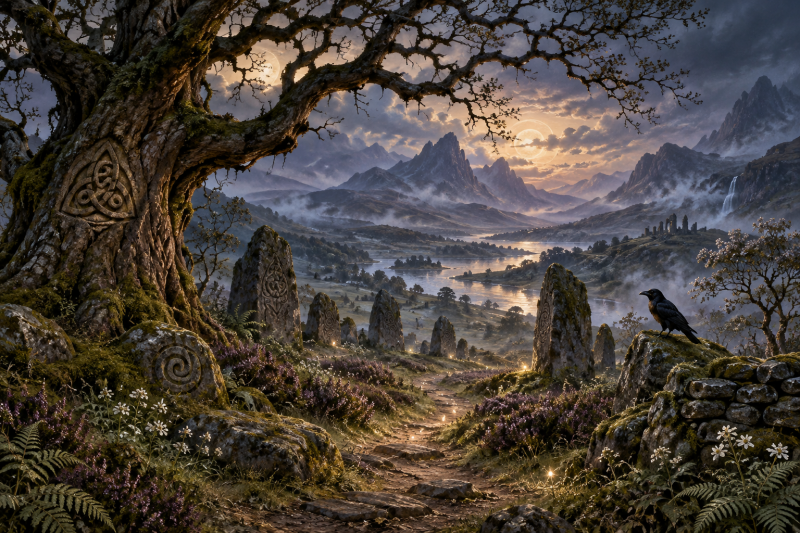
Today, sacred trees and ancient landscapes have become especially important within many forms of modern Paganism and nature-based spirituality.
Ancient trees may be treated as places for contemplation.
Seasonal celebrations may take place in woodland.
Stone circles can become powerful symbols of connection with the past.
People may leave offerings or spend time quietly within natural places.
These modern practices deserve to be understood on their own terms, but they should not automatically be described as unchanged survivals from ancient Celtic religion.
Some draw inspiration from genuine historical traditions.
Others developed much later.
Many combine old ideas with modern understandings of nature and spirituality.
The distinction matters because the genuine history is fascinating enough without needing to invent certainty where evidence does not exist.
Protecting the Places Behind the Stories
There is another side to celebrating sacred landscapes.
Ancient trees can be damaged.
Archaeological monuments can be worn away.
Wildflowers can be trampled.
Objects left as offerings can become litter or harm wildlife.
A tree covered with ribbons, plastic objects or candles may look spiritual to a visitor but can suffer real damage.
Perhaps one of the most meaningful ways to honour an ancient place is simply to leave it unharmed.
Walk quietly.
Take photographs.
Learn its history.
Notice the wildlife.
And allow the next visitor to discover it exactly as you did.
The old landscape does not need us to decorate it.
It has been creating its own beauty for thousands of years.
Where the Land Holds the Stories
An ancient tree does not need to contain a spirit to be extraordinary.
A standing stone does not need to have been raised by giants to make us wonder about the people who placed it there.
A spring does not need magical powers to have sustained generations of human life.
And a mountain does not need to hide another world to make us stop and stare when mist rolls across its summit.
That may be the greatest magic contained within these landscapes.
The real world and the world of folklore do not have to compete.
One tells us how a place came to exist.
The other tells us what generations of people felt when they stood there.
Together they transform an ordinary journey through the countryside into something much richer.
An oak becomes a survivor.
A river becomes a boundary.
A stone becomes a mystery.
A path through an ancient wood becomes an invitation to wonder what stories were told there before us.
And sometimes, when the evening light falls through old branches and the hills begin disappearing into mist, those stories don't seem quite so distant after all.
The land remembers — if we remember how to listen. 🌿