The Yew in British & Irish Folklore
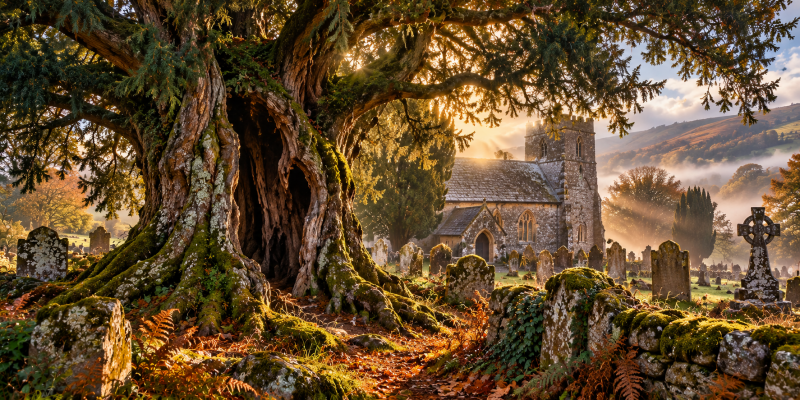
Few trees create a stronger sense of age and mystery than the yew. Across Britain and Ireland, ancient yews stand beside churches, among gravestones and within landscapes that have been used by generations of people for worship, burial and remembrance.
The yew's extraordinary longevity helped give it powerful associations with death, endurance and renewal. Unlike many deciduous trees, it remains green through winter, while old trunks can become hollow even as the tree continues growing for centuries.
Its frequent presence in churchyards has also produced one of Britain's most enduring historical questions. Were ancient yews planted because of Christian burial traditions, or were some already significant trees standing at sacred places before churches were built? Individual yews may indeed be extraordinarily old, but sweeping claims that churchyard yews are surviving trees of the ancient Druids go considerably beyond what the evidence can prove.
What survives is nevertheless remarkable: a living tree around which history, Christian tradition, folklore and ideas about the ancient past have become deeply intertwined.
Why Are Yew Trees Found in Churchyards?
One of the most familiar associations of the yew in Britain is with the churchyard. Ancient and veteran yews can be found beside churches throughout England, Wales and parts of Scotland and Ireland, sometimes appearing almost as old as the buildings themselves.
There is probably no single explanation for their presence. Yew is evergreen, extraordinarily long-lived and capable of surviving after its trunk has become hollow. These qualities made it a powerful tree in places concerned with burial, remembrance and eternal life, and the protected ground of a churchyard also offered old trees a greater chance of surviving for centuries.
Practical explanations have also been suggested. Yew foliage is poisonous to livestock, so growing the trees within enclosed churchyards could help keep animals away from them. Yew wood was also highly valued, particularly for bows, although this does not by itself explain the remarkable concentration of ancient yews at religious sites.
More intriguing is the possibility that some churches were established at places where important yews were already growing. Individual trees may indeed pre-date the churches beside them. Dating very old yews is notoriously difficult, however, because their trunks frequently become hollow and lose the oldest wood that would normally help establish their age.
The safest conclusion is therefore also the most interesting: Britain's churchyard yews represent many centuries of overlapping natural, Christian and local history, and individual sites need to be considered on their own evidence.
Were Yew Trees Sacred to the Druids?
Ancient yew trees are frequently described today as sacred trees of the Druids, and it is often claimed that Christian churches were deliberately built beside yews that had already been worshipped at pagan sacred sites. The idea is compelling, but the surviving evidence is more complicated.
We know that trees and groves could hold religious significance in Iron Age and ancient Celtic societies. Classical writers described sacred groves among peoples they identified as Celts, while later Irish and Welsh traditions preserve numerous stories in which particular trees possess unusual importance.
What we do not have is evidence showing that every ancient churchyard yew was once a Druidic sacred tree. Nor can the presence of an old yew beside a medieval church, by itself, prove that the site was used for pre-Christian worship.
The extraordinary age of some yews makes the question particularly intriguing. A number of surviving trees may be considerably older than the churches standing beside them, raising the possibility that certain places were important before Christianity became established there. But because very old yews are exceptionally difficult to date accurately, individual claims need to be treated cautiously.
Rather than imagining a single forgotten Druidic tradition behind every churchyard yew, it is more useful to see these trees as witnesses to many different periods of belief. Some may have stood through profound religious and cultural changes, accumulating new meanings while continuing to occupy the same piece of ground.
The Ancient Yews of Britain & Wales
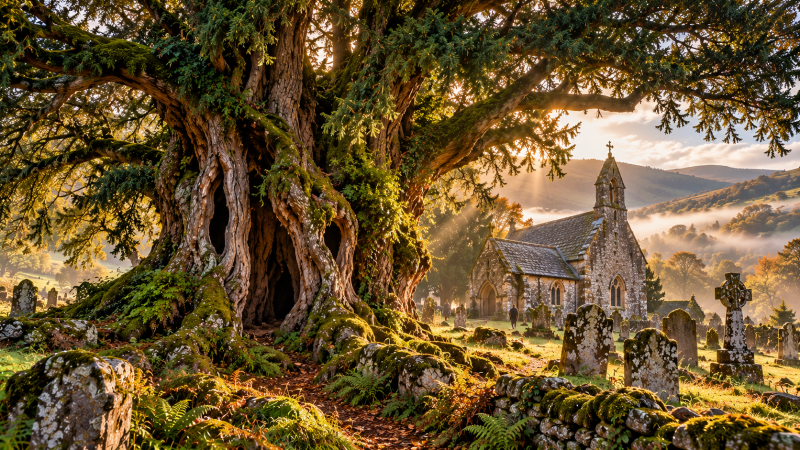
Britain contains some extraordinary veteran yews, several of which have stood for many centuries and have become landmarks in their own right. Their exact ages are often disputed because ancient yews become hollow, making conventional tree-ring dating extremely difficult.
The Fortingall Yew in Perthshire, Scotland, is among the most famous. Growing in the churchyard at Fortingall, it has often been described as one of Britain's oldest trees. Estimates of its age vary considerably, however, and precise claims extending back several thousand years should be treated cautiously.
Wales has equally remarkable examples. The Llangernyw Yew grows in the churchyard of St Digain's Church in Conwy and is commonly regarded as one of the country's oldest living trees. Like Fortingall, its enormous fragmented trunk demonstrates one of the peculiarities of ancient yews: a tree can continue living and renewing itself even after much of its original centre has disappeared.
These trees have inevitably attracted stories. Their immense age encourages people to imagine the generations that have passed beneath their branches — medieval villagers, clergy, mourners and communities whose names have long disappeared.
Ancient yews therefore occupy an unusual position between natural history and cultural memory. Whatever their precise ages, some have remained part of the same landscape for periods of time that are difficult to comprehend.
Yew, Death, Eternity & Renewal
The yew's close association with churchyards naturally connected it with death and remembrance, but the tree also possesses characteristics that make its symbolism more complicated than simply representing mortality.
Yews are evergreen. While many surrounding trees lose their leaves during winter, the yew remains dark green throughout the year. In a burial ground this enduring foliage could readily suggest ideas of continuity, eternal life and survival beyond death.
The tree's remarkable way of ageing adds another dimension. Ancient yews can become hollow as their central wood decays while living tissue continues growing around the outside. Branches may also reach the ground and form new growth. An apparently ancient and damaged tree can therefore remain vigorously alive.
Christian interpretations could easily accommodate these qualities. A tree growing among graves yet remaining green throughout winter provided a powerful natural image of life continuing in the presence of death.
Modern Pagan traditions have likewise associated yew with death, rebirth, transformation and the turning cycle of life. These interpretations fit the tree's extraordinary biology and long funerary associations, although they should not automatically be projected unchanged back into the beliefs of ancient Celtic peoples.
Perhaps this tension explains much of the yew's enduring fascination. It can appear ancient, hollow and almost dead while simultaneously producing fresh growth — a living reminder that decay and renewal can exist within the same tree.
The Poisonous Yew
Behind the yew's reputation as a tree of churchyards lies a very real danger. Most parts of the tree contain taxine alkaloids, compounds that are highly poisonous to humans and many animals.
The leaves and seeds are particularly dangerous if eaten, and livestock poisoning has long been associated with access to yew. This may help explain why keeping yews within enclosed churchyards made practical sense in agricultural communities where cattle and horses grazed nearby.
The tree's bright red fruits create an unusual contrast. The fleshy red covering, known as the aril, is not itself the most dangerous part, but the seed enclosed within it is toxic. Birds can feed on the fruits and disperse the seeds, helping yews spread naturally through the landscape.
It is tempting to connect the yew's poisonous nature directly with ancient beliefs about death and the supernatural. Such an interpretation is possible, but proving that this was the historical origin of its symbolism is much more difficult. The documented association between yews, burial grounds and mortality developed through many overlapping influences.
Nevertheless, the combination is striking: an extraordinarily long-lived evergreen tree, capable of surviving for centuries, yet containing substances powerful enough to cause death.
Yew Wood & the Medieval Longbow
Yew possessed another quality that made it enormously valuable: its wood. The combination of flexible sapwood and stronger heartwood made yew particularly well suited to the manufacture of powerful bows.
Yew became famously associated with the English and Welsh longbow, a weapon that played an important role in medieval warfare. Large quantities of suitable yew were eventually imported from continental Europe to satisfy demand for bow staves.
This practical history is very different from stories of sacred trees and churchyards, but it is an important part of understanding the yew. Medieval people encountered the tree not only as an ancient presence in burial grounds but also as a valuable natural material.
The same species could therefore occupy several worlds at once — churchyard tree, poisonous evergreen, ancient landmark and prized source of bow wood.
Yew in Welsh & British Folklore
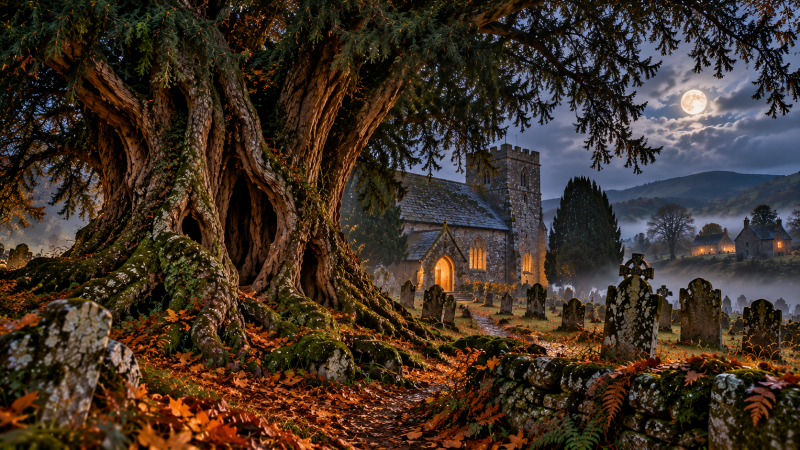
The presence of ancient yews in Welsh and British churchyards ensured that individual trees became woven into local stories. A tree that had apparently stood in the same place beyond living memory naturally invited speculation about everything it might have witnessed.
In Wales, one particularly atmospheric tradition surrounds the ancient yew at Llangernyw. Local folklore tells of the Angelystor, sometimes translated as the “Recording Angel”, a supernatural presence said to announce from the churchyard the names of parishioners who would die during the coming year.
According to later accounts, the voice was associated with the churchyard around All Hallows' Eve, giving the ancient yew and its surroundings an especially ominous reputation. As with many local legends, the precise age and development of the tradition are difficult to establish, and it should be treated as folklore rather than evidence of ancient Celtic belief.
Elsewhere, old churchyard yews accumulated their own local traditions, while their immense age encouraged stories connecting them with saints, early Christianity and the distant pre-Christian past.
This is one of the most fascinating ways folklore develops. An extraordinary natural object survives for centuries, generations tell stories about it, and eventually the tree and the legend become almost impossible to imagine separately.
Yew Symbolism & Modern Paganism
In modern Paganism and Celtic-inspired spirituality, the yew has become strongly associated with death, rebirth, transformation, ancestors, endurance and the Otherworld. Few British trees lend themselves so naturally to these themes.
Some of these modern associations have clear connections with the tree's historical setting. Yews have stood among graves and churches for centuries, while their evergreen foliage and extraordinary longevity provide powerful natural images of continuity and survival.
The yew's unusual growth also contributes to modern symbolism. An ancient tree may become hollow and fragmented while continuing to produce new living growth, making it an evocative symbol of renewal emerging from age and decay.
Modern spiritual traditions sometimes describe yew as an ancient Celtic tree of death or a gateway to the Otherworld. These interpretations can be meaningful within contemporary practice, but the historical evidence does not support treating them all as one unchanged belief inherited directly from the ancient Druids.
The distinction makes the yew more interesting rather than less. Its modern symbolism has developed from a remarkable combination of real biology, ancient trees, churchyard traditions, local legends and centuries of human imagination.
What Does the Yew Tree Symbolise?
The yew has accumulated several powerful meanings in British and Irish tradition, particularly death, remembrance, longevity, endurance and renewal. Many of these associations developed naturally from the tree's extraordinary lifespan and its centuries-old connection with churchyards and burial grounds.
Because yew remains evergreen through winter, it could also represent continuity and eternal life. Even extremely old trees can continue producing fresh growth after their trunks have become hollow and fragmented, creating a striking natural image of life persisting through age and decay.
Modern Pagan and Celtic-inspired traditions often extend these ideas to include rebirth, transformation, ancestors and the Otherworld. These interpretations fit naturally with the yew's appearance and historical associations, although they should not automatically be described as beliefs shared by all ancient Celtic peoples.
There is therefore no single historical “Celtic meaning” of the yew. Its symbolism has accumulated over centuries through nature, Christianity, burial traditions, local folklore and modern spirituality.
Explore Related Folklore
The folklore of the yew reaches far beyond the churchyard. Its extraordinary longevity, association with burial places and later symbolism of death and renewal connect it with wider traditions surrounding the Otherworld, ancestors, seasonal beliefs and supernatural landscapes.
The Celtic Otherworld — explore traditions of mysterious realms beyond the ordinary human world.
Shape-Shifting, Magic & Ancient Beliefs — discover traditions of magic, transformation and supernatural belief across Britain and Ireland.
Sources & Further Reading
Ancient Yew Group
A specialist resource dedicated to recording and studying Britain's ancient, veteran and notable yew trees, including churchyard yews and the difficulties involved in estimating their ages.
Woodland Trust — Yew
Background on the yew (Taxus baccata), including identification, ecology, longevity, mythology and traditional uses.
Royal Botanic Gardens, Kew — Taxus baccata
Botanical information about the European yew from one of Britain's leading botanical institutions.
Coflein — Royal Commission on the Ancient and Historical Monuments of Wales
A useful resource for researching historic Welsh churches, churchyards and archaeological sites associated with ancient trees and local traditions.