The Holly in British & Irish Folklore
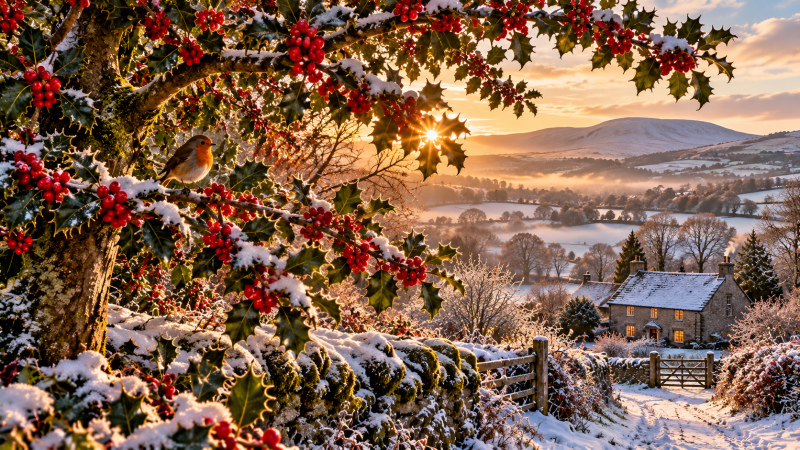
When much of the winter landscape has become bare, holly remains unmistakably green. Its glossy evergreen leaves and brilliant red berries made it one of the most distinctive plants of the British and Irish winter, and generations of tradition gathered around it.
Holly became associated with protection, good fortune, the home and midwinter celebration. Branches were brought indoors as seasonal decoration, while customs developed around when holly should enter the house, who should bring it in and when it ought to be removed.
Christianity gave the plant additional meanings, connecting its prickly leaves and red berries with the Passion of Christ. Yet holly also belonged to a much broader tradition of bringing evergreens into the home during the darkest part of the year.
In modern Paganism, holly has acquired strong associations with Yule, the waning year and the Holly King. Some of these traditions are modern developments rather than surviving ancient Celtic myths, making holly a particularly interesting example of folklore continuing to evolve.
From winter hedgerows to Christmas decorations, protective customs and modern Pagan symbolism, holly reveals how an ordinary native plant can become deeply embedded in season, belief and tradition.
Why Holly Became a Midwinter Plant
Holly possesses one characteristic that made it especially striking to people living in the British and Irish countryside: it remains green throughout winter. When deciduous trees had lost their leaves and much of the landscape appeared dormant, holly still carried glossy foliage and, on female plants, brilliant red berries.
Evergreens naturally became important during the darkest part of the year. Bringing greenery indoors offered colour and life at a season when both were scarce, and holly became one of several plants used in winter decoration alongside ivy, mistletoe and other evergreen foliage.
Over centuries these customs became closely associated with Christmas, but decorating homes with winter greenery belonged to a broader collection of seasonal traditions. Different regions developed their own rules concerning which plants should be brought indoors and when.
Holly's berries also made the plant particularly noticeable in the winter landscape. While poisonous to humans if eaten, they provide an important seasonal food source for birds and other wildlife.
The contrast is powerful: green leaves and bright berries surviving amid bare branches, frost and darkness. It is easy to understand why holly became associated with endurance, protection and the continuation of life through winter.
Holly in the Home — Protection & Good Luck
Bringing holly into the home was surrounded by traditions concerning protection, luck and the welfare of the household. Its evergreen leaves made it a natural winter decoration, but folklore gave those branches meanings beyond their appearance.
In parts of Britain, holly was regarded as protective. Keeping it around the house could be associated with guarding the inhabitants from witchcraft, harmful spirits or misfortune, while holly trees growing near buildings were sometimes considered fortunate.
Yet the customs came with rules. Traditions differed over when holly should be cut, when it could safely be brought indoors and when the decorations must be removed. Keeping Christmas greenery beyond its proper season could itself be considered unlucky.
One particularly curious tradition concerned prickly and smooth holly. Folklore recorded in parts of Britain claimed that the type brought into the house could indicate whether the husband or wife would rule the household during the coming year. As with many domestic customs, the precise version varied from place to place.
These traditions demonstrate an important feature of folklore: seasonal decoration was rarely just decoration. The plants brought across the threshold could become part of a network of beliefs concerning luck, protection and the uncertain year ahead.
Holly & Ivy — Winter Rivals
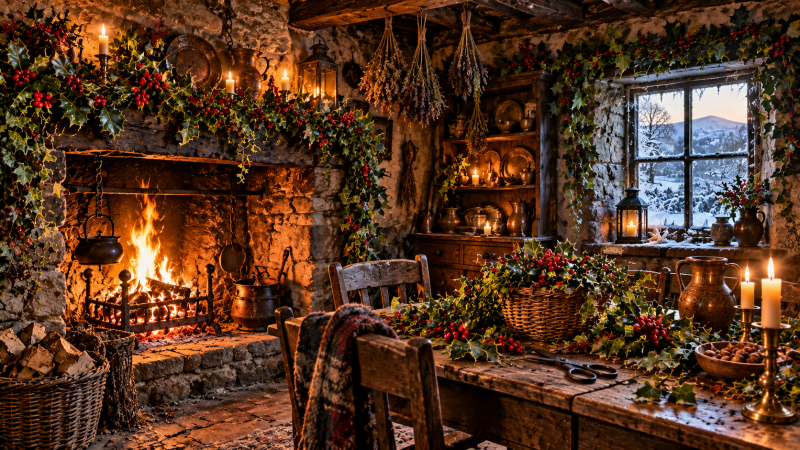
Holly and ivy have been paired in British winter tradition for centuries. Both remain green through the darkest months, making them natural choices for decorating homes, churches and communal spaces during the Christmas season.
The best-known expression of this partnership today is the traditional carol “The Holly and the Ivy.” Its surviving lyrics are strongly Christian, using holly's white blossom, red berries, prickles and bitter bark as symbols connected with the life and Passion of Christ.
Older folk traditions could also treat holly and ivy almost as rivals. In some songs and customs, the two plants represented opposing sides in playful contests, sometimes acquiring masculine and feminine associations. Holly was commonly identified with the male side and ivy with the female, although these meanings varied rather than forming one universal system.
This has occasionally been interpreted as evidence of an ancient Pagan battle between male and female vegetation spirits. The surviving evidence does not justify such a simple conclusion. Medieval and later seasonal songs, Christian symbolism and local folk customs all contributed to the traditions that eventually surrounded the two plants.
What is certain is that holly and ivy became inseparable from the British midwinter imagination. When the countryside itself offered relatively little greenery, these two plants could bring the living colour of the winter landscape indoors.
Holly & Christianity
As holly became increasingly associated with Christmas, Christian symbolism developed around the plant. Its prickly evergreen leaves and red berries were interpreted as reminders of the Passion of Christ.
The sharp leaves came to represent the Crown of Thorns, while the red berries symbolised Christ's blood. Because the plant remained green through winter, it could also be associated with eternal life.
These interpretations helped holly fit naturally into Christian Christmas traditions, particularly when churches and homes were decorated with greenery during the winter season.
It is sometimes claimed that Christianity simply adopted an already established “Celtic holly festival”. The historical picture is considerably more complicated. Winter greenery was used in various European traditions, but individual customs developed across different places and periods rather than descending from one identifiable ancient Celtic celebration.
Holly therefore demonstrates how folklore can accumulate layers. The same evergreen plant could carry seasonal, protective, Christian and later Pagan meanings, with new interpretations developing without necessarily erasing the older ones.
The Holly King & Oak King — Ancient Myth or Modern Tradition?
One of the most popular stories in modern Paganism describes an eternal struggle between the Holly King and the Oak King. The two figures represent the opposing halves of the year, with one gaining power as the other declines.
Modern versions commonly associate the Oak King with the waxing year, from midwinter toward midsummer, and the Holly King with the waning year, from midsummer back toward midwinter. Their symbolic battles are often placed around the solstices.
It is an evocative way of representing the changing seasons, but the Holly King and Oak King should not be presented as a clearly documented ancient Celtic myth. The familiar modern story belongs largely to later folklore interpretation and contemporary Pagan tradition.
Its imagery nevertheless draws upon much older themes: seasonal change, evergreen holly surviving winter, the strength of oak and stories in which rival figures represent opposing parts of the natural cycle.
Today the Holly King and Oak King form a meaningful part of some Pagan and Yule celebrations. Understanding the tradition as a living modern mythology rather than falsely labelling it an ancient Druidic story does not make it any less interesting.
When Should Holly Be Removed from the House?
Bringing holly indoors was only part of the tradition. Folklore also developed around how long the greenery should remain inside the house, and keeping it beyond the proper season could be regarded as unlucky.
In many later Christmas traditions, decorations were expected to be removed by Twelfth Night or Epiphany, although customs differed considerably between regions and periods. Holly and other greenery left hanging after the festive season could therefore become associated with misfortune.
Some traditions extended the life of Christmas greenery for longer. Rather than simply throwing it away, old holly might be burned, returned outdoors or replaced by fresh seasonal plants. Local practice could determine what was considered the correct treatment.
These customs reflect an older rhythm in which bringing plants into the home marked particular moments in the year. The greenery crossed the threshold for a reason, remained for its proper season and then had to leave when that season ended.
The superstition surrounding forgotten Christmas holly therefore reveals something larger than a rule about decorations: seasonal customs had boundaries, and ignoring those boundaries was believed to invite bad luck.
Holly, Protection & the Farm
Holly's protective reputation was not confined to Christmas decoration. In British and Irish folk tradition, the tree could be associated with the protection of homes, farms and livestock.
A mature holly left standing near a house or farm could be regarded as fortunate, and traditions sometimes warned against unnecessarily cutting down established trees. As with hawthorn and elder, practical considerations and supernatural beliefs could become intertwined.
Holly was also associated in folklore with protection against storms and lightning. Such beliefs varied locally, but they contributed to the idea that a holly tree near a dwelling might be something worth preserving.
Its dense evergreen foliage had a very practical value as well, providing shelter for birds and animals during harsh weather. Holly wood was useful, while its tough growth could contribute to hedges and boundaries.
Once again, folklore and everyday experience existed side by side. A tree that physically sheltered the farm through winter could easily acquire a reputation for protecting the household in less visible ways too.
Holly in British & Irish Folklore
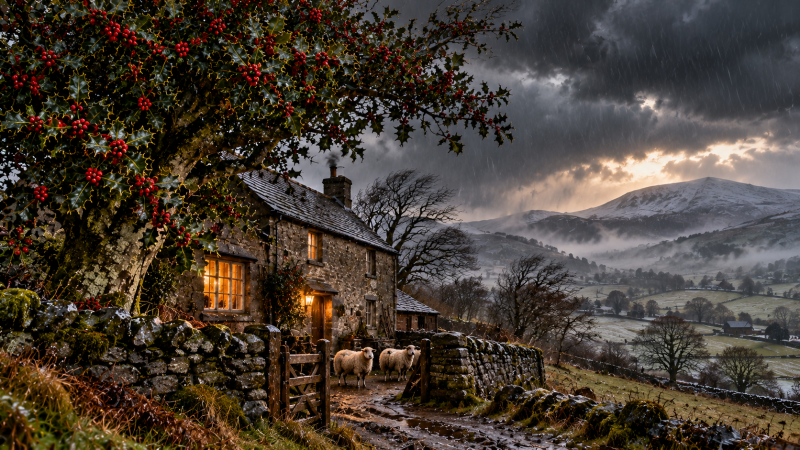
Across Britain and Ireland, holly became deeply connected with the winter landscape, household protection and seasonal custom. Its evergreen leaves made it conspicuous when surrounding woodland was bare, while its berries brought vivid colour to the darkest months of the year.
Regional traditions surrounding holly varied considerably. In some places it was considered fortunate to have a holly tree near the house, while elsewhere particular rules governed cutting the tree or bringing its branches indoors. Christmas customs added further traditions concerning when the greenery should enter and leave the home.
Holly also appears within Irish tree lore, but care is needed when modern sources describe every holly custom as an ancient “Celtic belief”. Much of the folklore recorded in Britain and Ireland developed during the medieval and early modern periods or even later, alongside Christian seasonal traditions.
This does not make the folklore less valuable. Instead, it shows how traditions continually develop. A native evergreen could acquire protective beliefs, become part of Christmas celebration and later gain additional meanings within modern Pagan practice.
Holly's story therefore spans many centuries rather than belonging to one particular religion or period. The tree remained the same while the stories surrounding it continued to change.
Holly Symbolism & Modern Paganism
In modern Paganism and nature-based spirituality, holly has become associated with protection, resilience, endurance and the continuing life of the natural world through winter.
Its evergreen foliage makes this symbolism particularly understandable. While many trees stand bare during the darkest months, holly remains green, and female plants may carry brilliant berries deep into winter. It provides a striking natural image of life continuing during an apparently dormant season.
Holly is particularly associated with Yule and the winter solstice in many contemporary Pagan traditions. Branches may be used as seasonal decoration, while the tree can represent protection, the waning half of the year or the persistence of life through darkness.
The modern story of the Holly King and Oak King has added another important layer to this symbolism. Although it should not be presented as a securely documented ancient Celtic myth, it has become a meaningful seasonal tradition within some forms of modern Paganism.
Holly's modern spiritual meaning therefore draws upon several different sources: the natural behaviour of the tree, older protective folklore, centuries of winter custom and living Pagan tradition.
What Does the Holly Tree Symbolise?
Holly has accumulated associations with protection, good fortune, endurance, winter and everlasting life.
Traditional British and Irish folklore connected holly with the household, seasonal luck and protection, while its evergreen leaves made it an obvious symbol of persistence through winter.
Christian tradition added further meanings, interpreting the prickly leaves and red berries in relation to the Passion of Christ and the evergreen foliage as a symbol of eternal life.
Modern Pagan traditions frequently associate holly with Yule, the winter solstice, resilience and the darker half of the year, particularly through the modern symbolism of the Holly King.
There is therefore no single ancient “Celtic meaning” of holly. Its symbolism is the result of many centuries of seasonal, Christian, folkloric and modern Pagan tradition.
Explore Related Folklore
Holly's traditions connect the winter landscape with seasonal celebration, household protection and changing ideas about the turning year. Explore some of the other folklore and traditions that surround Britain's and Ireland's sacred trees, winter customs and ancient landscapes.
Yule — The Winter Solstice — explore midwinter traditions, evergreens, fire and the return of the light.
The Oak in British, Irish & Celtic Folklore — discover the ancient oak traditions that later became connected with the modern story of the Oak King and Holly King.
The Hawthorn in British & Irish Folklore — another tree surrounded by protective traditions and warnings about disturbing it.
Sources & Further Reading
Woodland Trust — Holly
Useful background on holly (Ilex aquifolium), including identification, ecology, wildlife value, traditional uses and folklore.
Royal Botanic Gardens, Kew — Ilex aquifolium
Botanical reference material for European holly and its natural distribution.
Kew Science — Plants of the World Online
Dúchas — National Folklore Collection of Ireland
A valuable searchable collection for Irish seasonal customs, plants, Christmas traditions and local folk belief.
Dúchas — National Folklore Collection
The English Folk Dance and Song Society — Vaughan Williams Memorial Library
An excellent archive for traditional English songs and customs, particularly useful for the wider tradition surrounding holly, ivy and seasonal song.