The Hazel in Irish & British Folklore
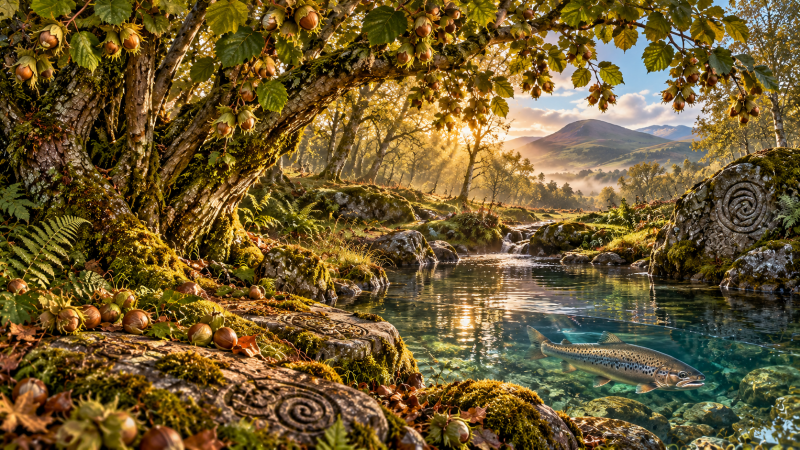
Hazel is one of the most fascinating trees in Irish mythology. Its nuts became associated with wisdom, knowledge and poetic inspiration, while magical hazel trees appear in one of Ireland's best-known traditions — the story of the Salmon of Knowledge.
In medieval Irish literature, hazelnuts fall into sacred water and are eaten by salmon, linking tree, river and animal in a remarkable chain of supernatural knowledge. The young Fionn mac Cumhaill ultimately gains this wisdom, creating a story that has remained one of the most enduring episodes of Irish mythology.
Beyond mythology, hazel was an immensely useful tree. Its flexible stems were harvested through coppicing and made into baskets, hurdles, fencing, walking sticks and countless everyday objects across Britain and Ireland.
Later folklore also connected hazel with divination, protection and the search for hidden water. As with other trees, some modern “Celtic meanings” combine genuine older traditions with much later interpretations.
Hazel therefore occupies an unusual position: an ordinary working tree of the countryside that also became associated with one of the most extraordinary substances imaginable — the knowledge and inspiration of the Otherworld.
The Hazels of Wisdom & the Well of Segais
One of the most remarkable traditions surrounding hazel appears in medieval Irish literature, where magical hazel trees grow beside a supernatural source of wisdom commonly known as the Well of Segais.
According to the tradition, hazelnuts fell from the trees into the water below. Salmon living in the water ate the nuts, and through doing so became associated with the knowledge and wisdom contained within them.
Different medieval texts preserve variations of the story, and the number and precise arrangement of the hazel trees are not always described in exactly the same way. What remains consistent is the powerful relationship between hazel, sacred water, salmon and supernatural knowledge.
The tradition also connects the well with the source of the River Boyne, one of Ireland's most important mythological rivers. In the story of Boann, approaching the forbidden well causes its waters to rise and flow outward, creating the Boyne.
Hazel therefore becomes part of a much larger mythological landscape. Knowledge does not exist only in books or human minds: it grows upon trees, falls into sacred water, passes into a salmon and can ultimately be transferred to a human being.
Few stories demonstrate more beautifully how Irish mythology connects animals, trees, rivers and the Otherworld into a single living landscape.
Hazel & the Salmon of Knowledge
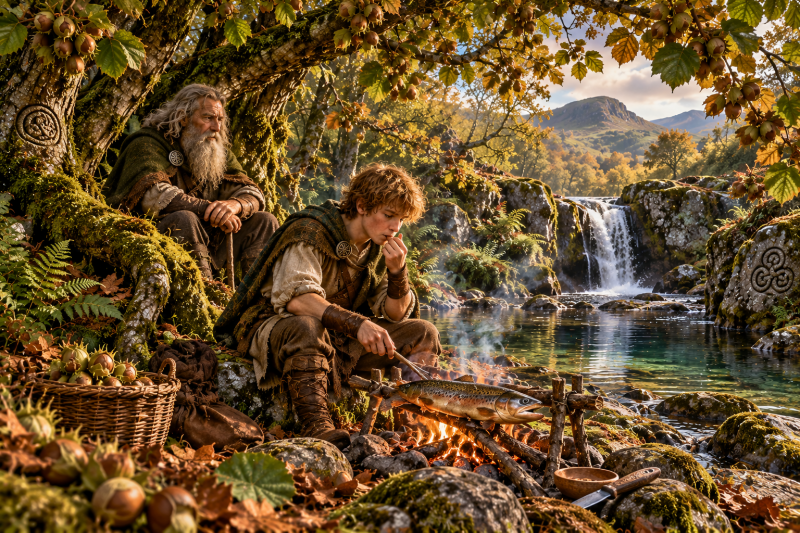
The connection between hazelnuts and supernatural wisdom reaches its most famous expression in the Irish story of Fionn mac Cumhaill and the Salmon of Knowledge.
According to the tale, the poet Finn Eces — sometimes rendered Finegas — had spent years seeking the extraordinary salmon associated with the source of wisdom. A prophecy had foretold that whoever first ate the fish would receive its knowledge.
The young Fionn was studying with the poet when the salmon was finally caught. Finn Eces instructed him to cook the fish but warned him not to eat any of it.
While cooking the salmon, a blister formed upon its skin. Fionn touched it with his thumb, burned himself and instinctively placed the thumb into his mouth. In that moment, the wisdom intended for the poet passed instead to Fionn.
Finn Eces recognised what had happened and allowed Fionn to eat the salmon. From then onward, tradition associated Fionn with extraordinary knowledge, poetry and insight. In later stories he could gain hidden knowledge by placing his thumb in his mouth.
Behind the famous salmon therefore stands another important element of the story: hazel. The fish's wisdom ultimately derives from the magical hazelnuts associated with the sacred waters, making the hazel tree an essential part of one of Ireland's greatest mythological traditions.
Discover the full story and wider traditions surrounding the fish:
The Salmon in Celtic & Irish Folklore →
Hazel, Wisdom & Poetic Inspiration
The association between hazel and wisdom extends beyond the simple idea that hazelnuts were magical food. In medieval Irish tradition, knowledge, poetry and inspiration were closely connected, and the hazels surrounding sacred waters became part of this wider world of supernatural understanding.
Poets occupied an important position in medieval Irish society. Learning involved years of training, while mythology imagined another kind of knowledge — insight that could come suddenly from contact with extraordinary places, animals or substances.
The story of Fionn illustrates this perfectly. His wisdom does not come through ordinary study alone. It passes from hazel to water, from water to salmon, and from salmon to Fionn, linking human knowledge directly with the natural and supernatural landscape.
This helps explain why hazel later became such a powerful symbol of inspiration, learning and hidden knowledge. The association is not simply a modern invention: it has genuine roots in medieval Irish literary tradition.
Modern Pagan and Celtic-inspired interpretations have expanded these themes, sometimes describing hazel as a tree of intuition, creativity and spiritual wisdom. These are contemporary developments, but they build upon a remarkably old connection between hazel and knowledge.
Hazel Rods, Divination & Finding Water
Hazel became strongly associated with divining rods and dowsing, the traditional practice of using a forked branch to search for hidden water, minerals or other objects beneath the ground.
Flexible forked branches of hazel were particularly favoured for this purpose in Britain and elsewhere in Europe. The dowser would hold the two ends of the branch while walking across the landscape, watching for movement of the rod that was interpreted as indicating something hidden below.
Over time, dowsing became surrounded by stories of people possessing a special ability to locate underground springs, wells, minerals and even buried treasure. Hazel's older associations with wisdom and hidden knowledge made it particularly well suited to this kind of folklore.
Dowsing remains practised today, but controlled scientific testing has not established it as a reliable method for detecting hidden water or objects. Its importance to folklore lies instead in the long-standing belief that the landscape contained things invisible to ordinary sight that certain people — sometimes aided by a particular tree — might nevertheless discover.
In this way, the hazel rod became another expression of the tree's wider reputation: a means of revealing knowledge that would otherwise remain hidden.
Hazel in the Working Countryside
Long before hazel became a modern symbol of Celtic wisdom, it was one of the most useful trees in the British and Irish countryside. Its ability to produce long, straight and flexible stems made it particularly suitable for coppicing.
Coppicing involves cutting a tree or shrub close to ground level and allowing new stems to grow from the base. Hazel responds extremely well to this form of management and can be harvested repeatedly without killing the plant.
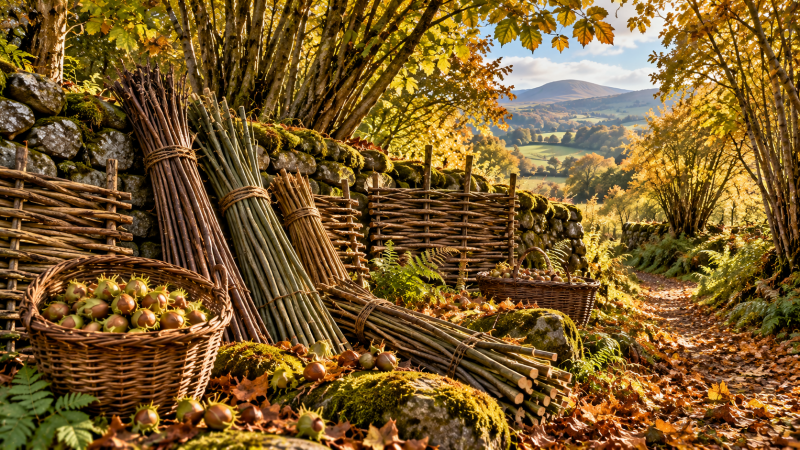
The resulting rods were used for woven hurdles, fencing, baskets, thatching spars, walking sticks and many other everyday objects. Hazel coppice also became an important feature of traditionally managed woodland.
Hazelnuts provided another valuable resource for both people and wildlife. Their annual appearance marked the progression toward autumn and connected the tree with the ordinary seasonal rhythms of rural life.
This practical history is an important counterpart to the mythology. The same tree whose nuts conveyed supernatural wisdom in Irish literature was also being cut, woven and harvested by generations of ordinary people.
Hazel in British & Irish Folklore
Hazel folklore developed differently across Britain and Ireland. In Ireland, its strongest surviving associations are with wisdom, sacred waters, poetry and supernatural knowledge, particularly through the traditions surrounding the hazels of wisdom and the Salmon of Knowledge.
Across Britain, hazel acquired additional associations with divination, protection and good fortune. Hazel rods became particularly familiar through dowsing traditions, while branches and nuts appeared in a variety of local customs.
Hazelnuts themselves were sometimes used in forms of love divination. In Britain and Ireland, nuts could be placed near a fire and their behaviour interpreted as a sign concerning lovers or future relationships. Such customs varied considerably from place to place and should not be imagined as one universal Celtic ritual.
Hazel also belonged firmly to the hedgerow and working woodland. Because people regularly harvested its nuts and cut its flexible stems, the tree remained closely connected with everyday rural life rather than becoming something encountered only in myth.
This combination is what makes hazel particularly interesting. In one tradition its nuts contain extraordinary wisdom; in another its branches reveal hidden water; elsewhere those same branches become baskets and fences. Mythology, folklore and ordinary countryside life all meet within the same tree.
Hazel Symbolism & Modern Paganism
In modern Paganism and Celtic-inspired spirituality, hazel is strongly associated with wisdom, knowledge, inspiration, intuition and creativity. Unlike some modern tree symbolism, these ideas have particularly strong roots in surviving medieval Irish tradition.
The magical hazels associated with sacred waters and the Salmon of Knowledge provide a clear historical connection between the tree and extraordinary wisdom. Through the story of Fionn mac Cumhaill, hazel also becomes linked with poetry, insight and knowledge that lies beyond ordinary learning.
Later traditions surrounding divining rods added another layer. Hazel could symbolically reveal what was hidden — whether underground water, buried objects or knowledge inaccessible to ordinary sight.
Modern practitioners may use hazel within spiritual or seasonal traditions as a symbol of learning, creativity, divination and the search for wisdom. These contemporary practices should not automatically be described as rituals inherited unchanged from the ancient Druids.
Hazel's modern symbolism is therefore unusual in having a particularly strong bridge between medieval Irish mythology and contemporary spiritual interpretation.
What Does the Hazel Tree Symbolise?
Hazel is most strongly associated with wisdom, knowledge and inspiration, particularly within Irish mythology.
Medieval traditions surrounding magical hazel trees, sacred water and the Salmon of Knowledge provide some of the clearest evidence behind this symbolism. Hazelnuts become sources of supernatural wisdom, which ultimately passes to Fionn mac Cumhaill.
British and later European folklore added associations with divination, hidden knowledge and good fortune, while the practical importance of hazel connected the tree with woodland crafts, harvest and everyday rural life.
Modern Pagan traditions commonly extend these themes to include intuition, creativity, learning and spiritual wisdom.
Rather than representing one universal ancient “Celtic meaning”, hazel's symbolism developed through mythology, folklore and centuries of practical interaction with the tree.
Explore Related Folklore
Hazel's association with wisdom, sacred water and the Salmon of Knowledge connects it with several other traditions across Irish mythology. Explore the animals, landscapes and supernatural places that form part of the same remarkable world of stories.
The Salmon in Celtic & Irish Folklore — discover the wider mythology of the Salmon of Knowledge and the extraordinary wisdom associated with the fish.
Salmon folklore page
Sacred Waters, Wells & Rivers — explore the folklore surrounding sacred wells, rivers and supernatural waters across Britain and Ireland.
Sacred Waters, Wells & Rivers
The Celtic Otherworld — discover the mysterious landscapes and supernatural realms of Celtic tradition.
The Celtic Otherworld
Sources & Further Reading
CELT — Corpus of Electronic Texts, University College Cork
A major collection of Irish historical and literary texts, including medieval material useful for exploring Fionn mac Cumhaill, Irish mythology and traditions surrounding supernatural knowledge.
CELT — University College Cork
Dúchas — National Folklore Collection of Ireland
An extensive archive of Irish folklore containing traditional material concerning trees, plants, wells, divination and rural customs.
Woodland Trust — Hazel
Useful background on hazel (Corylus avellana), including its ecology, traditional uses, coppicing and folklore.
Royal Botanic Gardens, Kew — Corylus avellana
Botanical reference material for common hazel.