Ivy in British, Irish & Celtic Folklore
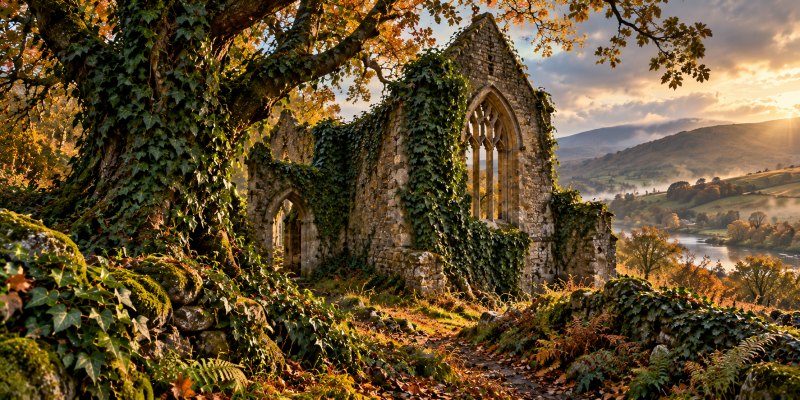
Clinging to ancient trees, stone walls and ruined buildings, ivy remains green through the darkest months of the year. Its ability to climb, spread and survive in shaded places has made it one of the most distinctive plants of the British and Irish landscape.
Ivy accumulated an extraordinary range of traditions. It became associated with winter greenery, protection, friendship, fidelity and endurance, while its evergreen leaves made it a familiar companion to holly during Christmas and midwinter celebrations.
Older traditions extend beyond Britain and Ireland. In classical mythology ivy was particularly associated with Dionysus, the Greek god of wine, while later British customs connected ivy with alehouses, seasonal festivities and household divination.
Ivy also appears in the later Ogham tree tradition through Gort. Modern Pagan and Celtic-inspired spirituality has subsequently developed associations with persistence, connection, transformation and the continuing cycle of life.
Yet ivy's symbolism has accumulated over many centuries. Not every modern meaning attributed to it can be traced directly to ancient Celtic religion, and traditions surrounding the plant often combine classical mythology, medieval custom, British folklore and modern Pagan interpretation.
From ruined churches wrapped in greenery to holly and ivy brought indoors at midwinter, this familiar climbing plant has become deeply entwined with ideas of survival, attachment and the persistence of life through winter.
Gort — Ivy & the Ogham Tradition
Ivy is commonly associated with Gort, one of the letters of the Ogham alphabet. As with the other plants in the later Ogham tree tradition, however, the relationship is more complicated than modern “Celtic Tree Alphabet” charts sometimes suggest.
Ogham began as an early writing system, and surviving inscriptions primarily record names, ancestry and relationships rather than instructions for tree magic or divination.
Medieval Irish scholarship later developed extensive associations around the Ogham letters, including connections with trees and plants. Ivy consequently became part of the wider body of tree lore that grew around the alphabet.
Modern Druidry and Pagan spirituality have expanded Gort's symbolism considerably. Because ivy climbs, binds itself to other surfaces and remains evergreen, it is now frequently associated with connection, determination, endurance and continuing life.
These modern meanings can form meaningful traditions in their own right, but they should not automatically be described as beliefs inherited unchanged from the ancient Druids.
Holly & Ivy — Midwinter Greenery
Holly and ivy have been brought together in British seasonal tradition for centuries. Both remain green during winter, making their foliage particularly striking when many deciduous trees have lost their leaves.
Evergreen branches were used to decorate homes and buildings during the Christmas season, while holly and ivy also appear together in traditional songs. The best-known surviving example is “The Holly and the Ivy,” although the familiar carol combines plant imagery with explicitly Christian symbolism.
Older folk customs surrounding winter greenery varied considerably between regions. Holly, ivy and other evergreens could all be brought indoors, while rules sometimes developed about when decorations should be put up or removed.
Modern Pagan traditions often interpret holly and ivy through ideas of seasonal balance, enduring life and the continuing cycle of the year. Some writers assign them ancient male and female roles, but such neat systems should not automatically be projected back into pre-Christian Celtic religion.
What is much easier to understand is why evergreen plants became important at midwinter: when the surrounding landscape appears dormant, holly and ivy remain visibly alive.
Ivy, Dionysus & the Ancient World
Ivy had powerful symbolism long before many of the British traditions recorded around it. In the ancient Greek world, the plant was particularly associated with Dionysus, the god connected with wine, theatre, ecstasy and religious celebration.
Dionysus and his followers were frequently depicted wearing crowns or wreaths of ivy, and the plant became one of his recognisable attributes. Ivy could decorate the thyrsus — the staff carried by Dionysus and his followers — alongside vine leaves and other vegetation.
The reason for the association is not entirely straightforward. Ivy's evergreen character may have contributed to its symbolism, while its close connection with Dionysian celebration placed it alongside the grapevine despite the two plants being very different.
This is classical Greek tradition rather than Celtic mythology, but classical ideas circulated widely through European literature and culture. Over many centuries they contributed another layer to the symbolism surrounding ivy.
Keeping the traditions separate is useful. Ivy does not need to be labelled universally “Celtic” for its folklore to be fascinating — its history crosses different cultures, religions and periods.
Ivy, Alehouses & the Tavern Sign
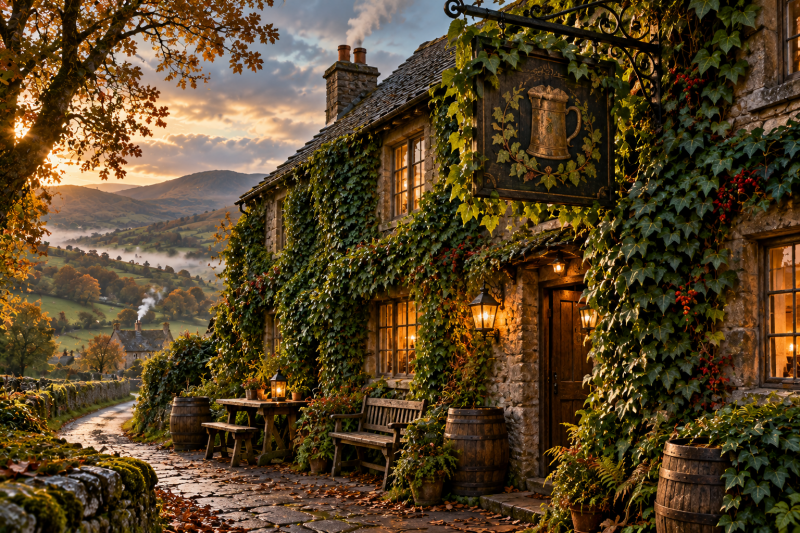
Ivy also developed an intriguing connection with ale and drinking houses. In medieval and early modern Europe, greenery displayed outside a building could indicate that drink was available within.
Ivy became particularly associated with this tradition, contributing to the old expression “Good wine needs no bush.” A “bush” or bunch of greenery could act as a simple sign advertising an establishment selling wine or ale.
The custom belongs to a wider history of signs that existed before widespread literacy. A traveller did not necessarily need to read a painted name if a familiar object or bundle of greenery identified the type of establishment ahead.
Ivy's older association with Dionysus makes the connection especially interesting, although we should not assume that every British ivy-covered tavern represented a conscious survival of ancient Greek religious symbolism.
Instead, ivy acquired another practical cultural identity: alongside the ruined wall, winter garland and woodland tree, it could also belong to the inn, alehouse and convivial gathering place.
Ivy, Protection & Good Fortune
Ivy acquired a variety of associations with protection and good fortune in British folk tradition. Its evergreen leaves and remarkable ability to survive in difficult conditions made it an obvious plant around which ideas of endurance could develop.
Bringing evergreen foliage indoors during winter formed part of seasonal decorating traditions, although beliefs about ivy varied from place to place. In some communities it was welcomed into the home, while elsewhere there could be rules or warnings concerning when ivy should be brought indoors or how long it should remain there.
Ivy could also appear in customs concerned with predicting luck, health or relationships. Like many forms of folk divination, these practices differed considerably between regions and were often passed down locally rather than forming part of one universal tradition.
The plant's habit of clinging tightly to trees and buildings later encouraged symbolism surrounding loyalty, attachment and fidelity.
These traditions show how easily ivy's physical characteristics could become metaphor. A plant that remains green, survives winter and holds firmly to its support naturally lends itself to stories about persistence, protection and enduring bonds.
Ivy Among Ruins & Churchyards
Few plants are as visually associated with old buildings as ivy. Across Britain and Ireland it climbs stone walls, ruined cottages, castles, churches and churchyard boundaries, sometimes surviving long after the people who built them have disappeared.
This has given ivy a powerful place in the imagery of memory and the past. A ruined building covered in evergreen leaves can appear simultaneously abandoned and alive — human stonework slowly becoming part of the surrounding landscape.
During the eighteenth and nineteenth centuries, ivy-covered ruins became particularly popular in Romantic art and literature, where they could evoke antiquity, melancholy, memory and the passage of time.
Ivy is sometimes described today as an ancient Celtic symbol of immortality. Its evergreen nature certainly makes that interpretation understandable, but claims of a single universal ancient Celtic meaning should be treated cautiously.
The real image is powerful enough without embellishment: generations pass, buildings crumble, and the ivy continues growing across the stones.
Ivy, Love & Fidelity
Ivy's habit of attaching itself firmly to trees, walls and buildings helped it become a natural symbol of attachment, friendship and enduring love.
Over time, this physical characteristic encouraged associations with loyalty and fidelity. Ivy could appear in decorative imagery connected with lasting relationships, while its evergreen leaves reinforced the idea of something continuing through changing seasons.
Ivy also appears in British folk customs involving love and divination. As with apples, nuts and other familiar plants, leaves could become part of attempts to predict future relationships, marriage or good fortune.
These customs were not necessarily remnants of an organised ancient Celtic system. Many recorded examples belong to much later folk tradition, when fortune-telling games formed part of seasonal gatherings and social entertainment.
Nevertheless, the symbolism is easy to understand. Ivy holds tightly to what supports it and remains green through winter, making it a powerful natural image of connection, constancy and relationships that endure.
Ivy in British & Irish Folklore
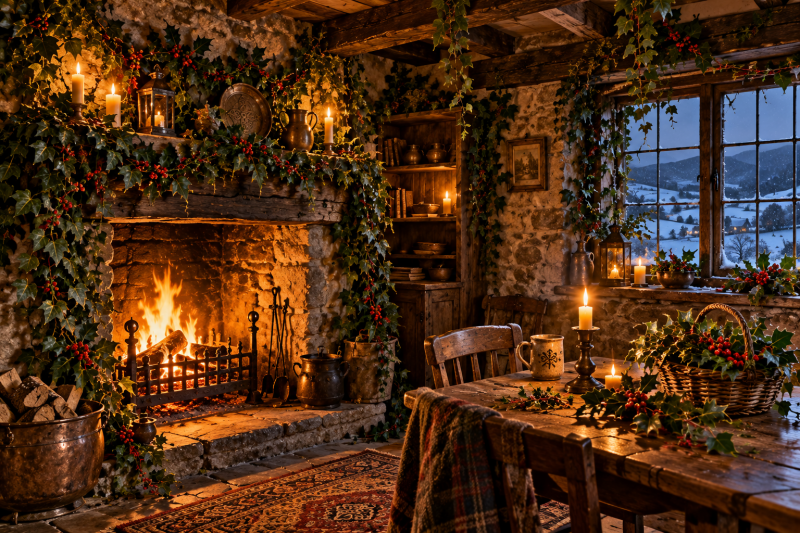
Ivy's folklore is unusually layered. Classical tradition associated it with Dionysus and wine, medieval and later customs connected greenery with inns and alehouses, and British winter traditions brought ivy indoors alongside holly and other evergreens.
Folk belief added ideas of protection, luck and divination, while ivy-covered churches and ruins gradually became powerful images of memory, age and the passing of time.
The later Ogham tree tradition provides another strand through Gort, while modern Paganism has developed further associations with endurance, transformation, connection and continuing life.
These traditions did not all originate at the same time or from the same culture. That is precisely what makes ivy interesting: its symbolism accumulated as different generations encountered the same persistent evergreen plant.
Ivy therefore belongs simultaneously to the winter home, woodland tree, ruined church, old inn and modern Pagan altar — each setting adding another layer to its remarkable cultural history.
Ivy Symbolism & Modern Paganism
In modern Paganism and Celtic-inspired spirituality, ivy is commonly associated with endurance, connection, protection, transformation and the persistence of life.
Its evergreen leaves provide an obvious foundation for these meanings. While many plants retreat during winter, ivy remains green, continuing to climb across trees, walls and old stonework.
Ivy's association with Gort in the later Ogham tradition has also influenced contemporary interpretations. Modern practitioners may use ivy as a symbol of determination, personal growth, friendship or the connections that bind people and communities together.
Midwinter traditions provide another important influence. Ivy's long-standing use as seasonal greenery alongside holly has encouraged modern associations with the Wheel of the Year, Yule and the continuation of life through winter.
These modern meanings do not need to be presented as an unchanged spiritual system inherited from the ancient Celts. Ivy's symbolism is better understood as a living tradition formed from Ogham, seasonal customs, folklore, classical influences and the natural characteristics of the plant itself.
What Does Ivy Symbolise?
Ivy is commonly associated with endurance, fidelity, friendship, protection and continuing life.
Its ability to remain green throughout winter contributed naturally to ideas of survival and persistence, while its habit of clinging firmly to trees and stone encouraged symbolism surrounding attachment and lasting relationships.
Winter decorating traditions connect ivy with seasonal renewal, while ivy-covered ruins have made the plant an enduring image of memory and the passage of time.
Modern Pagan traditions have expanded these associations through Gort and contemporary interpretations of the Ogham tree tradition.
Rather than possessing one universal ancient “Celtic meaning”, ivy accumulated its symbolism through nature, folklore, seasonal custom, literature and centuries of human imagination.
Explore Related Folklore
From winter greenery and ancient ruins to Ogham and old alehouse traditions, ivy connects several very different strands of British and Irish folklore. Explore some of the related plants, festivals and landscapes that form part of this wider tradition.
Add these four internal links:
The Holly in British, Irish & Celtic Folklore — explore holly's connections with winter greenery, protection, Christmas tradition and modern Pagan symbolism.
Yule — The Midwinter Festival — discover the folklore, customs and symbolism surrounding the darkest part of the year.
Sacred Trees & Ancient Landscapes — explore the relationship between trees, old places, monuments and the British and Irish landscape.
Sources & Further Reading
Woodland Trust — Ivy
Useful background on common ivy (Hedera helix), including its ecology, wildlife value, traditional uses and folklore.
Royal Botanic Gardens, Kew — Hedera helix
Botanical information on common ivy and its place within the Hedera genus.
Kew Science — Plants of the World Online
Dúchas — National Folklore Collection of Ireland
A major searchable archive of Irish folk belief and traditional customs, useful for investigating ivy, seasonal greenery and plant lore.
Dúchas — National Folklore Collection
CELT — Corpus of Electronic Texts, University College Cork
A collection of early and medieval Irish texts useful for researching Ogham and the historical background surrounding Gort.
CELT — University College Cork
Theoi — Dionysus
A useful collection of translated classical sources concerning Dionysus, including the god's association with ivy.