The Willow in British, Irish & Celtic Folklore
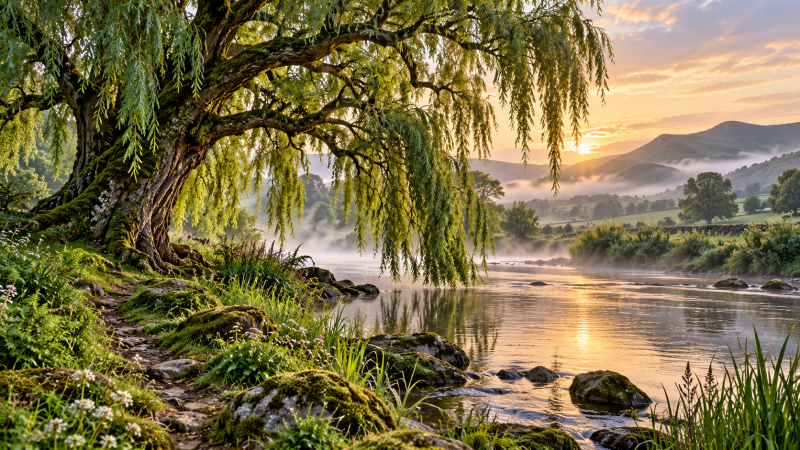
Few trees seem as closely connected with water as the willow. Growing beside rivers, streams, ponds and wet ground, its long flexible branches and ability to regenerate rapidly have made it a familiar feature of British and Irish landscapes for centuries.
Willow became surrounded by a remarkable mixture of traditions. It could be associated with healing, mourning, protection, witchcraft and enchantment, while its flexible stems provided one of the countryside's most useful materials for baskets, hurdles and other woven objects.
The tree also appears within the later Ogham tradition, where willow became associated with Saille. Modern Pagan spirituality has expanded this connection considerably, particularly through associations with water, intuition, the Moon and feminine spirituality.
Some of these ideas have genuine roots in older folklore, while others are much more recent. Willow's modern reputation as an ancient Celtic “tree of the Moon”, for example, is considerably more complicated than it sometimes appears online.
The real story of willow brings together rivers and wetlands, traditional medicine, rural craftsmanship, mourning customs, folk magic and modern Pagan belief — all surrounding a tree whose branches bend remarkably without easily breaking.
Saille — Willow & the Ogham Tradition
Willow is associated with Saille, one of the letters of the Ogham alphabet. As with Beith and Nion, this connection is genuine, although the elaborate spiritual meanings attached to Saille in modern books developed much later than the earliest Ogham inscriptions.
Ogham itself began as a writing system, with surviving inscriptions largely recording personal names, ancestry and relationships. Medieval Irish scholars subsequently preserved associations between Ogham letter names and trees or plants, helping create the tree lore familiar today.
Modern Druidry and Pagan traditions have greatly expanded the symbolism of Saille. Willow is now frequently associated with intuition, emotion, dreams, water and the Moon.
Some of these associations make intuitive sense because many willow species thrive beside rivers and on wet ground. However, we should be cautious about describing the entire modern symbolism as a spiritual system inherited unchanged from ancient Druids.
Willow's connection with Saille gives it a genuine place within the later Ogham tree tradition, while its broader meanings demonstrate how historical material can continue to inspire new traditions centuries later.
Willow, Water & the Landscape
Willow seems almost inseparable from water. Many species thrive in damp soils, riverbanks, wetlands and the edges of ponds, where their extensive root systems can become part of the living structure of the bank.
This natural association helps explain why water became so prominent in later willow symbolism. Rivers themselves occupy an important place within British and Irish folklore, sometimes representing boundaries, journeys, healing or entrances into supernatural landscapes.
Yet a willow beside a river did not automatically constitute a sacred site. The relationship between tree and water is first of all ecological — one that generations of people repeatedly encountered in the countryside.
Willow also regenerates remarkably readily. Cut branches of some species can root when placed into sufficiently damp ground, while pollarded or coppiced trees repeatedly produce new shoots.
Water, flexibility and regeneration therefore provide a natural foundation for later associations with change, resilience, emotion and renewal.
Willow, Healing & the Story of Aspirin
Willow has a long association with pain relief and traditional medicine. Preparations made from willow bark were used historically for complaints involving pain and fever, although methods and traditions varied considerably between cultures and periods.
The connection has a genuine chemical basis. Willow contains compounds called salicylates, including salicin. During the nineteenth century, research into salicin and related substances contributed to the development of medicines based on salicylic acid.
The history of modern aspirin is more complicated than the popular claim that aspirin is simply “made from willow bark”. Aspirin — acetylsalicylic acid — was developed through pharmaceutical chemistry, although the earlier investigation of willow and other salicylate-containing plants forms an important part of its scientific history.
This makes willow particularly interesting because traditional plant knowledge and modern medicine genuinely intersect. People used willow medicinally long before its chemistry was understood, while later scientists were able to investigate the substances responsible for some of its effects.
Historical willow remedies should not be treated as instructions for self-medication. Willow bark can cause side effects and interact with medicines, and its salicylate content is not equivalent to taking a controlled dose of a modern pharmaceutical.
Willow, Mourning & Sorrow
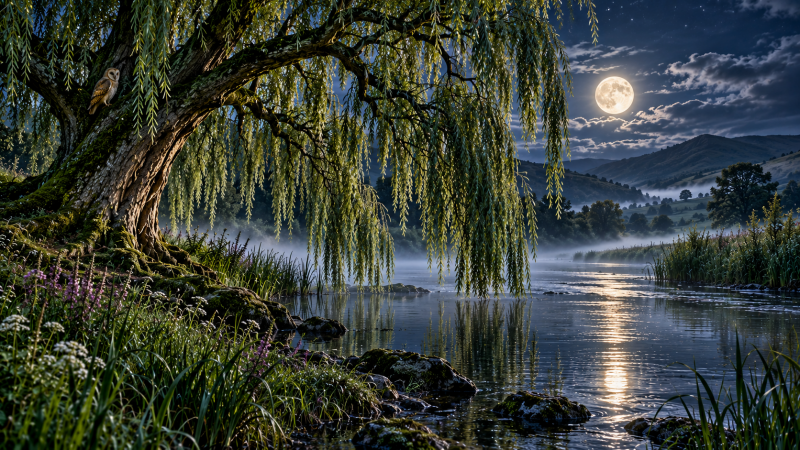
Willow also developed powerful associations with grief, lost love and mourning, particularly in British literary and popular tradition.
The image of the drooping willow naturally lent itself to ideas of sadness. By the early modern period, willow appears in songs, literature and drama as an emblem connected with forsaken lovers and sorrow.
Shakespeare made use of this established imagery. Willow appears in works including Othello and Hamlet, reinforcing an association between the tree, loss and tragic love that remained familiar for centuries.
The later popularity of the weeping willow made the connection even more visually powerful. Its hanging branches became a familiar feature of melancholy landscapes, cemetery art and imagery associated with remembrance.
This tradition is quite different from the modern Pagan idea of willow as a tree of intuition or lunar energy. Together they demonstrate how one tree can accumulate very different meanings through folklore, literature, landscape and spiritual interpretation.
Willow & the Moon — Ancient Belief or Modern Symbolism?
Willow is frequently described today as a sacred tree of the Moon, particularly in modern Pagan, Wiccan and Celtic-inspired writing. Its association with water, emotion, intuition and changing cycles makes the connection feel remarkably natural.
However, claims that the ancient Celts universally regarded willow as a lunar tree should be treated cautiously. The surviving early Irish evidence does not provide us with a complete ancient system assigning individual trees to planets, months or phases of the Moon.
Much of the elaborate lunar symbolism surrounding willow belongs to later interpretation and modern spiritual tradition. The popular Celtic Tree Calendar has also helped strengthen the idea that particular trees corresponded to fixed periods of the year.
This does not mean that modern lunar symbolism is meaningless. Willow naturally inhabits watery landscapes, and the Moon's visible relationship with tides and cycles provides powerful imagery for contemporary spiritual traditions.
The distinction simply helps us appreciate two different things: the historical folklore surrounding willow and the living symbolism that people continue to create around the tree today.
Willow, Witchcraft & Folk Magic
Willow also became associated with magic, enchantment and witchcraft in later folklore and popular imagination. Its unusual form, waterside habitat and ability to regenerate from cut branches gave the tree qualities that could easily appear mysterious.
Willow wood and branches have subsequently found a place in various forms of modern folk magic and Pagan practice, particularly in traditions concerned with water, divination, dreams, healing and intuition.
Care is needed when projecting these practices backwards. A modern willow wand or lunar ritual should not automatically be described as something performed by the ancient Druids simply because willow appears in Ogham tradition.
Older folklore and modern magical practice often influence one another, however. Trees already surrounded by stories provide natural material from which new customs and symbolism can develop.
Willow therefore occupies an interesting boundary between recorded folk tradition and continuing spiritual creativity — exactly the sort of boundary where folklore has always tended to grow.
Willow Basketry, Coppicing & the Working Countryside
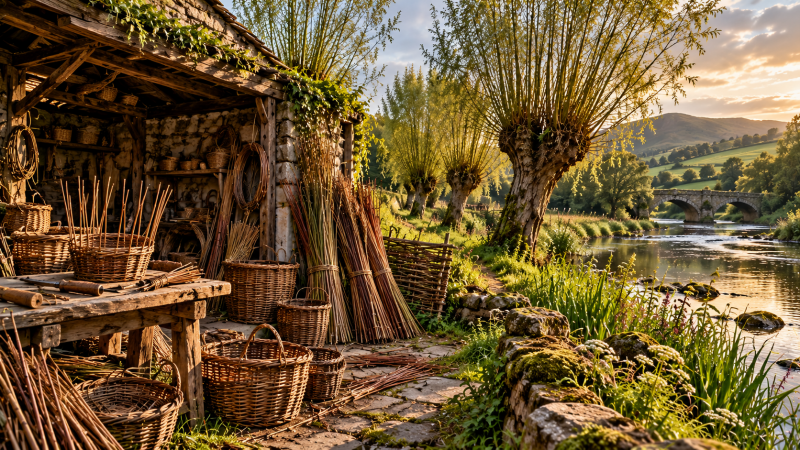
For generations, one of willow's greatest values was not magical at all. Its young stems are long, flexible and remarkably suitable for weaving, making willow an important material for basketry and countless other rural objects.
Willow could be managed through coppicing or pollarding, encouraging the tree to produce repeated crops of straight young shoots. Particular varieties were cultivated specifically for their flexible rods, commonly known as withies or osiers.
These rods could be woven into baskets, fish traps, hurdles and containers, while willow also found uses in fencing and other forms of rural construction. Basket-making became a skilled craft in areas where suitable willow could be grown and harvested.
The Somerset Levels became particularly famous for commercial willow growing, where the wet landscape provided ideal conditions for the crop. Willow cultivation and basket-making became closely connected with the character and economy of the area.
This practical history provides an important counterpart to the folklore. The willow beside the water was not merely a symbol of emotion, magic or the Moon — it was also a renewable resource that people could cut, regrow, harvest and weave year after year.
Willow in British & Irish Folklore
Willow folklore developed from many different strands rather than one single Celtic tradition. Its association with water, its medicinal history, its flexible branches and its distinctive appearance all contributed to the stories and symbolism that gathered around it.
In Britain, willow became particularly associated with mourning and forsaken love through literature and popular tradition. Folk medicine preserved another side of the tree, while basketry and coppicing kept willow firmly rooted in everyday rural life.
Irish tradition adds the connection with Saille and the later Ogham tree tradition, while modern Pagan practice has developed additional associations with intuition, lunar cycles, dreams and spiritual cleansing.
Some of these traditions are ancient or medieval, some belong to later folklore, and others are distinctly modern. Treating them separately allows the history of willow to remain visible rather than blending everything into an imaginary universal “Celtic belief”.
Willow's story is richer because of those layers. A riverside tree, medicinal plant, basket-maker's material, literary symbol and modern spiritual emblem can all exist within the same history.
Willow Symbolism & Modern Paganism
In modern Paganism and Celtic-inspired spirituality, willow is strongly associated with water, intuition, emotion, healing, flexibility and the Moon.
Some of these meanings reflect the natural character of the tree. Willows thrive in wet landscapes, their flexible branches bend without easily breaking, and many species regenerate readily after being cut. These qualities provide powerful symbols of adaptation, resilience and renewal.
The connection between willow and Saille in the Ogham tradition has also influenced modern spiritual interpretations. Contemporary practitioners may associate the tree with dreams, intuition, emotional understanding or periods of personal change.
Lunar symbolism is particularly prominent today, although the idea of willow as a universal ancient Celtic “Moon tree” should be treated cautiously. Much of the detailed system connecting willow with lunar cycles belongs to modern Pagan and esoteric tradition rather than surviving early Celtic evidence.
Modern willow symbolism therefore combines genuine Ogham tradition, older folklore, the ecology of the tree and contemporary spiritual practice.
What Does the Willow Tree Symbolise?
Willow is commonly associated with healing, resilience, emotion, mourning, intuition and renewal.
Its close relationship with water contributes to modern symbolism surrounding emotion and change, while its flexible branches provide an obvious image of the ability to bend without breaking.
Historical medicinal use gave willow a genuine connection with healing, while British literary and folk traditions developed powerful associations with sorrow, mourning and lost love.
Saille and the later Ogham tree tradition add another historical strand, while modern Paganism has expanded willow's symbolism to include the Moon, dreams and intuition.
There is therefore no single ancient “Celtic meaning” of willow. Its symbolism developed through landscape, medicine, folklore, literature, practical craft and modern spiritual tradition.
Explore Related Folklore
Willow's story connects rivers and wetlands with healing, Ogham, traditional craft and centuries of changing folklore. Explore some of the other trees, waters and beliefs that form part of the same British and Irish landscape.
Sacred Waters, Wells & Rivers — explore the folklore surrounding rivers, holy wells, offerings and supernatural waters across Britain and Ireland.
Sacred Waters, Wells & Rivers
The Birch in British, Irish & Celtic Folklore — discover Beith, Ogham, renewal, purification and traditional birch customs.
Birch folklore page
The Ash Tree in British, Irish & Celtic Folklore — explore Nion, Ireland's legendary trees, healing customs and protective folklore.
Ash folklore page
Sources & Further Reading
Woodland Trust — Willow
Useful background on Britain's native willows, their ecology, wildlife value, traditional uses and folklore.
Royal Botanic Gardens, Kew — Salix
Botanical reference material for the willow genus and its many species.
Kew Science — Plants of the World Online
Dúchas — National Folklore Collection of Ireland
A major archive of Irish folk belief and traditional practices, useful for researching willow, healing traditions and plant lore.
Dúchas — National Folklore Collection
CELT — Corpus of Electronic Texts, University College Cork
A valuable collection of early and medieval Irish texts for investigating Ogham and the historical background to Saille.