The Apple Tree in British, Irish & Celtic Folklore
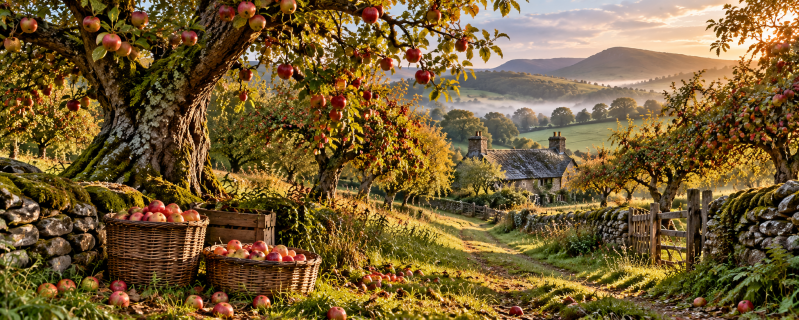
Few fruits carry as much mythology as the apple. Across the traditions of Britain and Ireland, apples became associated with harvest, abundance, love, divination and mysterious otherworldly places.
Medieval Irish literature tells of extraordinary islands and realms where magical apple trees grow, while the name Emain Ablach itself has long been associated with apples. Across the Irish Sea, medieval Arthurian tradition gave us Avalon, the mysterious island to which the wounded King Arthur was carried.
Apples also belonged firmly to ordinary rural life. Orchards were valuable places, and customs developed around ensuring a good harvest. In parts of Britain, orchard wassailing involved visiting apple trees in winter with noise, drink and ceremony in the hope of encouraging another fruitful year.
At autumn festivals, apples became part of games and divination traditions. Apple bobbing, peel divination and customs concerning love and marriage eventually became familiar features of Halloween and Samhain-season celebrations.
Modern Pagan traditions have added further meanings, connecting apples with the Otherworld, love, fertility, harvest, immortality and ancestral wisdom. As with so much Celtic-inspired symbolism, some of these ideas have deep historical roots while others developed much later.
From supernatural islands to cider orchards, the apple tree connects mythology with the agricultural year in a way few other trees can match.
Apples & the Irish Otherworld
Apples appear repeatedly in medieval Irish tales involving journeys beyond the ordinary human world. They can be associated with mysterious islands, supernatural visitors and places where the normal rules of time and mortality no longer seem to apply.
One particularly striking example appears in The Voyage of Bran. A mysterious woman from the Otherworld gives Bran a silver branch bearing white blossoms. After hearing her describe extraordinary lands across the sea, Bran and his companions set out upon their famous voyage.
Another important name is Emain Ablach, an otherworldly island or realm appearing in medieval Irish tradition. Its name has long been interpreted in connection with apples, contributing to the wider association between apple-bearing islands and supernatural landscapes.
These stories belong to a much richer Irish tradition of voyages to extraordinary places across or beneath the sea. Such realms may contain beautiful landscapes, endless abundance and strange relationships with time, themes that also appear elsewhere in Irish Otherworld literature.
Apples therefore became especially well suited to later symbolism surrounding immortality, abundance and passage into the Otherworld. Yet the surviving stories are more interesting than a simple symbolic definition: the apple can actually become part of the story that draws a human traveller away from the familiar world.
Avalon — The Mysterious Isle of Apples

Across the Irish Sea, apples also became associated with one of the most famous mysterious islands in British legend: Avalon.
Avalon appears prominently in the medieval Arthurian tradition. Geoffrey of Monmouth's twelfth-century Historia Regum Britanniae describes Arthur being taken to the island after he is mortally wounded at the Battle of Camlann.
Geoffrey later described the island more fully in Vita Merlini, calling it Insula Pomorum — the Island of Apples — and portraying it as an extraordinarily fertile place where crops grow without ordinary cultivation.
Later Arthurian tradition greatly expanded Avalon's mystery, linking it with enchantment, Morgan le Fay and the possibility that Arthur might one day return.
Modern writers frequently describe Avalon simply as an ancient “Celtic Otherworld”. There are certainly interesting parallels with Irish stories of supernatural islands, but the surviving Arthurian material developed through medieval Welsh, Breton, French and Latin literary traditions. It is therefore better to explore the similarities without pretending that every version came from one unchanged ancient Celtic belief.
What remains extraordinary is the recurring image itself: somewhere beyond the ordinary world lies an island of abundance, and apples grow there.
Apples, Samhain & Divination
Apples became closely associated with autumn festivities across Britain and Ireland. By the time the harvest was gathered and winter approached, apples were readily available for food, games and forms of popular divination.
One of the best-known customs is apple bobbing, in which players attempt to catch floating apples using only their mouths. Variations of apple games became associated with Halloween celebrations in Britain and Ireland, alongside nuts, fires and other seasonal customs.
Apples could also be used in love divination. In one familiar tradition, a person attempted to peel an apple in a single continuous strip before throwing the peel over their shoulder. The shape it formed was then interpreted as the initial of a future husband or wife.
Other games involved suspended apples, while apple seeds and peel could acquire their own fortune-telling traditions. These customs varied considerably by region and period and were often performed as entertainment as much as serious supernatural practice.
Modern Pagan celebrations frequently connect apples directly with Samhain, the dead and the Otherworld. Some of that symbolism draws upon genuine autumn customs, although today's spiritual interpretations should not automatically be projected unchanged into ancient Celtic religion.
What is certain is that apples became deeply woven into the traditional celebrations surrounding the end of harvest and beginning of winter.
Apples, Love & Marriage
Apples also became associated with courtship, love and marriage, particularly through the many games and divination customs practised by young people.
Apple-peel divination could supposedly reveal the initial of a future partner, while other traditions attempted to predict who would marry, whom they would marry or how fortunate the relationship might be.
The apple's abundance of seeds and its importance as a harvest fruit also made it an easy later symbol of fertility and abundance.
Yet not every apple custom belonged to an ancient fertility rite. Many recorded traditions were social games performed at gatherings, particularly around Halloween and other autumn celebrations.
That mixture is part of what makes folklore interesting. A simple fruit grown in an orchard could become food, entertainment, a courtship game and a glimpse into an imagined future — sometimes all during the same evening.
Wassailing the Apple Trees
In several cider-producing regions of England, particularly in the West Country, winter brought a remarkable custom known as orchard wassailing. Groups gathered among the apple trees to drink, sing, make noise and ceremonially wish the orchard a good harvest for the coming year.
Customs differed from place to place. Cider might be poured around the roots of an important tree, while pieces of toast soaked in cider could be placed among its branches. Songs or spoken verses addressed the tree directly and encouraged it to produce an abundant crop.
Noise was another important part of some celebrations. Pots, pans, guns or other loud instruments could be used to create a tremendous racket, sometimes explained as frightening harmful spirits away from the orchard.
Wassailing demonstrates just how personally people could relate to the trees upon which their livelihood depended. The apple tree was not merely a crop to be harvested — it could be visited, toasted, sung to and encouraged.
Orchard wassailing continues today in parts of Britain. Some celebrations preserve local traditions while others have been revived or reinvented, allowing an old agricultural custom to remain part of the modern winter calendar.
Apples, Harvest & Cider
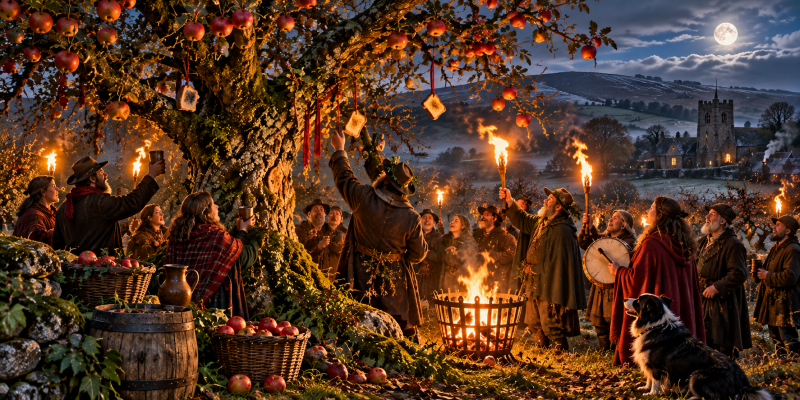
Beyond mythology and divination, apples were an important part of the rural economy. Orchards supplied fruit for eating, cooking and preserving, while vast quantities were grown specifically for cider making.
In traditional cider regions, autumn apple picking was followed by crushing and pressing the fruit to release its juice. Fermentation then transformed that juice into cider, creating a drink capable of being stored long after the fresh fruit had disappeared.
Orchards therefore formed part of the agricultural rhythm of the year. Blossom in spring, developing fruit through summer, harvest in autumn and wassailing in winter created a cycle that communities could watch and participate in generation after generation.
Old orchards also developed their own distinctive character. Crooked trees, hollow trunks, fallen fruit and grassland beneath the canopy created landscapes quite different from modern intensive fruit production.
This practical relationship with the apple tree helps explain why so much folklore gathered around it. Abundance was not merely symbolic — a successful apple harvest could genuinely matter to a household or community.
Apple Symbolism & Modern Paganism
In modern Paganism and Celtic-inspired spirituality, the apple has become associated with love, abundance, fertility, healing, wisdom and the Otherworld.
Unlike some modern tree symbolism, several of these associations have strong connections with older traditions. Medieval Irish literature genuinely links apples with supernatural journeys and otherworldly places, while Arthurian literature developed the mysterious apple-bearing island of Avalon.
Harvest customs provide another layer. Apples were important autumn foods, while games and divination involving apples became part of Halloween-season celebrations. Orchard wassailing demonstrates the importance of maintaining the relationship between people, trees and the coming harvest.
Modern practitioners may use apples during Samhain, harvest celebrations or rituals concerned with ancestors, love and abundance. The five-pointed pattern visible when some apples are cut across the centre has also acquired spiritual significance in some contemporary traditions.
As always, modern practice should not automatically be presented as unchanged ancient Celtic religion. Apple's symbolism has developed through medieval mythology, agricultural custom, folk belief, literature and contemporary Pagan spirituality.
What Does the Apple Tree Symbolise?
Apple is commonly associated with abundance, love, fertility, harvest and the Otherworld.
Its symbolism comes from several different traditions. Irish Otherworld tales connect apples with supernatural places and journeys, while medieval Arthurian literature gives us Avalon — the famous Island of Apples.
Autumn customs link apples with divination, courtship and the end of harvest, while orchard wassailing reflects hopes for renewal and future abundance.
Modern Pagan traditions have expanded these themes to include ancestral wisdom, immortality and spiritual journeys.
Rather than having one universal ancient “Celtic meaning”, the apple tree accumulated its symbolism through storytelling, orchard life, seasonal customs and centuries of changing belief.
Explore Related Folklore
From mysterious islands beyond the sea to winter wassailing in old orchards, apple folklore connects the Otherworld with the changing agricultural year. Explore some of the traditions and landscapes that surround these stories.
The Celtic Otherworld — explore Annwn, supernatural landscapes and traditions surrounding places beyond the ordinary human world.
Link to your existing Celtic Otherworld page.
Samhain — The Celtic Festival at Winter's Beginning — discover the autumn festival, seasonal customs and traditions surrounding the beginning of winter.
Sacred Waters, Wells & Rivers — explore the folklore of water, offerings and mysterious places across Britain and Ireland.
Sacred Waters, Wells & Rivers
Sources & Further Reading
CELT — Corpus of Electronic Texts, University College Cork
A major collection of early and medieval Irish literature, particularly useful for researching The Voyage of Bran, Emain Ablach and Irish Otherworld traditions.
CELT — University College Cork
The Camelot Project — University of Rochester
An academic Arthurian resource containing texts and material relating to Arthur, Avalon and the development of Arthurian legend.
Dúchas — National Folklore Collection of Ireland
A huge searchable collection of Irish folklore containing material on apples, Halloween customs, divination, harvest traditions and local belief.
Dúchas — National Folklore Collection
People's Collection Wales — Welsh Folk Traditions
A useful resource for Welsh social history, seasonal traditions and recorded customs.
Woodland Trust — Crab Apple
Background on Britain's native crab apple, including its ecology, traditional uses and folklore.